The way people buy cars has changed completely. Today, the journey starts online, often long before a customer steps onto your lot. If you want to boost your sales and grow your business, relying on old methods simply won’t cut it anymore. You need smart, modern ways to get noticed. We understand that diving into the world of online advertising can feel overwhelming, but it doesn’t have to be complicated or expensive.
We’ve broken down the very best ways to connect with potential buyers and keep your current customers happy. From making your website easier to use to applying powerful techniques like car dealership digital marketing and customer retention, these are the proven car dealership marketing strategies that will help you move more metal and build a loyal customer base. Let’s get started on simple steps you can take today to see real results tomorrow.
The Essential Digital and Traditional Marketing
1. Make Your Dealership’s Website Attractive and Easy to Use
Think of your website as your best, always-on salesperson. It needs to be fast, clean, and simple to navigate, especially on a mobile phone. If a customer can’t quickly find the price, pictures, and contact info for a specific car, they’ll leave.
Make sure your inventory is easy to search, every car has high-quality photos, and all contact buttons (like “Call Now” or “Check Availability”) work instantly.
2. Implement a Content Marketing Strategy
This is about being helpful rather than just salesy. A good content strategy means writing blog posts, guides, or short articles that answer your customers’ most common questions.
For example: “When is the best time to buy a used truck?” or “What warning lights should I watch out for?” This type of information builds trust and helps people see your dealership as a knowledgeable resource. This is a core part of effective car dealership marketing strategies.
3. Use Auto Dealer Advertising
Paid advertising is the fastest way to get your car in front of someone ready to buy right now. This means running targeted ads on platforms like Google Search and Facebook.
You can target people who live close to you and are searching for a specific type of car, like “used SUV near me.” Spending money on ads lets you jump to the front of the line and reach high-intent customers quickly.
4. Car Dealership Retargeting & Remarketing
Have you ever looked at a pair of shoes online, and then ads for those shoes follow you everywhere? That’s retargeting! It’s a powerful aspect of car dealership digital marketing.
If someone visited your website and looked at a specific model, you can show them ads for that exact car later. They are already interested, so this helps keep your dealership top-of-mind until they are ready to make a decision.
5. Don’t Neglect Social Media Marketing
Social media shouldn’t just be a place to post sales flyers. Use it to be human! Introduce your team, share videos of happy customers picking up their new cars, or post photos from a local event you sponsored.
This builds a sense of community and shows people the friendly faces behind the dealership name.
6. Invest in Video Marketing
Video is king right now because it’s so easy to consume. You don’t need a fancy camera; a smartphone works great! Post short videos doing car walkarounds, explaining a new feature, or giving quick maintenance tips.
Sharing these videos on your website and YouTube helps your brand connect with people and is a highly engaging element of car dealership marketing strategies.
7. Incentives and Discounts: Well-Working Car Sales Promotion
Sometimes, a buyer just needs a little push to choose you over the competition. Incentives can be powerful.
This could be a special low-interest financing rate, a discount on a specific vehicle, or added value like a free oil change package. Just make sure the promotion is clearly advertised and easy for the customer to understand.
8. Provide Exceptional Customer Service
The best marketing is a happy customer. When people come to your lot or call your office, treat them with honesty and respect.
If the in-person experience is great, they will be much more likely to buy from you, leave a five-star review, and tell their friends. Amazing service generates referrals, which are basically free sales!
9. Apply Retention Marketing
It costs much less money to keep an existing customer than it does to find a new one. Retention marketing is about staying in touch after the sale.
Send service reminders, a personalized email on the anniversary of their purchase, or an exclusive offer to trade in their current car for a new model. Keep them in your “dealership family” so they never look elsewhere.
10. Implement Chatbots and AI Technology
Ai Powered chatbot on your website is like having an extra receptionist who works 24/7. These simple tools can answer basic questions immediately, like “What are your Sunday hours?” or “Is VIN 1234 still available?” This speeds up service for the customer and saves your team valuable time, making it a smart part of your car dealership’s digital marketing strategy.
Powering Your Strategy with the Right Technology
To successfully implement these advanced car dealership marketing strategies, you need the right technology partner. That’s where Hudasoft comes in. As a leading custom Automotive Solutionsprovider, we don’t believe in one-size-fits-all software.
We specialize in building tailored mobile and web applications that fit your dealership’s exact processes, from developing unique inventory management systems that talk directly to your website to creating customer apps that handle service bookings and loyalty programs.
This custom approach ensures the digital tools you use, which are essential to modern car dealership digital marketing, are perfectly aligned with your business goals, making your operations smoother, your customer experience better, and ultimately, your sales easier to achieve.
Conclusion
By adopting these 10 comprehensive car dealership marketing strategies, your business can successfully bridge the gap between the online shopper and the in-person sale. Success isn’t about expensive gimmicks; it’s about providing a seamless, transparent, and trustworthy experience from the moment a potential buyer sees your content to the moment they drive off the lot.
Remember that the sophistication of modern car dealership digital marketing and effective customer retention efforts often requires tailored technology. Partnering with a dedicated custom Automotive Solutions provider like Hudasoft ensures you have the precise, high-performing tools from AI chatbots to custom inventory platforms needed to execute these strategies flawlessly and transform your marketing efforts into reliable, long-term sales growth.
FAQs
What is the single most important part of car dealership digital marketing?
Your dealership’s website. It is your main 24/7 sales floor. It must be fast, easy to use (especially on a phone), and clearly show your entire inventory, prices, and contact information.
How can I use a content strategy to attract more local buyers?
Create short, helpful articles or videos that answer customer questions (e.g., “When should I trade in my SUV?” or “What warning lights are serious?”). This builds trust and positions your dealership as a local expert.
What is “retargeting” and why do I need it?
Retargeting is showing specific ads to people who visited your website but didn’t buy a car. You need it because most customers don’t buy immediately. It keeps your dealership top-of-mind, reminding them of the cars they viewed, helping them return to complete the sale.
How can a custom solution like Hudasoft help my marketing efforts?
Use social media to be human. Share photos and videos of your team, happy customer pickups, and local events. This builds a sense of community and shows the friendly, trustworthy faces behind your business, which is a key part of modern car dealership marketing strategies.
That lost lead is the hidden cost of clinging to old ways. The reality is that the auto market is booming, but the modern buyer is ruthless: 95% do deep online research and expect the frictionless speed of Amazon. If your auto dealership is operating with fragmented systems and paper forms, you’re not just missing an opportunity; you’re facing a direct revenue drain.
This year, delay is business suicide. We know that 50% of qualified leads choose the dealer that responds first, and those who don’t embrace car dealership digital transformation are seeing their profit leak away through wasted staff time, manual errors, and high customer turnover. Modernization is no longer a luxury; it is the ultimate competitive weapon.
In this deep dive into automotive dealership digital transformation, we will expose the true cost of inefficiency and show you the exact strategies from instant AI chat to unified management systems that the most profitable dealers are using right now to secure higher conversions and dominate the market in 2025.
What is an Auto Dealership Digital Transformation?
Auto dealership digital transformation is simply rethinking how your dealership works by using smart technology to make everything easier. It’s not just about having a website; it’s about swapping out old, manual steps like paper files and fragmented computer programs for seamless digital processes.
The goal is to connect all parts of the dealership sales, finance, and service into one smooth system. This benefits everyone: your team works smarter, and the customer gets a fast, simple, and connected car-buying and ownership experience.
Benefits of Digital Transformation in the Automotive Industry
The rewards for completing a successful dealership digital transformation are high. They go beyond just having a modern look and touch every part of your business’s money-making ability:
Improved Efficiency and Lower Costs: Automating tasks like inventory updates and HR processes reduces manual work by as much as 30-50%. This saves time and cuts down on expensive errors.
Better Customer Loyalty: By giving customers a transparent, easy experience both online and in-person, you build trust and encourage them to return for service and their next vehicle purchase.
Faster Sales Cycle: Digital tools speed up every step, from online pre-approval for loans to digital signing of final documents, making the time spent at the dealership much shorter and more satisfying.
Mobile app development
Mobile app development are a key part of this transformation, keeping your brand right in the customer’s pocket. Developing a simple app can provide:
Easy Service Booking: Customers can schedule maintenance, check on their repair status, and approve service costs right from their phone.
Personalized Alerts: Send maintenance reminders, special offers, or timely updates based on their vehicle data.
Digital Car Key/Features: For newer, connected cars, the app acts as a remote control, offering features like remote start or checking fuel levels.
Challenges of Dealership Digital Transformation in the Automotive Industry
While the benefits are clear, the path to transformation has hurdles:
Old Systems (Legacy Systems): Many dealerships rely on outdated computer systems (DMS) that don’t talk to each other. Replacing or connecting these old systems can be complex and expensive.
Employee Resistance to Change: Staff are used to doing things a certain way. Training and motivating employees to adopt new software and change their daily routines is a major cultural challenge.
Data Security and Privacy: As more customer data (financial, personal) is moved online, dealerships must invest heavily in protecting it from cyber-attacks to maintain trust and follow strict privacy laws.
Integration Complexity: Making sure that your website, CRM, finance software, and service department systems all work together smoothly is a big technical challenge.
Examples of Dealership Transformation
To see how automotive dealership digital transformation works in practice, look at these successful examples:
1. Dealership management systems (DMS)
A modern DMS is the digital hub of a dealership. Instead of sales, service, and finance having their own separate computer programs, a unified DMS puts all customer and vehicle data in one place. This creates a “single source of truth,” meaning every employee sees the same, correct information, leading to faster service and zero confusion.
2. Hub-and-spoke operational models
This model changes the dealership’s physical structure. A large, expensive “Hub” acts as the central inventory, processing, and service center. Smaller, more affordable “Spokes” are satellite sales showrooms or convenient local service drop-off points closer to where customers live. This model lowers operating costs while expanding the dealer’s reach.
3. Service center transformation
The service department is transforming into a profit powerhouse. Digital tools allow technicians to send customers video inspections of their car, explaining needed repairs clearly. Customers can then approve or decline the work digitally on their phone, speeding up the repair time and dramatically increasing customer trust and service revenue.
4. New buying experiences for customers
The sales process is becoming hybrid:
Virtual Showrooms: Customers can browse inventory using 360-degree views or AR (Augmented Reality) from home.
Online Transaction Tools: Allowing buyers to configure payments, value trade-ins, and apply for credit online means they can complete up to 80% of the transaction before setting foot on the lot. The final visit is just a quick paperwork sign-off and key handover.
5. Direct-to-consumer models
While traditionally used by manufacturers like Tesla, some franchised auto dealerships are adopting elements of this model by creating separate digital storefronts where a buyer can complete the entire car purchase online, including home delivery. This provides ultimate convenience and caters to the segment of customers who want to avoid the showroom entirely
How Dealerships Can Accelerate the ROI of DMS Systems
A Dealership Management System (DMS) is the central, digital brain of the modern auto dealership, connecting sales, service, and finance. However, simply buying a new DMS doesn’t guarantee a return on investment (ROI). To truly accelerate your DMS’s value and boost your dealership’s digital transformation success, you must ensure the system is fully integrated and used correctly.
Here are the key strategies for maximizing the ROI of your DMS investment:
Mandate Full, Consistent Adoption The biggest killer of DMS ROI is partial use. If the sales team uses the DMS for leads but the service team uses a separate spreadsheet for scheduling, the data becomes fragmented. Require all departments to enter and retrieve all customer and vehicle data only through the DMS. This creates the “single source of truth” necessary for true efficiency.
Invest in Continuous Training A DMS is a complex tool. Training shouldn’t stop after the initial install. Provide ongoing, role-specific training for sales staff, service advisors, and accounting teams. When employees know how to use the advanced features like automated service reminders or inventory analysis, they can drive real results.
Leverage Integrated Analytics Modern DMS platforms offer powerful reporting tools. Don’t just pull basic sales reports. Use the system’s analytics to:
Identify Bottlenecks: Pinpoint exactly where deals slow down (e.g., F&I or trade appraisals).
Optimize Inventory: Use data to stock vehicles that sell fastest in your local market.
Track Profit Leakage: Find hidden costs, like excessive credit check fees or unused add-on applications, and eliminate them.
Go Truly Paperless Many dealerships keep the DMS for tracking but still rely on printing forms for F&I or service sign-offs. Use the DMS’s digital contracting and document management tools (often a key feature of automotive dealership digital transformation) to eliminate printing, storage, and retrieval costs, saving both time and money.
Integrate Third-Party Tools A modern DMS should not operate alone. Ensure your system seamlessly connects with your CRM, digital marketing platforms, and OEM portals. This prevents staff from manually moving data between systems, which saves time and eliminates costly errors, making the whole dealership’s digital transformation process much smoother.
Case Study
This case study shows the real-world impact of a customized digital solution on a typical dealership’s operations.
Service: Custom Dealership Management System (DMS)
Summary: Dealer ERP focused on creating a single system that centralizes and automates sales, service, and inventory. This system offers real-time data and analytics to boost staff efficiency and improve how customers are served.
Result Metric
Improvement
What This Means for the Dealership
Sales Team Efficiency
50% increase
Staff spend less time on paperwork and more time selling cars, leading to higher conversion rates.
Service Cycle Times
35% reduction
Customers get their cars back faster through automated service scheduling and quicker internal job hand-offs.
Inventory Accuracy
30% improvement
Real-time stock monitoring prevents double-selling cars and ensures the sales team always knows what vehicles are truly available.
Conclusion
The journey through auto dealership digital transformation is more than just a tech upgrade; it is the essential strategy for survival and success in 2025. The facts are clear: the modern customer demands speed, transparency, and a single, effortless experience across every touchpoint.
The time for delay is over. Dealerships that continue to struggle with fragmented systems, manual paperwork, and slow customer responses are actively losing money, sacrificing valuable leads and profit margins.
By investing in core systems like a unified DMS and adopting modern tools like AI chatbots and mobile service apps, the automotive dealership can achieve powerful results, as shown by the dealership management solution and Hudasoft Case Studies: major increases in staff efficiency, faster service times, and higher inventory accuracy.
Ultimately, this dealership’s digital transformation is about building trust. By simplifying the process and removing friction, you move away from old, high-pressure models and create the loyalty that drives repeat business and sustained profitability. The future of the car dealership is digital, and those who lead the charge today will dominate the market tomorrow.
FAQS
What does “Digital Transformation” mean for a car dealership?
It means using technology to improve every part of the dealership, from sales to service. The goal is to make processes faster, more efficient, and easier for customers.
What is the single most important technology in this transformation?
A unified Dealer Management System (DMS) or CRM. It centralizes customer and vehicle data, helping all teams work together seamlessly.
Why is this transformation so urgent right now?
Most buyers start their journey online, so slow or complicated processes lose customers immediately. Dealerships must be fast and transparent to stay competitive and capture revenue.
Does digital transformation mean in-person sales will disappear?
No, customers still visit for test drives and personal interaction. Digital tools just handle paperwork and financing online, making dealership visits quicker and more enjoyable.
Running a successful car dealership is about more than just selling cars; it’s about smart management, especially when it comes to the vehicles and parts you keep in stock. This stock is your inventory, and how you handle it is known as auto dealership inventory management. Having the right vehicles and parts at the right time is key to happy customers and healthy profits.
When inventory is managed poorly, it can lead to high costs from old stock sitting around or lost sales because you don’t have what a customer wants. This is why having a strong auto dealership inventory management system and following the best practices is so important in the fast-moving automotive industry.
A dedicated dealership management system can tie all these processes together, giving you better control and clear data to work with.
This blog will walk you through 10 essential car dealer inventory management best practices to help you boost your dealership’s efficiency and profitability.
What is an Auto Dealership Inventory Management System?
An auto dealership inventory management system is the process and technology used to track, organize, and manage a dealership’s stock of vehicles (new and used) and spare parts. Think of it as the brain that keeps track of everything on your lot and in your parts department.
This system covers the entire life cycle of your stock:
Acquisition: Deciding what to buy and where to buy it from.
Storage: Where the vehicle or part is located (on the lot, in the warehouse, in transit).
Tracking: Knowing the status of each item (available, sold, being reconditioned).
Sales/Use: How the item is sold to a customer or used in the service department.
Modern systems often involve specialized auto dealership inventory management software. This software automates many manual tasks and provides real-time data, which is crucial for making fast, smart decisions. A well-implemented system is designed to streamline these complex activities, ensuring that you always know what you have and what you need..
The Benefits of an Effective Inventory Management Program for Auto Dealers
Having an effective inventory management program is a moment of truth for any auto dealer. It brings several core benefits that directly impact your bottom line and customer satisfaction.
Higher Profits: By avoiding overstocking (which ties up money and leads to depreciation) and understocking (which leads to missed sales), you maintain a healthier cash flow and maximize the profit on each sale. Research suggests that adept inventory management can significantly reduce operational costs.
Faster Sales Turnaround: When you know exactly what is selling and what isn’t, you can focus your sales and marketing efforts on the right vehicles. According to industry data, top-performing dealers get used cars ready for the front line in just 4 days, compared to an average of 11 days. This speed is often achieved through excellent inventory practices.
Better Customer Service: A strong auto dealership part inventory management program ensures your service department has the spare parts needed for repairs. This reduces customer wait times and increases satisfaction, leading to repeat business and great reviews.
Reduced Costs: Long-term storage comes with high holding costs, including insurance, interest, and the vehicle’s value dropping (depreciation). Efficient management naturally reduces the time vehicles sit unsold, cutting down these expenses.
Data-Driven Decisions: The right system provides valuable data on popular models, sales trends, and profit margins. This allows managers to make inventory choices based on facts, not just guesswork.
An excellent dealership management solution is the foundation for all these benefits, helping you turn data into smart action.
10 Car Dealership Inventory Management Best Practices to Implement
Implementing these car dealer inventory management best practices will help you achieve a well-organized, profitable, and customer-focused operation.
1. Ensure Records Are Accurate and Up-to-Date
The foundation of good inventory management is accuracy. You need to know exactly what you own, where it is, and its current status in real-time. Manual tracking with spreadsheets or paper is prone to errors, which leads to discrepancies between your records and what’s actually on the lot.
Best Practice: Use your auto dealership inventory management software to track every vehicle and part from the moment it is acquired until it is sold. Every change in reconditioning status or lot location must be updated immediately. Regular physical audits should be conducted to double-check the digital records. Accurate data is essential for effective sales and accounting, preventing costly mistakes.
2. Deepen Supplier Relationships
Your suppliers are key partners, not just vendors. Strong relationships with vehicle manufacturers (OEMs) and auto parts suppliers can give you a competitive advantage.
Best Practice: Communicate regularly and share your demand forecasts with your key suppliers. This can help them ensure timely deliveries of popular models or critical spare parts. By working together, you can often secure better pricing, faster delivery times, and even priority access to in-demand stock. This is especially important for an auto dealership’s part inventory management program, where quick access to spare parts directly affects service repair times.
Just-in-Time (JIT) is a strategy where you keep stock levels low and order vehicles or parts only when they are needed for sale or service. This is a great way to save money.
Best Practice: Focus JIT on vehicles and parts with predictable demand or high holding costs. This minimizes the amount of capital tied up in slow-moving stock and reduces depreciation risk. While it’s hard to do JIT for every vehicle, it’s highly effective for managing your auto dealership’s part inventory management program. However, always maintain a small “safety stock” of your highest-demand parts to avoid frustrating stock-outs and delays.
4. Optimize Your Inventory Turnover Ratio
The Inventory Turnover Ratio shows how many times you sell and replace your average stock over a certain period (like a year). A high turnover is generally good, meaning vehicles aren’t sitting long. Industry benchmarks often aim for an ideal turnover of about 12 times a year, meaning stock sells every 30 days.
Best Practice: Continuously track this ratio using your auto dealership inventory management software. If a vehicle or category has a low turnover, it’s a clear signal that you need to adjust its price, marketing, or consider wholesale. A good car dealer’s inventory management best practice is to constantly look for ways to speed up your sales cycle.
5. Regularly Conduct an Inventory Analysis
Inventory analysis involves looking closely at your data to understand what’s performing well and what isn’t. This goes deeper than just the turnover ratio.
Best Practice: Categorize your inventory using methods like ABC Analysis (A-items are high-value and high-profit, C-items are low-value). Focus the most attention on your A-items to ensure their quality and quick sale. Identify your “dead stock” vehicles or parts that haven’t moved in a long time.
6. Increase Transparency in Your Pricing Models
Customers today are educated and expect clear, fair pricing. Hiding costs or using overly complex pricing strategies can push customers away.
Best Practice: Adopt an upfront, market-based pricing strategy, which is one of the most effective car dealer inventory management best practices. Use your auto dealership inventory management software to monitor competitor pricing and market trends in real-time. This helps you set a price that is competitive and appealing while still maintaining a healthy profit margin. Transparency builds trust, which speeds up the sales process and improves your reputation.
7. Price Vehicles Based on Estimated Time-to-Sell
Instead of pricing every vehicle the same way, tailor your strategy based on how quickly you expect it to sell. This is a smart approach for a modern dealership.
Best Practice: For highly popular models with low Days’ Supply (meaning they are selling fast), you can often command a higher price. For models that are sitting longer, price them aggressively from day one. You want to avoid the cost of letting them depreciate on your lot. Using market data allows you to forecast a vehicle’s Estimated Time-to-Sell and price it accordingly, ensuring a quick and profitable sale.
8. Research Consumer Behavior in the Vehicle Market
Understanding why and what your customers are buying is essential for smart stocking. This means looking beyond what sold last month.
Best Practice: Leverage the data and reporting features of your auto dealership inventory management software to study trends. Look for patterns in color, trim levels, engine types, and features that are popular in your local market. For instance, are trucks or SUVs more in demand? Which brands are getting high customer inquiries? Use this insight to inform your purchasing decisions, ensuring your inventory naturally aligns with local customer preferences. A ResearchGate study highlighted that utilizing behavior prediction technology, often integrated into a sophisticated auto dealership inventory management system, can help dealers predict market demand more accurately.
9. Keep an Eye on Aging Inventory
Any vehicle or part that stays on your lot too long is considered aging inventory, and it’s losing value every single day due to depreciation and holding costs.
Best Practice: Define a clear threshold for when stock becomes “aged” (e.g., 60 or 90 days). Once an item hits this mark, an immediate action plan must be triggered. This plan might involve a price reduction, a targeted marketing campaign, moving the vehicle to a high-visibility location, or wholesaling it to free up capital. Regular reports from your auto dealership inventory management system should flag all aging inventory automatically.
The best practices listed above are almost impossible to do efficiently without the help of technology. Investing in a robust automobile inventory management software is the single most effective step a dealership can take.
Best Practice: Choose a comprehensive auto dealership inventory management system that integrates all your operations: sales, service, parts, and finance. The software should offer real-time tracking, automated reporting on key metrics (like turnover and days’ supply), and tools for demand forecasting. For instance, an effective auto dealership part inventory management program relies on this software to track usage and automatically suggest reorder points, preventing stock-outs and speeding up service times. The use of technologies like GPS, RFID, and IoT, which are often integrated into such software, helps dealerships achieve real-time visibility and make data-driven decisions.
Final Thoughts
Success for an auto dealer hinges on efficiency, and the core of efficiency is smart inventory management. By adopting these car dealer inventory management best practices, from keeping accurate records to leveraging the power of modern auto dealership inventory management software, you can move vehicles faster, reduce costs, and significantly improve customer satisfaction.
A unified system, such as a Hudasoft platform, that naturally combines sales, parts, and service inventory into one system, will give you the complete picture you need to make the best decisions every day. Focus on using data to predict demand and keep your inventory fresh. By taking control of your stock through Custom Automotive Solutions, you take control of your future profitability.
FAQs
Q: What is the ideal Inventory Turnover Ratio for a car dealership?
A: While the ideal ratio can vary, many experts aim for an inventory turnover ratio of 12 or higher per year. This means you are, on average, selling and replacing your entire inventory every 30 days. A higher ratio indicates strong demand and efficient management.
Q: How does an auto dealership’s part inventory management program differ from vehicle inventory?
A: Vehicle inventory tracks fewer, high-value items that depreciate slowly, while parts inventory manages many low-value, fast-moving items focused on service availability. Parts use Min/Max levels and ABC analysis to ensure key items stay in stock.
Q: What is a “Days’ Supply” of inventory?
A: Days’ Supply (DS) shows how long current inventory will last at the current sales rate. For example, 60 DS means 60 days of stock; lower DS is better for used cars, while new car DS depends on market conditions.
Q: Is a dedicated dealership management solution really necessary for inventory?
A: Yes. A dedicated DMS integrates all departments, providing real-time data for forecasting, turnover analysis, and aging inventory control making operations more efficient and profitable.
Q: What is the main cost associated with poor car dealer inventory management?
A: The main costs are lost sales (due to not having the vehicle a customer wants) and depreciation or holding costs (money lost because vehicles sit on the lot too long, losing value and incurring interest, insurance, and storage costs).
The world of online shopping is moving faster than ever. If your e-commerce business isn’t adapting, it’s falling behind. The new engine driving massive growth for savvy retailers is Artificial Intelligence (AI).
AI is no longer a futuristic concept; it’s the tool that replaces guesswork with guaranteed results. It’s the silent assistant that manages every detail, from predicting the next must-have product to chatting with a customer at 3 AM.
Key Stats That Prove AI is a Must-Have:
The numbers don’t lie. This isn’t a trend; it’s a fundamental shift in how business is done:
Market Value: The global market for AI in e-commerce use cases is already valued at billions and is projected to skyrocket to over $22 billion by 2032, showing huge, rapid investment in this area.
Adoption Rate: Nearly 88% of e-commerce businesses are currently using or testing AI tools. Simply put, your competitors are already integrating this technology.
Sales Impact: Personalized product recommendations, a core AI feature, are expected to boost e-commerce sales by as much as 59%.
Why AI Is Essential for Your E-commerce Success
AI integration isn’t just about being modern; it’s the key to unlocking the three biggest growth drivers in online retail:
Scalability: AI automates repetitive tasks like customer service (chatbots) and inventory forecasting. This allows your business to handle 10x the customers and orders without hiring 10x the staff, making true scalability possible.
Personalization: AI analyzes mountains of data to treat every single customer like a VIP. This level of customized shopping experience is what today’s shoppers expect, leading to higher customer satisfaction and repeat purchases.
Profitability: By using AI for dynamic pricing and better fraud detection, you eliminate waste and maximize revenue on every single transaction. AI adopters often report a10-12% increase in average revenue.
Personalization & Customer Experience: Making Every Shopper Feel Like a VIP
Today’s shopper expects to be treated like an individual, not just a number. AI in e-commerce use cases shines brightest in delivering this hyper-personal experience, leading to higher loyalty and bigger purchases.
AI-Driven Product Recommendations: Your Smartest Salesperson
This is the most powerful AI use case in e-commerce for boosting your bottom line. AI doesn’t guess what a customer wants; it knows based on data, not just what they bought, but what others like them bought.
Collaborative Filtering: This works by looking at the entire customer base. If Customer A and Customer B both bought a camera and a tripod, and Customer A just bought a new backpack, the AI will recommend that same backpack to Customer B. It uses the “wisdom of the crowd.”
Content-Based Engines: This method focuses purely on the item itself. If a customer views a blue, leather handbag, the system recommends other blue, leather bags or even wallets made of the same blue leather.
Example in Action: Giants like Amazon and Netflix were built on this. For smaller shops, accessible tools like Shopify plugins now give you the same power to turn browsing into buying.
Dynamic Content Personalization: Changing Your Store in Real-Time
Your website and marketing messages shouldn’t look the same to every visitor. AI allows your content to be dynamic, meaning it changes based on who is viewing it right now.
Landing Pages: A customer who clicked an ad for “running shoes” shouldn’t see a headline about general sportswear. AI instantly changes the landing page headline, hero image, and key offers to be 100% focused on running gear.
Emails and Push Notifications: Abandoned cart emails become smarter. If a customer left a laptop in their cart, the AI doesn’t just remind them; it might include a notification that the specific model they looked at is low in stock or offer a targeted, small discount to close the deal right now. This makes all your communication feel urgent and relevant.
Visual Search and Style Matching: Shopping by Inspiration
When a customer sees an amazing pair of boots on social media or a cool chair in a friend’s living room, AI helps them find it on your store instantly.
Upload Photo and Get Product: The customer uploads a photo, and the AI uses image recognition technology to identify the key features (color, pattern, material, shape) and delivers the closest matching products from your catalog.
Sector
Visual Search Use Case
The Benefit
Fashion
Style Matching: A user uploads a screenshot of a celebrity’s dress.
Eliminates the “vocabulary gap” (not knowing the name of a style) and leads to instant product discovery.
Furniture & Home
Interior Matching: A user uploads a photo of their living room rug.
The AI recommends a sofa or cushions that perfectly complement the rug’s color and pattern, improving cross-selling.
This seamless transition from real-world inspiration to online purchase makes shopping feel magical, which is why visual search is a top-tier AI in the e-commerce use case.
Conversational Commerce & Chatbots: Support That Never Sleeps
The digital customer expects instant communication. AI-powered Conversational Commerce meets this demand head-on, turning simple chat windows into powerful sales and support tools. This is a foundational AI in an e-commerce use case for global scaling.
AI-Powered Customer Support Bots: The Instant Problem Solver
Forget waiting 48 hours for an email reply. AI chatbots handle the bulk of customer inquiries instantly, freeing up your human team for complex issues.
How they work: Using sophisticated Natural Language Processing (NLP), these bots understand the intent behind the customer’s question, not just the keywords.
Core Functions Handled by Bots:
FAQs: Answering common questions instantly (e.g., shipping costs, sizing).
Order Status: Providing real-time updates and tracking links.
Returns & Exchanges: Guiding the customer through the simple, automated return process.
The Benefit: Fast, 24/7 service drastically reduces friction in the shopping process. Happy customers mean fewer abandoned carts and better reviews.
Shopping Assistants: Selling Through Voice
The rise of smart speakers and voice assistants means customers are increasingly starting their shopping journey without touching a keyboard.
Voice-Enabled Bots: Integrating your store with platforms like Google Assistant and Alexa allows customers to:
Reorder their favorite coffee beans simply by saying, “Alexa, reorder my coffee.”
Search for products: “Hey Google, find me a new pair of Nike running shoes in blue.”
The Benefit: Voice search opens up a huge, convenient channel for effortless shopping, capturing sales from people who are multi-tasking or prefer hands-free interaction.
Multilingual AI Support: Breaking Global Barriers
If you sell internationally, language differences are a major hurdle. AI instantly tears this wall down.
Real-Time Translation: Advanced AI tools can translate customer questions and agent responses in real-time, allowing your support team to communicate seamlessly with customers in Spanish, Mandarin, German, and dozens of other languages.
The Benefit: This is a crucial AI in e-commerce use cases for global stores. It allows you to expand your market reach without the massive expense of hiring dedicated, multilingual support teams for every country. You can offer the same high-quality service worldwide, driving trust and massive international sales growth.
Intelligent Search & Navigation: Finding Products Faster Than Ever
A frustrated shopper is a lost sale. If a customer can’t find what they are looking for in seconds, they will leave. AI transforms your site’s search bar from a simple tool into an Intelligent Shopping Guide. This is one of the most direct AI use cases in e-commerce for increasing conversion rates.
Semantic Search Engines: Understanding What the Customer Really Wants
Most traditional search engines fail when a customer uses natural, descriptive language. Semantic Search, powered by AI, understands the meaning and context behind the words.
Beyond Keywords: A shopper might type, “cheap black dress for a wedding.” A traditional search might just show all black dresses. A Semantic Search understands:
Intent: Looking for a specific occasion.
Tone: Looking for a value price.
Result: It prioritizes black cocktail dresses under a certain price point, filtering out casual wear and expensive designer options.
The Benefit: Accurate, relevant results instantly. This dramatically reduces bounce rates and speeds up the path to purchase.
Auto-suggestions and Predictive Typing: Smarter UI
This is a small but mighty AI in an e-commerce use case that minimizes effort and speeds up the search process.
Predictive Typing: As the customer types “re…”, the AI predicts the full word or phrase based on popular searches and their own history (e.g., “running shoes,” “red coat,” or “refrigerator”).
Auto-suggestions: These are often coupled with visual previews—showing small images and prices of the suggested products right in the search drop-down menu.
The Benefit: It prevents typos and guides the shopper to the right product page before they even finish typing, creating a smoother User Interface (UI) that boosts conversion.
Image Recognition Search: The “Search by Image” Functionality
We touched on this in personalization, but it’s fundamentally a search feature that uses AI to replace text inputs with visual inputs.
How it Works: The AI uses complex algorithms to map the features of a customer-uploaded image (a pair of jeans, a kitchen appliance, etc.) to your product catalog.
“Search by Image” Functionality: This feature is critical for:
Fashion: Finding similar styles or patterns.
Home Goods: Matching a lamp or decorative item seen in a magazine.
The Benefit: It caters to visual shoppers and solves the problem of “I know what it looks like, but I don’t know what it’s called.” By integrating this powerful AI use case in e-commerce, you create a modern, frictionless shopping experience.
Inventory Management & Demand Forecasting: Maximizing Efficiency and Profit
The invisible costs of e-commerce are often tied up in inventory, either too much (wasted capital) or too little (lost sales). This is where AI in e-commerce use cases provides massive operational gains by making your supply chain intelligent.
AI Forecasting Models: Predicting Spikes and Lulls
Traditional forecasting relies on looking at last year’s sales. AI forecasting looks at hundreds of data points, making it vastly more accurate.
Predicting Inventory Demand: AI models analyze data, including:
Historical Sales: Patterns from previous years and months.
External Factors: Upcoming holidays, social media trends, competitor promotions, and even weather patterns (e.g., predicting demand for snow boots).
Marketing Plans: The impact of an upcoming email blast or influencer campaign.
The Benefit: Knowing exactly when to order, and how much, minimizes the chance of being out of stock during a demand spike or being stuck with excess inventory during a lull.
AI doesn’t just predict; it acts. Once the forecast model predicts a shortage, an automated system takes over.
Syncing with Suppliers: These systems can automatically generate purchase orders and send them to your suppliers when stock levels drop to a pre-determined, AI-optimized point.
The Benefit: This is the concept of Just-In-Time (JIT) inventory, which means you hold onto inventory for the shortest possible time. This dramatically reduces warehousing costs and improves cash flow, demonstrating a powerful operational AI use case in e-commerce.
SKU Performance Analysis: Spotting Hidden Issues
AI continuously monitors the health of every single product (SKU) in your catalog, alerting you to problems that might otherwise go unnoticed.
AI Highlighting Issues: The system flags products that are:
Slow-Moving: Products taking up shelf space that should be discounted or bundled to move faster.
High Risk of OOS (Out-of-Stock): Items are selling faster than predicted, prompting an emergency replenishment.
High Return Rates: Flagging products with poor reviews or high returns, indicating a potential product quality or listing description issue.
The Benefit: By analyzing performance at the individual product level, AI ensures that inventory management is always optimized, helping you make smarter, data-driven decisions about which products to push and which to phase out.
Dynamic Pricing & Promotions: Maximizing Revenue on Every Sale
Price is the single biggest factor influencing a customer’s decision. Using fixed prices means you’re leaving money on the table. AI ensures you set the perfect price at the perfect time for the perfect customer. This is a game-changing AI in an e-commerce use case for profitability.
AI-Based Price Optimization: Finding the Revenue Sweet Spot
AI removes the guesswork from pricing by constantly analyzing vast amounts of real-time data to determine the optimal price for every product.
Competitor Analysis: AI bots continually scrape your competitors’ sites. If a competitor runs out of a popular item, your price can instantly be adjusted upwards to capture maximum profit.
Time-of-Day/Day-of-Week: Prices can subtly shift based on when people are most likely to buy (e.g., slightly lower prices during slow afternoon hours to encourage sales, and higher prices during peak evening browsing).
User Behavior: Prices can even be tailored based on the customer’s browsing history or loyalty status, rewarding frequent shoppers or testing higher prices on those who consistently buy premium items.
The Benefit: You always sell at the highest possible price the market will bear, drastically boosting your profit margins.
Real-time Discount Management: Offers That Convert
Generic, site-wide discounts are expensive and often unnecessary. AI allows you to be surgical with your promotions, targeting only those who need a nudge to buy.
Personalized Deals: AI identifies customers who have abandoned a cart and offers them a small, targeted discount (like 5% off) within minutes to close the sale. The goal is to give a discount only when it’s absolutely needed.
Urgency-Based Discounts: If a shopper views a product three times but hasn’t bought, the AI can trigger a limited-time, 1-hour flash deal specifically for them, using urgency to drive the final purchase decision.
The Benefit: You save money by avoiding unnecessary, blanket discounts, ensuring every promotion is highly effective and targeted.
Price elasticity measures how much demand changes when the price changes. AI uses machine learning to predict this with incredible accuracy.
How it Works: The model tests small price fluctuations on various products and customer segments to learn exactly how sensitive they are to price changes.
The Outcome: The AI learns, for instance, that a 10% price drop on Product A leads to a 50% jump in sales, but the same drop on Product B only leads to a 5% jump.
The Benefit: This deep insight allows you to make strategic decisions:
Price Sensitive Products: Use dynamic pricing to keep them competitive.
Price Insensitive Products (Premium/Unique): Maintain higher prices and margins.
By leveraging these powerful AI use cases in ecommerce, your pricing strategy moves from guesswork to a scientifically optimized revenue engine.
Fraud Detection & Cybersecurity: Protecting Your Business and Your Customers
The growth of e-commerce has also brought the rise of sophisticated cybercrime. Relying on old-school security rules is not enough. AI in e-commerce use cases provides a dynamic, learning defense system that stays ahead of fraudsters.
Transaction Monitoring: Flagging Suspicious Activity in Real-Time
Traditional security often flags a transaction after the fraudulent purchase has occurred. AI works in the moment, preventing the loss before it happens.
Behavioral Analysis: AI systems create a profile of “normal” behavior for every customer. They monitor hundreds of data points in milliseconds:
Unusual login locations or devices.
Multiple high-value purchases in a short time frame.
A sudden, large transaction on an account that usually makes small purchases.
The Benefit: By using machine learning to detect tiny anomalies, the AI can instantly flag and block suspicious activity, preventing chargebacks and financial loss. It acts as a digital bodyguard for every transaction.
Customer Identity Verification: Building a Secure Foundation
Account Takeover (ATO) fraud and fake accounts are major threats. AI uses advanced tools to make sure the person logging in is who they say they are.
AI-Based KYC (Know Your Customer): For marketplaces or high-value sales, AI can quickly analyze official documents and cross-reference data points to verify identity during onboarding.
Biometric Tools: Advanced e-commerce platforms use behavioral biometrics, analyzing typing speed, mouse movements, and swipe patterns, to identify if the user is the true account holder, adding a layer of security far beyond a simple password.
The Benefit: This dramatically reduces the risk of stolen credentials being used to commit fraud, securing customer data, and preventing account takeovers.
Return Fraud Prevention: Stopping Abuse and Saving Costs
Return fraud, often called “friendly fraud,” is a growing concern where customers abuse return policies for financial gain. AI helps spot these costly patterns.
Detecting Abnormal Return Patterns: The AI flags customers who:
Have a significantly higher return rate than average for no clear reason.
Frequently return items purchased during a deep-discount sale.
Consistently return empty boxes or different items.
The Benefit: By identifying these costly behavioral anomalies, the system can assign a higher risk score to the customer or prompt additional manual review, preventing loss and maintaining the integrity of your store policies.
Logistics & Supply Chain Automation: The Engine of Efficiency
After you’ve made the sale, the customer experience shifts entirely to delivery. Slow, expensive, or incorrect shipments can ruin customer loyalty. AI in e-commerce use cases ensures your supply chain is a fast, cost-effective, and highly reliable engine.
Smart Warehouse Management: The Automated Fulfillment Center
The modern warehouse uses AI to move goods faster and with far fewer errors than ever before. AI turns a chaotic space into a perfectly choreographed dance of efficiency.
AI Routing, Sorting, and Scanning: AI determines the most efficient path for a worker or a robot to travel when picking items for an order (picking route optimization). Computer Vision systems powered by AI instantly confirm that the correct items are being picked and packed, drastically reducing human errors.
Inventory Slotting: AI analyzes which products sell fastest together and places them physically close to each other in the warehouse, minimizing travel time and speeding up the picking process.
The Benefit: Faster order fulfillment means happier customers and lower labor costs, a critical AI use case in ecommerce for handling peak season surges like the holidays.
Delivery Time Optimization: Faster and Cheaper Shipping
The last mile of delivery is often the most expensive and complex part of the journey. AI makes sure you get the right package to the right door at the right time.
AI-Powered Route Planning and Dispatch: The AI processes real-time data on traffic, weather, road closures, and delivery windows for hundreds of packages simultaneously. It then calculates the absolute best route for every single driver.
Predictive Delays: AI can also warn customers instantly if a delivery is likely to be delayed due to unforeseen issues, allowing for proactive communication that saves on customer support calls.
The Benefit: Significantly reduced fuel costs, fewer late deliveries, and the ability to offer reliable, accurate Estimated Time of Arrival (ETA), which is a huge competitive advantage.
Reverse Logistics: Automating Returns
Returns (known as reverse logistics) are costly, complex, and time-consuming. AI streamlines the entire process, turning a headache into a predictable operation.
Automating Returns Processing: AI automatically scans the return reason and item condition (often via a photo or video upload from the customer) and instantly generates the return label and refund approval.
Restocking Decisions: Instead of simply sending a returned item back to a generic shelf, AI instantly determines the best next step:
If perfect, send directly for restocking.
If slightly damaged, route to the area for refurbishing or an open-box sale.
If damaged beyond repair, route for disposal.
The Benefit: Faster refunds lead to better customer retention, and intelligent restocking decisions minimize loss, maximizing profitability from returned items. This smart automation is a highly valuable AI in an e-commerce use case.
Visual Merchandising & AR/VR Integration: Shopping in a Digital World
In e-commerce, the product image is the experience. AI and advanced visualization tools are bridging the gap between online and in-store shopping, making browsing more immersive and accurate.
AI in Product Photography & Styling: Perfect Visuals, Instantly
Professional, high-quality images used to be a massive expense. AI automates the time-consuming parts, ensuring every product looks its best.
Automated Editing: AI tools can instantly remove backgrounds, correct lighting, and standardize image sizes across thousands of products with a single click, saving countless hours of manual work.
Model Placement and Styling: For clothing, AI can digitally “dress” a variety of virtual models with the product photo, showing the item on different body types without a costly photoshoot.
The Benefit: High-quality, consistent visuals lead to higher engagement and drastically reduce the number of returns due to poor expectations, a smart AI use case in e-commerce.
The biggest hesitation for online clothing or accessory shoppers is “Will it fit?” Augmented Reality (AR), powered by AI, provides the answer.
AR for Clothing, Glasses, Makeup: Customers use their phone’s camera to “virtually try on” a pair of sunglasses, see how a lipstick shade looks on their face, or view a piece of furniture in their own living room.
Smart Fittings: AI uses existing data (like size guides and customer reviews) along with a customer’s input (height, weight, body shape) to recommend the most accurate size, going beyond simple measurements.
The Benefit: This provides confidence to the buyer, dramatically lowering the rate of costly returns and exchanges.
AI-Generated Store Layouts: An Adaptive Shopping Experience
Just like a good brick-and-mortar store guides you through, an AI-powered site adapts its layout and promotions to who you are.
Adaptive UI Based on User Persona: If you’re a first-time visitor, the AI might prioritize simple navigation and a welcome discount banner. If you’re a returning VIP, the layout might prominently feature your saved lists, previous categories, or new arrivals in your preferred price range.
The Benefit: The store feels custom-built for every shopper, speeding up the process and creating a delightful, frictionless experience.
Marketing Automation & Customer Retention: Maximizing Lifetime Value
Finding a new customer is expensive; keeping an existing one is pure profit. These AI in e-commerce use cases focus on reaching the right customer with the right message at the right time.
Smart Email Campaigns: Personalized Communication at Scale
Email marketing moves beyond simple scheduling to truly intelligent delivery.
AI-Generated Subject Lines: AI tests hundreds of subject lines to see which ones drive the highest open rates before sending them to your entire list, guaranteeing better engagement.
Send-Time Optimization: AI determines the exact time each customer is most likely to open their email and schedules the send accordingly, ensuring your message lands when they are ready to shop.
The Benefit: Higher open rates, lower unsubscribe rates, and more clicks leading back to your store.
No more wasting ad money on generic campaigns. AI makes your marketing laser-focused.
Behavior-Based Ad Retargeting: AI segments your audience into hyper-specific groups (e.g., “Browsed green shirts but didn’t click size,” “Added shoes to cart but abandoned”). You then serve each group a highly customized ad, like showing the green shirt shopper a 10% off coupon for that specific item.
The Benefit: Every dollar spent on advertising is maximized, leading to a much higher Return on Ad Spend (ROAS).
Customer churn is when a customer stops buying from you. AI is your early warning system.
Identifying Drop-Off Patterns: AI analyzes buying frequency, time between purchases, and site activity to identify customers who are highly likely to become inactive soon.
The Action: Once identified, the AI triggers a specific intervention, a personalized survey, a unique discount, or an email highlighting new products to re-engage them before they leave entirely.
AI for Sustainability in E-Commerce: Selling with a Conscience
As consumers increasingly demand environmentally friendly options, AI is helping businesses meet this challenge transparently and efficiently. This is a vital new frontier for AI use cases in e-commerce.
The massive waste created by overstocking and unsold inventory is a huge environmental problem.
Reducing Overproduction: By using sophisticated AI Forecasting Models (as discussed in Section 4), brands can predict demand so accurately that they only produce what they need, minimizing waste and cutting costs simultaneously.
The Benefit: A leaner, more ethical supply chain with a much smaller environmental footprint.
Eco-Friendly Recommendations: Guiding Green Choices
AI can help customers shop for their values by integrating product sourcing and materials data into the recommendation engine.
AI Surfacing Sustainable Products: When a customer searches for “t-shirt,” the AI can subtly promote the “organic cotton” or “recycled fabric” option first, guiding the shopper toward a greener purchase without compromising quality.
The Benefit: Drives sales of higher-margin, more sustainable products and builds brand loyalty with environmentally conscious shoppers.
Carbon Footprint Tracking with AI: Transparency is Key
Customers want to know the environmental impact of their order. AI can provide that data in real-time.
Informing Buyers of Greener Choices: During checkout, AI can calculate the estimated carbon footprint of different shipping options (e.g., standard vs. express) and display it, allowing the customer to choose a more eco-friendly option.
The Benefit: Builds trust and encourages customers to make more sustainable purchasing decisions, reinforcing the brand’s ethical commitment.
Conclusion
We have mapped out the entire landscape of modern retail, showcasing ten critical areas where AI delivers tangible, advanced results. From the first click to the final delivery, AI use cases in ecommerce are no longer abstract concepts; they are the proven engines that power today’s most profitable businesses. We’ve seen how AI boosts sales through hyper-personalized product recommendations, saves money by optimizing inventory, builds trust with 24/7 customer service and strong fraud protection, and maximizes profit by dynamically setting the perfect price for every transaction.
The businesses that view AI in ecommerce use cases as essential infrastructure are the ones winning the market share battle right now, operating faster, smarter, and infinitely more efficiently. The bottom line is that integrating AI is no longer optional; it is the defining competitive advantage for every modern online store.
It doesn’t replace your team; it simply gives your team the superpowers of speed, accuracy, and personalized intelligence. To quickly implement these advanced strategies, from high-performing chatbots to custom, AI-integrated e-commerce platforms, consider partnering with an expert. Companies likeHudasoft specialize in delivering these custom AI and e-commerce development solutions, helping you move from reading about these powerful AI in e-commerce use cases to actively profiting from them.
FAQS
How does Amazon use AI in e-commerce?
Amazon uses AI to personalize product recommendations, optimize pricing, manage inventory, improve search results, and power voice assistants like Alexa for better shopping experiences.
How does AI apply to online shopping?
AI in online shopping helps recommend products, enhance customer service through chatbots, detect fraud, predict trends, and create personalized shopping experiences.
The shift to Artificial Intelligence (AI) is changing how businesses operate, promising massive improvements in everything from customer service to operational speed. However, moving from an exciting idea to a fully working AI system in a large company is tough. Many organizations find that the journey to adopting AI is full of unexpected bumps and roadblocks.
This blog post breaks down the most common challenges and barriers that companies face when trying to implement AI. We’ll use simple language and real statistics from trusted sources to help you understand why these projects often get stuck.
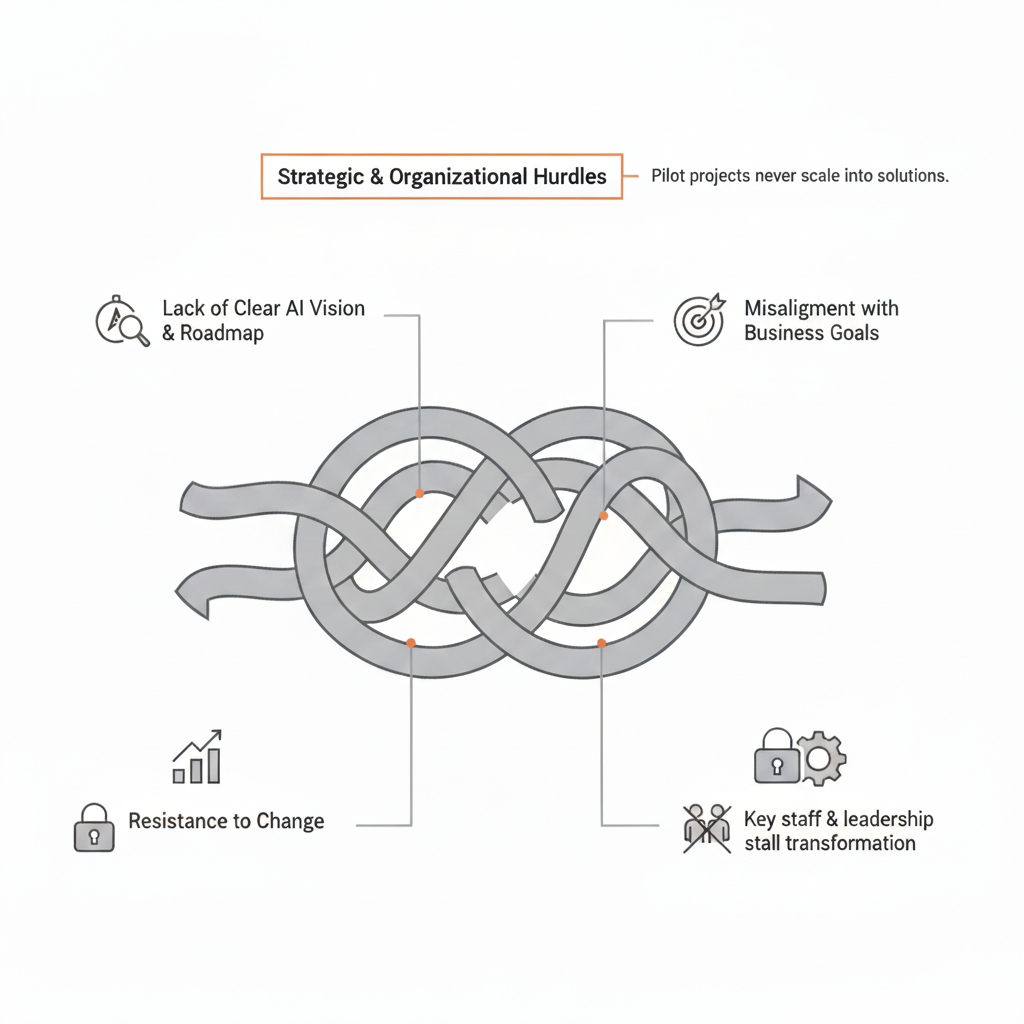
1. Strategic & Organizational Hurdles
The first set of challenges often isn’t about the technology itself, but about having a clear plan.
Lack of Clear AI Vision and Roadmap: Many companies jump into AI without a clear idea of why they are using it or how it fits into their big picture. They start small “pilot” projects that never grow into company-wide solutions.
Misalignment with Business Goals: AI initiatives must solve real business problems. If an AI project doesn’t clearly support a major company goal, like reducing costs or improving sales, it won’t get the necessary funding or attention.
Resistance to Change: People naturally resist changes to how they work. This resistance, especially from key staff or leadership, can quickly stall an AI project. Leadership, not employees, is often the biggest barrier to AI successbecause they don’t steer the transformation fast enough
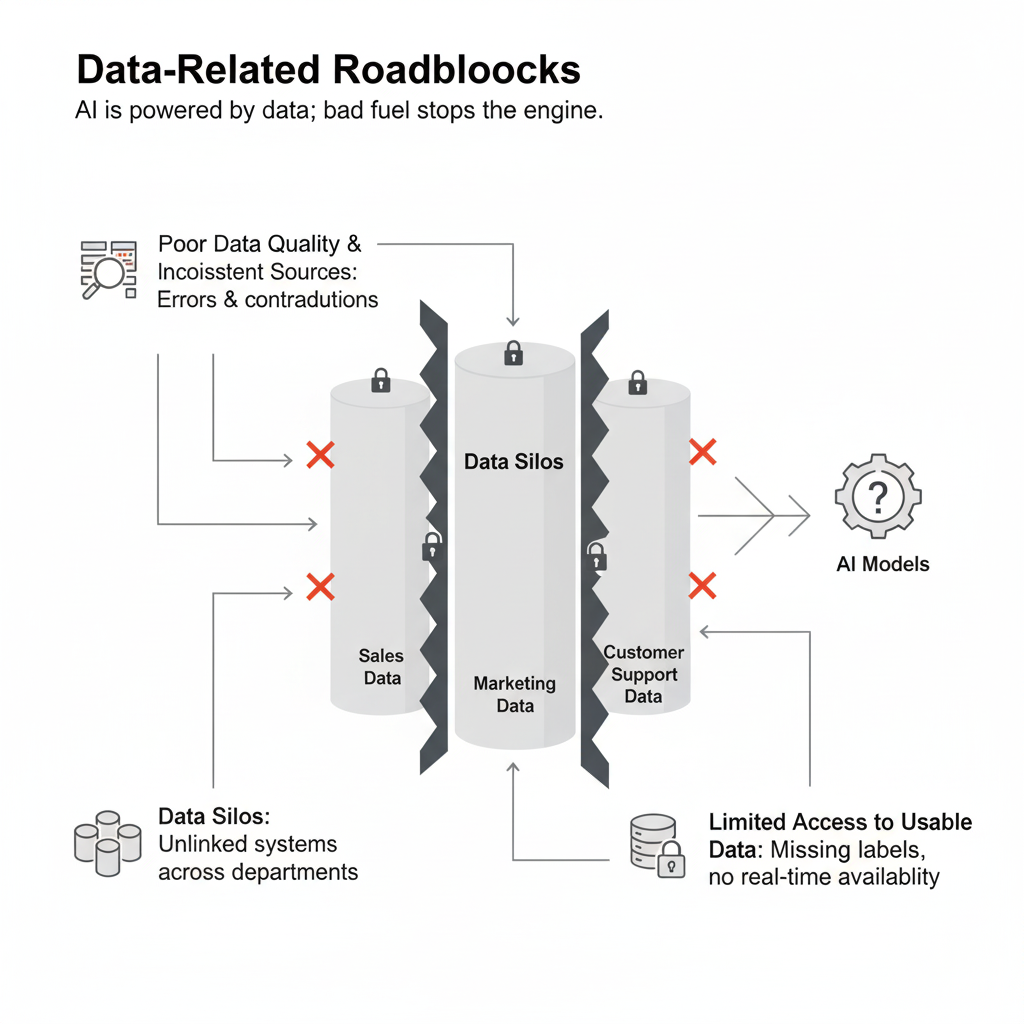
2. Data-Related Roadblocks
AI is powered by data; it’s the fuel for the engine. If the fuel is bad, the engine won’t run. This is a critical barrier, with research from top firms showing that data problems are the number one cause of AI failure.
Poor Data Quality and Inconsistent Sources: AI models need clean, accurate, and consistent data. If your data is full of errors or contradictions, the AI’s results will be useless. This is a crucial problem:Gartner predicts that 60% of AI projects will be abandonedby the end of 2026 if they are not supported by “AI-ready data”.
Data Silos: Data often sits in separate, unlinked systems across different departments. AI needs to see the whole picture, but these “data silos” make it impossible to gather the unified dataset needed for training.
Limited Access to Usable Data: Finding data that is properly labeled (meaning the data has tags that tell the AI what it is) or available in real-time can be a huge headache.
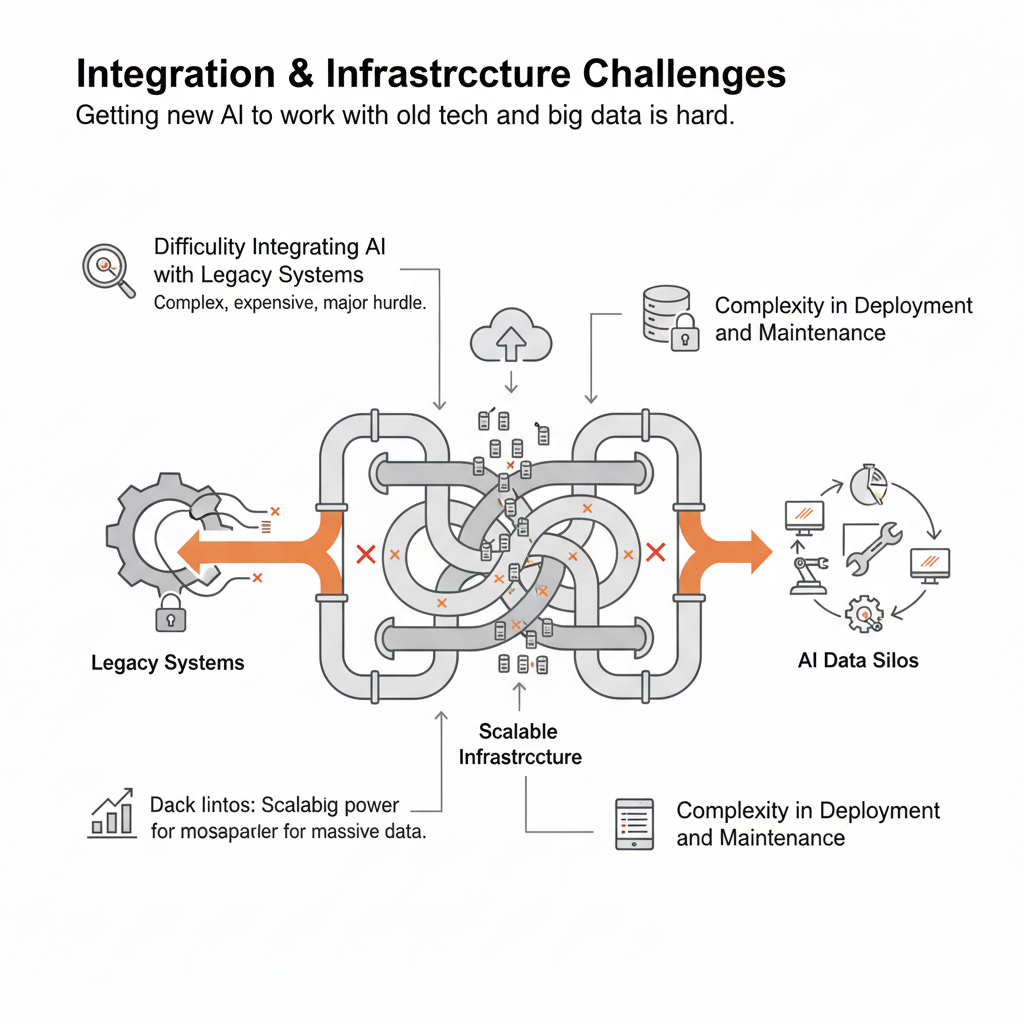
3. Integration & Infrastructure Challenges
Once you have the idea and the data, you need the right technology to make it work.
Difficulty Integrating AI with Legacy Systems: Most large companies rely on older computer systems (legacy systems) that weren’t built with AI in mind. Getting new, advanced AI tools to work with these older systems is often technically very complex and expensive.
Integration is a huge barrier: 55% of leaders cite the challenge of integrating AI with existing technology as a major hurdle to adoption.
Lack of Scalable Infrastructure: Running and training complex AI models requires huge computing power. Companies need a robust, flexible infrastructure (like cloud computing) that can handle massive data growth.
Complexity in Deployment and Maintenance: Getting an AI model working is one thing; deploying it to users and then continuously monitoring and updating it is a complex, ongoing process.
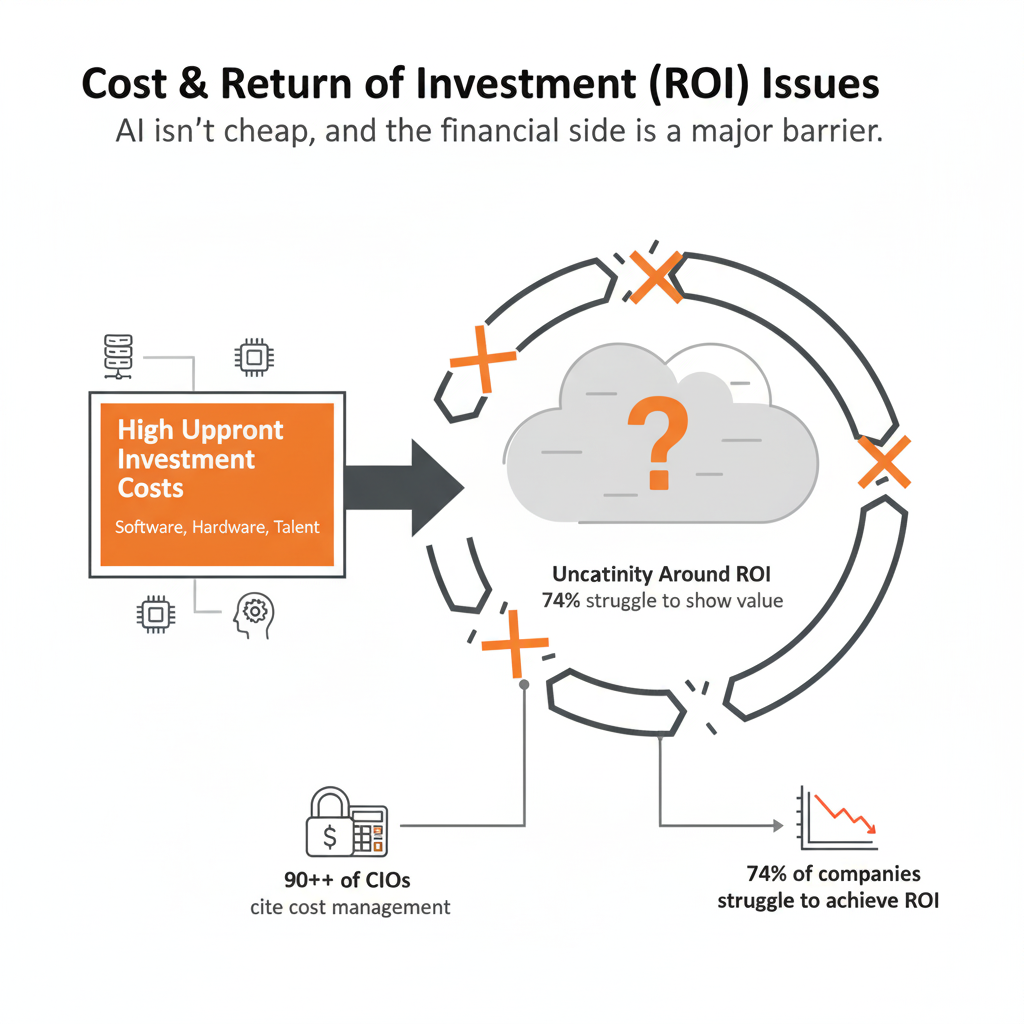
4. Cost & Return on Investment (ROI) Issues
AI isn’t cheap, and the financial side is a major barrier for adoption.
High Upfront Investment Costs: The initial costs for AI, covering specialized software, powerful hardware, and hiring expert talent, are substantial.
Uncertainty Around ROI: It’s often hard to clearly measure how much money an AI project will save or generate. Research shows that 74% of companies struggle to achieve and scale tangible value from their AI initiatives.
Hidden Costs: The costs don’t stop after launch. More than 90% of CIOs cite managing cost as limiting their ability to get value from AI.
5. Talent & Skills Gap
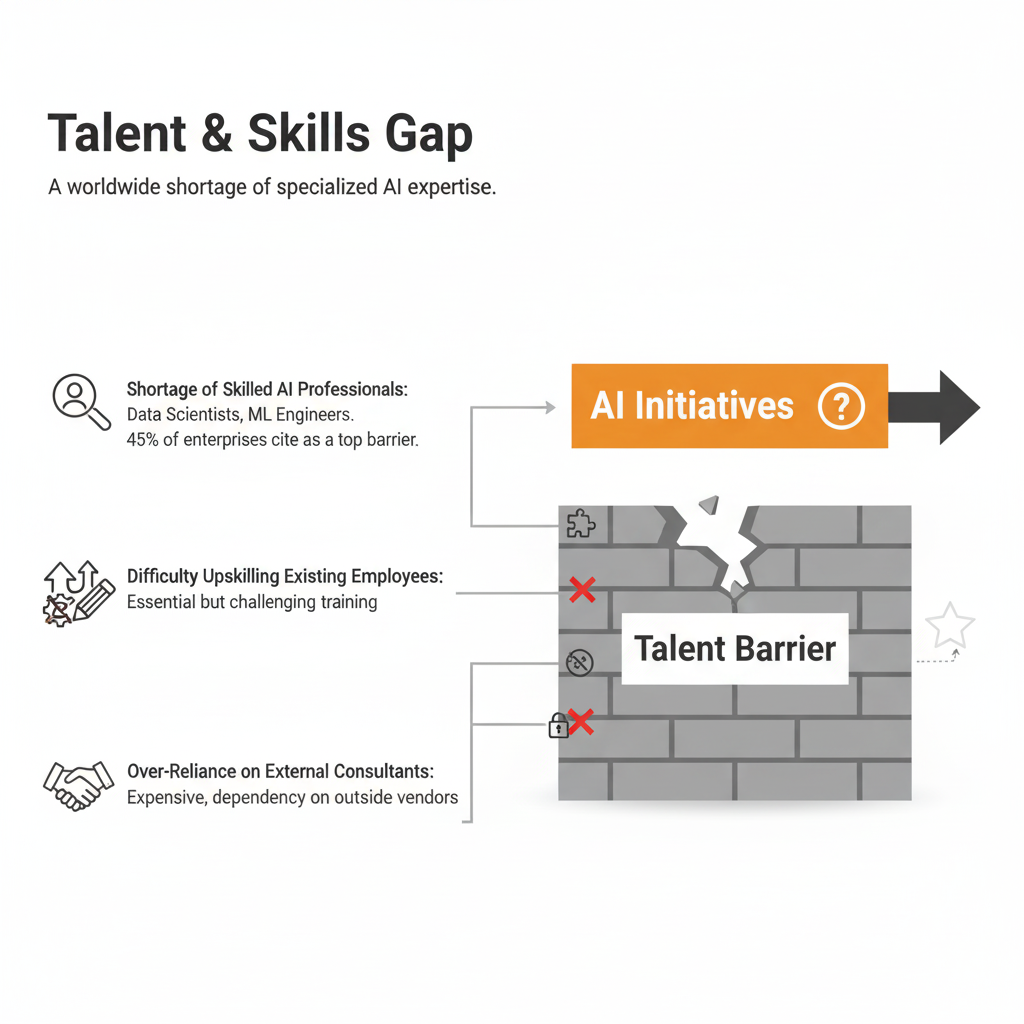
AI requires highly specialized knowledge, and there’s a worldwide shortage of this expertise.
Shortage of Skilled AI Professionals: There simply aren’t enough qualified data scientists, machine learning engineers, and AI architects. A 2023 Gartner survey found that 45% of enterprises cite a shortage of AI-skilled workers as a top barrier.
Difficulty Upskilling Existing Employees: Training current employees to work with AI is essential, but challenging.
Over-Reliance on External Consultants: Many companies become overly dependent on expensive outside consultants or vendors because they lack internal expertise.
6. Ethical, Trust, & Governance Issues
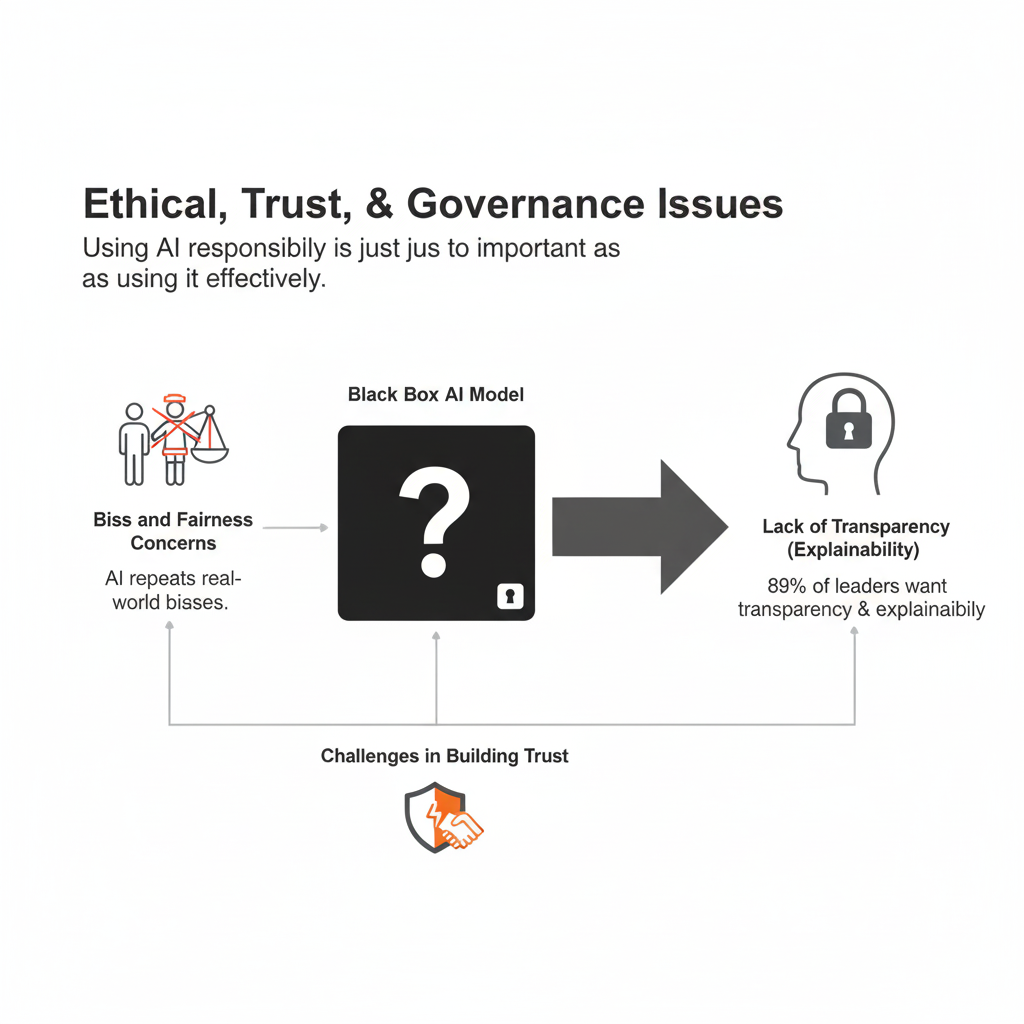
Using AI responsibly is just as important as using it effectively.
Bias and Fairness Concerns: If the data used to train an AI model reflects real-world biases, the AI will learn and repeat that bias.
Lack of Transparency (Explainability) is a Major Concern: Many advanced AI models work like a “black box”; you can’t easily see why the AI made a specific decision. This is a critical barrier to trust, with 89% of leaders saying it is very important that AI solutions are both transparent and explainable.
Challenges in Building Trust: Users and stakeholders need to trust that the AI is fair, secure, and used appropriately.
7. Compliance & Regulatory Headaches
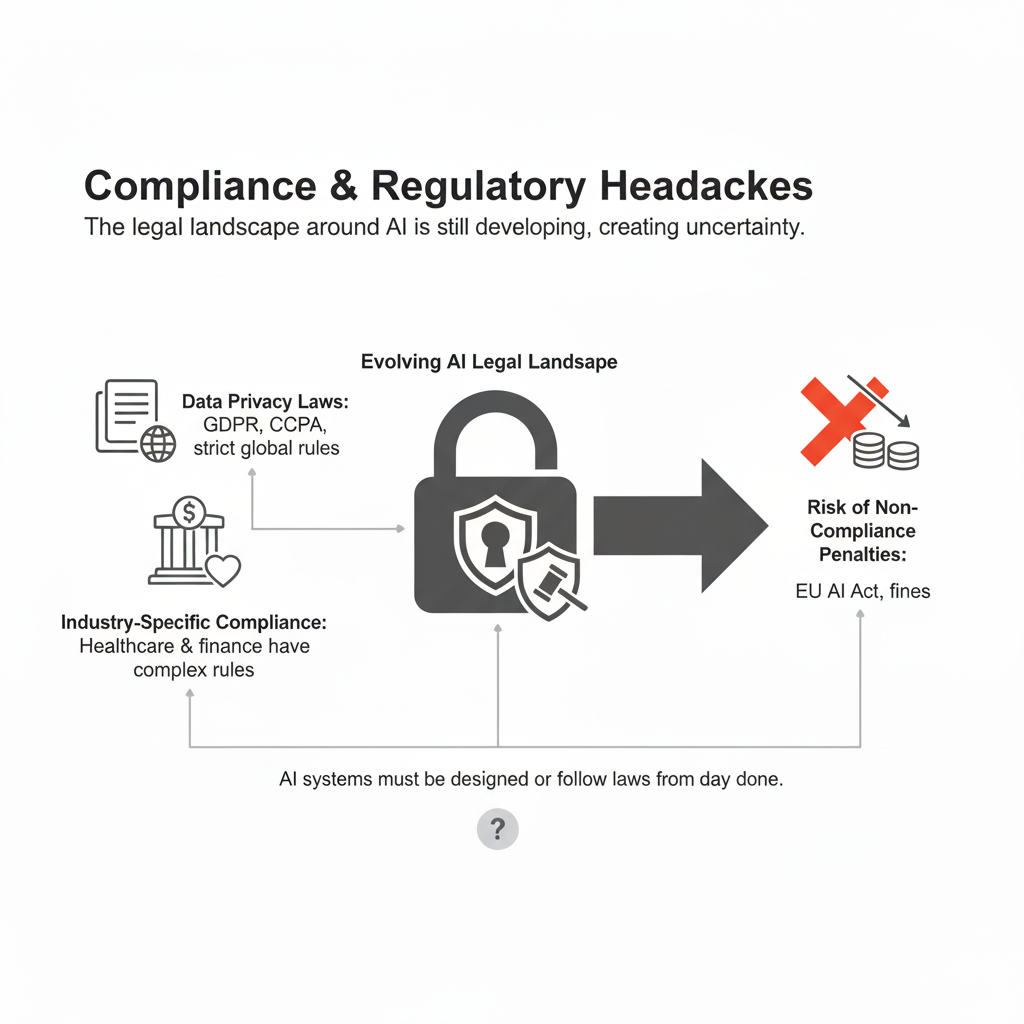
The legal landscape around AI is still developing, creating uncertainty.
Data Privacy Laws: Strict global rules like GDPR and CCPA dictate how data must be handled. AI systems must be designed to follow these laws from day one to avoid heavy penalties.
Industry-Specific Compliance: Regulated industries like healthcare and finance have their own complex rules that AI must comply with.
Risk of Non-Compliance Penalties: The evolving laws, such as the EU AI Act, impose new compliance burdens and the risk of fines.
8. Vendor & Ecosystem Challenges
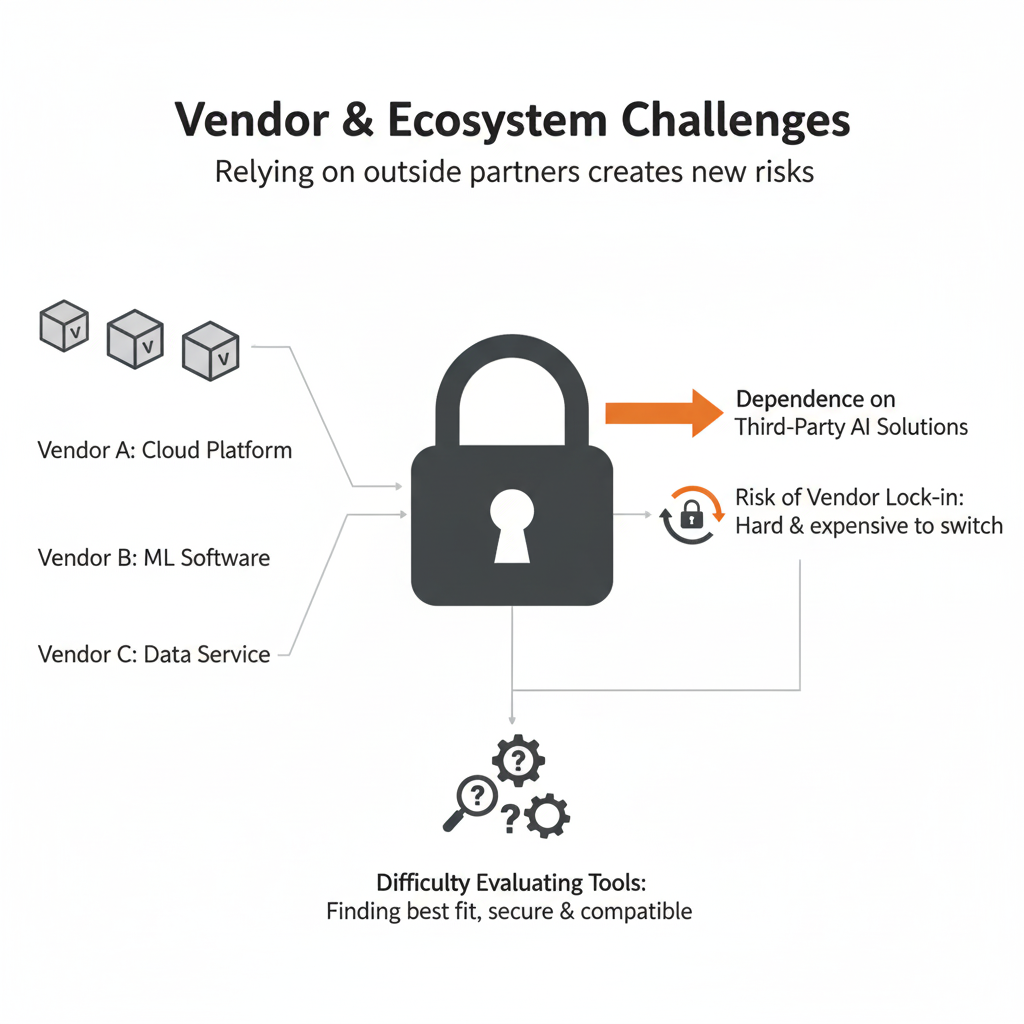
Since few companies build all their AI from scratch, they rely on outside partners, which creates new risks.
Dependence on Third-Party AI Solutions: Relying heavily on one vendor’s tools can make a company vulnerable.
Risk of Vendor Lock-in: If a company builds its whole system on one vendor’s platform, it becomes tough and expensive to switch later, a situation known as vendor lock-in.
Difficulty Evaluating Tools: It’s a big job to figure out which of the many AI tools available is the best fit, secure, and compatible with existing systems.
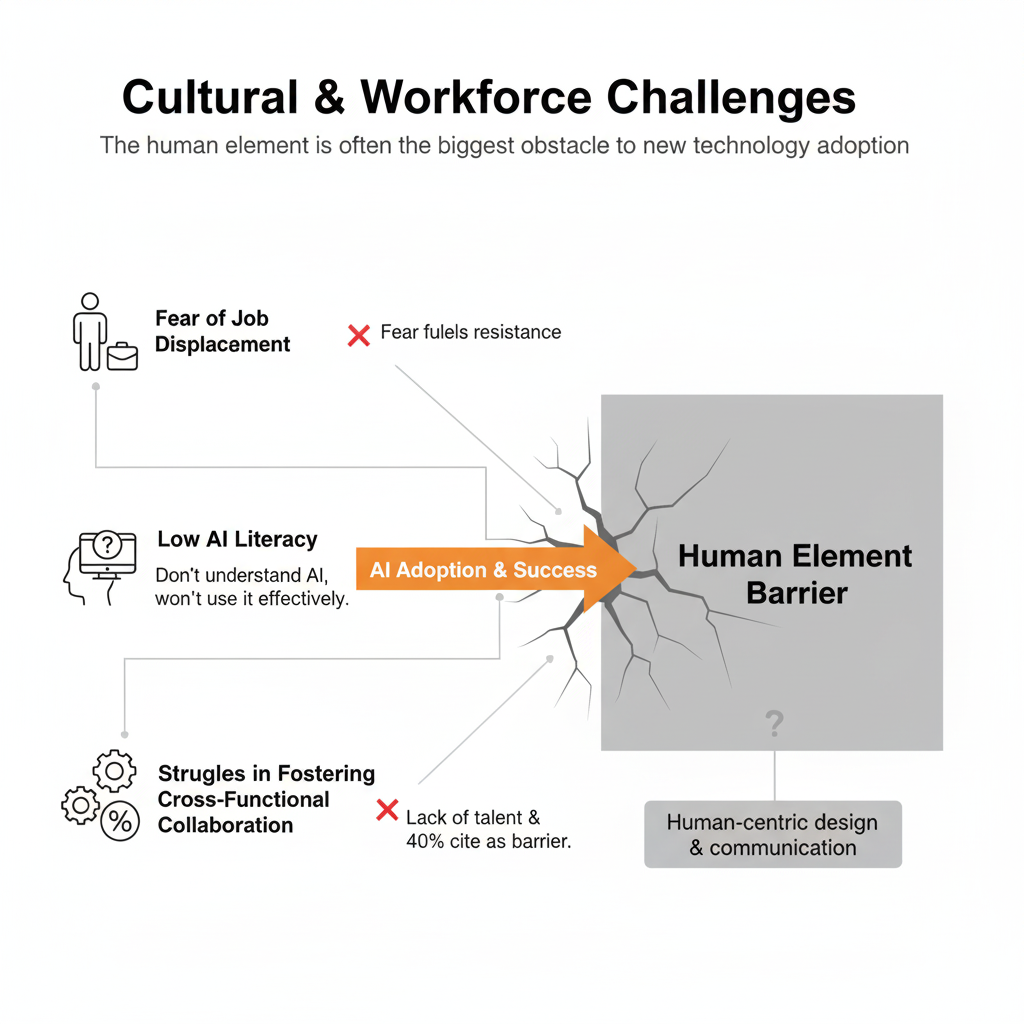
9. Cultural & Workforce Challenges
The human element is often the biggest obstacle to new technology adoption.
Fear of Job Displacement: Many employees worry that automation will eliminate their jobs. This fear fuels resistance.
Low AI Literacy: If employees and decision-makers don’t understand what AI is and what it can do, they won’t use it effectively.
Struggles in Fostering Cross-Functional Collaboration: Successful AI requires close teamwork between technical experts and business experts. The core challenge here is talent: 40% of organizationscite a lack of talent and skills as a key reason for not embedding AI capabilities more broadly across the company.
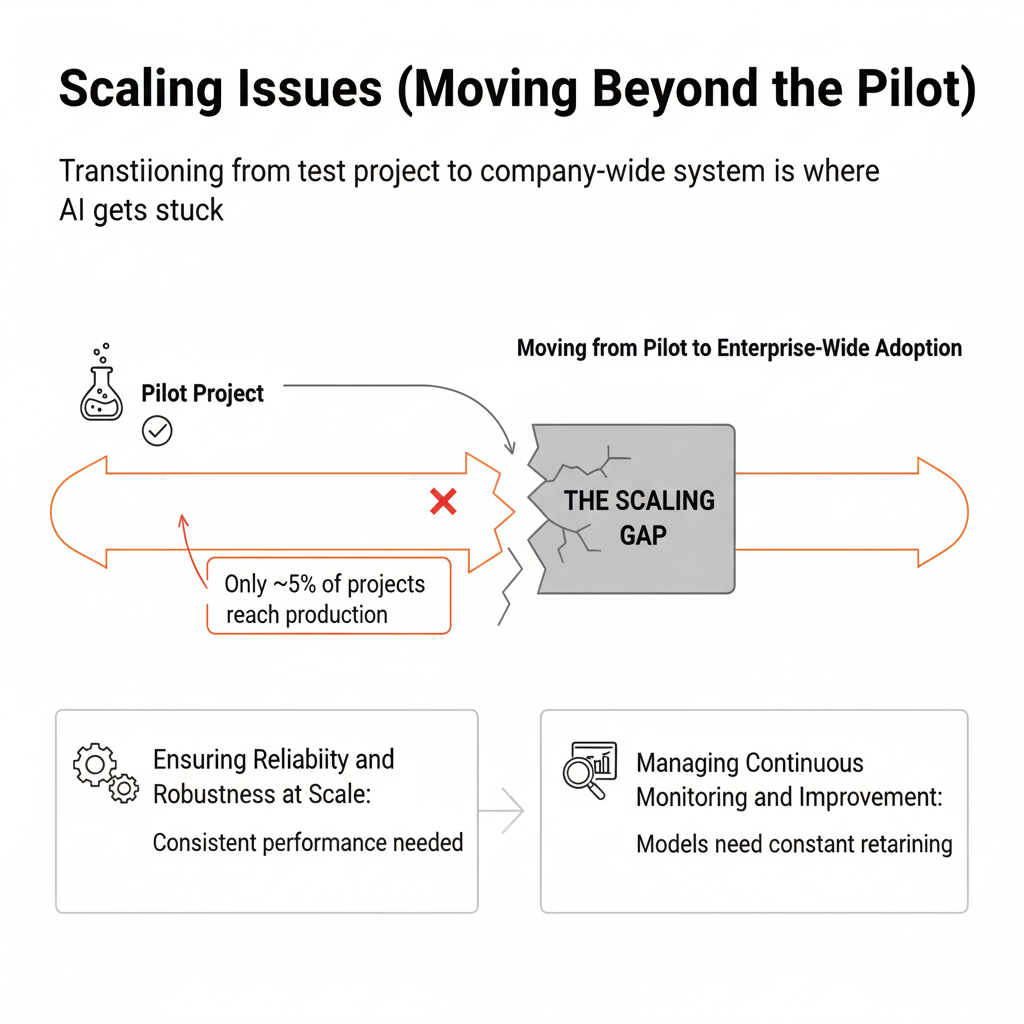
10. Scaling Issues (Moving Beyond the Pilot)
The transition from a small, successful test project (pilot) to a full, company-wide system is where many AI initiatives get stuck.
Moving from Pilot to Enterprise-Wide Adoption: A small pilot might work perfectly with a controlled dataset, but scaling it up to handle millions of transactions across the entire organization is different. Only about 5% of Generative AI pilot projects successfully reach full production with measurable ROI.
Ensuring Reliability and Robustness at Scale: The AI model needs to perform consistently and accurately, regardless of the volume or type of data it encounters.
Managing Continuous Monitoring and Improvement: AI models are not “set and forget.” They need constant monitoring and retraining to stay effective.
Final Words
Adopting AI is not just a technology upgrade; it’s a business transformation. The challenges, from data quality to culture change, are real, but understanding them is the first step toward success. Companies that tackle these issues head-on, with a clear strategy, smart data governance, and a commitment to training their people, will be the ones that truly unlock the transformative power of AI.
If your organization requires specialized support to navigate these complex integration or governance hurdles, consulting a dedicated technology partner like Hudasoftcan provide the necessary expertise and roadmap to accelerate your AI adoption journey.
FAQs
What are the concerns of AI adoption? Main concerns include poor data quality, high costs, privacy risks, lack of skilled talent, and employee resistance.
What are the ethical challenges in AI adoption? Key challenges are bias, lack of transparency, accountability issues, and data privacy concerns.
What are the factors affecting the adoption of AI? Adoption depends on strategy, leadership, technology, skilled staff, and financial investment.
The healthcare industry is undergoing a profound transformation, powered by the incredible advancements of Artificial Intelligence (AI) and Machine Learning (ML). This isn’t just a technological upgrade; it’s a fundamental change in how we approach wellness, diagnosis, and patient care. The diverse AI use cases in healthcare are ushering in an era of precision medicine and operational efficiency.
What We’ll Cover
This article will break down the essential AI use cases in the healthcare industry, showcasing how these technologies are driving significant healthcare innovation. We will explore applications across the entire spectrum of care, including diagnosis and medical imaging, where AI acts as a “second set of eyes” to detect diseases earlier and more accurately.
We’ll look at treatment and drug discovery, using AI/ML to accelerate the development of new therapies and personalize existing ones. Next, we’ll cover administration and operations, focusing on automating time-consuming tasks to reduce burnout and free up clinical staff.
Finally, we’ll detail patient care and monitoring, using AI in telehealth, remote patient monitoring (RPM), and chronic condition management for improved outcomes.
Why AI in Healthcare? The Imperative for Change
The adoption of AI use cases in the healthcare industry is a critical response to system complexities. Simply put, AI and ML deliver speed, precision, and personalization at a scale that humans alone cannot achieve.
Key Benefit
AI’s Role in Healthcare Innovation
Strategic Impact
Diagnostic Speed
Analyze millions of medical images (MRIs, X-rays) faster and more consistently than humans.
Enables earlier detection of diseases like cancer and stroke, significantly improving outcomes.
Personalization
Model patient responses using unique genomic data, medical history, and lifestyle factors.
Transforms “one-size-fits-all” medicine into truly personalized treatment, minimizing side effects.
Cost Reduction
Automate complex administrative tasks (e.g., billing, documentation, scheduling) via NLP.
Increases operational efficiency, reduces manual errors, and alleviates staff burnout.
Drug Acceleration
Predict the efficacy and toxicity of novel compounds in silico (via computer simulation).
Dramatically shortens the timeline and cost of drug discovery and clinical trials.
Top AI Use Cases in Clinical, Research & Operational Settings
The following sections detail the essential AI use cases in healthcare across the entire spectrum of care.
1. Medical Imaging & Diagnostics
AI-powered radiology (MRI, CT scans, X-rays) represents a transformative AI use case in the healthcare industry, enhancing accuracy and speed.
Core Application
AI Technology & Function
Outcome
Image Interpretation
Deep Learning (CNNs) trained on massive datasets.
Faster, more accurate image interpretation, acting as a “second set of eyes” for radiologists and providing quantitative analysis (size, volume).
Cancer & Trauma
Automated recognition of subtle patterns.
Early detection of cancer (e.g., microcalcifications in mammography) and complex fractures or dislocations in trauma settings.
Neurological Disorders
Real-time analysis of brain scans.
Immediate detection of acute conditions like brain hemorrhages and vessel occlusions, indicative of a stroke.
2. Predictive Analytics & Deterioration Alerts
Predictive analytics benefits from Machine Learning (ML) to forecast patient risk based on real-time data from EHRs, labs, and vitals.
Identifying High-Risk Patients: ML models continuously analyze subtle physiological changes to flag patients at risk of conditions like sepsis hours before traditional systems, dramatically improving survival rates.
Real-Time Alerts in ICU: In the ICU, AI analyzes the trend and inter-relationships between multiple vital signs (e.g., heart rate vs. blood pressure) to predict imminent events like cardiac arrest, enabling proactive intervention.
3. Personalized Medicine & Treatment Planning
Personalized Medicine is the pinnacle of healthcare innovation, driven by sophisticated AI and ML use cases in healthcare analysis.
Application
AI Role
Result in Patient Care
Oncology
Integrating imaging, history, and tumor genomic profile.
Selecting the best treatment options (e.g., specific immunotherapy) to enhance efficacy and reduce toxicity.
Pharmacogenomics
Analyzing genetic variations (polymorphisms).
Precision dosing and avoiding drugs likely to cause adverse reactions in a specific patient.
Drug Combinations
Recommending optimal drug and dosage combinations.
Vital for complex diseases where trial-and-error prescribing is dangerous.
4. Virtual Health Assistants & Chatbots
Conversational AI and Natural Language Processing (NLP) provide scalable, 24/7 patient support.
24/7 Symptom Checkers: Chatbots offer triage advice, guiding patients to the correct level of care and reducing unnecessary emergency room visits.
Mental Health Support: Specialized agents offer digital therapy and support based on techniques like CBT, significantly expanding accessibility.
Post-Discharge Follow-ups: Assistants automate medication reminders and track compliance, reducing readmissions and ensuring continuity of patient care.
AI in Hospital & Administrative Operations
AI use cases in the healthcare industry are optimizing the complex, costly, and manual administrative side of operations.
Operational Area
AI Function
Impact on Efficiency & Cost
Workflow Automation
NLP-Driven Transcription (Ambient AI) and revenue cycle optimization.
Reduces physician burnout by automating documentation; streamlines scheduling, billing, and documentation, cutting manual errors.
Resource Optimization
Predictive Models analyze admissions, illness trends, and capacity.
Accurate forecasting for bed occupancy, staffing levels, and supply inventory improves patient flow and reduces costs.
Fraud & Billing
Anomaly Detection and automated code auditing using ML.
Transforms fraud detection by flagging suspicious claims in real-time; ensures billing accuracy and compliance.
AI in Drug Discovery & Clinical Trials
The application of AI in pharmaceuticals is one of the most financially impactful AI use cases in healthcare innovation.
Faster Compound Screening: Deep Learning models predict the properties and efficacy of millions of novel molecules in silico, significantly accelerating the preclinical phase.
Targeted Patient Recruitment: AI in healthcare analyzes EHR data and genomics to quickly identify ideal clinical trial candidates, drastically cutting down on recruitment time and costs.
Optimizing Trial Design: Predictive analytics forecast drop-out rates and help researchers identify which treatments are working or failing sooner, reducing the overall duration and cost of trials.
Remote Patient Monitoring & Public Health
AI extends care into the home and analyzes population-level health trends.
Area
AI Function
Value
RPM & Wearables
ML analyzes real-time data from biosensors, smartwatches, and CGMs.
Triggers AI-based anomaly alerts to predict health crises (e.g., cardiac events) hours or days in advance, revolutionizing chronic condition management (COPD, hypertension).
Epidemic Prediction
Pandemic Modeling and NLP analysis of social media/health records.
Forecasts disease spread (e.g., COVID-19) and detects outbreak patterns much faster than traditional surveillance, ensuring global health security.
Ethical, Privacy & Regulatory Challenges
The successful deployment of these AI use cases in healthcare demands rigorous attention to governance.
Ethical & Bias: Algorithmic bias must be constantly monitored to ensure that models, trained on potentially imbalanced data, do not lead to misdiagnoses or suboptimal care for marginalized groups. The “black box” problem demands greater transparency.
Privacy & Security: Securing vast quantities of highly sensitive Protected Health Information (PHI) and genomic data is paramount. Strict controls over informed consent and data anonymization are non-negotiable.
Regulatory & Accountability: Legal frameworks must adapt to classify and approve continuously learning AI systems. Clear lines of accountability must be established for diagnostic errors to ensure patient safety remains the priority.
Conclusion
The comprehensive analysis of AI use cases in healthcare clearly demonstrates that the technology is no longer a futuristic concept; it is the operational backbone of modern medicine. From the earliest stages of drug discovery and diagnostics to continuous patient care and operational efficiency, AI and Machine Learning (ML) are delivering tangible, life-saving benefits.
The strategic adoption of these technologies fulfills the triple mandate of healthcare: improving quality, reducing costs, and expanding access. Companies like Hudasoft are at the forefront, developing solutions that influence AI to enhance clinical decision support and optimize administrative workflows, showcasing the practical application of these innovations in the real world.
The shift toward truly personalized medicine, driven by AI in healthcare, is revolutionary. AI systems now integrate genomic and clinical data to move beyond the “one-size-fits-all” approach, while predictive analytics and Remote Patient Monitoring (RPM) shift the care model from reactive intervention to proactive, preventative management. This commitment to healthcare innovation is essential.
However, realizing the full potential requires diligently navigating the challenges of algorithmic bias, data privacy, and evolving regulatory frameworks. The future of the healthcare industry is inseparable from the strategic application of AI. By continuing to invest in ethical development and robust implementation, we can ensure that these powerful tools lead to a safer, more equitable, and more effective global health system.
FAQS
What are the risks of AI in healthcare? AI can pose risks such as data privacy breaches, biased algorithms, misdiagnosis, lack of transparency, and overreliance on technology.
How is AI used in hospitals today? AI is used for diagnosing diseases, predicting patient outcomes, managing hospital workflows, analyzing medical images, and supporting treatment decisions.
Can AI replace doctors? No, AI cannot replace doctors; it supports them by handling data analysis and routine tasks, but human judgment and empathy remain essential.
What is the difference between ML and AI in healthcare? AI is a broad field focused on simulating human intelligence, while ML (Machine Learning) is a subset of AI that learns from data to make predictions or decisions.
What are the applications of agentic AI in healthcare? Agentic AI can automate administrative tasks, personalize patient care, assist in diagnostics, optimize resource use, and enable continuous patient monitoring.
I remember the first time I really saw the difference AI was making in retail. I was browsing online, just casually looking for a new jacket. I didn’t click anything, didn’t type a brand, just scrolled.
But the next day? Everything changed.
I opened a different website, and right there, front and center, was a recommendation for a jacket that was perfect exactly for my style, in the right color, and even close to my usual price range. I thought, “How did they know that?”
That moment was when I stopped just reading about AI and started seeing the real, powerful AI use cases in retail. I realized this wasn’t future technology anymore; it was the engine running every smart store right now.
I started doing some research, looking into how the biggest companies were using these smart systems. What I found wasn’t science fiction; it was smart business.
Why Smart Technology is the Foundation of Modern Retail
Smart computer systems, often called AI, are fundamentally changing how every part of a store operates. It’s not just a nice add-on; it’s the core system that helps businesses move from simply guessing what customers want to knowing it
Simply put, AI helps retailers do two main things brilliantly:
Understand You Better: It turns massive amounts of shopper data into clear steps to give you a personalized experience.
Run Smoother: It handles boring, repetitive tasks like managing stock, freeing up human workers for important customer interactions.
The Retail AI Boom: Context by the Numbers
This isn’t just a trendy idea; it’s a massive shift with significant financial backing.
The global Artificial Intelligence in Retail market is exploding, with projections showing it will reach over $40 billion by 2030.
This rapid growth is driven by retailers realizing that adopting AI can both cut operating costs and boost annual revenue by creating a much better shopping experience.
Let’s dig into this blog, which is your easy-to-read guide on how smart computer systems (AI) are changing shopping. We’ve cut out the complex talk to show you the simple, powerful ways this technology works daily.
We’ll dive into the best AI use cases in retail. You’ll see how AI helps manage stock so shelves are never empty and how AI in retail examples creates personal shopping experiences. Plus, discover how retail AI technology handles customer questions instantly, any time of day.
Customer-Facing AI Use Cases: An In-Depth Analysis
The deployment of Artificial Intelligence (AI) and Machine Learning (ML) has fundamentally reshaped customer engagement across various sectors. This report details four primary customer-facing AI use cases, outlining the underlying methods, illustrative examples, and the critical business benefits derived from these technologies.
3. Customer-Facing AI Use Cases
3.1 Personalized Product Recommendations
This category moves beyond simple rule-based suggestions to offer truly individualized product pathways, directly influencing discovery and conversion rates.
Example: Amazon, Zalando (Amazon’s approach is exemplified by Amazon Personalize).
AI Methods: Collaborative filtering (predicting preferences based on similar users), Natural Language Processing (NLP) (analyzing product descriptions and reviews), and Behavioral Clustering (grouping users based on real-time and historical interaction patterns).
Deep Dive (Amazon): Amazon Personalize utilizes real-time user activity, item metadata, and user profiles to train custom, private ML models. Recently, this has been augmented by Generative AI (Large Language Models) to not only suggest what to buy, but also to dynamically personalize the description of the recommended item, highlighting features most relevant to the individual customer (e.g., changing a generic title to “Gluten-Free Cereal for Your Morning Routine”).
Impact: This drives critical business outcomes, including increased click-through rates, higher average order value, and improved customer loyalty by reducing “choice paralysis.”
3.2 AI Chatbots and Virtual Shopping Assistants
These tools provide instant support and interactive, guided shopping experiences, bridging the gap between digital and physical interaction.
Example: Sephora’s Virtual Artist.
AI Methods: This often involves a blend of technologies. Chatbots use NLP and NLG (Natural Language Generation) for conversation. Virtual assistants like Sephora’s employ Augmented Reality (AR) integrated with Computer Vision and Facial Geometry Analysis.
Deep Dive (Sephora): The Virtual Artist uses AI algorithms to analyze a user’s facial geometry and real-time lighting conditions to apply a digital makeup overlay with high precision. This allows users to virtually try on thousands of products, such as lipstick shades or eyeshadows.
Benefits:
24/7 Support and immediate product suggestions significantly reduce customer friction.
Reduced Bounce Rates by instantly engaging users with interactive content.
Quantifiable Results: Customers who used Sephora’s Virtual Artist were reported to be 3 times more likely to complete a purchase, and the tool contributed to a 30% reduction in returns for makeup products, proving the value of virtual product confidence.
3.3 Visual Search and Image Recognition
This technology allows consumers to use the world around them as a search query, transforming the shopping funnel.
Example: ASOS visual search.
How it works: Visual search relies on powerful Deep Learning models, specifically Convolutional Neural Networks (CNNs), trained on massive image datasets. These networks power the Computer Vision process, which breaks down an input image (uploaded photo or screenshot) to identify key visual features like shape, color, texture, and pattern. The system then uses Content-Based Image Retrieval (CBIR) to match these features to similar products in the inventory database.
Benefits:
Intuitive Discovery: Users bypass complex keywords and search barriers.
Speed: The human brain processes images much faster than text, leading to quicker product identification.
Increased Conversion: By accurately matching inspiration photos to purchasable items, the likelihood of a successful sale significantly increases.
3.4 AI-Powered Loyalty Programs
Loyalty programs transition from offering blanket discounts to delivering highly specific, timely, and relevant rewards and incentives that maximize customer lifetime value.
Example: Starbucks Rewards AI personalization engine (powered by the Deep Brew platform).
AI Methods: Reinforcement Learning (to optimize the timing and type of offer), Predictive Modeling (to forecast inventory and staffing needs), and Data Analytics (processing huge volumes of transactional, geographic, and temporal data).
Deep Dive (Starbucks): The Deep Brew platform analyzes numerous factors, including a user’s historical purchases, time of day, weather conditions, local store inventory, and even community tastes. It then generates Hyper-personalized Rewards (e.g., a BOGO offer on a cold drink specifically for a customer who buys cold drinks on rainy Mondays).
Impact: This micro-targeting is designed to nudge “occasional customers” into becoming habitual visitors. Starbucks has reported that the AI initiatives have led to a 30% Return on Investment (ROI) and a notable increase in customer visit frequency and transaction size, bolstering the Starbucks Rewards membership base.
This report provides an executive summary of modern AI applications in the customer-facing domain, demonstrating how sophisticated machine learning and generative technologies are directly tied to measurable business value.
4. Backend & Operational AI Use Cases
This is where the real cost savings and efficiency gains happen. These AI use cases in the retail industry help stores run smarter, faster, and with way less waste. They don’t directly talk to you, but they make sure your favorite products are always available at a good price.
4.1 Demand Forecasting (The Fortune Teller)
No one likes an empty shelf or a pile of wasted, unsold products. AI fixes that. This is a crucial use case in retail for profitability.
How it works: Smart machine learning models look at sales history, weather, local events, and holiday schedules to predict exactly how many of a specific item (SKU) will sell at a specific store. It’s like a retail fortune teller for inventory, giving highly precise numbers.
Big Example: Walmart uses this smart retail AI technology for hyperlocal inventory optimization, predicting needs store by store.
The Benefits:
Less money wasted on storing or tossing unsold goods.
More profit from ensuring customers always find what they need.
Fewer stockouts (empty shelves), which frustrate shoppers.
4.2 Inventory & Supply Chain Optimization
This is the power of AI, making sure things move quickly and cheaply from the factory to the shelf.
How it works: AI takes over the boring, repetitive tasks: automating restocking orders, finding the fastest routes for items inside the warehouse, and analyzing which suppliers are the fastest and most reliable. This is a core AI use case in the retail industry for efficiency.
Big Example: H&M uses AI to get a better handle on its stock, helping reduce unsold stock, which saves millions and makes the business more sustainable.
The Benefits:
Lowers shipping costs and speeds up delivery times.
Reduces environmental waste from excess products.
Automates complex ordering and routing decisions.
4.3 Price Optimization Engines (The Dynamic Price Tag)
Prices used to change only when a human manager decided. Now, it’s instant and driven by data.
How it works: These systems watch competitor prices, how quickly items are selling, and whether a promotion is running. They then dynamically adjust prices in real-time. This technology ensures the store is always competitive while maximizing profit.
Big Example:Target uses these real-time price adjustment models to react instantly to competitor price drops and stay competitive.
The Benefits:
Never leaving money on the table when demand is high.
Quickly clearing out old stock when demand is low.
Avoids slow, manual changes by reacting instantly to the market.
4.4 Fraud Detection and Risk Prevention
AI is the silent, super-fast security guard for every transaction, protecting both the store and the customer.
How it works: AI anomaly detection models learn what a “normal” purchase looks like. If a purchase suddenly appears from a new city, with a huge value, or with odd timing, the AI flags it instantly as suspicious. This is one of the most vital AI in retail examples for financial health.
The Tools: These technology tools are used at every checkout (POS Point of Sale) to identify fraudulent transactions in real-time.
The Benefits:
Stops theft and fraud right when it happens.
Minimizes financial losses and chargeback fees.
Protects customer data by keeping the security system adaptive.
5. In-Store AI Use Cases
The store itself is now getting smarter. AI in retail examples aren’t just in the backend anymore; they’re in the aisles, at the checkout, and watching the shelves. These applications are designed to make your shopping trip smoother, faster, and more convenient.
5.1 Smart Shelves and Computer Vision (The Digital Shelf Manager)
This technology ensures the shelves are always full and helps staff find things immediately.
How it works: Computer vision technology, using small cameras or sensors embedded on the shelf edges, constantly monitors the inventory. It tracks products in real-time and alerts staff the moment a shelf is running low or if items are placed incorrectly. It’s essentially an automatic, always-on inventory counter.
Big Example:Kroger Edge utilizes smart shelving systems that not only track inventory but also display real-time pricing and personalized offers to customers standing in front of the shelf.
The Benefits:
Eliminates empty shelves (reducing lost sales).
Frees up employee time previously spent manually counting stock.
Reduces waste by monitoring product dates and ensuring proper stock rotation.
5.2 AI-Powered Checkout (Just Walk Out Tech)
This is the holy grail of convenience: skipping the checkout line entirely.
How it works: This system uses a sophisticated network of overhead cameras, weight sensors in the shelves, and AI to track every item you pick up and put down. The system creates a virtual shopping cart for you. When you simply walk out, the system automatically charges your connected payment method.
Big Example: The Amazon Go model pioneered this frictionless shopping experience, proving that sensors, cameras, and AI can facilitate a truly seamless exit-checkout process.
The Benefits:
Zero wait time at checkout is the ultimate convenience.
Higher customer satisfaction and speed.
Better data on shopping behavior (which items are browsed but not bought).
5.3 Customer Footfall and Heat Mapping (The Store Strategist)
Every minute you spend in a store is data that AI can use to improve the layout for the next shopper.
How it works: AI analyzes anonymous data from existing in-store CCTV cameras or Wi-Fi signals to map customer movement. This creates a “heat map” that shows which areas are most visited (hot spots) and which are ignored (cold spots). This information is then used for layout optimization.
Big Example: Retailers globally use this technology to see if customers are noticing promotional displays or finding the items they came for easily, optimizing the entire store flow.
The Benefits:
Improved store layout for logical, easy shopping.
Optimal placement of high-margin products and new promotions.
Smarter employee placement in the busiest areas to help customers quickly.
6. AI in Marketing & Customer Engagement
This section focuses on how retailers use AI to understand what you want, when you want it, and how you feel about them. This is the difference between annoying marketing and helpful marketing.
6.1 Predictive Analytics for Campaigns (The Smart Campaign Planner)
Marketing used to be about blasting messages to everyone. Now, AI uses data to figure out exactly who will buy what, and when. This is the ultimate tool for avoiding annoying your customers with irrelevant ads.
How it works: Predictive analytics models chew through purchase history, browsing data, and demographic information to score customers based on their likelihood to convert. This allows marketers to create highly specific segments and target the customers most likely to convert with tailored messages.
Big Example: Email campaign personalization with AI is a perfect example. Instead of sending a generic “20% off everything” email, a customer who bought running shoes last month might get an email specifically about new smartwatches or accessories, maximizing the chances of the offer being relevant.
The Benefits:
Higher Return on Investment (ROI) for marketing spend.
Reduced “spam fatigue” for customers by sending only relevant offers.
Deeper understanding of customer purchasing cycles.
6.2 Sentiment Analysis & Social Listening (The Brand Barometer)
Every customer review, tweet, or Facebook comment about a brand is valuable, but manually reading them all is impossible. AI does the listening for you, 24/7, providing real-time brand monitoring.
How it works: Sentiment analysis uses Natural Language Processing (NLP) to automatically read and categorize vast amounts of text from social media and review platforms. It determines the emotional tone (positive, negative, or neutral) of customer feedback, allowing retailers to see what people truly feel about a product or service.
Big Example: A retailer can use this to spot a sudden flood of negative comments about a faulty zipper on a new jacket line in minutes, not weeks. This instant feedback loop drives feedback-driven product improvements much faster than traditional surveys.
The Benefits:
Instant crisis detection before a small problem becomes a PR disaster.
Direct, honest feedback for product development and quality assurance.
Better customer service by quickly routing urgent negative mentions to a response team.
Wrapping It Up
The simple truth is that AI use cases in retail are no longer a choice; they are the new standard for doing business. Companies like Hudasoft are driving this change, providing the essential retail AI technology that makes smart shopping possible.
From the moment you start browsing online (thanks to smart recommendations) to the moment you walk out of a store without queuing, AI is quietly making everything smoother, faster, and much more personal.
It’s clear that the future of AI in the retail industry belongs to the businesses that use this technology not just to save money on the back-end (inventory, pricing), but also to genuinely delight the customer on the front-end. By building smart, adaptive systems with partners like Hudasoft, retailers are ready to thrive in the changing world of shopping!
FAQS
What are the best AI tools for retail? Popular tools include Shopify Magic, Google Cloud AI, Salesforce Einstein, Microsoft Azure AI, and Amazon Personalize for inventory, sales, and customer insights.
Is AI affordable for small retail businesses? Yes. Many AI tools offer affordable, scalable plans or integrations with existing POS and eCommerce systems.
How do I start implementing AI in my store? Begin by identifying key areas like inventory, marketing, or customer service. Then choose a simple AI tool and integrate it gradually.
What kind of data is needed for AI in retail? Sales records, customer behavior data, inventory levels, and marketing performance metrics are essential for effective AI insights.
Over the last ten years, the car dealership industry has undergone a quiet revolution. Shoppers moved from weekend lot hopping to late night research on their phones. Online marketplaces normalized price transparency. Pre approvals, digital contracting, and e signing compressed days into hours. The future of auto dealerships is not a replacement of the traditional model so much as a hybrid: high touch local service layered over high tech, self service convenience.
This isn’t just a channel shift; it reshapes how stores forecast demand, source inventory, design showrooms, staff front lines, and measure success. Those prepared to meet evolving expectations fast, transparent, digitally enabled will define the future of car dealerships. In this guide, we unpack automotive retail future trends, the technologies enabling them, and the operational moves that separate leaders from laggards.
1) Shifting Consumer Behavior
Online first is the default
In 2025, most buyers complete the majority of their journey online: researching trims, reading reviews, comparing prices, running “out the door” payment scenarios, and checking trade in values. By the time they arrive on site, they’re validating a decision rather than starting one.
Convenience is the baseline
Customers want frictionless progress: at home test drives, rapid appraisals, minimal paperwork, and instant visibility into taxes and fees. They prefer chat or text for quick questions and self booked appointments. If a competitor reduces steps to “click → confirm → drive,” that becomes the benchmark.
Self service tools are standard
Price calculators, trade in valuation, credit pre qualification, and appointment scheduling are table stakes. The best experiences live inside dealership apps that let shoppers virtually browse inventory, view reconditioning reports, and reserve test drives without calling the store.
Implication: Make research effortless, data transparent, and in person moments purposeful. Behavior has shifted permanently; processes and tooling must follow.
2) Digital Retail & E Commerce for Vehicles
From showroom first to hybrid journeys
The future belongs to blended paths: start online, finish in store; or start in store, finalize remotely. True omnichannel means the deal follows the customer quotes, appraisals, and documents sync whether the shopper is on a phone, a laptop, or at a desk with a product advisor.
Click to buy, pre approvals, remote signing
Digital retail compresses cycle time. Buyers can structure payments, select protection products, upload documents, and e sign contracts remotely. That speed delights customers and improves turn rates and funding velocity.
Benefits: reach, speed, attribution
Wider reach: merchandise across marketplaces and your site with consistent, enriched specs.
Faster closing: fewer back and forths and fewer abandoned deals.
Better lead tracking: clean data pipelines show which channels produce appointments that actually buy.
Challenges: trust, security, transparency
Trust: detailed photos, reconditioning notes, third party history reports.
Transparency: no bait pricing; show fees early; publish inspection summaries.
Context integration: DMS/CRM integrations should unify online and in store transactions, ensuring every step from VIN decode to funding stays in sync.
3) Technology Driving Dealership Operations
The auto dealer industry is becoming software defined. The store that measures, automates, and learns faster wins.
Modern DMS as the operational backbone
A contemporary DMS coordinates inventory, desking, recon, service, and titles. The best systems speak natively to your website, call tracking, and lenders reducing double entry and errors.
AI and predictive analytics for advantage
Demand forecasting: align acquisition with local search and sales patterns.
Lead scoring: route hot leads to senior reps; automate nurture for lower intent visitors.
Targeted offers: recommend trims, payment structures, or F&I menus based on buyer profiles.
AR/VR and rich media experiences
Virtual walkarounds, 360° interiors, and customizable visualizations (colors, packages) lift engagement and reduce uncertainty especially for remote buyers.
IoT and connected data
Real time diagnostics and service alerts deepen after sales relationships and drive recurring revenue. Proactive maintenance reminders transform one time buyers into long term customers.
Custom apps can become the hub for staff workflows and customer engagement, bridging showroom, service bay, and website into one living system. To orchestrate all these tools without duct tape, many dealer groups partner with automotive app development services to build a secure layer that unifies DMS, CRM, digital retail, and lender APIs keeping inventory, pricing, and deal data consistent across every channel.
4) Rise of Direct to Consumer (DTC) Models
Pressure on traditional distribution
OEMs selling online sometimes with delivery have changed expectations. That doesn’t eliminate dealers, but it shifts value toward service quality, local expertise, and the in person experiences digital can’t replicate.
Where dealerships win
Personalization: matching needs with local inventory and financing realities.
Trust and speed: handover quality, truthful reconditioning, same day resolutions.
Community presence: test drives, trade ins, and service relationships are easier locally.
Hybrid partnerships
Forward looking OEMs and retailers share data and coordinate inventory, marketing, and delivery. The result: customers get simplicity; stores retain relevance.
5) The Evolving Role of the Physical Showroom
From transactional to experiential
The future of auto retail reframes the store as an experience center: fewer desks, more demo zones; fewer paper stacks, more interactive displays. Visitors should feel guided, not processed.
Smaller footprints, smarter formats
Urban micro showrooms, pop ups in high traffic malls, and mobile event units extend reach without heavy real estate overhead. These spaces serve as on ramps to digital flows rather than standalone destinations.
Physical spaces that amplify digital
Showrooms should accelerate decisions made online: short, high quality test routes; rapid appraisals; clean, photo ready delivery bays. Every minute on site should create value the internet alone can’t.
6) Regulatory and Compliance Changes
As digital transactions scale, compliance evolves with them.
Data privacy & cybersecurity: protect PII with encryption, access controls, and regular audits.
Online financing & disclosures: ensure compliant e signature flows and clear presentation of rates, terms, and fees.
Advertising & consumer protection: consistent pricing across channels; honest claims; accurate condition disclosures.
Record keeping: digital deal jackets with retention schedules and tamper evident storage.
Forward leaning stores appoint a compliance owner, run quarterly audits, and use software to enforce disclosure and document standards.
7) Future Staffing & Skills
From sales reps to product advisors
The car dealership industry is redefining frontline roles. Advisors focus on discovery, education, and guiding digital tools; closing relies less on pressure and more on clarity.
New competencies
Comfort with DMS/CRM and digital retail flows.
Ability to explain F&I products without jargon.
Virtual selling skills: video walkarounds, screen sharing, remote delivery.
Data literacy: reading dashboards, improving follow up quality, testing outreach cadences.
Hybrid teams
Remote BDC agents can handle top funnel engagement and appointment setting, while in store specialists focus on test drives, appraisals, and delivery. Done right, it’s a force multiplier.
8) Opportunities for Growth
Flexible ownership and subscriptions
Shorter commitments, subscription bundles, and usage based models appeal to new segments. Pilot programs, weekend packages, seasonal upgrades can differentiate a store and capture fresh demand.
Advanced after sales packages
Predictive maintenance plans, pickup/drop off, and extended protection products create recurring revenue and higher lifetime value.
Loyalty through customer data
Use consented data to personalize service reminders, trade up opportunities, and targeted outreach. Respect privacy; deliver timely, relevant value, and retention follows.
9) Challenges & Threats
Digital only competitors
Online only platforms compress steps and lower overhead. Compete with speed, certainty, and community convenience: faster test drives, transparent appraisals, and superior after sales support.
Tech costs vs. ROI
Point solutions add up and create complexity. Consolidate where possible. Measure lift (time to fund, gross per unit, appointment to sale) to justify spend.
Legacy processes
Paper stacks and siloed systems slow progress. Standardize e workflows, automate hand offs, and retire redundant steps.
Multi channel inventory management
Syndicate listings with consistent data (specs, price, recon status) and keep aging policies strict. Stale inventory erodes margins and search visibility.
10) Case Studies & Examples
Case A: The fast follower that won on experience
A mid market dealer group adopted digital retail with transparent “all in” pricing, 30+ image galleries, and inspection PDFs on every VDP. They introduced virtual appointments and at home test drives within 48 hours. Internally, they connected DMS, CRM, and call tracking to one dashboard. Results: appointment to sale rate up double digits, days to fund down significantly, and higher review volume citing “easy,” “clear,” and “no surprises.” Takeaway: clarity and speed beat noise.
Case B: The store that stalled
Another store invested heavily in ads but kept paper driven processes. Inventory photos were inconsistent; pricing online didn’t match in store quotes; disclosures came late in the process. Outcome: high bounce, low show rates, poor reviews, and rising return visits without conversions. Takeaway: marketing spend can’t outrun broken operations.
11) Trends to Watch (2025 and Beyond)
AI copilots for sales and service: summarizing leads, suggesting next best actions, drafting compliant responses.
AR enhanced listings: interactive walkthroughs with live feature explanations.
Connected after sales: telematics based service scheduling and loyalty nudges.
Payments and identity innovation: faster, safer funding with integrated KYC and fraud controls.
Sustainability transparency: lifecycle information, battery health reporting, eco service options become selling points.
These future automotive developments are already in motion, reshaping car dealership industry trends and raising the bar for convenience and trust.
12) Action Steps: How to Prepare Now
Audit the journey: Map every step from first click to funded deal. Remove two steps this quarter.
Elevate merchandising: Standardize 30+ photos, add 360° where possible, publish reconditioning notes and PDFs.
Unify systems: Ensure DMS, CRM, website, and lenders are synced; eliminate duplicate entry.
Clarify pricing: Display out the door estimates online; align in store quotes exactly.
Digitize the desk: Implement e signatures, remote contracting, compliant menu presentations.
Retrain roles: Shift reps toward product advisors; invest in virtual selling and finance literacy.
Measure what matters: Track appointment to sale, gross per unit (front/back), recon cycle time, time to fund, and review velocity.
Pilot new models: Test a subscription or flexible ownership product; create an after sales bundle with pickup/drop off.
Harden compliance: Quarterly audits, role based access controls, automated disclosure checks.
Tell your story: Showcase transparency and convenience across your website, listings, and reviews this is your durable moat.
Conclusion
The future of auto dealerships is the steady conversion of friction into clarity. Shoppers will continue to start online, expect instant answers, compare transparently, and finish wherever it’s easiest. The stores that thrive won’t just add tools; they’ll orchestrate them. They’ll design experiences that feel intuitive, adopt analytics that guide decisions, and develop teams that can advise as well as sell.
In short: simplify the path to “yes,” make trust visible, and measure everything. Do that, and you’ll be ready for the next wave of trends in the automobile sector, the pressures of DTC, and the opportunities of a software defined auto dealership industry.
FAQs
What defines the future of auto dealerships in 2025 and beyond? Hybrid retail journeys, AI assisted operations, transparent pricing, and experience centric showrooms supported by integrated DMS/CRM and secure digital contracting.
How will the future of car dealerships change staffing? Roles shift from pure sales to advisory and digital; teams need fluency with virtual selling, financing tools, and data driven follow up.
Which technologies matter most for the automotive retail future? Connected DMS, CRM with automation, digital retail/e signature, AI for forecasting and lead scoring, AR/VR for merchandising, and secure payment/identity layers.
What are the biggest threats to the auto dealer industry? Online only competitors, tech bloat without ROI, legacy paper processes, and inconsistent pricing across channels.
Where are the best growth opportunities? Subscription and flexible ownership models, predictive after sales packages, and loyalty programs built on clean, consented customer data.
The United States automotive retail industry is more competitive than ever. From shifting consumer expectations to unpredictable inventory cycles, dealerships are dealing with challenges that directly affect both short term profits and long term stability.
In competitive states like Texas, especially in cities such as Houston, Dallas, and Austin, dealerships that ignore these issues risk losing market share to faster moving competitors.
With average dealership profit margins hovering around 3.9 percent in 2024 according to NADA, even small operational mistakes can have a big financial impact.
This article takes a closer look at the most pressing dealership management problems, the real business risks they create, and how leaders can solve them through technology, better processes, and data driven decisions.
1. Poor Inventory Management
One of the most common problems with car dealerships is poor inventory control. Weak dealership inventory management can result in overstocking slow-moving vehicles or failing to stock high-demand models.
In Texas, many dealerships in Houston carry too many pickup trucks based on historical sales trends but miss out on the growing demand for electric vehicles in urban markets. This leads to dealership inventory problems that tie up capital and reduce cash flow.
Modern automotive app development services can help dealerships address these challenges by creating mobile and web platforms for real-time inventory tracking, automated stock alerts, and demand forecasting. These tools allow decision-makers to act on data instead of guesswork, reducing the risk of costly car showroom problems.
Key takeaway: Implementing real-time inventory tracking and demand forecasting through technology solutions like those enabled by automotive app development services can prevent significant financial losses.
2. Lack of Real Time Data and Insights
Another major challenge automotive dealers face is working without real time data. Many dealerships still rely on outdated spreadsheets and delayed reports, which slows down decision making.
For example, in Dallas, the price of pre owned SUVs can change in a matter of days due to auction trends or local supply shortages. Without up to date market data, dealerships risk overpricing vehicles and losing sales or underpricing and losing profit.
Key takeaway: Data delays are dealership operational issues that directly reduce competitiveness.
3. Weak Lead Management and CRM Integration
Missed leads are one of the most preventable car dealer issues. Dealership CRM issues occur when leads from different channels are not centralized and acted upon quickly. A dealership management system with built-in CRM capabilities can ensure that no lead slips through the cracks.
For example, a Houston dealership running a weekend social media campaign might get several leads late on Saturday. Without an integrated CRM system within the dealership management system, those prospects might not get contacted until Monday, by which time they may have visited another dealership.
Key takeaway: CRM integration within a dealership management system ensures every lead is captured, tracked, and followed up on quickly, which is critical in competitive automotive retail markets.
4. Inefficient Sales and Marketing Alignment
Sales and marketing teams that work in silos create a serious car dealership challenge. Without coordination, marketing budgets are often wasted targeting the wrong audience.
Statista estimates that about 26 percent of automotive advertising budgets go toward low quality leads. In Texas, some dealerships spend heavily on truck ads in areas where electric vehicle demand is higher, leading to poor returns.
Key takeaway: Shared reporting and collaborative planning between marketing and sales teams reduces wasted spend and helps avoid this automotive retail problem.
5. Poor Customer Experience
Customer experience can make or break a dealership’s reputation. Long wait times, unclear financing terms, and inconsistent service quality are common car dealership problems that push customers away.
In large Texas markets, customers have many options. Cox Automotive reports that 69 percent of buyers will not return after a bad experience.
Key takeaway: Reducing dealership operational issues that affect customer experience is just as important as managing inventory and pricing.
6. Service Department Bottlenecks
The service department often contributes up to 49 percent of a dealership’s gross profit, yet many service centers underperform.
Common dealership operational issues in service include long scheduling delays, insufficient parts availability, and missed opportunities to upsell. For example, high volume service centers in Houston often face repair backlogs that result in lower customer satisfaction scores.
Key takeaway: Improving service department efficiency directly impacts revenue and customer loyalty.
7. Financial and Compliance Risks
Errors in financing paperwork or failure to follow state compliance rules can create serious dealership management problems.
In Texas, dealerships must follow strict DMV regulations regarding sales tax, titling, and documentation. Failing to comply can result in fines, lawsuits, or even license suspension.
Key takeaway: Using a dealership management system with built in compliance checks can reduce the risk of costly mistakes.
8. Resistance to Digital Transformation
Some dealerships still resist adopting digital tools and online processes, which is a major car dealership challenge.
In Houston, dealerships offering online financing and digital retailing options outperform competitors by as much as 22 percent in certain segments. Dealerships that avoid technology upgrades are falling behind in the automotive retail market.
Key takeaway: Digital transformation is no longer optional; it is essential for survival.
9. Staff Turnover and Training Gaps
High staff turnover rates, especially in sales roles, remain one of the most expensive dealership management problems.
Dealerships in Texas that provide career development programs and regular skills training have been able to reduce turnover and improve sales consistency.
Key takeaway: Investing in people is one of the fastest ways to solve multiple car dealer issues at once.
10. Marketing Inefficiencies
Without proper ROI tracking, marketing spend can quickly become wasted spend.
In Dallas, one dealership invested heavily in statewide billboard campaigns that increased brand awareness but did not generate measurable leads. This kind of automotive retail problem not only wastes budget but can also create dealership inventory problems if vehicles do not sell as planned.
Key takeaway: Every marketing dollar should be tied to measurable lead generation and sales conversion.
Conclusion
The most common problems with car dealerships in 2025 from dealership inventory management challenges to dealership CRM issues are avoidable.
Texas dealerships that address these car showroom problems early can gain a significant competitive edge. Real time analytics, integrated CRM systems, streamlined operations, and well trained staff are no longer optional tools. They are the foundation of sustainable automotive retail success.
Dealership leaders who wait until profits start to drop will find it harder to recover. The time to fix dealership management problems is now.
FAQs
What are the most common car dealership problems today? The most common issues include poor inventory management, weak CRM integration, poor customer experience, and resistance to digital transformation.
How can dealers solve dealership inventory problems? Dealers can use real time demand forecasting, automated reordering, and market trend analysis to prevent overstocking and understocking.
What causes dealership CRM issues? CRM issues are often caused by poor integration between lead sources, lack of automation, and outdated software.
Why are dealership operational issues dangerous? They directly reduce profitability, customer retention, and the ability to compete in a fast changing market.
What is the best way to address automotive retail problems? Adopt integrated technology, invest in training, and use data driven decision making to improve operational efficiency.
The used car segment continues to outperform broader auto retail because buyers want value, faster availability, and transparent ownership histories. Financing options have widened, digital marketplaces have normalized remote shopping, and consumers are comfortable comparing vehicles online before they ever step onto a lot. For founders, this means entry barriers are lower than they used to be if you pair sound operations with smart technology.
This end to end playbook shows you how to start a used car dealership in 2025 the right way: researching demand, shaping an auto dealership business plan, securing your license, designing the lot, staffing, offering financing, and scaling with modern tools. You’ll also see where custom automotive software (inventory sync, CRM, analytics) eliminates busywork and creates a smoother buyer experience.
1. Understand the Market Before You Start
Start with evidence, not instincts. A clear read on local demand prevents you from overpaying for the wrong vehicles and mispricing your inventory.
a) Size up demand
Track the fastest moving makes/models and price bands in your city.
Note seasonality: convertibles and sport trims tend to move faster in summer; AWD/4×4 in winter prone regions.
Compare private party asking prices vs. dealer retail to gauge workable margins.
b) Study competition
Walk competing lots and showrooms. Log stock count, typical mileage, reconditioning quality, detailing standards, and list prices.
Capture their selling angles (e.g., no haggle pricing, 7 day exchange, certified multi point inspection).
Identify service gaps you can own: better reconditioning, longer limited warranties, or faster approvals.
c) Choose your niche
Economy: commuter cars and compact SUVs under a defined price ceiling.
Luxury: late model German/Japanese premium vehicles with clean service histories.
Hybrid/Electric: pre owned electrified options (offer charging guidance and battery health transparency).
Vintage/Enthusiast: smaller volume, higher margin requires deep sourcing expertise.
d) Define buyer profiles
Families upgrading to larger vehicles.
First time buyers who need help navigating financing.
Fleet buyers seeking multiple units with predictable upkeep.
Enthusiasts who pay for excellent maintenance records and rare trims.
Document all of this in a short market memo it becomes the backbone of your pricing strategy and inventory plan.
2. Create a Solid Business Plan (Your Operating Blueprint)
A credible auto dealership business plan aligns money, manpower, and marketing. Keep it concise but numeric.
Core sections
Executive summary: your positioning (“value first commuter cars with verified histories”), target area, and 12 month goals.
Market & competitor analysis: the gap you’ll fill and the inventory mix to match it.
Revenue streams: retail sales, trade ins, F&I income (lender reserves, service contracts, GAP), and after sales services (basic maintenance, detailing packages).
Marketing plan: local SEO, marketplace listings, social proof (reviews), short form video walkarounds, referral incentives, and neighborhood partnerships.
Systems & controls: inventory acquisition rules, appraisal standards, recon checklists, price change cadence, desk deal process, and daily reporting.
Average gross per unit (front): after recon and packs.
Units/month to break even: fixed spend ÷ gross per unit (add conservative F&I per unit for realism).
Track this weekly; adjust acquisition and pricing to stay on plan.
Tech tip: Modern dealership management apps centralize inventory, POs, recon status, and customer records. Tie your CRM to ad sources so you can see which channels create appointments that actually buy.
3. Legal Requirements and Licensing
Rules vary by jurisdiction, but these pillars are consistent:
Business entity & registrations: form an LLC or corporation for liability protection; obtain a tax ID.
Dealer license: expect proof of commercial location, displayed signage, photos of office/lot, background checks, and fees.
Surety bond & insurance: protects consumers and your business (general liability, garage liability, dealer plates).
Record keeping: maintain deal jackets, temp tags, title/registration paperwork, buyer’s guides, odometer disclosures, and finance documents for the required retention period.
Consumer protection & advertising: honor cooling off rules where applicable, disclose prior damage accurately, and avoid deceptive pricing.
Lemon law and warranty obligations: understand your region’s rules on implied warranties and required disclosures for used vehicles.
Quarterly: review insurance/bond coverage; privacy and fair lending refresher training.
Annually: renew dealer license; signage and security checks; lender re papering; policy updates for advertising and data privacy.
Assign a single owner for regulatory tasks to prevent surprises.
4. Choosing the Right Location
Your site must sell the product before a salesperson says a word.
Selection criteria
Visibility & traffic: frontage on a busy road, clean angles for photography, and night lighting for security/curb appeal.
Ingress/egress: easy test drive routes and safe turning lanes.
Lot capacity: enough stalls for initial inventory plus 30–40% headroom.
Zoning & neighbors: confirm auto sales is permitted; mind noise rules and shared parking.
Lease vs. buy
Lease for lower initial outlay and flexibility.
Buy if you want long term control and to invest in permanent improvements.
Indoor vs. outdoor display
Indoor: ideal for premium units; supports a showroom feel.
Outdoor: maximizes inventory visibility and walk in traffic. Most successful stores blend both: an indoor showroom for hero cars and a well striped outdoor lot for volume movers.
5. Sourcing Inventory (Without Overpaying)
Your acquisition discipline determines your margins.
Primary channels
Dealer only auctions: fast volume; use lane history and condition reports; set strict max bids by trim/mileage.
Trade ins: train staff to appraise quickly; use book values plus local sales data; build a same day vehicle checklist so you can retail units fast.
Fleet/rental sales: predictable service histories; great for late model, higher mileage value purchases.
Direct purchases from owners: run “We buy cars” ads; convenient for sellers, profitable for you.
Inspection best practices
Pre purchase VIN history check (title status, prior damage, recall status).
100 to 150 point condition inspection (engine, transmission, brakes, suspension, electronics).
Paint depth readings to verify bodywork quality.
Battery/12V and, for electrified, high voltage system checks; document State of Health where supported.
Stock diversity
Mix quick turn bread and butter units (compact SUVs, sedans) with a few premium or niche vehicles for higher average front end gross.
Keep at least two price bands for first time buyers vs. upgrade shoppers.
Sample deal math (one unit)
Acquisition: $9,400
Reconditioning: $600
List price: $12,990
Sold: $12,490 → Front end gross: $2,490
F&I net (service contract + GAP): $650
Total gross before pack:$3,140
Showing math builds trust and helps you evaluate margins objectively.
6. Setting Up Your Dealership (Space, Systems, and Software)
Lot layout
Group by body type and price tier; keep best sellers front row.
Clear wayfinding: tall price banners, window stickers with QR codes to the VDP (vehicle detail page), and “Just In” cones for freshness.
Photo bay with a neutral backdrop for consistent online shots.
Sales & admin offices
A quiet F&I room for disclosures and e signing.
Secure document storage (physical and digital).
Guest lounge with Wi Fi and beverages—time at the store should feel intentional, not tedious.
Instead of stitching tools together, use our automotive app development services to sync real time inventory, VIN specs, recon status, and appointments across your DMS, CRM, and website so buyers see accurate listings and your team sells with fewer clicks.
7. Staffing Your Business (Org, Hiring, Compensation)
Key roles
Sales consultants: product knowledge + empathy; trained to present options, not pressure.
F&I manager/admin: lender relationships, disclosures, menu selling, funding packages.
8. Offer Financing and Additional Services (F&I That Builds Trust)
A strong F&I program broadens eligibility and boosts per unit returns—when it’s transparent.
Financing options
Lender network: community banks, credit unions, and near prime partners; maintain a matrix of tiered approvals.
In house (“buy here, pay here”): higher yield but requires collections infrastructure and careful underwriting—consider starting with third party lenders first.
Value add menu
Limited powertrain warranties or service contracts (clearly define what’s covered).
A second site with a complementary niche or geography.
Analytics note: Dashboards inside dealership apps make KPIs visible in real time, surfacing which sources generate buyers (not just clicks) and which inventory themes produce the healthiest grosses.
11. Common Mistakes to Avoid
Overpaying at acquisition because you fell in love with a unit stick to your buy box.
Weak reconditioning that undermines retail value; buyers notice uneven paint and warning lights.
Sloppy paperwork leading to funding delays or compliance exposure.
Price baiting online vs. in store destroys trust and reviews.
Ignoring digital merchandising: poor photos, missing feature lists, and thin descriptions mean fewer VDP views and showings.
Scaling too soon without process maturity and cash discipline.
Mini Checklist: What Do I Need to Open a Dealership?
Registered business entity + tax ID
Approved commercial location (zoning, signage)
Dealer license, surety bond, and insurance
DMS/CRM and e signature tools
Bank/lender relationships
Recon equipment and photo bay setup
Initial inventory aligned to your niche
Compliance playbook and document checklists
Trained team with clear compensation plans
This checklist answers the frequent query: what do I need to open a dealership use it to structure your launch timeline.
Startup Costs (Estimates)
Cost Item
Low
Mid
Notes
Dealer license & bond
$2.5k
$5k
Varies by state/region
Insurance (garage/liability)
$3k
$8k
Annualized
Leasehold improvements
$5k
$25k
Signage, lighting, office
DMS/CRM & tools
$1.5k
$4k
Setup + first year
Photo bay & recon tools
$2k
$7k
Basic starter kit
Initial inventory
$80k
$250k
8–20 units mix
Working capital
$10k
$30k
Titles, fees, buffer
Estimates only adjust to your local market and risk tolerance.
Conclusion: Marry Process with Software for Durable Advantage
Learning how to start a used car dealership in 2025 is equal parts discipline and experience. The discipline: buy right, recondition consistently, price transparently, document everything, and measure what matters. The experience: knowing your buyers, your market’s sweet spots, and which units deserve a second look on auction day.
Layer modern tooling over those fundamentals inventory sync, self booked test drives, lender integrations, and analytics to reduce errors and help your team sell more with fewer clicks. If you’re ready to operationalize this playbook, grab the startup cost template and recon checklist from our Homepage, and book a walkthrough of our automotive app development services to see how the pieces connect.
FAQs
How to start a car dealership business with lean capital?
Narrow your inventory focus, aim for fast turns, lease the site, keep fixed spend low, and deploy software to extend your team’s capacity.
Can you own a dealership without a franchise?
Yes. Independent used car stores are common. You still need a dealer license, compliant advertising, and strong record keeping.
How to own a car lot and stay compliant?
Confirm zoning, display required signage, maintain complete deal jackets, and renew licenses, insurance, and bonds on schedule.
How to start a car showroom business for premium units?
Create an indoor gallery with controlled lighting, high end detailing, and full documentation (service history, inspection report) to justify premium pricing.
What do I include in an auto dealership business plan?
Market gap, inventory strategy, startup budget, break even math, lender list, marketing channels, and KPI targets.