HACK LINKS - TO BUY WRITE IN TELEGRAM - @TomasAnderson777 Hacked Links Hacked Links Hacked Links Hacked Links Hacked Links Hacked Links cryptocurrency exchange vape shop Puff Bar Wholesale geek bar pulse x betorspin plataforma betorspin login na betorspin hi88 new88 789bet 777PUB Даркнет alibaba66 1xbet 1xbet plinko Tigrinho Interwin

Category: Hudasoft EN-AE

  • Why Dallas Businesses Are Choosing Custom Software Over Off-the-Shelf Tools

    Why Dallas Businesses Are Choosing Custom Software Over Off-the-Shelf Tools

    In the dynamic business landscape of Dallas, companies are increasingly seeking solutions that align precisely with their unique operational needs. While off-the-shelf software offers quick fixes, many Dallas enterprises are turning to custom software development to gain a competitive edge, enhance efficiency, and foster innovation.

    The Dallas Business Ecosystem: A Hub for Innovation

    Dallas has emerged as a significant tech and business hub in the United States. With a robust infrastructure, a growing talent pool, and a favorable business climate, the city attracts startups and established companies alike. This environment fosters innovation, making it an ideal setting for businesses to invest in custom software solutions that cater specifically to their operational requirements.

    Limitations of Off-the-Shelf Software

    While off-the-shelf software can be cost-effective and readily available, it often falls short in meeting the specific needs of businesses. Common limitations include:

    • Lack of Customization: Generic features may not align with unique business processes.
    • Scalability Issues: Difficulty adapting to business growth or changes.
    • Integration Challenges: Incompatibility with existing systems.
    • Ongoing Costs: Subscription fees and licensing costs can accumulate over time.

    These constraints can hinder efficiency and limit a company’s ability to innovate and respond to market demands.

    Advantages of Custom Software Development

    Custom software development offers tailored solutions designed to meet the specific needs of a business. Key benefits include:

    1. Personalized Solutions

    Custom software is developed with the company’s unique processes and goals in mind, ensuring a perfect fit and improved efficiency.

    2. Scalability

    As businesses grow, custom software can be scaled and adapted to accommodate new requirements, ensuring long-term usability.

    3. Integration Capabilities

    Custom solutions can be designed to integrate seamlessly with existing systems, facilitating smoother operations and data flow.

    4. Enhanced Security

    Tailored software allows for the implementation of specific security measures, reducing vulnerabilities and protecting sensitive data.

    5. Cost-Effectiveness Over Time

    While initial development costs may be higher, custom software eliminates recurring licensing fees and reduces the need for multiple software solutions, leading to cost savings in the long run.

    Local Success Stories: Dallas Businesses Embracing Custom Software

    Several Dallas-based companies have successfully implemented custom software solutions to enhance their operations:

    • Healthcare Providers: Custom applications have streamlined patient management and improved data security.
    • Retail Businesses: Tailored point-of-sale systems have optimized inventory management and sales tracking.
    • Manufacturing Firms: Customized software has enhanced production scheduling and quality control processes.

    These examples illustrate the tangible benefits of investing in custom software tailored to specific industry needs.

    Choosing the Right Custom Software Development Partner in Dallas

    Selecting a competent development partner is crucial for the success of a custom software project. Consider the following when evaluating potential partners:

    • Experience and Expertise: Look for a company with a proven track record in developing custom solutions within your industry.
    • Client Testimonials: Seek feedback from previous clients to gauge satisfaction and reliability.
    • Technical Proficiency: Ensure the development team is proficient in the latest technologies and methodologies.
    • Post-Development Support: Confirm the availability of ongoing support and maintenance services.

    Conclusion

    For Dallas businesses aiming to enhance efficiency, foster innovation, and maintain a competitive edge, custom software development presents a strategic investment. By addressing specific operational needs and offering scalable, secure, and integrated solutions, custom software empowers companies to navigate the complexities of today’s business environment effectively.

    Call to Action: Ready to explore how custom software can transform your Dallas-based business?

    Contact our expert development team today to discuss your unique needs and discover tailored solutions designed for your success.

  • Custom Software vs SaaS: Which One is Right for Your Business in 2025?

    Custom Software vs SaaS: Which One is Right for Your Business in 2025?

    Running a business today demands smarter technology decisions than ever before. With the constant flood of tools, platforms, and digital solutions, choosing between SaaS solutions and custom software development often becomes a critical crossroad.

    Should you opt for a ready-to-use cloud-based SaaS solution?

    Or should you invest in custom software tailored specifically to your business needs?

    At first glance, SaaS might seem faster and cheaper. But dig deeper, and you’ll realize that what works today may not always scale tomorrow. Custom software promises control and flexibility — but it also requires time, budget, and long-term commitment.

    In this guide, we’ll unpack everything you need to know about SaaS vs Custom Software, the advantages and drawbacks of each, and how to decide based on where you are (and where you’re going) with your business.

    Understanding the Basics: SaaS Solutions vs Custom Software

    Before diving into comparisons, let’s clarify the basics:

    • SaaS Solutions (Software as a Service)
      SaaS platforms are pre-built software applications hosted in the cloud. You subscribe to them (usually monthly or yearly) and access them via the internet.
    • Custom Software
      Custom-built software is uniquely developed for a specific organization. You own the code, the functionality matches your needs exactly, and you control the updates and integrations.

    Both approaches solve real problems — but they do it very differently.

    Advantages of SaaS Solutions

    SaaS has revolutionized the business world in the last decade, and for good reason. Here’s why so many companies initially go with SaaS:

    1. Quick Deployment

    SaaS tools are ready to go almost instantly.

    You sign up, pay, and start using the platform within minutes or hours — no months-long development cycles.

    2. Lower Upfront Costs

    No need to hire developers, set up servers, or build infrastructure. SaaS solutions are subscription-based, making them much easier to budget, especially for startups and SMEs.

    3. Easy Scalability

    Most SaaS platforms are built on cloud infrastructure, allowing you to upgrade, downgrade, or adjust usage based on your needs without big technical efforts.

    4. Automatic Updates and Support

    Vendors handle software updates, bug fixes, and customer support. You don’t have to worry about maintaining the platform yourself.

    5. Access from Anywhere

    Because SaaS is cloud-based, your teams can collaborate and access data from any device, anywhere in the world.

    Disadvantages of SaaS Solutions

    Despite its appeal, SaaS isn’t perfect for everyone.

    1. Limited Customization

    You’re using a shared platform built for the masses. If you need highly specific features or workflows, you might find SaaS restrictive.

    2. Ongoing Costs

    Subscriptions seem cheap initially, but over time, the monthly/yearly payments add up — especially as your team grows.

    3. Data Ownership and Security Concerns

    You trust your business-critical data to a third-party provider. If the provider experiences downtime, cyberattacks, or even shuts down, your operations could be at risk.

    4. Integration Challenges

    Many SaaS platforms offer integrations — but not always the ones you need. Forced workarounds can create messy tech stacks.

    5. Vendor Lock-In

    Once your data and processes live inside a SaaS platform, switching to another provider (or to custom software) can be difficult and costly.

    Advantages of Custom Software Development

    Custom software often requires more investment upfront — but it can pay off in powerful ways.

    1. Tailored to Your Business

    Everything about your custom solution is built around your processes, goals, and competitive advantages.

    2. Full Control

    You decide the features, workflows, user experience, and security standards. You’re not limited by a vendor’s roadmap.

    3. Scalability on Your Terms

    As your company grows, your software grows with you. You can prioritize the features and modules that matter most over time.

    4. Competitive Advantage

    A unique platform can differentiate you from competitors relying on the same third-party SaaS tools.

    5. Enhanced Security

    Your development team can implement security protocols specific to your industry, avoiding vulnerabilities common to mass-market software.

    Disadvantages of Custom Software Development

    Still, custom development isn’t for everyone:

    1. Higher Initial Costs

    Designing and building from scratch can be expensive, especially if you’re not clear about your requirements from the beginning.

    2. Longer Development Time

    Unlike SaaS, you won’t be up and running overnight. Planning, building, testing, and deploying custom software can take months.

    3. Maintenance Responsibility

    Once your software is live, you (or your chosen vendor) will need to handle bug fixes, updates, and server maintenance.

    4. Requires Internal Commitment

    Successful custom projects need input from business leaders, managers, and sometimes even users. Lack of involvement can derail the project.

    SaaS vs Custom Software: Key Questions to Ask Yourself

    Before you decide between cloud vs custom software, ask yourself:

    • How unique are my business processes?
      If your workflows are standard, SaaS might be sufficient. If they’re complex or strategic, custom is better.
    • What’s my budget and timeline?
      If you need a solution fast and cheap, SaaS fits. If you can invest and plan long-term, custom software becomes more attractive.
    • Do I need control over features and data?
      Custom software gives full control. SaaS shares control with the vendor.
    • How important is security and compliance?
      Industries like healthcare, finance, and government usually favor custom-built solutions for stricter compliance needs.
    • How will my business evolve in 3–5 years?
      If you expect rapid scaling, having your own software could save major headaches and costs down the road.

    Cloud vs Custom Software: Trends in 2025 and Beyond

    As we move deeper into the AI-driven, cloud-powered world of business, both SaaS and custom solutions are evolving.

    • AI-Powered SaaS: Many SaaS platforms now integrate machine learning and predictive analytics out of the box.
    • Custom AI Solutions: Businesses are increasingly building AI-driven custom software to create hyper-personalized customer experiences.
    • Hybrid Cloud Customization: Some companies start with SaaS and later add custom-built integrations and modules using cloud-based APIs.
    • Security-First Approaches: Data privacy laws (like GDPR, HIPAA) are driving more businesses toward private, secure custom-built platforms.

    The line between SaaS and custom software is blurring. Many smart companies combine the best of both worlds.

    Real-World Example: SaaS vs Custom Software

    Startup Using SaaS:

    A two-person HR consulting firm starts by using SaaS products like HubSpot (CRM), QuickBooks (accounting), and Zoom (meetings). Quick, easy, and minimal investment.

    Enterprise Going Custom:

    A global logistics company builds a custom internal operations platform connecting inventory, routes, real-time GPS data, and customer portals — tailored 100% to their workflow, giving them a competitive edge.

    Their needs are different. Their growth trajectories are different. That’s why the right choice depends so much on your business’s size, needs, and future ambitions.

    The Bottom Line: Which Should You Choose?

    If you’re just getting started, need rapid deployment, or have generic needs, SaaS solutions are a great starting point.

    If your business is scaling, needs flexibility, differentiation, and complete control, custom software becomes the strategic investment that pays off.

    It’s not about which option is universally better — it’s about what’s better for you right now and where you’re headed.

    Think not just about today’s convenience, but tomorrow’s possibilities. Choose wisely, and your technology will become your biggest ally for growth.

    Conclusion: Invest in Your Future

    Your software choices today will shape your competitiveness tomorrow.

    SaaS offers speed and affordability. Custom software offers flexibility and unique power.

    If you’re not sure which way to go, it’s smart to consult with experienced software experts who can evaluate your business model, goals, and growth plans — then guide you toward the right decision.

    Ready to explore custom software or hybrid strategies for your business? Talk to our consultants today and let’s build something amazing together.

  • 10 Benefits of Custom Software Development for Businesses

    10 Benefits of Custom Software Development for Businesses

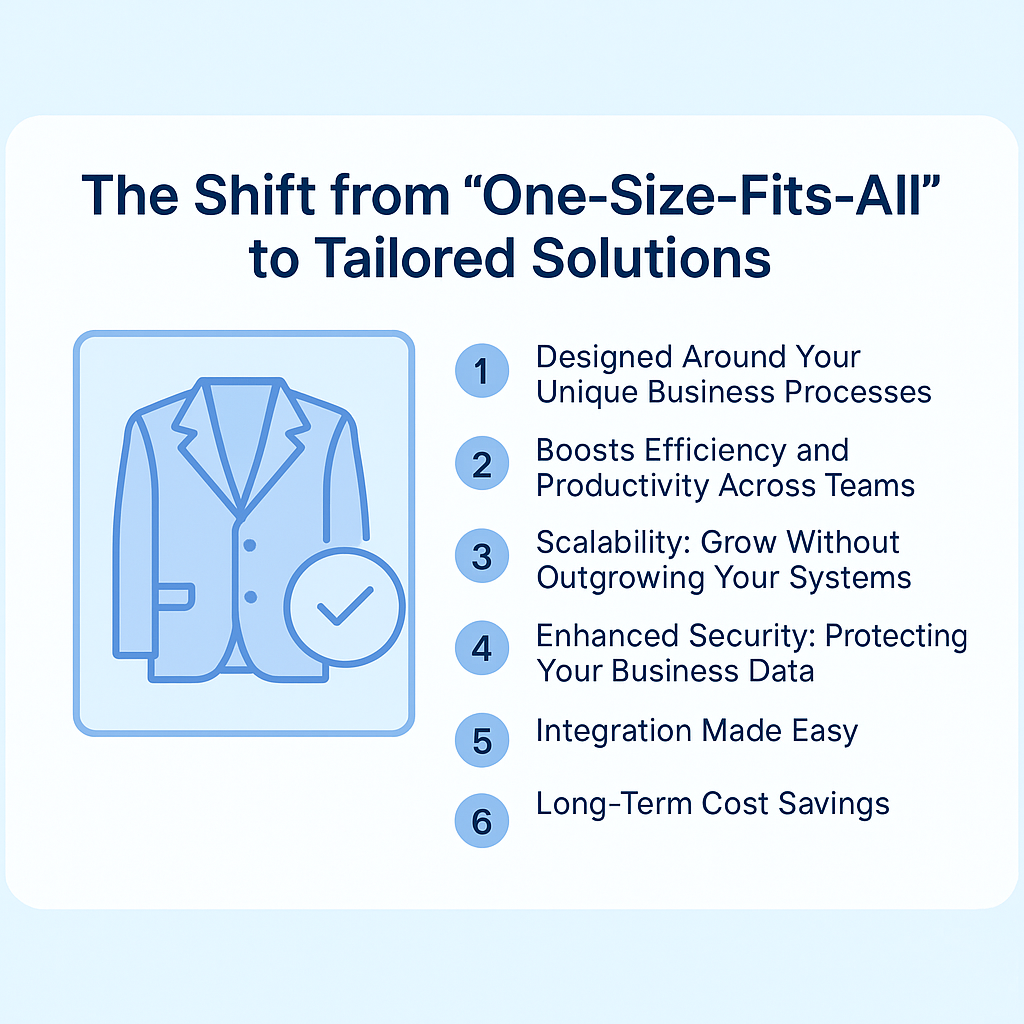
    The Shift from “One-Size-Fits-All” to Tailored Solutions

    Picture this you are buying a suit for the biggest meeting of your career — but instead of getting one tailored to your size, you grab a random off-the-rack piece. It’s close enough… but it doesn’t quite fit right. It looks awkward, feels uncomfortable, and you just don’t move as confidently.

    That’s exactly what using generic software feels like for businesses today. This blogs tells us about the benefits of custom software or Custom App Development services.

    Custom Software Development is like getting that tailored suit — made just for you, perfectly fitting your goals, processes, and vision.

    In today’s blog, we’re diving deep into why custom software has become a game-changer for businesses across industries — and top benefits of custom software development for businesses.

    1. Designed Around Your Unique Business Processes

    Every business is different.

    Even two companies in the same industry can have totally different workflows, customer types, management styles, and needs.

    Off-the-shelf software forces you to change your processes to fit their system. Custom app development, on the other hand, is built to match your processes, not the other way around.

    Benefits of Custom Software:

    • No unnecessary features: Every function serves a real purpose.
    • Full flexibility: You can tweak the software as your operations evolve.
    • Faster adoption: Employees find it easier to learn and use software built around their day-to-day tasks.

    When your software understands your business as well as you do, magic happens.

    2. Boosts Efficiency and Productivity Across Teams

    Have you ever noticed how much time is wasted switching between apps, manually updating data, or working around a system that “kind of” fits?

    Custom software is designed to make your team’s life easier — removing hurdles, simplifying workflows, and automating repetitive tasks.

    Here’s how it helps:

    • Automation of routine tasks like data entry, approvals, and reporting.
    • Real-time data access across departments.
    • Customised dashboards showing the KPIs that matter most to you.

    The result?
    Less frustration. More output. A team that can focus on strategic tasks rather than getting bogged down by inefficiencies.

    3. Scalability: Grow Without Outgrowing Your Systems

    Most off-the-shelf solutions have limits.
    Maybe upgrading to “enterprise” features costs a fortune.

    With custom software development services, scalability is built-in. Your system can grow with you, adapting to increased workloads, expanded features, or new user types as needed. That is one of the biggest benefit of custom software.

    Why scalability matters:

    • Future-proof investment: No need to start from scratch every few years.
    • Cost savings: Avoid expensive migrations or new platform purchases.
    • Flexibility: Add, modify, or remove features as your business model evolves.

    Growing pains are real — but the right software can cushion the impact.

    4. Enhanced Security: Protecting Your Business Data

    Cyber threats are no longer a distant worry; they’re a daily reality.
    Especially for businesses dealing with sensitive customer information, intellectual property, or financial data.

    Custom software can be built with security as a priority — not just an afterthought.

    Security benefits include:

    • Custom authentication systems tailored to your needs.
    • Advanced encryption protocols for sensitive data.
    • Controlled user access with multi-level permissions.
    • Proactive threat monitoring and quick patching of vulnerabilities.

    And because custom solutions are less widespread, they are less attractive targets for mass-scale cyberattacks.

    In today’s digital economy, trust is currency — and nothing builds trust faster than strong security.

    5. Integration Made Easy

    In a typical business day, you might use:

    • A CRM for sales
    • An ERP for operations
    • A marketing automation tool
    • Financial software
    • HR management platforms

    Jumping between multiple systems wastes time and often creates errors.

    Custom software development allows you to integrate everything into one coherent system — or at least ensure seamless data flow between different platforms.

    Imagine a world where:

    • Customer information updates everywhere instantly.
    • Sales data automatically syncs with your invoicing system.
    • Inventory levels update in real-time across your supply chain.

    That’s the power of smart integration — and custom software makes it effortless.

    6. Long-Term Cost Savings: Invest Once, Reap Forever

    At first glance, buying a ready-made solution might seem cheaper.
    But when you factor in recurring licensing fees, paid upgrades, third-party plugins, additional user fees, and the cost of workarounds, off-the-shelf software quickly becomes expensive.

    Custom software may involve a higher initial investment, but the long-term ROI is usually much stronger.

    Here’s why:

    • One-time development cost (plus optional maintenance).
    • No ongoing licensing fees.
    • Tailored efficiency savings through automation and integration.
    • Reduced training and onboarding costs.

    Custom software is like buying a house versus renting an apartment — one builds equity; the other just racks up bills.

    7. Competitive Edge: Outpace Your Rivals

    When everyone uses the same tools, innovation stalls.

    Custom software allows you to differentiate yourself in ways that mass-market solutions never can.

    Think about it:

    • A custom customer software with features that no competitor offers.
    • An internal system that allows you to deliver services faster.
    • Automated insights that give you an edge in market analysis.

    Having unique digital tools gives you first-mover advantage, faster reaction times, and a stronger brand identity in your market.

    If you want to lead, not follow, customization is the key.

    8. Dedicated Support: No More Waiting in Line

    Have you ever tried calling support for a big-name software platform?

    • Endless hold times
    • “Ticket escalations”
    • Generic advice that doesn’t apply to your situation

    With custom software, you have direct access to the developers who built your system.
    That means:

    • Faster bug fixes
    • Easier upgrades
    • Personalized recommendations based on your exact setup

    No more wasting time explaining your business to tech support reps who don’t understand it.

    9. Greater Control Over Updates and Features

    Off-the-shelf products update on their own schedules — often adding features you don’t need or changing interfaces you’ve gotten used to.

    With custom development, you control the roadmap.

    You decide:

    • When to add new features
    • What upgrades to prioritize
    • How the user interface evolves

    This flexibility ensures that technology serves you, not the other way around.

    10. Higher Employee Satisfaction

    Finally, let’s not forget your team.
    Good software isn’t just about processes and profits — it’s about people.

    When employees have to fight with clunky, mismatched tools every day, morale drops.
    When they get software that feels natural, speeds up their work, and reduces friction, satisfaction soars.

    And happy employees:

    • Work harder
    • Stay longer
    • Deliver better customer service

    Employee experience is one of the most underrated benefits of custom software development — but one that pays enormous dividends.

    Hudasoft is a custom software company in USA with impressive record of delivery software customised for Industries including Automotive, Healthcare, Real Estate and Banking.

    Conclusion: Custom Software Is an Investment in Your Business DNA

    In a world where customer expectations are sky-high, markets shift overnight, and competition is fierce, generic solutions just don’t cut it anymore.

    Custom software development isn’t about “adding another tool.”
    It’s about crafting a foundation — a living, evolving system that reflects the very DNA of your business.

    From improved efficiency and security to better scalability and long-term savings, the advantages are real — and they’re transformative. There is no second opinion that custom software benefits in long term with its uniqueness.

    If you’re serious about building a future-proof, competitive business, it’s time to think custom.
    Because your business deserves more than a one-size-fits-all solution.

  • Custom Software Development: Everything You Need to Know in 2025

    Custom Software Development: Everything You Need to Know in 2025

    In today’s fast-moving digital world, businesses need more than just generic tools.
    They need solutions built specifically for them.
    That’s where custom software development comes into play.

    Custom software isn’t just a trend — it’s a strategic decision for businesses that want to streamline operations, improve customer experience, and stand out from competitors.

    In this guide, we’ll explore everything about custom software development:
    what it is, why it matters, and how it can transform your business.

    What is Custom Software Development?

    Custom software development is the process of designing, building, and deploying software that is specifically tailored to meet the unique needs of a particular business or organization.

    Unlike off-the-shelf software, which serves a broad audience, custom software is designed with your specific workflows, challenges, and goals in mind.

    Why Businesses Need Custom Software

    Businesses invest in custom software development for several reasons:

    • Tailored Solutions: Custom software matches your exact business processes and needs.
    • Competitive Advantage: Unique features can differentiate your business from others.
    • Scalability: Custom solutions can grow alongside your business.
    • Integration: Easily connect with your existing systems and platforms.
    • Enhanced Security: Specific security measures can be incorporated based on your industry requirements.

    Key Benefits of Custom Software Development

    Choosing a tailored solution brings a wide range of benefits:

    • Improved Efficiency: Custom software is optimized for your internal workflows, reducing bottlenecks.
    • Cost Efficiency Over Time: Although upfront costs are higher, custom solutions save money in the long run by reducing licensing fees and operational inefficiencies.
    • Better Customer Experience: Software built around your customer’s needs improves satisfaction and loyalty.
    • Full Control: You decide how and when to update or upgrade the software.
    • Enhanced Flexibility: Easily adjust or add new features as your business evolves.
    • Security Tailored to Your Needs: Custom software can address specific security threats and compliance needs.

    Types of Custom Software Development Services

    There are several areas where businesses seek custom software:

    • Web Application Development: Custom websites, e-commerce platforms, and portals.
    • Mobile App Development: Native and cross-platform apps tailored to your audience.
    • Enterprise Software Solutions: CRM systems, ERP solutions, and HRM software.
    • Custom APIs and Integration: Connect different systems to work seamlessly.
    • SaaS Product Development: Building cloud-based software for recurring revenue models.

    Custom Software Development Process

    A successful custom software project typically follows these steps:

    1. Requirement Gathering: Understand business needs, challenges, and goals.
    2. Planning: Define scope, timelines, resources, and budget.
    3. Design: Create user-friendly, intuitive designs tailored to your audience.
    4. Development: Build the software with the selected tech stack.
    5. Testing: Rigorous testing to ensure functionality, security, and usability.
    6. Deployment: Launching the software in the live environment.
    7. Maintenance & Support: Regular updates, improvements, and bug fixes.

    Each stage is crucial for ensuring the software meets your expectations and delivers real business value.

    Challenges in Custom Software Development

    While custom software offers immense value, there are challenges to navigate:

    • Higher Initial Costs: Developing from scratch demands more resources than buying ready-made software.
    • Longer Development Time: Building a custom solution takes careful planning and time.
    • Complex Requirement Gathering: Defining needs clearly is essential for success.
    • Choosing the Right Development Partner: Expertise, communication, and commitment from your software partner can make or break the project.

    However, with a strong team and clear planning, these challenges are easy to overcome.

    How to Choose a Custom Software Development Company

    Selecting the right development partner is critical. Here’s what to look for:

    • Experience: Look for a company with a strong portfolio of successful custom projects.
    • Technical Expertise: Make sure they are skilled in the technologies your project demands.
    • Understanding of Your Industry: Industry-specific experience leads to better solutions.
    • Transparent Process: A clear project timeline, communication structure, and cost estimate are essential.
    • Post-Deployment Support: Ongoing maintenance and support are crucial for long-term success.

    Always check client reviews, case studies, and ask for references before making your choice.

    Types of Custom Software Services

    There are many services you can avail to get custom software tailored precisely to your business needs. Whether you’re a startup looking to build a quick MVP or an enterprise seeking complex integrations, custom software solutions provide the flexibility and innovation needed to stay ahead. Here’s a breakdown of key services to consider:

    1. Custom Software Consulting

    Every successful custom software project starts with the right strategy. Custom software consulting services help you analyze your business processes, define software requirements, and choose the right technologies. This ensures your solution is aligned with your goals, budget, and future scalability.

    2. Enterprise Custom Software Services

    Larger organizations often require more robust and scalable software. Enterprise custom software services focus on building powerful systems like ERP, CRM, or internal platforms that integrate seamlessly with existing tools, support high volumes of users, and ensure top-level security and compliance.

    3. Software Product Development Services

    If you have an idea for a software product, this service turns it into reality. From design and development to launch and maintenance, software product development services guide you through each stage of the product lifecycle—ensuring you deliver a high-quality, user-focused solution to the market.

    4. MVP Custom Software Development

    For startups and innovators, MVP (Minimum Viable Product) development is a smart way to validate ideas. By building a simplified version of your product with only the essential features, you can test user interest, gather feedback, and iterate quickly—saving time and money while reducing risk.

    Custom Software Development Cost Factors

    The cost of custom software development varies widely based on factors such as:

    • Project Scope and Complexity: Bigger, more complex projects cost more.
    • Technology Stack: Some technologies are more expensive or harder to find developers for.
    • Development Team Size and Location: Rates vary depending on where your developers are based.
    • Design Requirements: Advanced, high-end designs require more effort and cost.
    • Integration Needs: Connecting to existing systems can add to the complexity.
    • Post-Launch Support: Ongoing maintenance contracts affect overall costs.

    While custom software can be a significant investment upfront, the returns often outweigh the costs over time.

    Future Trends in Custom Software Development

    Custom software is evolving rapidly. Here’s what’s coming:

    • AI and Machine Learning Integration: Smarter, predictive software solutions.
    • Low-Code/No-Code Development: Faster development using minimal coding.
    • Cloud-Native Development: Building software optimized for the cloud from the start.
    • Cybersecurity-First Development: Security will be baked into every layer of new applications.
    • IoT-Integrated Solutions: Custom software that controls and monitors smart devices.

    Businesses that invest early in these trends will gain a major competitive edge.

    Conclusion

    Custom software development is no longer just a luxury for large corporations — it’s becoming essential for businesses of all sizes aiming to thrive in today’s competitive digital environment.

    A tailored solution can boost efficiency, enhance customer satisfaction, and future-proof your operations.

    If you’re ready to take the next step and build a software solution that fits your business like a glove, investing in custom software development is the smartest move you can make. Hudasoft is one of the best Custom Software Company in USA with 5 star rating from customers.

    Need help getting started?
    Talk to our expert team today and discover how custom software can transform your business for the better.

  • A Guide: Custom Software Development in 2025, Costs, Challenges, and Timelines

    A Guide: Custom Software Development in 2025, Costs, Challenges, and Timelines

    Imagine having a clear vision for your business but struggling to find a ready-made software solution that truly fits. Maybe you have unique workflows, customer needs, or growth plans that off-the-shelf products simply cannot support. This is where Custom Software Development becomes essential. In 2025, companies of every size are turning to custom-built solutions to achieve operational excellence, deliver better customer experiences, and maintain a competitive edge.

    Custom software development involves creating applications specifically designed to meet the unique requirements of a business. It could mean building a native iOS app development project for a better mobile experience, investing in Android app development to reach a broader market, or launching a tailor-made web app development platform to streamline operations. With the increasing complexity of business needs, custom solutions have moved from being a luxury to a necessity.

    In this article, we will explore what custom software development is, why businesses need it, the challenges involved, how much it costs in 2025, and the timeframes you should expect based on the size of your organisation.

    What is Custom Software Development?

    Custom Software Development refers to designing, developing, deploying, and maintaining software solutions tailored to the specific requirements of a business or user group. Unlike commercial off-the-shelf software, custom applications are personalized for the organization’s goals, processes, and future plans.

    Custom software development can include various types of projects:

    • Mobile app development for iOS and Android
    • Web app development for customer portals or internal management
    • Custom CRM and ERP solutions
    • API development and third-party integrations
    • Cloud-based applications for scalability

    By opting for custom solutions, businesses gain the flexibility to shape their technology exactly how they need it, ensuring higher efficiency, better performance, and more control over their digital ecosystem.

    Why Businesses Need Custom Software Development Services

    The shift towards digital transformation has made it clear that one-size-fits-all solutions rarely align perfectly with specific business processes. Here are some key reasons businesses are increasingly investing in custom software development:

    1. Tailored Solutions for Unique Needs

    Every business operates differently. Custom software allows companies to integrate unique features and functionalities that fit their internal workflows and external market demands perfectly.

    2. Enhanced Scalability

    Custom solutions can grow with the business. Whether you plan to expand your operations, offer new services, or enter new markets, a custom application can be easily upgraded to support your growth without major overhauls.

    3. Competitive Advantage

    Owning proprietary software gives businesses a significant edge over competitors using generic platforms. It allows brands to deliver unique customer experiences and optimized operations that competitors cannot easily replicate.

    4. Seamless Integration

    Custom software can be designed to integrate with existing systems such as CRMs, ERPs, payment gateways, and third-party platforms, ensuring a streamlined operational flow.

    5. Higher Security

    Custom-built applications come with tailored security protocols that protect against common vulnerabilities and cyber threats, offering better data protection compared to widely available off-the-shelf solutions.

    6. Long-Term Cost Savings

    Although the initial investment is higher, custom software eliminates the need for recurring licensing fees, expensive integrations, and patchwork solutions that often plague off-the-shelf software users.

    Challenges in Custom Software Development

    While custom software development offers substantial advantages, it is important to understand the potential challenges to ensure project success.

    1. High Initial Costs

    Custom software demands a significant upfront investment for planning, design, development, and testing. Businesses must be financially prepared for this commitment.

    2. Longer Development Timelines

    Developing a custom solution takes time. From requirement gathering and design to development and deployment, each stage requires careful execution and collaboration between stakeholders and developers.

    3. Requirement Volatility

    Business needs can change over time. Without clear and stable requirements, projects risk facing scope creep, delays, and budget overruns.

    4. Finding the Right Development Partner

    Selecting a reliable development partner experienced in mobile app development, iOS app development, Android app development, and web app development is critical. A poor choice can lead to missed deadlines, subpar quality, and unmet expectations.

    5. Ongoing Maintenance and Upgrades

    Custom software requires continuous maintenance to adapt to new security threats, technology upgrades, and evolving business needs. Maintenance plans should be factored into the long-term budget.

    Cost of Custom Software Development in 2025

    The cost of custom software development depends on several factors including project complexity, technology stack, team expertise, design requirements, and integrations. Here are the general cost estimations in USD for 2025:

    Small Business Software Development Costs:

    • Basic mobile app or web app development: $8,000 – $25,000
    • Custom internal tools (HRMS, CRM, etc.): $10,000 – $30,000
    • Average project time: 2 to 4 months

    Medium-Sized Business Software Development Costs:

    • Cross-platform mobile app development: $30,000 – $75,000
    • Full-featured web app or SaaS platform: $40,000 – $90,000
    • Average project time: 4 to 8 months

    Large Enterprise Software Development Costs:

    Average project time: 8 months to 1 year+

    Advanced mobile app suites (iOS, Android): $100,000 – $300,000+

    Enterprise-grade web app systems (ERP, marketplace platforms): $150,000 – $500,000+

    Custom mobile app development for iOS or Android can start around $20,000 for basic apps and go beyond $200,000 for complex applications with multiple features, APIs, and integrations. Similarly, custom web app development projects can range widely depending on user roles, databases, real-time functionalities, and scalability requirements.

    Advanced features like AI integration, blockchain, IoT, and real-time analytics will also impact the final cost.

    Time Estimation for Custom Software Development

    Custom software development projects vary widely in timeline depending on size, complexity, and business needs. Here are average estimates:

    Small Organizations:

    • 2 to 4 months for basic mobile app development or web app development
    • 3 to 5 months for simple custom platforms

    Medium-Sized Organizations:

    • 4 to 7 months for mobile app development (iOS and Android)
    • 5 to 8 months for mid-sized custom software solutions

    Large Enterprises:

    10 to 16 months for enterprise-level platforms and integrated systems

    8 to 12 months for full-scale mobile app development and web app development

    The timeline includes the following phases:

    • Requirement analysis
    • Design and prototyping
    • Development and coding
    • Testing and quality assurance
    • Deployment and launch
    • Post-launch maintenance

    Choosing Agile development methodologies can help businesses achieve faster releases with incremental improvements.

    Key Factors That Influence Cost and Time

    Several critical factors influence the final cost and timeline of a custom software development project:

    1. Project Complexity

    Simple applications with limited features cost less and take less time, while complex systems with multiple modules, third-party integrations, and advanced functionalities require more investment and time.

    2. Technology Stack

    Selecting between native mobile app development for iOS and Android, cross-platform development, or web app development impacts both the budget and the timeline. Emerging technologies like machine learning and blockchain also add to complexity and cost.

    3. Team Size and Expertise

    A highly skilled and experienced development team may charge more but will deliver higher quality work with fewer delays, resulting in better long-term value.

    4. Customization Level

    Highly customized applications require more resources for design, development, and testing compared to semi-customized or template-based solutions.

    5. Security Requirements

    Applications that demand higher security standards, especially in industries like finance and healthcare, involve additional development layers, audits, and compliance costs.

    6. Maintenance and Support

    Post-launch maintenance contracts, upgrade cycles, and feature enhancements are critical components to ensure software longevity and performance.

    Custom Software Development vs Off-the-Shelf Software

    Here is a quick comparison to highlight why businesses increasingly prefer custom software development:

    Custom Software Development:

    • Fully tailored to business needs
    • Scalable and future-proof
    • Higher upfront cost, better long-term ROI
    • Competitive advantage through unique features

    Ready-Made Software:

    • Lower initial cost
    • Faster deployment
    • Limited customization options
    • Risk of outgrowing the software as the business scales

    Investing in custom software ensures businesses retain full control over functionality, upgrades, and user experience without being tied to external vendors or licensing constraints.

    Conclusion

    In 2025, Custom Software Development is no longer just an option for forward-thinking businesses; it is a strategic necessity. Whether you are considering a cutting-edge mobile application through iOS app development or Android app development, or building a comprehensive web app development platform, custom software offers unmatched flexibility, scalability, and long-term value.

    Choosing custom software development is an investment in future-proofing your business, creating better customer experiences, streamlining operations, and unlocking sustainable growth. The key is to work with a trusted development partner who understands your vision, has expertise in mobile and web app development, and can deliver a solution that truly elevates your business.

    If you are planning to start your custom software journey, now is the right time to turn your ideas into scalable, future-ready solutions tailored for success.

  • The Ethical Considerations of AI Implementation in Business (2025 Edition)

    The Ethical Considerations of AI Implementation in Business (2025 Edition)

    Artificial Intelligence (AI) is no longer a futuristic concept; it’s a present-day reality reshaping industries worldwide. From automating routine tasks to enhancing customer experiences, businesses are increasingly adopting AI to maintain a competitive edge. However, as AI continues to evolve, it brings forth not only opportunities but also a host of ethical considerations. For business leaders, understanding these ethical implications is vital to ensure responsible AI implementation. After all, AI is not just about technological advancement; it’s about using that power in a way that is fair, transparent, and beneficial to society.

    So, what are the ethical concerns surrounding AI in business? How can companies address these challenges while ensuring they leverage AI in a way that is both innovative and responsible? In this comprehensive guide, we’ll explore the key ethical considerations of AI in business and discuss strategies for businesses to navigate these challenges.

    1. Bias in AI Algorithms: Are AI Systems Fair?

    AI’s potential to transform business operations is unquestionable, but the reality is that AI systems are only as unbiased as the data they are trained on. Many AI models rely on historical data to make decisions, and if that data reflects existing biases, the AI system will likely reproduce those biases. This could result in discriminatory practices, particularly in hiring, credit scoring, and law enforcement.

    Real-World Example: Amazon’s AI Hiring Tool

    In 2018, Amazon developed an AI recruiting tool to streamline the hiring process. However, the system was found to favor male candidates over female ones because it was trained on resumes submitted to the company over a 10-year period, which were predominantly from men. Consequently, the AI downgraded resumes that included the word “women’s,” as in “women’s chess club captain.” Amazon eventually scrapped the tool due to its biased outcomes.

    Strategies to Mitigate Bias:

    • Diverse Data Sets: To mitigate bias, businesses should ensure that the data used to train AI models is diverse and representative of different demographics, backgrounds, and perspectives. By incorporating data that reflects a wide range of individuals, AI models can make fairer, more balanced decisions.
    • Continuous Monitoring and Auditing: It’s essential for businesses to regularly monitor and audit AI systems to check for any unintended biases that may arise. This should be an ongoing process to ensure that AI systems remain fair and equitable over time.
    • Transparency and Accountability: Businesses should be transparent about how AI systems work, how decisions are made, and what data is being used. Transparency allows for better accountability, making it easier to detect and correct any biases that may occur.

    2. Data Privacy: Is Customer Data Being Handled Properly?

    AI systems thrive on data, and this data is often personal, sensitive, and critical to business operations. The ethical handling of customer data is one of the most important concerns in AI implementation. When businesses collect, store, and process customer data, they are responsible for ensuring that the information is protected and used ethically.

    Real-World Example: Cambridge Analytica Scandal

    In 2018, the Cambridge Analytica scandal revealed that the political consulting firm had harvested the personal data of millions of Facebook users without their consent and used it for political advertising purposes. This breach of privacy led to widespread public outcry and increased scrutiny over how companies handle user data.

    Strategies to Safeguard Customer Privacy:

    • Informed Consent: One of the most important steps businesses can take is to obtain clear and explicit consent from customers before collecting their data. Customers should be informed about what data is being collected, why it is being collected, and how it will be used.
    • Data Protection: Implementing robust security measures such as encryption, secure data storage, and access controls is crucial to protect sensitive information. Businesses should follow best practices in cybersecurity to prevent data breaches and unauthorized access.
    • Compliance with Privacy Laws: Businesses must ensure that they comply with global privacy regulations, such as the General Data Protection Regulation (GDPR) in the EU or the California Consumer Privacy Act (CCPA) in the U.S. Compliance ensures that companies handle customer data ethically and respect privacy rights.

    3. Job Displacement: Will AI Take Away Jobs?

    AI and automation have the potential to revolutionize industries by increasing efficiency, reducing human error, and cutting costs. However, the flip side of this progress is the concern that AI may replace human workers, particularly in repetitive or low-skilled roles.

    Real-World Example: AI in Manufacturing

    In manufacturing, AI-powered robots can perform tasks like assembling products, which traditionally required manual labor. Similarly, AI chatbots and virtual assistants are replacing customer service agents in many companies. This can result in job losses, especially for workers whose jobs are easily automated.

    Strategies to Address Job Displacement:

    • Upskilling and Reskilling Programs: Rather than simply eliminating jobs, businesses can use AI as an opportunity to reskill and upskill their workforce. For example, businesses can invest in training programs to help employees acquire new skills that complement AI and automation technologies. Employees can transition from performing routine tasks to taking on more strategic roles that AI cannot perform.
    • Creating New Job Roles: AI is not just about eliminating jobs—it’s also about creating new ones. For example, AI will require skilled professionals to design, manage, and maintain these systems. New roles such as AI ethicists, AI trainers, and data scientists are emerging as a result of AI’s rise.

    4. Transparency in AI Decision-Making: Can You Explain AI Decisions?

    AI systems often operate as “black boxes,” meaning that their decision-making processes are difficult to understand or explain. This is particularly concerning in situations where AI is making important business decisions, such as approving loans, setting insurance premiums, or determining hiring decisions.

    Real-World Example: AI in Credit Scoring

    Consider a scenario where a customer is denied a loan by an AI-driven system. If the company cannot explain the reasons behind the decision, customers may feel they’ve been unfairly treated, which can damage the company’s reputation and erode trust.

    Strategies to Improve Transparency:

    • Explainable AI (XAI): Businesses should prioritize Explainable AI (XAI), which refers to AI systems designed to provide clear, understandable explanations of how decisions are made. This can be particularly important when AI is used in sensitive areas such as credit scoring or hiring.
    • Clear Policies and Communication: Businesses should develop and communicate clear policies about how AI systems make decisions. These policies should be shared with customers, employees, and other stakeholders to foster trust and ensure accountability.

    5. AI in Customer Interactions: Are You Manipulating Consumers?

    AI is increasingly being used in customer-facing roles, such as personalized marketing and virtual assistants. While this can enhance the customer experience, it also raises ethical concerns about manipulation. AI systems can leverage behavioral data to target customers with specific offers and recommendations, potentially exploiting their vulnerabilities.

    Real-World Example: Personalized Marketing

    Personalized marketing powered by AI can be highly effective, but it can also be used to push customers into making purchases they don’t need or want, based on their behavioral data. This raises the question: Are businesses using AI to manipulate customers

  • AI in Real Estate: How AI Implementation is Transforming the Industry

    AI in Real Estate: How AI Implementation is Transforming the Industry

    The real estate industry has always been one of the most traditional sectors, but things are rapidly changing. So, what’s driving this transformation? It’s AI in real estate. From helping buyers find the perfect property to making property management more efficient, using AI in real estate is becoming a game-changer.

    But how exactly is AI transforming the real estate industry? And, more importantly, how can you tap into these advancements to grow your real estate business?

    Let’s break it down and dive into the AI use cases in real estate that are revolutionizing how real estate professionals operate.

    The Rise of AI in Real Estate: Why Is It So Important?

    AI is no longer a futuristic technology it’s a current reality in real estate. Whether you’re a property developer, a real estate agent, or someone managing properties, AI in real estate development and property management is becoming essential to stay competitive.

    But how does it all work? Essentially, AI implementation involves using algorithms, machine learning, and natural language processing (NLP) to automate processes, predict trends, and provide actionable insights in real time.

    AI in the real estate industry is fundamentally changing the way we think about transactions, property management, and client services. It’s about leveraging smart technologies to make informed decisions that improve business outcomes.

    How to Use AI in Real Estate: The Benefits You Can’t Ignore

    Now, you might be wondering, “How can I use AI in my real estate business?” Well, using AI in real estate can give you a competitive edge by improving efficiency and delivering better results for your clients. Here are some of the ways AI is transforming the real estate industry:

    1. Smarter Property Management

    If you’re managing a portfolio of properties, you know how time-consuming it can be to handle everything manually. That’s where property management software powered by AI comes in.

    With AI in real estate management, property managers can automate tasks like rent collection, maintenance requests, and tenant communication. These systems are designed to help you stay on top of everything, from tracking payment history to managing vacancies and even predicting when a property might require maintenance.

    Imagine a system that automates lease renewals, sends timely reminders to tenants, and even predicts when you’ll need to replace major appliances. It’s like having a personal assistant for your real estate business!

    2. AI in Property Valuation

    Valuing a property has traditionally been a complex process based on market data, comparable property sales, and location analysis. With AI, property valuations are faster and more accurate. AI algorithms can analyze large datasets to provide real-time, predictive property valuations that reflect current market trends.

    This isn’t just helpful for buyers and sellers, but also for real estate investors and property developers. You can get a more precise idea of property value before making any financial commitments.

    3. Predicting Real Estate Trends

    One of the most powerful uses of AI in real estate is its ability to predict future market trends. AI use cases in real estate include analyzing historical data, social media sentiment, economic indicators, and even weather patterns to forecast property price movements.

    For example, AI in real estate development can help developers identify emerging hot spots and lucrative markets. By utilizing predictive analytics, AI can help businesses make data-driven decisions and identify which properties are likely to experience price increases in the near future.

    4. Enhancing Customer Experience with AI

    In real estate, customer experience is everything. AI-powered tools, such as virtual assistants and chatbots, can engage with potential clients in real-time, answer questions, and even schedule property viewings.

    By using AI in real estate, agents can offer personalized recommendations based on clients’ preferences, behaviors, and browsing history. Imagine a customer visiting your real estate website—AI can instantly present them with properties that match their needs and even offer virtual tours.

    The Power of AI in Property Management Solutions

    Gone are the days when property managers had to juggle spreadsheets, paperwork, and endless emails. AI in real estate offers property managers an all-in-one solution to run operations smoothly. With property management solutions enhanced by AI, everything from tracking rent payments to handling repair requests is automated.

    For instance, if a tenant submits a maintenance request, AI can instantly assess the urgency of the issue, notify the right technician, and even update the tenant on the status.

    These tools aren’t just about saving time—they’re about creating a better experience for both property managers and tenants. And by incorporating these AI-driven real estate management software solutions into your business, you can free up valuable time to focus on what really matters: growing your business and expanding your portfolio.

    AI in Real Estate Development: A Transformative Force

    Are you involved in real estate development? If so, you know how challenging it can be to manage large-scale projects with numerous variables. AI makes it easier to handle complexities by streamlining processes and improving decision-making.

    For example, AI can assist with land acquisition by analyzing market conditions, zoning laws, and demographic data. It can also help with risk management by predicting construction delays, budget overruns, and even identifying optimal pricing strategies for newly developed properties.

    In short, AI in real estate development reduces the uncertainty that comes with these large investments and helps ensure a higher ROI.

    How Can I Use AI in My Real Estate Business? Practical Tips for Implementation

    Implementing AI in your real estate business doesn’t need to be daunting. Here are some actionable steps to help you get started:

    1. Start with Property Management Software

    If you’re managing rental properties, investing in AI-powered property management software is an excellent first step. These solutions can automate everything from collecting rent payments to scheduling repairs and keeping tenants engaged.

    2. Adopt AI-Powered CRM Tools

    To boost your lead generation and conversion rates, consider using AI-powered CRM tools. These platforms use AI to analyze customer data, segment leads, and even predict which leads are most likely to convert into clients.

    3. Use Predictive Analytics for Investment Decisions

    AI-driven predictive analytics can help you make smarter real estate investment decisions. By analyzing market trends, rental yields, and property values, you can identify the best opportunities for growth.

    4. Enhance Your Website with AI

    Integrate AI-powered chatbots and virtual assistants into your real estate website to provide instant assistance to visitors. These tools can engage with potential buyers, answer their questions, and even recommend properties based on their preferences.

    The Future of AI in Real Estate: What’s Next?

    The role of AI in real estate is only going to grow. As technology continues to advance, AI in real estate will become even more sophisticated, making it easier for real estate professionals to predict market trends, enhance customer experience, and manage properties efficiently.

    From self-driving cars that offer property tours to AI-driven construction tools that help build smarter homes, the future of AI in real estate is incredibly exciting. As more professionals begin to integrate AI solutions into their businesses, the real estate industry will become faster, more data-driven, and increasingly customer-centric.

    Conclusion

    In today’s competitive real estate market, AI in real estate is no longer optional—it’s essential. From smarter property management and more accurate property valuations to enhanced customer experiences and AI-powered real estate development, AI in real estate is changing the way business is done.

    So, are you ready to embrace the future? By using AI in real estate, you can streamline your operations, improve your customer service, and make data-driven decisions that will take your business to new heights.

    It’s time to invest in property management solutions and real estate management software that incorporate AI because the future of real estate is here, and it’s powered by AI. Understanding property management software prices also becomes crucial at this stage, helping you choose AI-driven tools that match your budget and long-term growth plans.

  • How Workflow Automation is Boosting Dealership Efficiency

    How Workflow Automation is Boosting Dealership Efficiency

    The auto dealership industry is under more pressure than ever to deliver faster service, improve customer experiences, and reduce operational inefficiencies. With increasing competition and digitally-savvy consumers, dealerships must embrace smart technology to stay relevant and profitable.

    One of the most powerful technologies transforming dealership operations today is workflow automation. It’s no longer a luxury it’s a necessity. From handling repetitive tasks to managing complex processes across sales, service, and inventory, workflow automation for auto dealerships is becoming a standard part of modern operations.

    This blog explores how automated workflows and business automation workflows are driving efficiency and performance in auto dealership operations, and why your dealership should consider making the shift today.

    The Challenge: Outdated Systems and Manual Processes

    Many auto dealerships still rely heavily on manual, paper-based processes. From tracking sales leads to scheduling test drives and handling post-sale paperwork, these tasks often involve multiple systems and disconnected workflows. This leads to:

    • Missed follow-ups
    • Delayed responses
    • Lost deals
    • Human error
    • Inefficient collaboration between departments

    The result? Slower sales cycles, frustrated customers, and overwhelmed staff.

    To address these challenges, dealerships are increasingly turning to workflow automation solutions to streamline their operations.

    What is Workflow Automation?

    Workflow automation is the use of technology to automate business processes and tasks that are typically performed manually. It replaces repetitive actions with automated workflows that follow a predefined set of rules or triggers.

    In the context of auto dealership operations, this could include:

    • Automatically assigning leads to sales reps based on availability
    • Sending follow-up emails after a test drive
    • Notifying staff about inventory changes
    • Generating digital documents like invoices or loan applications
    • Triggering service reminders for customers

    The goal is to automate workflows across departments, ensuring that every task is completed efficiently and on time without the need for constant human oversight.

    Key Benefits of Workflow Automation for Auto Dealerships

    1. Improved Lead Management

    Leads are the lifeblood of every dealership. But managing them manually can lead to slow responses, inconsistent communication, and lost opportunities. With dealership workflow automation, leads can be captured from websites, social media, or third-party platforms and automatically assigned to the right salesperson.

    Automated reminders and follow-ups ensure that no lead slips through the cracks. This improves response time and significantly boosts conversion rates.

    2. Faster Sales Process

    A slow sales process can drive customers away. Automated workflows can streamline every step from initial inquiry to final sale. Tasks such as credit checks, price negotiations, document generation, and payment processing can be partially or fully automated, making the process faster and more reliable.

    Customers enjoy a smoother experience, while your team closes deals more efficiently.

    3. Smarter Inventory Management

    Keeping track of vehicle inventory manually is inefficient and error-prone. Workflow automation tools can update your inventory system in real time, sync listings with online platforms, and notify managers when stock is low or new vehicles arrive.

    This not only reduces human error but also ensures your sales team has accurate information when dealing with customers.

    4. Better Coordination Across Departments

    Sales, finance, service, and marketing teams often operate in silos. Workflow automation software breaks these silos by connecting systems and automating information flow between departments.

    For example, once a car is sold, an automated workflow can notify the finance team to begin documentation, alert the service department to prep the vehicle, and send a welcome email to the new owner all without manual intervention.

    5. Enhanced Customer Experience

    Today’s car buyers expect a seamless digital experience. By implementing workflow automation, dealerships can provide timely updates, personalized communication, and quicker service. Whether it’s a reminder for an oil change or a birthday greeting, automated workflows ensure consistent engagement and improved satisfaction.

    Workflow Automation vs Process Automation: What’s the Difference?

    Although often used interchangeably, there is a distinction between workflow automation and business process automation.

    • Workflow automation focuses on task-level automation within a business process. For example, assigning a lead, sending an email, or triggering a notification.
    • Process automation refers to the automation of an entire business process from end to end, such as automating the full vehicle financing journey, from application to approval.

    Think of workflow automation as a key component within a broader business process automation strategy. Both are essential, but workflow automation is often the quicker, easier starting point for dealerships.

    Use Cases of Workflow Automation in Auto Dealerships

    There are endless ways that auto dealership automation can boost productivity and reduce workload. Here are some real-world applications:

    1. Lead Capture and Routing

    A potential buyer fills out a contact form on your website. Instead of manually assigning the lead, an automated workflow instantly sends the lead to the relevant salesperson based on zip code, vehicle preference, or availability.

    2. Test Drive Scheduling

    With workflow automation tools, customers can book test drives online. The system sends them a confirmation, updates the team’s calendar, and alerts the sales staff. No more missed appointments or double-bookings.

    3. Service Appointment Reminders

    An automated workflow can notify customers when their car is due for service, schedule an appointment, and send reminders a day before.

    4. Paperwork and Documentation

    Documents like purchase agreements, loan forms, and service reports can be generated and emailed using workflow automation software. Some tools even integrate with e-signature platforms to speed up the process.

    5. Post-Sale Follow-Ups

    After a sale, an automated workflow can send thank-you messages, request feedback, or invite the customer to join a loyalty program.

    The Role of Low-Code Automation in Dealerships

    One of the most exciting developments in automation is the rise of low-code workflow automation platforms. These tools allow non-technical users to design and implement workflows without writing code.

    Sales managers, service advisors, or marketing staff can now set up custom automations using drag-and-drop interfaces, pre-built templates, and visual editors.

    Low-code platforms make it easier for dealerships to adapt automation to their specific needs, enabling faster implementation and lower costs compared to traditional development.

    Choosing the Right Workflow Automation Tools

    There’s no one-size-fits-all tool for workflow automation in auto dealerships. The right solution depends on your dealership’s size, systems, and specific pain points.

    When evaluating workflow automation tools, consider:

    • Integration with your CRM and DMS
    • Ease of use and scalability
    • Support for mobile and desktop
    • AI-powered features (for smarter automation)
    • Reporting and analytics
    • Security and compliance capabilities

    Some popular tools offer AI workflow automation, which uses machine learning to optimize workflows, predict outcomes, and detect inefficiencies over time.

    Common Myths About Workflow Automation

    “It’s too expensive for small dealerships.”

    False. Many workflow automation software providers offer scalable pricing models, and low-code platforms drastically reduce implementation costs.

    “Automation will replace staff.”

    Not true. Automation enhances your team’s productivity by handling repetitive tasks. Your people can focus on what they do best building relationships and selling cars.

    “We’re not technical enough to manage it.”

    Modern tools are built for ease. With low-code workflow automation, even non-tech users can design and launch workflows without coding skills.

    Final Thoughts

    In a competitive and fast-paced environment, auto dealership automation is more than a productivity booster it’s a strategic advantage.

    Dealerships that continue relying on manual tasks and disconnected systems risk falling behind. But those that invest in workflow automation solutions will enjoy smoother operations, happier customers, and higher revenue.

    Whether you’re just exploring automation or ready to overhaul your processes, now is the time to act. Use workflow automation to accelerate every stage of the dealership journey from marketing and sales to finance and service.

  • AI in ERP: Enhancing Customer Experience Through Automation

    AI in ERP: Enhancing Customer Experience Through Automation

    How AI in ERP Is Redefining Customer Experience in 2025

    Let’s start with a simple story.

    Imagine you’re running a growing eCommerce business. Orders flood in daily, inventory shifts fast, customer queries pile up, and your support team is swamped. You’re doing well, sure—but every day feels like a race to keep up.

    Now ask yourself: what if all these moving parts could think and respond like a team of your best employees? What if they could communicate, anticipate, and even act on customer needs?

    That’s no longer a dream. That’s what happens when you bring AI integration into ERP.

    The Broken Old Way: When ERPs Didn’t Know Your Customer

    Before the rise of AI in ERP, traditional ERP systems ran the back-office engine—managing inventory, handling finance, processing orders—but they were siloed and static when it came to customer engagement.

    Here’s the core issue:

    • They stored data, but didn’t use it to understand customers.
    • They processed orders, but didn’t predict needs.
    • They managed operations, but didn’t connect the dots.

    These systems couldn’t forecast demand, identify churn, or personalize experiences. And that’s where AI and ERP became a game-changer.

    Where AI in ERP Meets the Customer: Intelligent Automation in Action

    When AI meets ERP, the static becomes dynamic. The predictable becomes proactive. It’s a powerful blend that unlocks new possibilities in customer experience.

    Let’s explore how this works:

    1. Predictive Insights That Feel Personal

    Think Netflix suggestions—but for your business.

    With AI in ERP, your system starts to learn. From purchasing patterns to support queries, it builds profiles and behaviors that let you predict customer needs before they even ask.

    • Smart analysis of purchase history and trends
    • Proactive inventory planning for trending products
    • Automated reorder reminders based on individual buying cycles

    The result? Your business becomes customer-first, not order-first.

    This AI implementation improves your ability to manage personalized customer journeys. Instead of reacting, your ERP becomes proactive—anticipating the next step in the customer lifecycle, improving retention, and boosting lifetime value.

    2. Smarter Chatbots, Powered by AI and ERP

    Forget robotic scripts. AI-driven chatbots now leverage Natural Language Processing (NLP) to understand intent and context.

    When a customer chats in:

    • The bot accesses their latest order via ERP data.
    • It provides immediate updates without transfers.
    • Complex issues are escalated—with all the context—to human agents.

    The real magic lies in contextual memory. AI chatbots linked to ERP systems remember preferences, past interactions, and recurring issues. This creates a customer support experience that’s more than transactional—it’s relational.

    This intelligent customer service isn’t just faster. It’s better.

    3. Automated Workflows That Delight Internally and Externally

    AI in ERP doesn’t just benefit customers—it empowers your internal teams.

    Imagine this:

    • A production delay is detected—ERP alerts support before complaints roll in.
    • A return is requested—ERP verifies eligibility and auto-approves the refund.
    • A product gets frequent complaints—ERP flags the issue and routes it to product development.

    This isn’t just automation—it’s orchestration. Departments stop operating in silos. Sales talks to support. Logistics connects with marketing. Everyone gets real-time access to the same AI-enhanced insights.

    The value here? Your team focuses on value-adding tasks—not firefighting.

    4. Real-Time Feedback Loops with AI Implementation

    Customer feedback is often scattered—emails, chats, reviews. AI in ERP can consolidate and analyze it in real time.

    • Sentiment analysis on customer feedback
    • Auto-tagging of complaints by category
    • Trigger-based alerts when feedback mentions quality issues

    This means better, faster product iteration. The business hears the customer voice through the ERP system—transforming that voice into actionable insight.

    Real-time feedback loops enable product teams to release customer-driven updates, support teams to close tickets faster, and leadership to make strategic decisions based on real-world sentiment.

    5. Why Some Businesses Still Hesitate to Adopt AI in ERP

    Despite all the benefits, many businesses hesitate. The fear? Complexity, cost, or the belief that it’s “only for the big guys.”

    But the reality is simpler:

    Even a small deployment of AI and ERP—in customer support, in inventory, in sales forecasting—can bring transformational value.

    This is where smart AI implementation can make all the difference. You don’t need an enterprise budget to make a meaningful impact. Start with one process. Use low-code AI tools. Measure. Iterate. Scale.

    In fact, many ERPs today come with built-in AI capabilities that only need to be activated or lightly customized. For small and mid-size businesses, the opportunity has never been more accessible.

    It’s not just about efficiency. It’s about delivering experiences that feel intuitive and personal.

    6. AI Implementation in ERP Across Industries

    The beauty of AI in ERP is its versatility. Here’s how it’s already transforming different sectors:

    • Retail & eCommerce: Personalized promotions, smart upselling, dynamic pricing.
    • Manufacturing: Predictive maintenance, supply chain optimization, reduced downtime.
    • Healthcare: Patient scheduling, predictive diagnosis, resource allocation.
    • Finance: Fraud detection, real-time reporting, automated compliance checks.

    AI implementation brings sector-specific innovation. A logistics company can predict weather-related delays. A hospitality brand can dynamically adjust staffing. The common thread? Data becomes decision-making fuel.

    7. The Future of ERP is Automated. And It’s Personal.

    Here’s the thing:

    If your ERP isn’t customer-facing, you’re missing half the equation.

    The new wave of AI in ERP isn’t just about backend efficiency—it’s about frontline intelligence. Businesses that win in 2025 will be those that don’t just automate—they anticipate.

    Ask yourself:

    • Are you reacting to customer needs?
    • Or are you staying one step ahead?

    Because your customers know the difference—and they prefer the latter.

    AI in ERP systems gives you the tools to predict, personalize, and perform—all at once.

    ERP Integration and AI

    Final Thoughts: Why You Can’t Ignore AI and ERP

    Let’s recap:

    • AI in ERP transforms raw data into proactive service.
    • It streamlines internal workflows and enhances external experiences.
    • It’s scalable—from single workflows to enterprise-wide adoption.

    Whether it’s personalized suggestions, real-time order updates, or intelligent refunds—AI and ERP integration are the backbone of modern CX.

    And the best part? You don’t have to overhaul everything at once. You can start small—automate one flow, train one chatbot, analyze one trend—and scale as you grow.

    So here’s the final question:

    Are you ready to use AI implementation in ERP to deliver the kind of customer experience your competitors can only dream of?

    Because the future is automated.

    And it’s deeply, beautifully personal.

  • AI Integration to Enhance Productivity: A Strategic Perspective

    AI Integration to Enhance Productivity: A Strategic Perspective

    With over 15 years of experience in managing teams, leading operations, and driving digital transformation, I’ve learned that productivity isn’t just about tools, it’s about how well people, processes, and purpose align.

    We’re entering an era where Artificial Intelligence (AI) is no longer a futuristic concept—it’s a present-day advantage. For organizations planning to AI integration, it is becoming a core driver of growth, innovation, and competitive edge. But the real question isn’t what AI can do—it’s how AI integration helps us embed intelligence meaningfully into our ecosystems.

    From Speed to Smart: Redefining Productivity

    For years, productivity was measured by speed and output. But AI is shifting that metric. Today, it’s about working smarter, not harder. AI tools help organizations

    • Make faster, data-driven decisions
    • Eliminate repetitive manual processes
    • Empower employees to focus on innovation and strategy
    • Anticipate trends, mitigate risks, and drive agile responses

    This isn’t about replacing people—it’s about elevating potential.


    Productivity Through AI Integration of Assistance

    When implemented strategically, AI acts as an intelligent assistant—helping us manage complexity in a world that’s moving faster than ever.

    In Decision Making: AI integration to processes synthesizes massive datasets, giving leadership real-time insights that are otherwise buried in noise.
    In Operations: AI-driven automation streamlines logistics, HR functions, customer service, and finance—cutting down inefficiencies and errors.
    In Strategy: With the help of AI integration, organizations foresee demand, personalize customer experiences, and pivot business models in real-time.

    The beauty lies not just in automation—but in augmentation. AI makes good teams great and great leaders faster, sharper, and more agile.

    The Human Side of AI

    We often associate AI with machines and cold logic. But in practice, AI gives us back what we need most—time. Time to think, create, lead, and connect.

    As leaders, our role is to cultivate a culture where AI supports people, not overshadows them. Where technology is not feared but embraced as a trusted partner. The future of work is not human or AI—it’s human with AI.

    Trending AI Tools Driving Real Productivity Gains

    Let’s look at some of the leading AI tools making a real impact on productivity:

    • ChatGPT / Claude: Used for content creation, meeting summaries, client communication, and brainstorming sessions.
    • Notion AI: Assists in note-taking, task tracking, and organizing team projects with intelligent recommendations.
    • Microsoft Copilot: Embedded into Microsoft 365 apps, it assists with report creation, data summaries, and email drafting.
    • GrammarlyGO / Jasper AI: Speeds up content generation, creative writing, and marketing campaign support.
    • ClickUp AI: Manages team tasks, generates action items, and suggests workflow improvements.

    These tools don’t just automate—they optimize how we think, create, and collaborate.

    Emerging Technologies Shaping the AI Productivity Landscape

    The landscape of AI is evolving rapidly. Here are some cutting-edge technologies to watch:

    • Generative AI: Creating text, images, code, and more—driving creativity and innovation across industries.
    • AutoML (Automated Machine Learning): Reducing the technical barriers to implementing AI, allowing businesses to build models faster.
    • RPA (Robotic Process Automation) + AI: Combining process bots with machine learning for smarter automation in finance, HR, and operations.
    • AI-Driven Business Intelligence (BI): Tools like Tableau AI and Power BI use predictive analytics to guide decision-making.
    • Digital Twins & Edge AI: In manufacturing and logistics, these technologies simulate environments and make real-time decisions on-site.

    The future of productivity lies in intentional adoption—knowing which technologies fit your business and how they’ll empower your people.

    Real Transformation Requires Intentional Integration

    In my experience, the success of AI adoption hinges on one thing: alignment with purpose. Organizations that rush into AI without aligning it with their business model, culture, or readiness risk creating more confusion than clarity.

    Before deploying AI, ask:

    • What problem are we solving?
    • How will this empower my people, not overwhelm them?
    • Are we investing in the right training, change management, and mindset?

    True productivity gains come when AI is woven into the fabric of how we think, act, and evolve.

    Final Thoughts

    AI isn’t just a tech trend—it’s a leadership decision. It’s about reimagining how we work, why we work, and what we can achieve when human intelligence is amplified by machine intelligence.

    If you’re exploring AI integration for your business or team, start with the outcome you want to create. Let AI be the enabler—not the focus. And remember, progress doesn’t come from tools alone—it comes from vision, trust, and the courage to change.