HACK LINKS - TO BUY WRITE IN TELEGRAM - @TomasAnderson777 Hacked Links Hacked Links Hacked Links Hacked Links Hacked Links Hacked Links cryptocurrency exchange vape shop Puff Bar Wholesale geek bar pulse x betorspin plataforma betorspin login na betorspin hi88 new88 789bet 777PUB Даркнет alibaba66 1xbet 1xbet plinko Tigrinho Interwin

Category: Hudasoft

  • Top Android Automotive Apps to Enhance Your Driving Experience

    Top Android Automotive Apps to Enhance Your Driving Experience

    The automotive industry has long been at the forefront of technological innovation, and mobile apps are now playing a crucial role in its ongoing transformation. Android automotive apps are enhancing vehicle management, improving operational efficiencies, and offering new ways to connect with customers. Whether it’s for car diagnostics, vehicle maintenance, or dealer management, these mobile solutions are becoming essential for businesses and consumers alike.

    In this blog, we’ll explore the best Android automotive apps, covering key categories like fleet management and more. We’ll also highlight how these apps are shaping the future of the automotive industry.

    The Role of Mobile Apps in Automotive Industry Digital Transformation

    The automotive industry is rapidly embracing digital technologies, and mobile apps have become a vital part of this transformation. With the increasing demand for convenience and efficiency, businesses in the automotive sector are turning to mobile solutions to streamline operations and meet consumer expectations.

    Today’s consumers expect connected car apps that integrate with their smartphones for a seamless, personalized experience. Whether it’s tracking maintenance schedules, locating charging stations, or managing fleet vehicles, mobile apps provide the necessary tools to enhance user experience and improve business operations.

    From vehicle diagnostics to dealer management systems (DMS), mobile apps are driving the digital transformation in the automotive industry, enabling businesses to better serve their customers and increase operational efficiency.

    Market Trends and Consumer Expectations

    Consumers today are more tech-savvy than ever before and demand easy access to services through mobile devices. From car maintenance apps to fleet management solutions, mobile apps are meeting the growing need for convenience, real-time updates, and enhanced connectivity.

    For automotive businesses, this digital shift represents an opportunity to engage customers in new ways. Dealer ERP solutions help streamline dealership operations, while mobile automotive ecosystems enable businesses to collect valuable data, analyze customer preferences, and create more personalized experiences.

    Top Automotive Apps in Each Category

    Let’s explore some of the best Android automotive apps available, showcasing the top solutions across various categories and how they help both consumers and businesses.

    1. Automotive Dealer Management Solutions

    Dealer management systems (DMS) are essential for dealerships looking to manage their operations efficiently. These systems help streamline sales, service, inventory management, and customer interactions by integrating all dealership functions into a single platform.

    • CDK Global: One of the leading dealer management systems (DMS), CDK Global offers a suite of tools for sales, service, parts, and accounting. The platform helps dealerships optimize operations, manage customer relationships, track inventory, and improve service delivery. It’s designed to increase operational efficiency and boost profitability.
    • Reynolds and Reynolds: Known for its comprehensive ERP solutions, Reynolds and Reynolds provides tools for inventory management, CRM, and finance. The system helps dealerships automate tasks, reduce operational overhead, and improve customer engagement. Reynolds and Reynolds is widely recognized for its industry-leading integrations.
    • DealerERP: DealerERP offers an all-in-one dealer management system that helps dealerships manage vehicle inventory, sales, service, and customer relations. The platform is highly customizable, enabling dealerships to streamline operations and improve customer service, making it easier to scale operations and stay ahead of the competition.

    Dealer ERP apps are critical for dealerships aiming to reduce inefficiencies, improve customer service, and boost profitability.

    2. Car Maintenance and Diagnostics Apps

    Car maintenance and diagnostics apps are becoming increasingly important for vehicle owners who want to stay on top of their vehicle’s health. These apps provide real-time diagnostics, track fuel efficiency, and help schedule routine maintenance to prevent costly repairs.

    • Car Scanner ELM OBD2: This app connects to your car’s OBD2 port and provides real-time diagnostics. It allows users to monitor over 50 parameters, including engine health, fuel consumption, and service reminders. Car Scanner helps users stay informed about their car’s performance and prevent major issues before they arise.
    • FIXD: FIXD is another powerful car diagnostic tool that connects to your car’s OBD2 port. The app provides real-time data and easy-to-understand reports on vehicle issues, helping users avoid costly repairs and ensure their car is always running smoothly.
    • Drivvo: Drivvo helps users manage car expenses, fuel consumption, and maintenance schedules. The app provides reminders for oil changes, tire rotations, and other routine maintenance tasks, ensuring that users stay on top of their vehicle’s needs.

    These apps help car owners save money on repairs and improve the lifespan of their vehicles by detecting issues early and staying on top of maintenance schedules.

    3. Fleet Management Apps

    For businesses that rely on a fleet of vehicles, fleet management apps are indispensable. These apps help businesses track vehicles, optimize routes, monitor fuel usage, and schedule maintenance, ensuring the fleet operates at peak efficiency.

    • Samsara: Samsara offers a comprehensive fleet management solution that provides real-time GPS tracking, driver behavior monitoring, and route optimization. It helps businesses improve efficiency, reduce fuel costs, and ensure compliance with industry regulations.
    • Geotab: Geotab provides advanced fleet management tools that track vehicle performance, optimize routes, and provide in-depth analytics on fleet operations. The platform is designed to help businesses monitor fuel consumption, improve driver safety, and reduce maintenance costs.
    • Fleet Complete: Fleet Complete offers a suite of fleet management tools that allow businesses to track vehicles, schedule maintenance, and manage driver behavior. The app also provides real-time reporting, helping businesses make data-driven decisions to improve fleet efficiency.

    These fleet management apps are critical for businesses that operate multiple vehicles, helping them reduce costs, improve productivity, and ensure the safety of their drivers.

    4. Car Buying and Selling Apps

    For consumers, car buying and selling apps make the process of purchasing or selling a vehicle easier and more transparent. These apps provide features for browsing listings, comparing prices, and even completing transactions online.

    • Autotrader: Autotrader is one of the most popular car buying and selling platforms, offering a vast inventory of new and used cars. The app provides tools for comparing prices, exploring financing options, and scheduling test drives, making the car buying process easier for consumers.
    • CarGurus: CarGurus is known for its smart search engine that helps users find the best deals on new and used cars. It provides price analysis tools, helping buyers make informed decisions and find the best value for their money.
    • Vroom: Vroom offers a fully online car buying and selling experience, allowing users to browse listings, buy cars, and schedule home delivery. The app simplifies the buying process and offers a hassle-free experience for both buyers and sellers.

    These apps simplify the car-buying process, offering convenience and transparency for both buyers and sellers.

    Conclusion: The Future is Mobile and Connected

    The future of the automotive industry is undoubtedly mobile and connected. As technology continues to evolve, automotive businesses are leveraging mobile solutions to streamline operations and enhance the customer experience. From dealer management systems to vehicle maintenance apps, the integration of mobile technology is shaping the future of the automotive ecosystem.

    To stay competitive and meet the growing expectations of consumers, businesses must invest in automotive app development to create smarter, more efficient solutions. By embracing digital ecosystems, automotive companies can improve operational efficiency, reduce costs, and offer better customer service. Mobile apps are no longer just an added convenience; they are essential tools for businesses looking to succeed and innovate in an increasingly digital world.

  • Dealership Best Practices: A Practical Playbook for High-Performing Stores in 2025

    Dealership Best Practices: A Practical Playbook for High-Performing Stores in 2025

    The automotive retail industry is changing fast. Inventory cycles are shorter, buyers begin their journey online, and service departments carry a larger share of lifetime value than ever. In this climate, dealership best practices aren’t Jargon; they’re the operating system that keeps sales steady, customers loyal, and teams aligned. When leaders institutionalize automotive dealership best practices across sales, operations, customer experience, and technology, performance becomes consistent and scalable rather than luck and heroics.

    This playbook distills car dealership best practices that you can implement immediately without marketing fluff. We’ll cover the full stack: sales process discipline, customer experience and retention, inventory and lead management, CRM and analytics, staff training, finance and compliance, fixed-ops excellence, and what it takes to be future-ready. Use it to audit current workflows, standardize SOPs, and build a culture of continuous improvement.

    Why “Best Practices” Matter

    “Best practices” translate strategy into repeatable actions. They reduce variability, speed up onboarding, and keep decisions close to data. In dealerships, that means:

    • Consistency: Standardized steps from lead to close, from RO open to RO close.
    • Trust: Clear pricing and paperwork, predictable timelines, and proactive communication.
    • Performance: Fewer handoffs, tighter follow-up, cleaner data, and less rework.

    This guide focuses on seven pillars: sales, customer experience, inventory, CRM and analytics, compliance and finance, training, and forward-looking practices (EVs, sustainability, hybrid retail). Throughout, we’ll reference auto dealer best practices, dealer strategies, and dealership management best practices that directly impact daily execution.

    2) Sales Process Best Practices

    2.1 Streamlined Buying Journey

    Modern buyers want clarity and speed. Map your sales funnel from first contact to delivery and remove friction:

    • Reduce handoffs: One clear owner per stage (BDC → Product Specialist → F&I → Delivery).
    • Compress steps: Consolidate test drive, appraisal, and initial F&I discovery to avoid repeat Q&A.
    • Pre-fill paperwork from CRM data; avoid asking the customer for the same information twice.
    • Set expectations early: Share a simple timeline (e.g., “Today we’ll drive, appraise, price, and outline financing options.”).

    2.2 Consultative Selling

    Replace pressure with guidance:

    • Train staff to open with needs analysis: commute length, cargo needs, family size, and budget guardrails.
    • Present good/better/best options, with transparent trade-offs (total cost of ownership, warranty coverage, resale).
    • Use demo drives to validate fit, not hard-close.
    • Summarize choices back to the customer: “Given your budget and highway mileage, here are two trims and one CPO option that fit.”

    2.3 Transparency Builds Trust

    Trust is a competitive advantage. Adopt a no-surprise policy:

    • Display line-item pricing (vehicle, fees, add-ons) in writing before F&I.
    • Provide a one-pager on warranties and protection products: what they cover, what they don’t, and who benefits most.
    • Offer a written out-the-door figure and hold to it unless conditions change (e.g., accessories requested).

    2.4 Digital-First Buyers

    Many buyers arrive with a near-final decision:

    • Make the handoff from online to showroom seamless. Notes from chats, forms, and trade-in tools should be visible to sales.
    • Offer appointment confirmation texts, a named contact, and a clear arrival process (parking, check-in, wait time).
    • Enable remote steps: pre-approval, trade estimate uploads, accessory selection, and delivery scheduling.

    Outcome: A cleaner funnel, fewer stalls, and higher close rates are hallmarks of dealership sales process best practices and car sales best practices.

    3) Customer Experience & Retention

    3.1 First Impression Matters

    Experience starts before hello:

    • Website: Fast loading, accurate inventory, payment estimators that actually work.
    • Showroom: Clean, well-signed, with visible pricing and “what to expect” posters.
    • Staff presence: Warm greeting within 60 seconds, a beverage offer, and a clear next step.

    3.2 Finance & Insurance Experience

    F&I should feel like a continuation of the consultative process:

    • Clarify the customer’s monthly target and preferred term early.
    • Present 2–3 product bundles aligned to real risk, not one-size-fits-all.
    • Keep F&I under a set SLA (e.g., 45 minutes) unless outside factors dictate otherwise.

    3.3 Post-Sale Relationships

    Retention is built after delivery:

    • Schedule the first service before the customer leaves the lot.
    • Send a “New Owner Essentials” pack: maintenance intervals, warranty FAQs, and how to book service in two taps.
    • Follow-up cadence: 48 hours (satisfaction), 30 days (settling in), 6 months (service reminder).

    3.4 Complaint Handling

    Turn issues into loyalty moments:

    • Acknowledge quickly, diagnose with empathy, resolve visibly.
    • Provide a single point of contact; avoid bouncing the customer.
    • Log every complaint in CRM with root cause; review monthly for systemic fixes.

    Outcome: Tie every post-sale touchpoint to the dealership management system (DMS) and surface it in the CRM to keep communication accurate and on time.

    Result: Higher CSI, stronger reviews, and improved service retention are the cornerstones of dealership customer experience and retention strategies.

    4) Inventory & Lead Management

    4.1 Balancing Inventory

    Profit hides in the turns:

    • Diversify by velocity: Maintain a healthy mix of fast movers and differentiated units.
    • Aging policy: Price to move before day 45; strict action at day 60+ (markdowns, wholesale, retail specials).
    • Use predictive signals: seasonal patterns, OEM campaigns, local demand for trims/packages.

    4.2 Lead Tracking Discipline

    Every lead costs money, don’t waste it:

    • Day 0: Respond within minutes via the customer’s channel.
    • Day 1–7: Structured sequence (calls, SMS, email) with value in every touch.
    • Qualification fields: Budget range, trade-in status, decision timeline, and must-have features.
    • Mark clear outcomes (set, show, sold, lost with reason).

    4.3 CRM + Inventory Integration

    Syncing sales and stock reduces friction:

    • Real-time availability in the CRM to prevent selling ghosts.
    • Hold/Reserve mechanics to reduce double-selling.
    • Automatic price and incentive updates reflected in desked deals.

    Outcome: Faster turns, fewer dead leads, tighter desked deals, proof of dealership inventory management best practices, and dealership lead management best practices.

    5) Technology Integration in Dealerships

    5.1 CRM as the Backbone

    The CRM is your single source of truth:

    • Standardize lead sources, stages, and required fields.
    • Make activity logging non-negotiable; if it’s not in the CRM, it didn’t happen.
    • Use dashboards for morning huddles: yesterday’s leads, today’s appointments, and aging deals.

    5.2 Analytics for Smarter Decisions

    Move beyond gut feel:

    • Pricing analytics: Monitor market days’ supply by trim; price within a strategic band.
    • Sales funnel analytics: Set stage conversion benchmarks; coach where leaks occur.
    • Service analytics: Track RO value, hours per RO, and comeback rates; identify training or parts gaps.

    5.3 AI & Automation

    Let machines handle repetitive steps; let people handle nuance:

    • Chat intake that books appointments and collects qualifiers.
    • Automated follow-ups are tied to the lead stage and customer intent.
    • Predictive lead scoring to prioritize human effort where the win probability is highest.
    • Summarization of long threads in the CRM for fast handoffs.

    5.4 Digital Retailing Tools

    Extend the showroom to the living room:

    • Accurate payment calculators tied to real rates and fees.
    • Trade-in photo workflows with AI condition guidance.
    • Virtual walkarounds and build-and-price experiences.
    • eSign and remote delivery options were allowed.

    Outcome: A modern tech stack that supports dealership software best practices, automotive CRM best practices, dealership website best practices, and practical AI in dealership operations.

    6) Employee Training & Internal Processes

    6.1 Product & Sales Training

    Keep skills current and measurable:

    • Weekly micro-trainings on model updates, competitor comparisons, and objection handling.
    • Role-play key scenarios: price transparency, payment objections, and warranty education.
    • Certify staff quarterly; tie certification to floor privileges.

    6.2 Technology Upskilling

    Tools only work if people use them:

    • Mandatory CRM proficiency tests for new hires and refreshers for veterans.
    • Short how-to videos are embedded in the tools.
    • “Peer coaches” for each platform (CRM, desking, service DMS).

    6.3 Standardized Processes

    Codify what great looks like:

    • Playbooks for sales (lead response, demo, desking), service (check-in, upsell ethically, checkout), and F&I.
    • Visible SOP posters; quick-reference cards for new hires.
    • Monthly audits for adherence; coach, don’t police.

    6.4 Culture of Accountability

    Make metrics motivating, not punitive:

    • Scorecards for each role with 3–5 north-star KPIs.
    • Recognize leading indicators (appointments set, on-time follow-ups), not just results.
    • Celebrate process wins that lead to customer wins.

    Outcome: A team that executes dealership employee training best practices and lives by auto dealership CRM best practices every day.

    7) Financial & Compliance Practices

    7.1 Transparency in Financing

    Clarity prevents churn at the finish line:

    • Share out-of-the-door numbers early, including taxes/fees.
    • Offer multiple payment paths (cash, finance, lease) with side-by-side comparisons.
    • Document any conditional elements (rebates, credit tiers) plainly.

    7.2 Ethical Sales Practices

    Short-term pressure undermines long-term trust:

    • Match products to needs (e.g., tire/wheel for city potholes, appearance packages for coastal climates).
    • Provide opt-in consent for communications; make unsubscribing easy.
    • Prohibit bait pricing and tied add-ons.

    7.3 Compliance & Regulations

    Protect customers and the business:

    • Train staff on privacy, credit disclosures, and record retention.
    • Use checklists for F&I steps and eSign compliance.
    • Quarterly compliance reviews; fix root causes, not just symptoms.

    Outcome: Fewer chargebacks, cleaner audits, and a reputation for integrity, proof of dealership finance and insurance best practices, and robust compliance in automotive dealerships.

    8) Service & Maintenance Best Practices (Fixed Ops)

    8.1 Service Department = Long-Term Revenue

    Loyalty lives in the shop:

    • Promote the first service at delivery; pre-book and confirm via SMS.
    • Offer transparent menus for common services with real wait times.
    • Track service NPS separately from sales; fix frictions quickly.

    Outcome: A mobile-first service journey via a service app built with Automotive app development services keeps scheduling, RO status, and pickup/drop-off seamless and visible to advisors.

    Result: Faster turnarounds, higher service NPS, and stronger retention across the ownership lifecycle.

    8.2 Preventive Maintenance Focus

    Educate, don’t upsell:

    • Vehicle-specific maintenance plans based on driving patterns.
    • Short videos or one-pagers explaining why/when a service matters.
    • Document declined services respectfully for follow-up.

    8.3 Service Scheduling Efficiency

    Respect time:

    • Real-time appointment slots with accurate durations.
    • Express lanes for basic services; pickup/drop-off options where feasible.
    • Text the advisor’s name and estimated completion; notify of delays before the customer asks.

    8.4 Parts & Warranty Management

    Keep the ecosystem flowing:

    • Stock the fast movers; monitor fill rate and backorder trends.
    • Streamline warranty claim documentation; train advisors on requirements.
    • Tie parts forecasting to seasonality and RO patterns.

    Outcome: High retention, stable RO volume, and efficient operations key dealership service department best practices within automotive aftersales best practices.

    9) Future-Ready Dealership Practices

    9.1 Rise of EVs

    Prepare now:

    • Train teams on EV fundamentals, range conversations, and home charging.
    • Stock level-two chargers for demos; maintain an EV test route.
    • Create EV-specific service offerings (software updates, battery health checks).

    9.2 Sustainability Practices

    Operational efficiency and brand trust:

    • LED lighting, energy management, water-wise wash bays.
    • Recycling programs for tires, oil, and batteries.
    • Transparent reporting on sustainability initiatives internally and in the showroom.

    9.3 Hybrid Customer Journeys

    Meet buyers where they are:

    • Build flows that start online, continue in-store, and finish remotely if needed.
    • Keep one owner across channels to avoid repeating steps.
    • Provide digital status for orders: build progress, VIN assignment, and delivery windows.

    9.4 Data-Driven Future

    Use data responsibly:

    • Define data governance: access, retention, and consent.
    • Automate privacy requests and opt-out flows.
    • Use anonymized trend data for planning; no need to over-personalize to be helpful.

    Outcome: A store aligned with the future of car dealership best practices and pragmatic automotive digital retailing best practices.

    Why Hudasoft Is the Technology Partner Behind High-Performing Dealerships

    Hudasoft stands out as a trusted technology partner by delivering scalable, intelligent dealership management system solutions that empower auto dealerships to thrive in a modern, rapidly progressing market. By perfectly integrating CRM, inventory management, digital retail tools, and compliance workflows into a unified platform, Hudasoft helps dealerships to simplify operations, enhance customer experiences, and improve sales performance. In an industry where transparency, speed, and data-driven decision-making define success, Hudasoft’s technology enables dealers to adopt best practices, respond quickly to changing consumer behavior, and future-proof their business for 2025 and beyond.

    Conclusion

    The top-performing stores don’t win by luck. They win by making excellence routine, clarity in the sales path, a customer experience that respects time and budget, inventory that turns, a CRM that tells the truth, disciplined training, ethical finance, and a service department that customers trust.

    Treat this guide as a blueprint. Audit one pillar per week. Document the SOP, set the SLA, train the team, measure outcomes, and improve the process. The compounding effect is remarkable: shorter cycle times, better CSI, stronger gross, and a durable reputation.

    In short, dealership best practices, rooted in automotive dealership best practices, car dealership best practices, and the right dealer strategies, turn variability into consistency and intent into outcomes. The stores that commit to this operating system will be the ones still thriving when the next market shift arrives.

    Quick Reference: Metrics That Matter (Pin This)

    • Sales: Response time, set rate, show rate, close rate, front/back gross, days to deliver.
    • CX: CSI by stage (sales, F&I, delivery, service), review velocity, and rating distribution.
    • Inventory: Days’ supply by segment/trim, aging buckets, price-to-market, turn.
    • CRM: % activities logged, follow-up SLA adherence, stage conversion leaks.
    • F&I: Menu penetration by product, time in F&I, chargebacks, compliance audit scores.
    • Service: RO count, hours per RO, ELR, comeback rate, parts fill rate, appointment adherence.

    Use these metrics to validate that your best practices for car dealership success are not just written, they’re working.

    Implementation Checklist (One-Week Sprints)

    1. Week 1 – Sales Path: Map and compress steps, define SLAs, and publish the one-page buyer journey.
    2. Week 2 – CRM Truth: Standardize stages/fields, enforce logging, launch daily dashboards.
    3. Week 3 – Inventory Discipline: Aging policy, pricing bands, weekly turn review.
    4. Week 4 – CX & F&I: Out-the-door quote template, F&I menu alignment, post-sale follow-up cadences.
    5. Week 5 – Service: Online scheduling refinement, advisor texting, express service flow.
    6. Week 6 – Training: Role-play calendar, tool certifications, SOP posters.
    7. Week 7 – Compliance: Checklists, privacy flows, quarterly audit rhythm.
    8. Week 8 – Future-Ready: EV readiness plan, sustainability quick wins, hybrid journey mapping.

    Each sprint makes your store more predictable, more trusted, and more profitable. That’s the real power of disciplined dealership management best practices, the kind that makes success repeatable.

  • Top AI Agent Frameworks: Comparison & Guide To Building Agents

    Top AI Agent Frameworks: Comparison & Guide To Building Agents

    After spending a few hours, I just thought: For years, we’ve had AI that could answer questions. But what if AI didn’t just answer questions, it actually solved problems?

    That’s the shift happening right now. We’re moving beyond static chatbots and simple large language models (LLMs) to AI Agents: autonomous, goal-directed systems that can reason, plan, use tools, and execute multi-step tasks all on their own.

    This isn’t just an upgrade; it’s a paradigm shift in software, and it’s about to change how every business operates.

    Why the Rise of Agent-Based AI Now?

    The surge of interest in autonomous AI agents isn’t a random trend—it’s the logical next step driven by three breakthroughs:

    Smarter Core Models: The latest generation of LLMs (such as GPT-4, Claude 3, and Gemini) has remarkable reasoning and planning capabilities. They aren’t just predicting the next word; they can break down a complex, high-level goal into a series of smaller, executable steps. This “cognitive layer” is the agent’s brain.

    The Tool-Use Breakthrough: Agents are no longer trapped in the virtual world of their training data. Frameworks have enabled them to use external tools, from browsing the web and running Python code to interacting with APIs, databases, and enterprise systems like Salesforce or Jira. This gives them the hands to actually do things in the real world.

    The Need for Autonomy: Businesses are hitting the ceiling of what traditional automation (like Robotic Process Automation or simple scripts) can handle. We need systems that can adapt when things go wrong, search for missing information, and coordinate with other systems, exactly what an autonomous agent is built to do.

    It’s the combination of a powerful brain, a toolset, and a self-correcting workflow that makes agentic AI a viable solution for complex, real-world problems today.

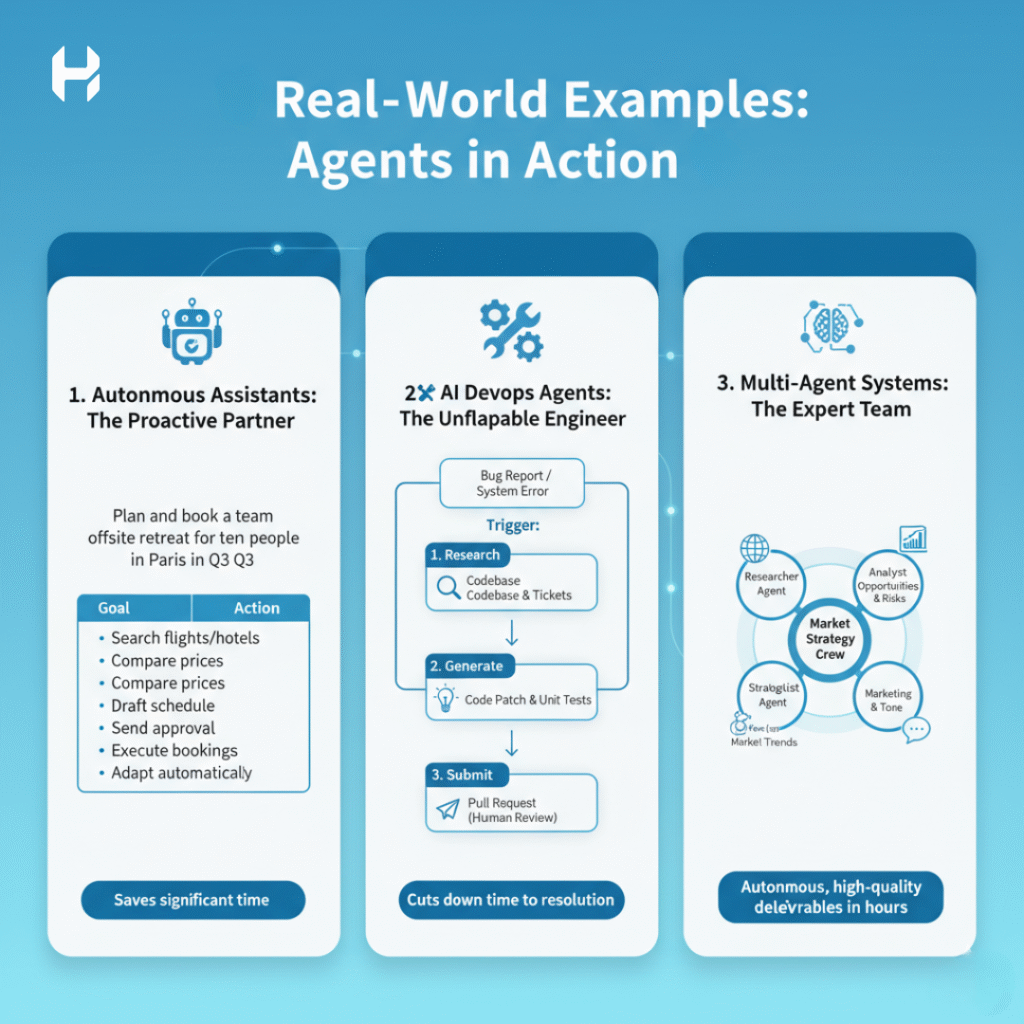
    Real-World Examples: Agents in Action

    The concept of an AI agent is already moving from research labs to mission-critical business applications. Here’s where they are delivering undeniable value:

    1. Autonomous Assistants (The Proactive Partner)

    Forget your voice assistant that just sets a timer. A true autonomous assistant takes a high-level goal and runs with it.

    Goal: “Plan and book a team offsite retreat for ten people in Paris in Q3.”

    Agent Action: The agent doesn’t just suggest hotels; it searches for flights, checks hotel availability in real time, compares prices against a budget, drafts a schedule, sends a summary email for approval, and then executes the bookings, all with minimal intervention, and adapts if a flight is suddenly sold out.

    2. AI DevOps Agents (The Unflappable Engineer)

    In the fast-paced world of software development and IT, agents are taking over routine and troubleshooting tasks.

    Use Case: Self-Healing Codebase: An AI DevOps agent constantly monitors application performance. If a user submits a bug report or the system logs an error, the agent’s workflow kicks in:

    1. It researches the bug in the codebase and past ticket history.
    2. It generates a fix (code patch).
    3. It writes unit tests for the fix.
    4. It submits a pull request for human review, documenting all its steps. This dramatically cuts down the time from bug detection to resolution.

    3. Multi-Agent Systems in Enterprise AI (The Expert Team)

    The most exciting use case is when specialized agents work together, often called a “crew” or “multi-agent system.” Each agent has a focused role, and they collaborate to achieve a goal far too complex for a single AI.

    • Use Case: Market Strategy Crew:

    “Researcher Agent” searches the web and financial databases for current market trends.

    “Analyst Agent” takes the data and identifies key opportunities and risks.

    “Strategist Agent” uses the analysis to draft a detailed marketing plan and executive summary.

    “Reviewer Agent” checks the final output for consistency and tone before presentation.

    This collaborative model is fundamentally changing workflows, transforming a manual, week-long project into an autonomous, high-quality deliverable in hours.

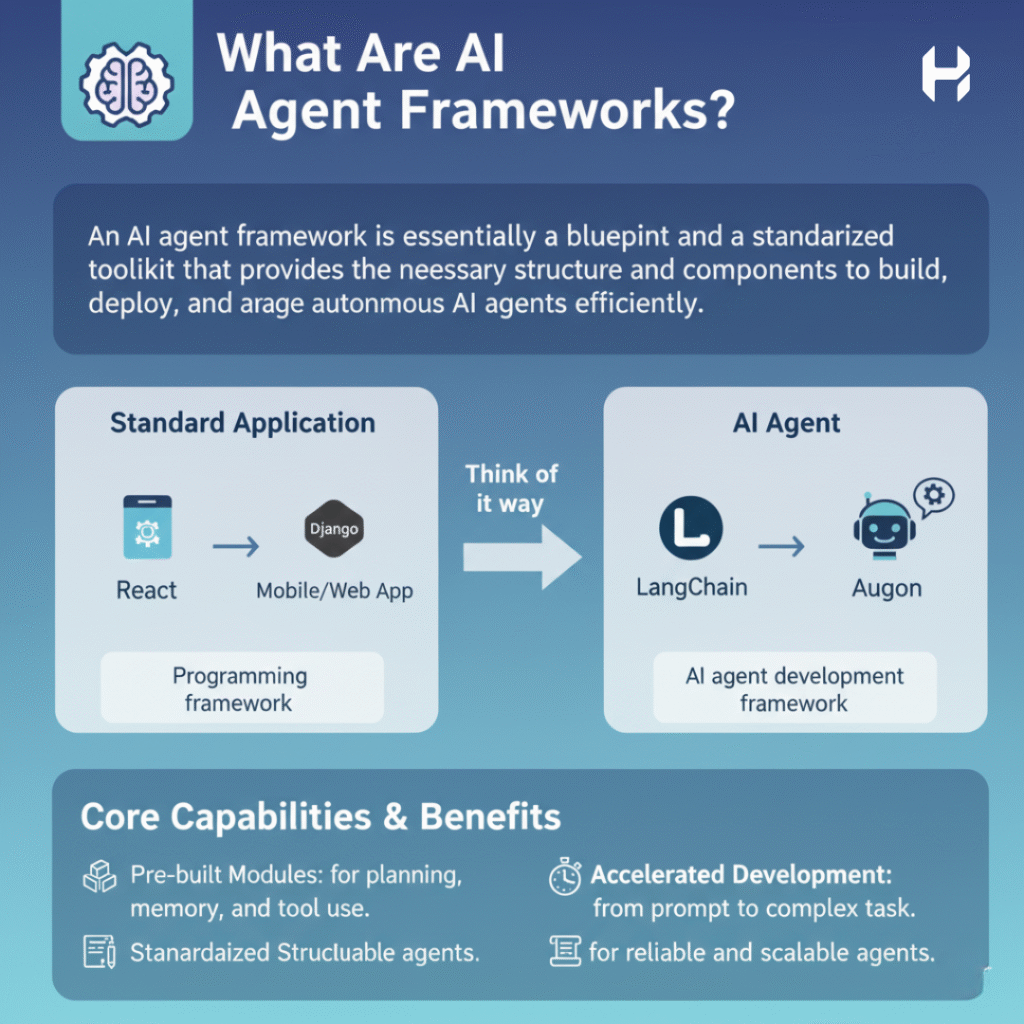
    What Are AI Agent Frameworks?

    An AI agent framework is essentially a layout and a standardized toolkit that provides the necessary structure and components to build, deploy, and manage autonomous AI agents efficiently.

    Think of it this way: building a standard application requires a programming framework (like React or Django). Building a self-directing, reasoning AI requires an AI agent development framework (like LangChain or AutoGen).

    These frameworks accelerate development by offering pre-built modules for the core capabilities an agent needs to move from a simple prompt to a complex, executed task.

     7 Popular AI Agent Frameworks (with Comparison)

    The landscape of building AI agents’ autonomous programs that can plan, use tools, and execute complex tasks is defined by a handful of powerful frameworks. Choosing the right one is crucial for your project, whether you’re building a single workflow or an entire team of collaborating agents.

    Here is a breakdown of the most popular AI agent frameworks and their ideal use cases:

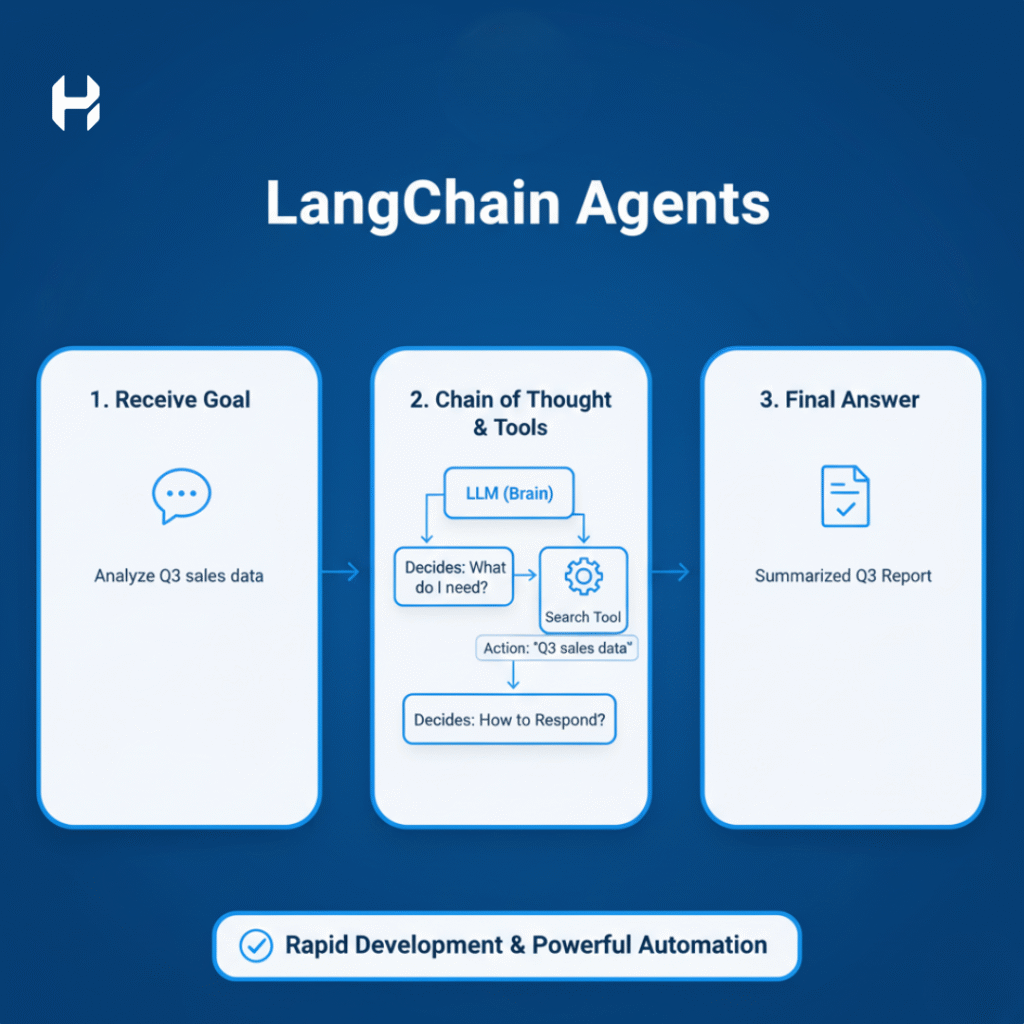
    1. LangChain Agents

    The Pioneer and Modular Toolkit

    Overview: LangChain was instrumental in popularizing the concept of LLM-powered agents using the ReAct (Reasoning and Action) loop. It is a massive ecosystem designed for high flexibility and control.

    Core Strength: It offers the largest ecosystem of components, tools, and connectors, making it the most versatile choice for integrating LLMs with external data sources (RAG) and APIs.

    Ideal Use Cases: Building API-driven conversational assistants that require fine-grained control over prompt engineering and tool-use selection. Excellent for complex RAG applications requiring multi-step retrieval.

    Multi-Agent Approach: Typically handles single-agent tasks, but its components can be used to manually construct multi-agent systems.

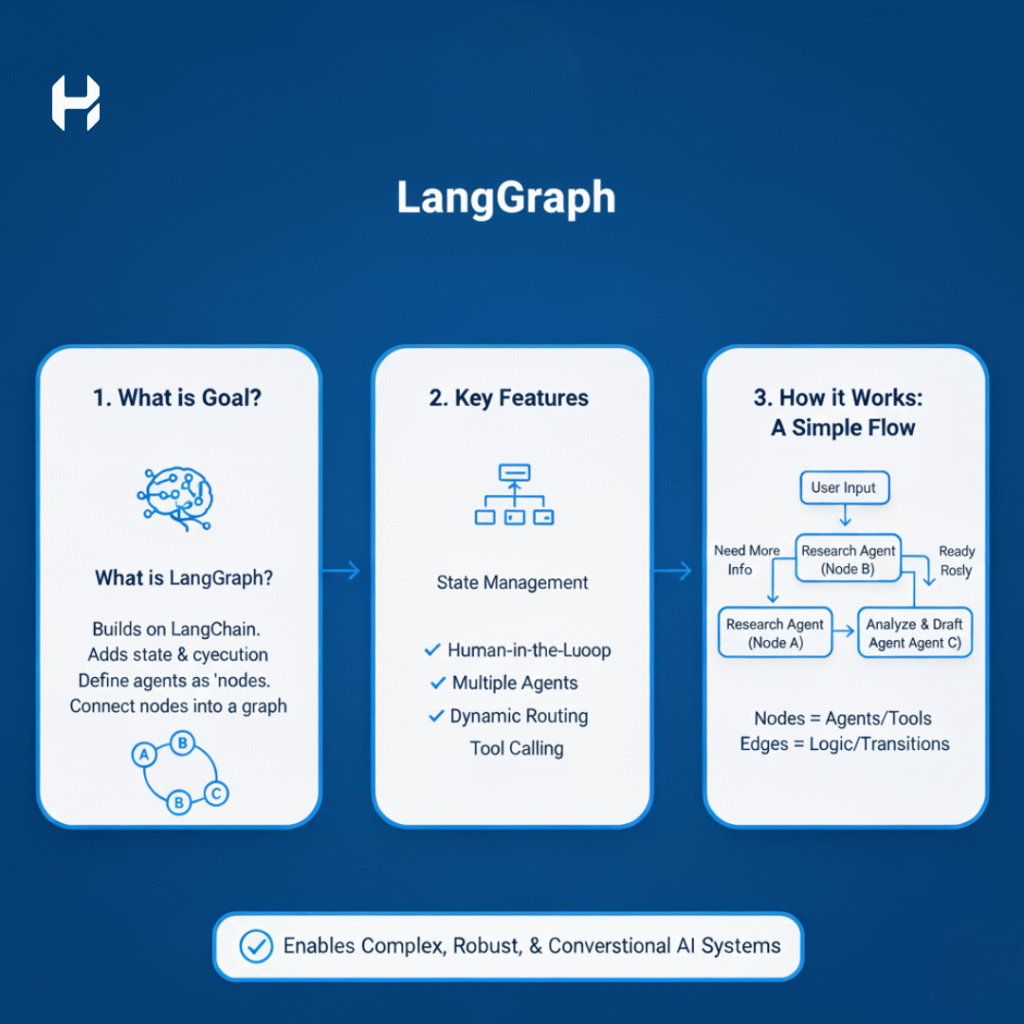
    2. LangGraph

    Structured, Stateful Multi-Agent Workflows

    Overview: LangGraph is an essential extension of LangChain, developed specifically to handle complex, multi-step workflows that require cyclical or conditional logic.

    Core Strength: It utilizes a graph-based architecture where agents and functions are nodes, and the workflow is defined by conditional edges. This allows agents to work together, pass information back and forth, and decide which agent should act next in a structured, stateful manner.

    Ideal Use Cases: Creating strong multi-agent systems that need to review, revise, or escalate work. Perfect for stateful processes where agents need to loop back on a task (e.g., self-correction).

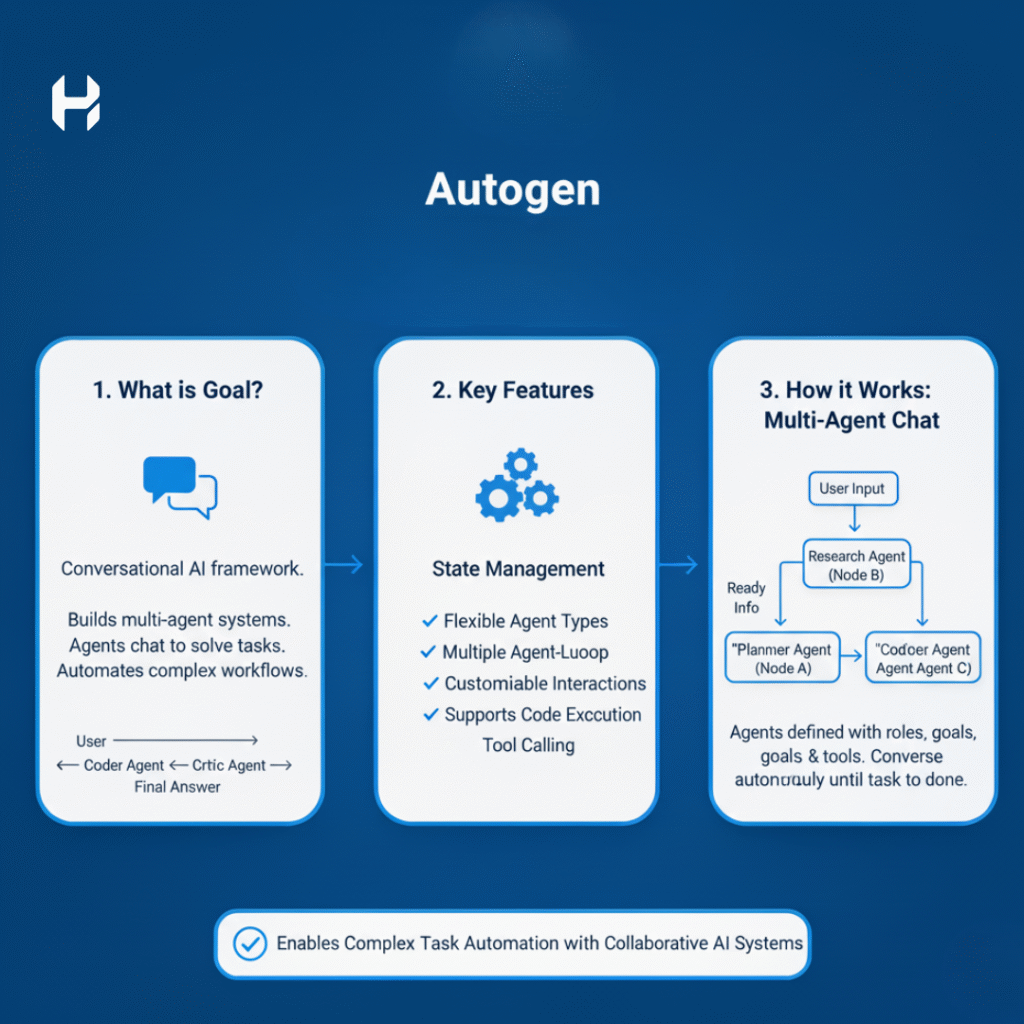
    3. AutoGen (Microsoft)

    Conversational Multi-Agent Systems

    Overview: Developed by Microsoft, AutoGen excels at simulating natural, conversational collaboration between multiple agents, often featuring a User Proxy Agent to represent the human user.

    Core Strength: Exceptional at conversational orchestration, allowing agents to “talk” to each other to solve a goal. It includes strong, built-in support for agents to write, execute, and debug code in a secure environment.

    Ideal Use Cases: Automated software development tasks (from idea to coded, tested solution). Ideal for collaborative coding, research, and technical troubleshooting where agents need to discuss and iterate on a solution.

    Multi-Agent Approach: Peer-to-peer conversation and task resolution.

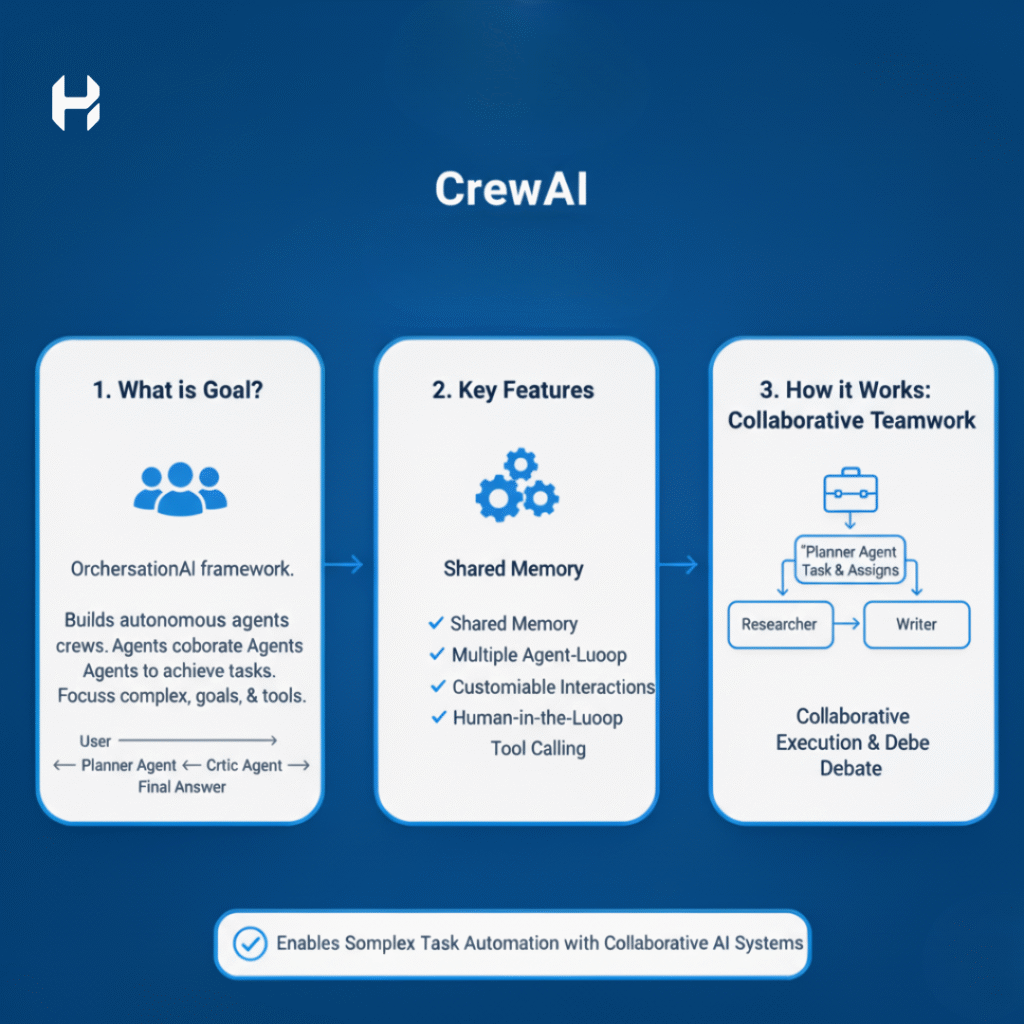
    4. CrewAI

    Role-Based Collaboration Framework

    Overview: CrewAI simplifies the creation of collaborative “crews” by focusing heavily on assigning clear, specialized roles, goals, and tools to each agent (e.g., a “Researcher” and a “Writer”).

    Core Strength: It has a clean, intuitive API and is designed to model team-like workflows quickly. It handles the structured collaboration, task delegation, and sequencing between agents seamlessly.

    Ideal Use Cases: Automated content generation (blog posts, reports). Market research and analysis where defined inputs and outputs are needed from different expert roles within a strict, structured workflow.

    Multi-Agent Approach: Defined roles with delegated tasks, strong focus on delivering a final, consolidated output.

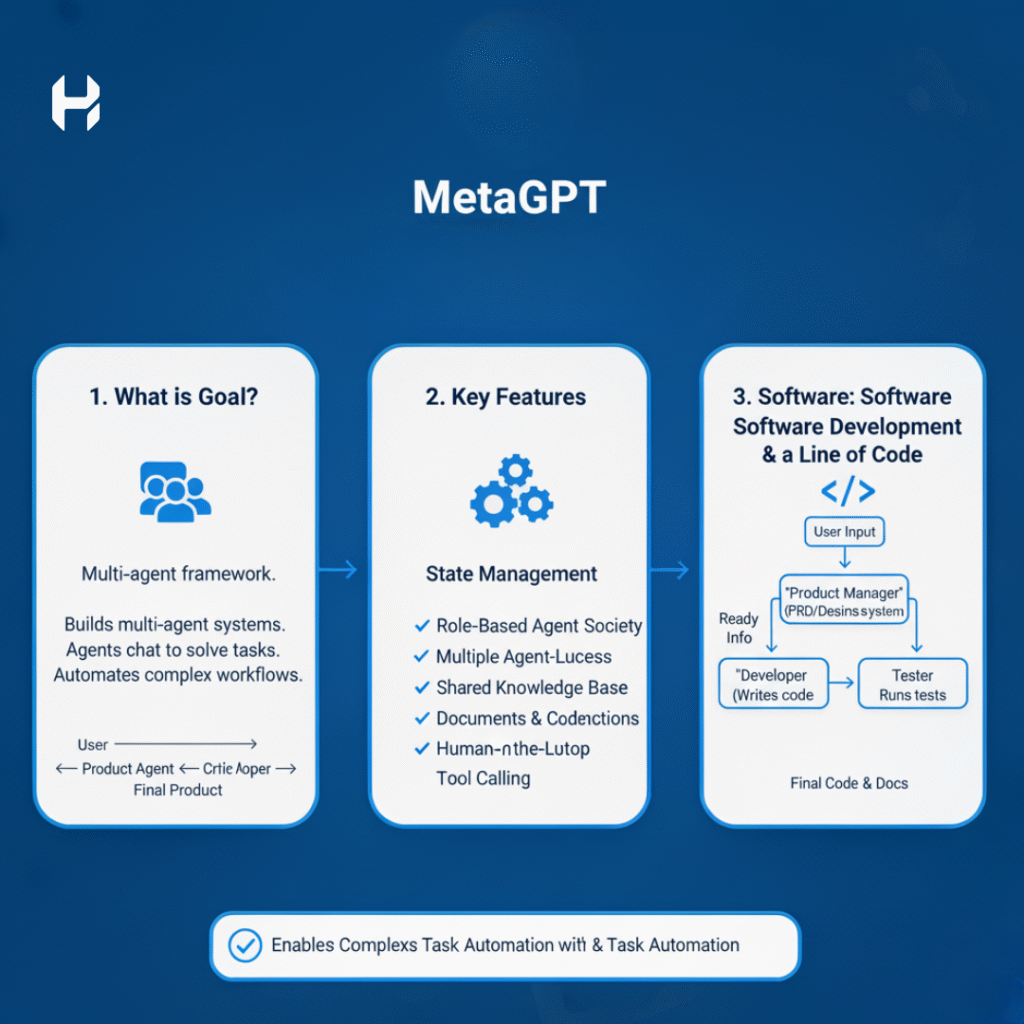
    5. MetaGPT

    The AI Software Company Simulator

    • Overview: MetaGPT takes the multi-agent concept to the extreme by simulating an entire software company, with agents filling roles like Product Manager, Architect, and Engineer.
    • Core Strength: It is driven by pre-defined Standard Operating Procedures (SOPs), which ensure the agents follow a disciplined, assembly-line process. It generates complete project artifacts (user stories, competitive analysis, API definitions, and final code) from a single user requirement.
    • Ideal Use Cases: Automated software development project generation (creating a Minimum Viable Product from a simple prompt). Simulating complex, multi-component organizational workflows.

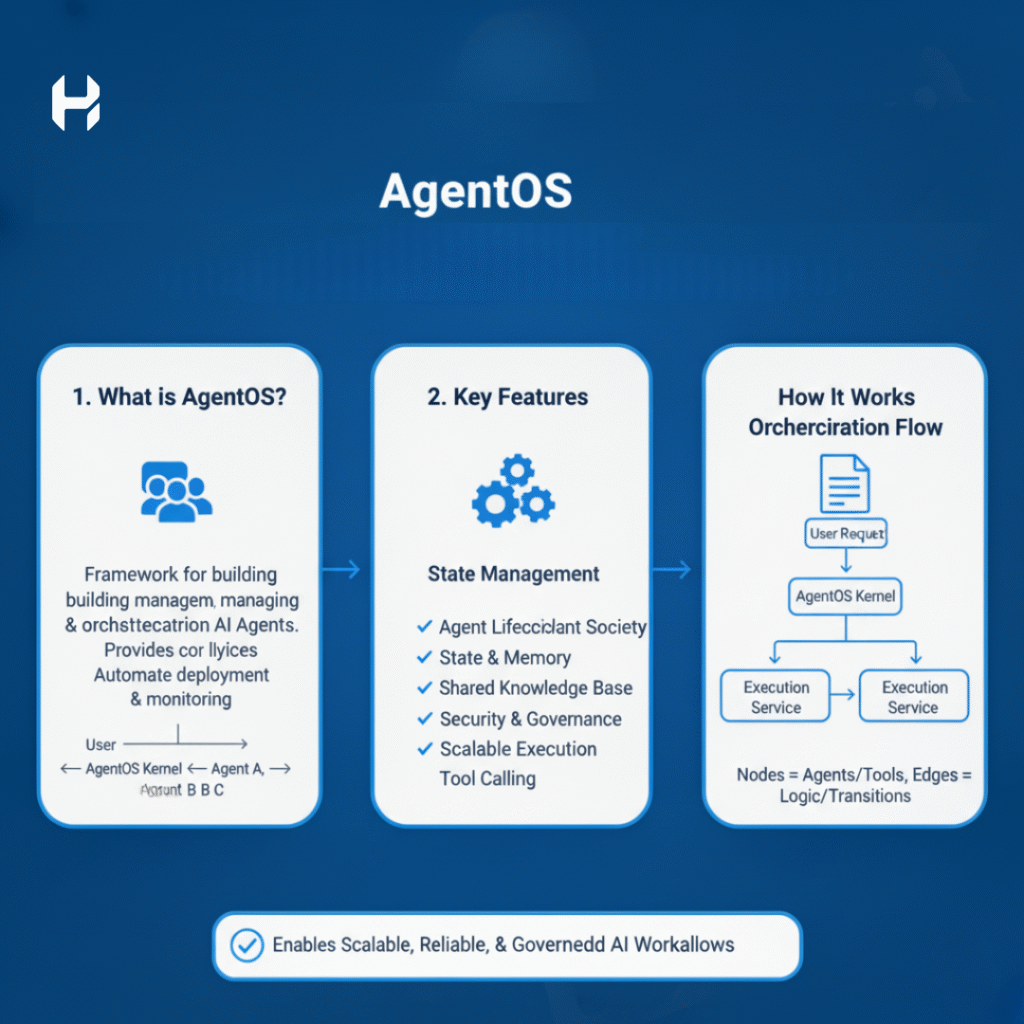
    6. AgentOS (Microsoft Agent Framework)

    Enterprise-Grade Stability and Control

    • Overview: This refers to the evolution of Microsoft’s agent efforts, combining the best of AutoGen and Semantic Kernel into a more robust, enterprise-grade framework.
    • Core Strength: Designed for production-ready systems with a focus on stability, type safety, and governance. It introduces explicit Workflows for complex multi-agent execution paths and provides excellent telemetry and observability.
    • Ideal Use Cases: Mission-critical enterprise applications, long-running processes, and teams heavily invested in the Microsoft ecosystem that require auditing and monitoring.

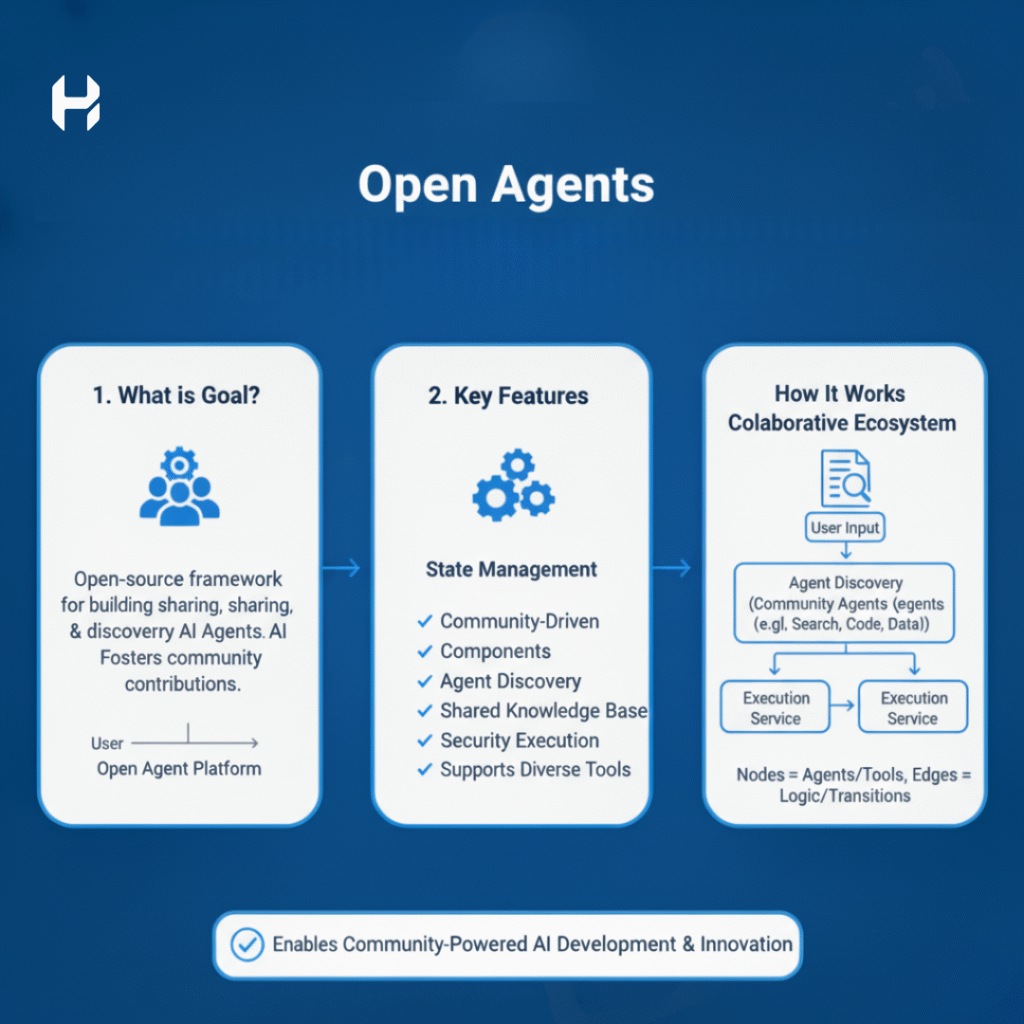
    7. Open Agents (OpenAI Agents SDK)

    Lightweight, Production Deployment

    • Overview: Often referencing the official frameworks released by leading LLM developers like the OpenAI Agents SDK, this approach prioritizes simplicity, reliability, and minimal abstraction.
    • Core Strength: Focuses on core, production-ready features like Handoffs (delegation to specialist agents), Guardrails (input/output validation), and Sessions (automatic state management). It is naturally integrated and optimized for its parent LLM models (e.g., GPT).
    • Ideal Use Cases: Production-facing applications where reliability, a simple architecture, and minimal latency are critical. Teams that need Human-in-the-Loop (HITL) approval features.

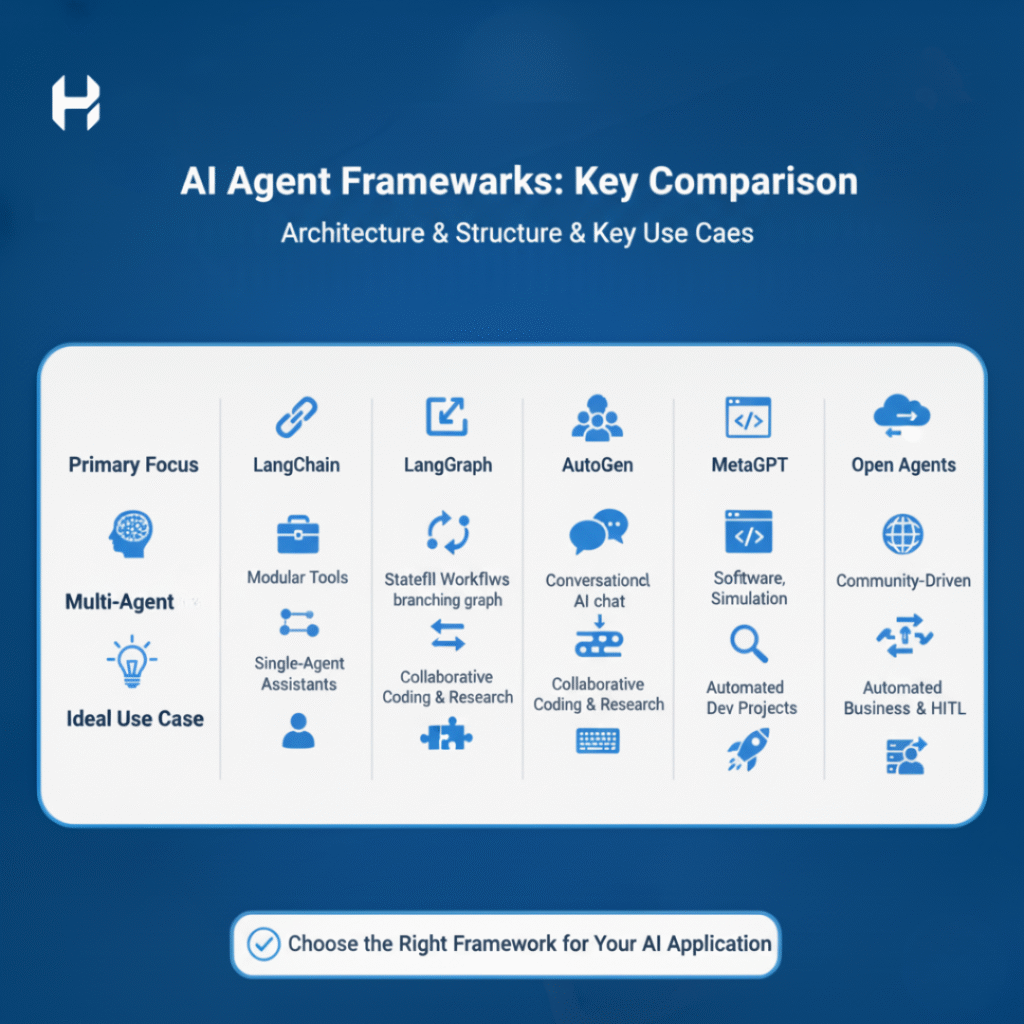
    AI Agent Frameworks: Key Comparison

    Here is a concise comparison table of the most popular AI agent frameworks, highlighting the distinctions in their architecture and primary use:

    FrameworkPrimary FocusMulti-Agent StructureIdeal Use Case
    LangChain AgentsModular Components & Tool UseLow-level orchestration (linear)Single-Agent RAG/API Assistants
    LangGraphStateful Workflow OrchestrationGraph-based (cyclical, branching)Complex, multi-step agentic processes
    AutoGen (Microsoft)Conversational CollaborationPeer-to-peer conversationCollaborative Coding & Research
    CrewAIRole-Based DelegationDefined roles with delegated tasksStructured Business Workflows/Content
    MetaGPTSoftware Company SimulationSOP-driven assembly lineAutomated Software Project Generation
    AgentOSEnterprise-Grade Stability & ControlExplicit graph workflowsProduction systems, Auditing
    Open Agents (SDKs)Lightweight, Production DeploymentPrimitives like ‘Handoffs’Reliability, HITL, Native GPT users

    What AI Agent Frameworks Do

    AI agent frameworks are structured toolkits that provide the necessary architecture for a Large Language Model (LLM) to become a goal-directed, autonomous agent. They abstract away the complexity of making an LLM execute multi-step tasks in the real world.

    These frameworks standardize the agent’s core capabilities:

    Planning & Reasoning: Breaking down a complex, high-level user goal into a dynamic sequence of smaller, executable steps.

    Tool-Use: Providing reliable mechanisms for the agent to select, call, and interpret results from external tools, APIs, code interpreters, and databases.

    Memory Management: Handling both short-term conversation context and long-term knowledge retrieval (RAG) to ensure the agent acts with full context.

    Orchestration: Managing the flow of decision-making and, in multi-agent frameworks, coordinating the specialized collaboration between different AI entities.

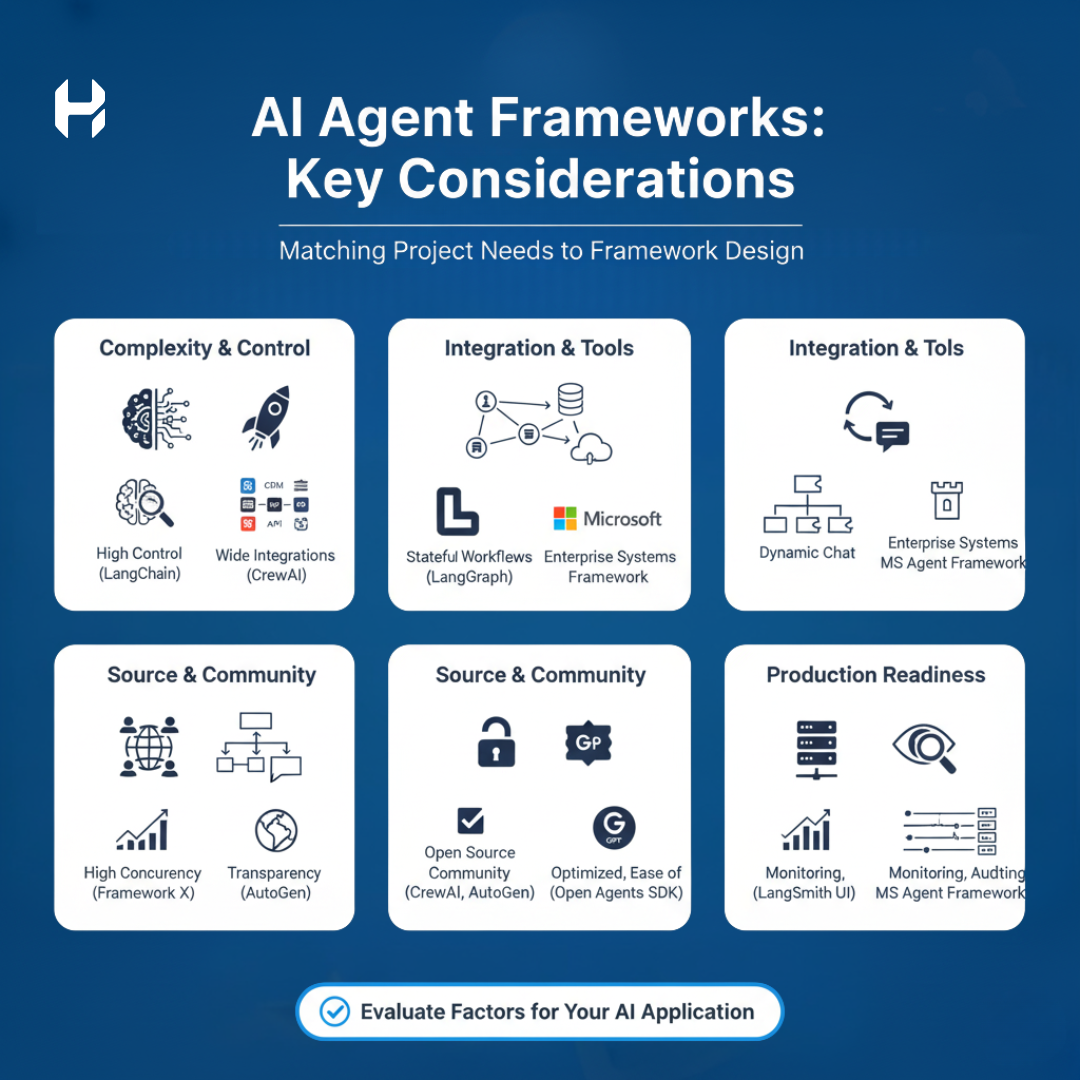
    Factors to Consider When Choosing

    Selecting the best AI agent framework requires matching your project’s needs to the framework’s design philosophy. Evaluate these key factors:

    Technical Complexity vs. Plug-and-Play

    High Control (Complex): Frameworks like LangChain and LangGraph offer deep modularity, giving you granular control over every prompt and component. This requires more upfront engineering but provides maximum customization.

    Plug-and-Play (Simplified): Frameworks like CrewAI and AutoGen abstract much of the complexity, offering a higher-level, more opinionated API for faster prototyping and easier definition of collaborative roles.

    Integration with Internal Tools & APIs

    The framework’s ability to seamlessly connect agents to your proprietary systems (CRMs, databases, internal code) is critical.

    LangChain leads in ecosystem maturity and the sheer breadth of available integrations and tool connectors, while Microsoft Agent Framework focuses on robust integration within the enterprise environment.

    Support for LLM Orchestration

    • Orchestration is the framework’s method for guiding the agent’s behavior.

    Graph-based Orchestration (e.g., LangGraph): Excellent for defining complex, stateful workflows with explicit loops, branching, and human-in-the-loop steps.

    Conversational Orchestration (e.g., AutoGen): Best for dynamic, event-driven, peer-to-peer interactions where agents naturally converse until a goal is met.

    Open-Source vs. Proprietary

    Open Source: Frameworks like CrewAI, AutoGen, and LangChain offer full transparency, auditability, and massive community support, reducing vendor lock-in.

    Proprietary/Vendor-Led: Frameworks like the Open Agents SDK (often closely tied to models like GPT) benefit from native optimization and simpler integration with their parent platform, often trading flexibility for ease of use and reliability.

    Scalability and Observability

    For production systems, you need features that ensure stability and easy debugging.

    Scalability refers to the framework’s ability to handle high concurrency.

    Observability (via tools like LangSmith or built-in logging) is crucial for tracing the agent’s step-by-step decisions, which is essential for auditing and improving autonomous systems. Frameworks designed for enterprise use, like the Microsoft Agent Framework, prioritize these features with built-in telemetry.

    AI Agent Frameworks: Key Feature Comparison

    The development of AI agents relies on specialized frameworks that provide the underlying architecture for autonomy, tool use, and multi-agent collaboration. This table offers a quick comparison of the most popular AI agent frameworks, highlighting their primary design focus and key features to help you determine the best fit for your development needs.

    FrameworkMulti-agentTool UseMemoryOpen SourceIdeal For
    LangChain AgentsYes (via LangGraph)Extensive (Vast Ecosystem)Modular (RAG, Vector DBs)YesHighly flexible RAG & API integration
    LangGraphNative (Graph-based)Relies on LangChainStateful graph nodesYesComplex, cyclical workflows & self-correction
    AutoGenNative (Conversational)Strong (Code Execution)Managed per conversationYesCollaborative coding & dynamic research
    CrewAINative (Role-based)Good (Focus on delegation)Contextual sharing between agentsYesStructured team-based workflows & content creation
    MetaGPTNative (SOP-based)Focused on software toolsManaged per project lifecycleYesAutomated software development project generation
    Microsoft Agent FrameworkNative (Workflow-based)Enterprise-gradeRobust, thread-basedYesEnterprise scalability and regulated environments
    Open Agents (SDKs)Limited (Handoffs)Native integrationManaged per sessionVariesSimple, reliable, production-ready GPT apps

    Final Words

    The global conversation around AI has fundamentally shifted. It’s no longer about simple chatbots or reactive models; it’s about autonomous, goal-driven AI agents. The frameworks we’ve analyzed from the flexible LangChain ecosystem to the collaborative CrewAI and the enterprise-focused Microsoft Agent Framework are not just libraries; they are the essential building blocks of the next wave of automation.
    While specific platforms like Hudasoft (or similar enterprise/integration-focused solutions) may offer specialized tools, most advanced AI agent workflows ultimately rely on the core principles and architectures defined by these foundational frameworks.

    The key takeaway is this:

    • Focus on the Workflow, Not Just the Agent: The true value of agentic AI comes from redesigning entire business processes. The agent is the integrator, the orchestrator, and the self-correcting worker that connects systems, eliminates manual hand-offs, and drives efficiency.
    • The Trend is Specialization and Interoperability: As the market matures, we will see highly specialized agents (e.g., a “compliance agent” for finance) that must collaborate seamlessly. The focus is shifting toward standardized protocols to allow agents built on different frameworks (and integrated through platforms like Hudasoft) to work together.
    • Enterprise Adoption Demands Governance: For production use, features like Scalability, Observability, and Human-in-the-Loop (HITL) controls are paramount. Frameworks designed for enterprise use prioritize these features to ensure auditability and safe deployment, which is a core requirement for any platform like Hudasoft catering to large organizations.

    By understanding the strengths of these AI agent frameworks and choosing the one that aligns with your complexity needs, be it the plug-and-play simplicity of CrewAI or the structured control of LangGraph, you are positioning yourself at the forefront of the AI rebellion.

    FAQS


    How is an AI agent different from a chatbot?

    A chatbot is reactive and limited primarily to dialogue; it answers questions based on its knowledge. An AI agent is autonomous and goal-oriented, able to reason, plan multi-step actions, use external tools (like APIs), and execute complex tasks without continuous human intervention.

    Can I use multiple frameworks together?

    Yes. Combining frameworks is common. For instance, a high-level collaboration framework (like CrewAI) can be used to organize agents that rely on the deep RAG and tool features provided by a modular system (like LangChain). Frameworks like LangGraph are often used specifically to orchestrate and manage components from various sources.

    Are AI agents safe for enterprise use?

    Yes, but they require robust governance. Safety features built into modern frameworks include Guardrails to prevent harmful actions, Human-in-the-Loop (HITL) controls for sensitive tasks, and Observability (tracing and logging) to ensure every autonomous decision is fully auditable.

    What skills do I need to build agent-based apps?

    Key skills are Python proficiency and strong Prompt Engineering to guide the LLM’s reasoning. Additionally, developers need knowledge of API/Tool Integration to connect agents to real-world services and Workflow Design to structure the agents’ complex, multi-step autonomous processes.

  • AI Implementation: Framework, Process & Plan For Businesses

    AI Implementation: Framework, Process & Plan For Businesses

    Artificial intelligence (AI) is rapidly transitioning from a theoretical concept to a non-negotiable component of modern business strategy. The true measure of its impact, however, lies not in the sophistication of the technology itself, but in the effectiveness of its integration.

    Why is it more than just installing algorithms?

    Successfully adopting AI is much more profound than simply “installing algorithms.” While the underlying code and models are critical, true artificial intelligence implementation is fundamentally a strategic and organizational challenge. It involves:

    Data Strategy: AI is only as effective as the data it’s trained on. This requires comprehensive data governance, cleaning, and preparation, a massive undertaking often consuming up to 80% of project time.

    Process Redesign: AI augments or automates human tasks, which necessitates overhauling existing workflows and business processes, not just adding a new tool.

    People and Culture: It requires significant change management, employee training, and fostering a culture that trusts and collaborates with AI systems, addressing understandable concerns about job displacement.

    Ethical Governance: Establishing ethical guidelines for fairness, transparency, and accountability is essential to mitigate bias and maintain public trust.

    The growing importance across industries

    The increasing strategic necessity of AI is reflected in its pervasive adoption across the global economy. Every major sector is leveraging AI to gain a competitive edge:

    In Healthcare, AI accelerates drug discovery, aids in diagnostics (e.g., analyzing medical images), and personalizes treatment plans.

    In Finance, it is critical for real-time fraud detection, algorithmic trading, and personalized customer risk assessment.

    Retail utilizes AI for predictive demand forecasting, optimizing inventory, and creating hyper-personalized customer recommendations.

    Manufacturing uses it for predictive maintenance, analyzing sensor data to anticipate equipment failure, reducing downtime, and saving millions.

    What is AI implementation?

    AI implementation is the comprehensive and systematic process of transforming an organization’s strategic AI objectives into functional, scalable, and value-generating systems integrated into daily operations.

    It is the execution phase of the AI life cycle, moving a trained machine learning model from a test environment (proof-of-concept) into a production environment where it can interact with real-world data and directly impact business outcomes. This involves technical steps, like system integration and model monitoring, as well as strategic steps, like establishing governance and measuring the business impact against initial goals.

    Key Components of an AI Implementation Framework

    A powerful AI implementation framework is the structured backbone for translating AI potential into tangible business results. It provides a cyclical, multi-faceted AI implementation process that addresses technical, organizational, and strategic needs. The following seven steps represent the critical phases required for a successful artificial intelligence implementation plan.

    1. Define Business Objectives

    This foundational step answers the “why” of your AI initiative. It’s the moment to specifically align AI initiatives with key business goals. Without clear, measurable goals, AI projects risk becoming mere proof-of-concepts that never deliver value.

    Align AI initiatives with key business goals: Focus on high-level objectives like increasing revenue, reducing operational costs, or enhancing customer satisfaction.

    Identify high-impact, measurable use cases: Prioritize projects that offer a clear path to return on investment (ROI), such as using predictive maintenance to minimize equipment downtime or leveraging natural language processing (NLP) to automate customer service responses.

    2. Assess Data Readiness 

    Data is the fuel for AI, making data readiness a non-negotiable step in the AI implementation process. This phase determines if the organization possesses the necessary data assets to support its objectives.

    Audit existing data (quality, availability, structure): Conduct a thorough inventory to confirm data is accurate, complete, relevant, and in a format usable for model training. Poor data quality is the most common reason for AI project failure.

    Establish data governance, privacy, and compliance standards: Define clear policies for data handling, storage, and access, ensuring strict adherence to regulations (like GDPR, HIPAA, etc.) and maintaining ethical use.

    3. Build the Right Team & Capabilities 

    AI requires specialized human capital and cross-functional collaboration. The people component is vital for sustaining the artificial intelligence implementation plan beyond the initial deployment.

    Define roles: Data Scientists, Engineers, Product Owners: Create a cross-functional team that bridges the gap between business needs (Product Owner), data expertise (Data Scientist), and production readiness (Data/ML Engineer).

    Upskill internal teams or onboard external expertise: Invest in training existing staff on new tools and AI concepts (AI literacy) or strategically hire experienced professionals to rapidly accelerate capabilities.

    4. Select Technology & Infrastructure

    Choosing the correct technology stack ensures the AI system is scalable, secure, and cost-effective. This decision impacts the entire AI implementation process and future agility.

    Decide on AI platforms (cloud vs on-premise): Evaluate the trade-offs between the flexibility and scalability of cloud-based services (AWS, Azure, GCP) and the control of on-premise solutions.

    Set up scalable infrastructure and MLOps pipelines: Implement MLOps (Machine Learning Operations) practices to automate, manage, and govern the development, testing, and deployment of models. This ensures the system can handle growth and be updated efficiently.

    5. Develop & Test AI Models

    This is the technical heart of the process, where the algorithms are built and refined. The goal is to create a model that meets the business KPIs defined in Step 1.

    Choose the right algorithms based on use case: Select appropriate machine learning techniques (e.g., deep learning for image recognition, random forests for classification) based on the problem type and available data.

    Train, validate, and evaluate models with business KPIs: Rigorously test the model’s performance on unseen data. Crucially, the evaluation metrics (e.g., accuracy, precision) must be linked back to the desired business outcomes (e.g., cost savings, efficiency gains).

    6. Deploy & Integrate 

    Deployment is the transition from a technical success to a business solution. This step ensures the AI is operational and seamlessly integrated into existing business workflows, a key challenge in implementing AI in business.

    Move from PoC to production: Establish stable APIs and endpoints to serve predictions in real-time or batch mode.

    Integrate AI with existing systems (CRM, ERP, etc.): Ensure the AI model can effectively receive data and feed its predictions directly into the operational systems that frontline users rely on.

    7. Monitor, Improve & Scale

    AI systems are dynamic, requiring continuous attention. This final, cyclical step ensures the long-term value and relevance of the investment.

    Continuously monitor model performance: Track key metrics to detect model drift (when accuracy degrades over time due to changing real-world data) and technical failure.

    Iterate with feedback loops and scale to new use cases: Use performance data and user feedback to retrain and refine the model, completing the lifecycle and setting the stage to apply the learned framework to new, more ambitious projects.

    The effective execution of the seven-step AI implementation framework hinges on selecting the right technical tools. Once an organization has defined its strategy, secured its data, and built its team, the next critical step (Steps 4 and 5) in the artificial intelligence implementation plan involves choosing the software and libraries that will enable model development and deployment. These are the engines that power the AI implementation process.

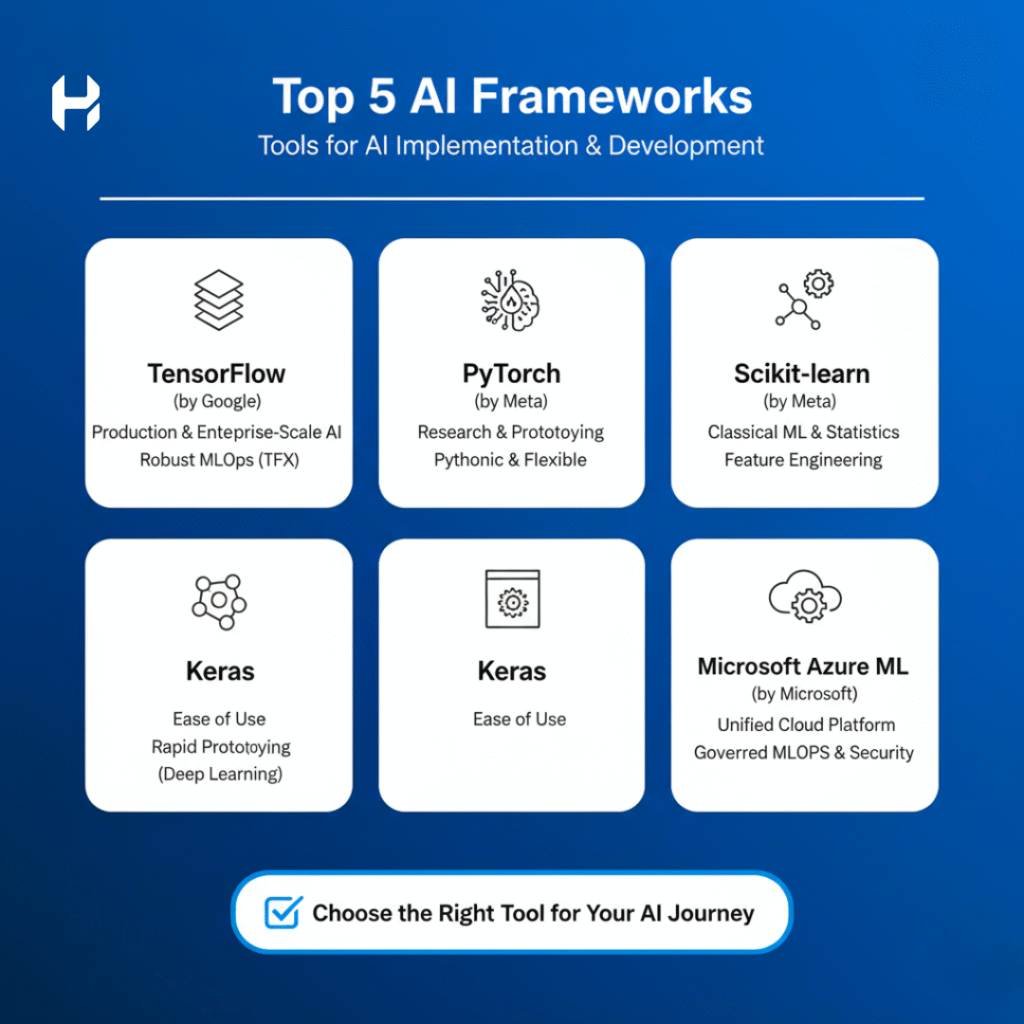
    Top 5 AI Frameworks

    When executing an artificial intelligence implementation plan and moving into the development phase (Step 5 of the framework), the choice of the correct software and library is paramount. These platforms provide the tools, libraries, and APIs necessary to handle the complex computations involved in model training and deployment, significantly streamlining the AI implementation process.

    Here are five leading AI frameworks and platforms widely used by organizations and data scientists to execute their artificial intelligence implementation:

    1. TensorFlow (by Google) 

    An open-source, end-to-end platform for machine learning. TensorFlow is renowned for its production readiness and deployment capabilities, allowing models to be easily deployed across various platforms, including servers, edge devices, and mobile devices.

    Key Strength: Excellent for large-scale, enterprise-level AI implementation due to its robust tooling for production (TensorFlow Extended – TFX) and its versatility in handling deep learning and classical ML tasks.

    2. PyTorch (by Meta) 

    An open-source machine learning library primarily used for applications utilizing the Python programming language. It is characterized by its dynamic computation graph, which offers greater flexibility and ease of debugging during experimentation and development phases.

    Key Strength:
    Highly favored by the research community and for rapid prototyping because of its Pythonic nature and flexibility, making it a powerful tool for initial development within the AI implementation process.

    3. Scikit-learn 

    The most popular open-source library for traditional machine learning tasks in Python. It includes a vast collection of algorithms for classification, regression, clustering, and dimensionality reduction.

    Key Strength:
    While not a deep learning framework, Scikit-learn is essential for the initial stages of many projects and is a core component of how to implement AI for classical statistical modeling and feature engineering. It integrates seamlessly with Python’s scientific computing stack (NumPy, SciPy).

    4. Keras 

    A high-level API written in Python and designed for fast experimentation. Keras can run on top of several deep learning frameworks, including TensorFlow, simplifying the user interface and reducing the cognitive load of building neural networks.

    Key Strength:
    Ease of use and rapid prototyping. Keras makes building deep learning models highly intuitive, allowing data scientists to quickly iterate and test ideas, speeding up the development stage of the artificial intelligence implementation plan.

    5. Microsoft Azure Machine Learning (Azure ML) 

    Unlike the first four (which are primarily open-source libraries), Azure ML is a cloud-based platform offering a comprehensive set of services, tools, and infrastructure for managing the entire machine learning lifecycle (MLOps), from data preparation to deployment and monitoring.

    Key Strength:
    Provides a unified, governed environment for the entire AI implementation process. It is a strategic choice for businesses focused on how to implement AI in business within the Microsoft ecosystem, emphasizing compliance, security, and integration with other enterprise services.

    The selection of a framework largely depends on the organization’s existing technology stack, the complexity of the use case, and the stage of the AI implementation process (e.g., PyTorch for research vs. TensorFlow or Azure ML for deployment).

    Final Words

    The successful execution of artificial intelligence implementation is the key differentiator for modern enterprises. It requires more than algorithms; it demands a robust AI implementation framework and a detailed artificial intelligence implementation plan that governs data, talent, and ethical use. The goal is to successfully answer the challenge of how to implement AI in business by consistently translating technical capability into measurable value.

    For organizations navigating this complex AI implementation process, specialized partners can be invaluable. Companies like Hudasoft provide comprehensive support, offering expertise from initial AI Consulting and Model Development to full-scale AI Implementation and system integration. By benefiting from their specialization, particularly in custom software and emerging sectors, businesses can accelerate their time-to-value and ensure their AI strategy yields consistent, powerful results.

    The future of business lies in viewing AI not as a product, but as a continuous, strategically managed process of innovation.

    FAQS

    Q: What is the implementation process of AI?
    A: The AI implementation process involves defining goals, collecting and preparing data, selecting algorithms or models, training and testing the model, deploying it into production, and continuously monitoring and improving its performance.

    Q: What are the AI frameworks?
    A: Common AI frameworks include TensorFlow, PyTorch, Keras, Scikit-learn, MXNet, and Caffe tools used to build, train, and deploy AI and machine learning models.

  • Car Dealership Analytics: Transforming Data Into Profit and Performance

    Car Dealership Analytics: Transforming Data Into Profit and Performance

    Dealership analytics refers to the process of collecting, processing, and analyzing data generated across all departments of a car dealership, including sales, service, inventory, and marketing, to derive actionable insights. It moves the business from making decisions based on ‘gut feeling’ to using verifiable, quantitative evidence. This holistic view of car dealership analytics allows management to see true performance metrics, identify bottlenecks, and forecast future trends.

    The Importance of Data-Driven Decision-Making

    In the highly competitive modern automotive landscape, data analytics for car dealers is no longer a luxury but a necessity. Relying on data-driven decision-making offers several critical advantages:

    • Optimized Inventory: By analyzing past sales data and current market trends, dealers can accurately predict demand for specific makes, models, and features, ensuring they stock the right cars and minimize costly carrying charges.
    • Targeted Marketing: Understanding customer behavior and demographics helps create precise campaigns, boosting the effectiveness of automotive marketing analytics and dramatically lowering customer acquisition costs.
    • Enhanced Customer Experience: Analytics can predict when a customer is ready for their next service appointment or a trade-in, allowing the dealership to proactively engage them, boosting customer loyalty and lifetime value.
    • Profit Maximization: Detailed insights expose areas of inefficiency in operations or service bays, leading to improved throughput and higher profit margins across the entire business.

    Integrating Analytics with the Dealership Management System (DMS)

    The core source of this data is the Dealership Management System (DMS), which serves as the operational backbone of the business. The DMS holds the raw, transactional data sales records, repair orders, customer information, inventory status, and financial transactions.

    Analytics tools integrate directly with this DMS. They don’t just pull raw numbers; they take that complex data and apply statistical models and business logic to transform it into meaningful metrics (like closing ratios, profit per vehicle, and customer retention rates). This integration is crucial because it ensures the data is:

    1. Current: Decisions are based on real-time or near-real-time data.
    2. Accurate: The analysis uses the single, verified source of truth from the DMS.
    3. Comprehensive: It links data from different siloed departments (e.g., connecting a service visit to a future sales opportunity).

    This seamless flow of information is what enables a dealer to move beyond basic reporting toward sophisticated capabilities like predictive analytics in the automotive industry.

    What Is Car Dealership Analytics?

    Car dealership analytics is the systematic process of collecting, processing, and analyzing the massive amounts of data generated across all operational departments of an automotive retail business. This includes everything from initial customer contact and sales closings to service bay efficiency and parts inventory. Essentially, it transforms raw dealership data, the numbers behind every transaction, service appointment, and marketing click, into actionable intelligence. This holistic view, often referred to as auto dealership analytics, allows management to move past relying on ‘gut instinct’ and use quantifiable facts to guide high-stakes decisions.

    Why Analytics Matters for Dealerships

    In the highly competitive modern automotive landscape, sophisticated data analytics for car dealers is no longer a luxury but a necessity. Relying on data-driven decision-making offers several critical advantages that directly impact profitability and customer retention:

    • Inventory Optimization: Analytics accurately predicts demand for specific makes, models, and features by analyzing past sales and market trends, ensuring the dealership stocks the right cars and minimizes costly inventory carrying charges.
    • Targeted Marketing: This is where automotive marketing analytics excels. Understanding customer behavior and demographics helps dealers create hyper-specific campaigns, dramatically promoting lead quality and lowering customer acquisition costs.
    • Future Proofing: Advanced practices, such as predictive analytics in the automotive industry, allow dealers to forecast future market shifts, model potential service bay bottlenecks, and predict the optimal time for a customer to trade in their vehicle, maximizing customer lifetime value.

    Role of Dealership Management Software (DMS) in Analytics

    The central nervous system of any dealership is the Dealership Management System (DMS), which serves as the operational backbone of the business. The DMS holds the raw, transactional data sales records, repair orders, customer information, inventory status, and financial transactions.

    Analytics tools integrate directly with the DMS. They don’t just pull raw numbers; they apply complex statistical models and business logic to transform that data into meaningful metrics (like closing ratios, profit per vehicle, and customer retention rates). This seamless integration is essential because it ensures all analysis is based on a single, verified source of truth, allowing dealers to move from basic historical reporting to powerful predictive insights.

    [Learn more about Dealership Management Software →]

    Case Example: IBIZI

    The Power of Dealership Analytics in Practice

    The development of the IBIZI platform by Hudasoft serves as a powerful illustration of modern auto dealership analytics in action, directly addressing the limitations of legacy systems.

    The Challenge: Dealerships were struggling with scattered communication, manual deal entry (leading to 100% duplicate deal numbers), and a complete lack of centralized data. Management teams had Zero Business Intelligence, relying on instinct rather than real-time performance indicators. This environment suppressed efficiency and hindered customer engagement.

    The Solution: IBIZI was engineered as a comprehensive automotive dealership management solution that uses deep API integrations (with systems like CDK Global and VinSolution) to unify data across sales, service, and inventory. The core value lies in applying advanced analytics and reporting to this centralized data, moving the focus from simple recording to predictive insights.

    The Results (Impact at a Glance):

    The shift to a data-driven model delivered immediate, measurable impact:

    MetricOutcomeCore Analytic Principle
    Deal Entry Time70% FasterStreamlined process metrics.
    Service Lead Time30% ReductionOperational efficiency analysis.
    Inventory Visibility3x IncreaseReal-time car dealership analytics for stock control.
    Customer Satisfaction25% ImprovementAutomotive marketing analytics via feedback loops and engagement portals.

    Conclusion: Using Data to Win

    The days of guessing how to run a car dealership are finished. Car dealership analytics is the necessary tool for any modern, successful dealership today.

    We’ve seen how using data analytics for car dealers changes everything: it fixes messy paperwork, helps you order the right cars (inventory), and makes your staff work faster. The IBIZI example showed that when you use your data, you get real results, like making sales entry 70% faster and making customers 25% happier.

    The biggest advantage is using predictive analytics in the automotive industry. This simply means using old sales data to guess what will happen next. You stop looking backward and start looking ahead, predicting what cars people will want and when a customer needs service.

    If a dealership wants to be profitable and keep customers, it must rely on data. The future of selling cars belongs to the dealers who use simple, clear numbers, not gut feelings, to make every important business choice.

  • Understanding Profit Margins in Car Dealerships: What Dealers Really Make

    Understanding Profit Margins in Car Dealerships: What Dealers Really Make

    The idea that car dealers make a killing on every sale, the massive profit per car, is one of the most persistent and widespread misconceptions in the auto industry. Most customers believe that when a dealer drops the price by a thousand dollars, they’re sacrificing a huge slice of their own profit.

    The reality is that while the car dealership business is highly profitable, very little of that profit comes from the price of the vehicle itself.

    This article will pull back the curtain on dealership finances, providing a clear breakdown of actual profit margins for new and used cars, and revealing the less obvious departments where dealerships truly earn their money.

    What Is a Profit Margin in a Car Dealership?

    A profit margin is a key financial metric that shows how much of a business’s revenue is converted into profit. It is expressed as a percentage and is essential for understanding a dealership’s financial health.

    The main difference lies in what costs are deducted:

    Margin TypeDefinitionCosts Subtracted
    Gross Profit MarginThe profit made solely on the sale of a vehicle, part, or service item.Only the Cost of Goods Sold (COGS) the price the dealer paid for the item (e.g., the wholesale cost of the car, or the cost of the replacement part).
    Net Profit MarginThe ultimate measure of the business’s overall profitability.ALL expenses are subtracted, including COGS, operating costs (salaries, rent, utilities, advertising), interest, and taxes. This is the “bottom line.”

    Formula

    The general formula for calculating any profit margin is:

    Profit Margin=RevenueProfit​×100

    Where “Profit” changes based on whether you are calculating Gross Profit or Net Profit.

    Typical Margin Range in the Auto Dealership Industry

    The auto retail business is characterized by high volume and surprisingly low net margins, especially when compared to other retail sectors.

    Department/CategoryTypical Gross Profit Margin RangeTypical Net Profit Margin Range
    New Vehicle Sales2.5%−5% (Very competitive)Often close to 0% (The department may not be net profitable on its own)
    Used Vehicle Sales10%−12% (More flexible pricing)Varies widely based on reconditioning costs
    Financing & Insurance (F&I)20%−50% (High-margin products)A significant source of net profit for the store
    Service and Parts (Fixed Operations)40%−60%+ (Labor is the highest margin)The primary source of stable net profit
    Overall Dealership (The Bottom Line)Varies widely, but is typically low due to overhead.1%−3% (The surprising final net profit on total revenue)

    How Dealerships Make Money: The Four Core Revenue Streams

    The misconception that dealers make massive profits on the sale price of a car is debunked when looking at the entire business model. A successful dealership operates not as a single retail store, but as a multi-department enterprise with four core revenue streams.

    1. New Car Sales: The Volume Driver

    The new car department is the engine that drives the whole business, even though it is the lowest-margin activity.

    • Profit Source: The difference between the dealer’s invoice cost (what they pay the manufacturer) and the selling price.
    • The Reality: Competition and price transparency (customers shopping around) compress this margin. The average gross profit is often only 2.5% to 5% of the vehicle price.
    • True Earnings: A large portion of the New Car Department’s financial value comes from manufacturer incentives, volume bonuses, and holdbacks (money the manufacturer refunds to the dealer later), which are paid after the sale is complete. The purpose of new car sales is less about the direct profit and more about driving volume and generating customers for the high-margin departments (F&I and Service).

    2. Used Car Sales: The Better Margin

    Used vehicles offer the dealership much greater control over pricing and profit.

    • Profit Source: The difference between the vehicle’s acquisition cost (from trade-ins or auctions) and its retail selling price.
    • The Reality: Because there is no fixed MSRP, the dealer can invest in “reconditioning” (repairs and cleaning) and then price the vehicle strategically. This allows for a healthier gross profit margin, typically ranging from 10% to 12%.
    • True Earnings: The Used Car Department is consistently a more profitable department than New Car Sales because of the higher percentage profit margin on each unit sold.

    3. Financing and Insurance (F&I): The Back-End Profit

    The F&I office is often referred to as the “back end” of the deal, and it is a major profit center with very high margins.

    Profit Source: Selling financial products and risk protection to the customer after the car price has been agreed upon.

    Key Products:

    • Financing: The dealer works with various banks and can add a small markup to the interest rate (known as the “reserve” or “buy rate”), earning a commission from the lender.
    • Extended Warranties/Service Contracts: These are sold at a significant markup, often generating 50% or more in profit per sale.
    • Add-ons (GAP Insurance, Paint Protection, etc.): These products cost the dealer very little but are sold for hundreds of dollars, carrying very high profit margins.

    True Earning: The revenue generated by the F&I department can often be equal to, or even exceed, the net profit generated by the sale of the vehicle itself.

    4. Parts and Service Department (Fixed Operations)

    Known as “Fixed Operations,” this department provides the stable, recurring income stream that covers most of the dealership’s substantial overhead costs (rent, utilities, etc.).

    • Profit Source: Highly profitable sales of labor and parts for vehicle maintenance and repair.
    • The Reality: The gross profit margin on Labor is typically the highest, often reaching 70% or more, while Parts sales carry margins of 40% to 50%.
    • True Earnings: This department is crucial because it ensures the dealership remains profitable even during months when vehicle sales are slow. It builds a long-term customer relationship that provides reliable, high-margin revenue throughout the life of the car.

    A car dealership’s profitability is a delicate balance influenced by both external market forces and internal operational efficiency. Maintaining high margins requires actively managing these diverse factors.

    Factors That Affect Dealership Profit Margins

    A. Macroeconomic & Market Factors

    These are external forces that dramatically influence the price a customer is willing to pay and the cost of the dealership’s operation.

    FactorImpact on Profit MarginExplanation
    Brand StrengthDirectly affects pricing power.Dealerships selling popular, high-demand, or luxury brands can command higher prices and realize better margins on both new and used vehicles.
    Local DemandControls sales volume and negotiation room.High local demand (e.g., specific truck models in a rural area or luxury SUVs in an affluent suburb) reduces the need for heavy discounting, preserving the gross profit margin.
    Interest RatesDirectly impacts the highly profitable F&I department.High interest rates increase the dealer’s floorplan cost (the interest paid to hold unsold inventory), increasing overhead. For the customer, high rates reduce affordability, suppressing demand and sales of profitable F&I products.
    Manufacturer IncentivesCan create or destroy new car margin.Factory-to-dealer incentives (volume bonuses, holdbacks) are often the largest source of “gross profit” on new car sales. Changes to these programs immediately affect the bottom line.
    CompetitionReduces new car gross profit.In highly competitive markets, dealers must price aggressively to match or beat rivals, which compresses the new car department’s gross profit margin.

    B. Internal Operational Factors

    These are the areas a dealer principal has direct control over, mainly focused on cost control and efficiency.

    FactorImpact on Profit MarginExplanation
    Inventory ManagementDirectly impacts holding costs and turnover.Aged inventory (vehicles held for over 60–90 days) depreciates in value daily, incurs rising floorplan interest, and forces margin-killing price reductions. Efficient inventory management ensures the right vehicles are stocked and sold quickly.
    Digital Tools & CRM AdoptionAffects sales efficiency and lead conversion.Modern tools streamline the sales process, allowing the sales team to handle more leads, manage follow-up (crucial for Service/F&I revenue), and accurately calculate deal profitability in real-time.
    Reconditioning EfficiencyAffects the high-margin Used Car department.The speed and cost of getting a trade-in repaired, cleaned, and market-ready (time-to-market) directly affects its final selling price and margin. Delays cost money through lost opportunity and daily depreciation.
    Service Department EfficiencyAffects the highest margin department.Maximizing technician billable hours, properly pricing labor and parts, and ensuring a fast-turnaround parts inventory are critical to generating the stable, high-margin revenue of Fixed Operations.

    The Role of an Advanced Dealer Management System (DMS) Platform

    An advanced Dealer Management System (DMS) is the mission-critical software that integrates all dealership operations, Sales, F&I, Service, Parts, and Accounting into a single platform, serving as the central nervous system for profit optimization.

    DMS FunctionalityHow It Affects Profitability
    Reduce Manual ErrorsPreserves Margin and Compliance
    Optimize StockMinimizes Carrying Costs
    Maintain Accurate Profit VisibilityEnables Data-Driven Decisions
    Streamline F&IMaximizes High-Margin Revenue

    How Dealerships Improve Their Profit Margins: Strategies for Each Department

    To sustainably improve profitability, dealerships must focus on increasing both volume and margin across all four core revenue centers—not just car sales. Modern dealerships implement strategic operational efficiencies and leverage data-driven technology to achieve this.

    1. Optimize Inventory Management (Sales Profit)

    Since vehicles are depreciating assets and carry high holding costs (floorplan interest), rapid and efficient inventory turnover is paramount to preserving margin.

    • Efficient Inventory Turnover:

    Reduce Days Supply: Actively manage both new and used car inventory to maintain an optimal “days supply” (the number of days it would take to sell all current stock). Shorter time-to-sale minimizes interest costs and depreciation.

    Data-Driven Sourcing (Used Cars): Use advanced pricing and market analysis tools to determine the precise local market value before acquiring a used vehicle. Buying “right” at auction or in a trade-in ensures a healthy initial margin.

    Rapid Reconditioning: Streamline the internal process (service, detailing, photography) for used vehicles. Every day a car is waiting for reconditioning is a day of lost sales opportunity and margin erosion.

    2. Maximize the Fixed Operations (Service and Parts)

    The service department is the highest-margin profit center. Improving its efficiency guarantees a stable income, even when sales are slow.

    • Upselling Service Packages:

    Service Menu Presentation: Clearly present tiered service packages (Good, Better, Best) for routine maintenance, often including bundled parts and labor for high-margin items like brake service or fluid flushes.

    Targeted Upsells: Use multi-point inspections to identify immediate and future repair needs, and proactively schedule the next service appointment while the customer is still in the dealership.

    Labor Rate Management: Regularly review and adjust the customer labor rate to ensure it reflects market conditions and maximizes the high gross margin on technician time.

    3. Leverage Digital Marketing and CRM Systems (Lead Generation and Efficiency)

    Digital tools transform how dealers acquire customers and manage their teams, drastically improving the cost-per-sale.

    Targeted Advertising: Utilize digital advertising (SEM, social media) to target customers based on specific vehicle demand, driving high-quality, high-intent leads that convert at a better rate than general traffic.

    Customer Relationship Management (CRM) Usage: Mandate and train staff to use the CRM for every customer interaction. A well-managed CRM ensures no lead is missed, tracks communication history for personalization, and identifies the most profitable leads for immediate follow-up.

    Performance Metrics: Use CRM data to analyze salesperson efficiency, tracking key metrics like lead-to-show rate and show-to-close rate to identify training needs and ensure the sales team is operating at peak productivity.

    4. Cross-Selling Finance, Insurance, and Add-ons (F&I Profit)

    The F&I department is a margin powerhouse where most of the profit per deal is generated.

    Structured Presentation: Use a non-negotiable, transparent digital menu to present all finance and protection products (Extended Warranties, GAP Insurance, Tire & Wheel Protection, etc.). This ensures every product is offered to every buyer, maximizing the chances of cross-selling the high-margin products.

    F&I Penetration Rate: Actively track the percentage of deals that include F&I products (penetration rate). Setting high internal targets and incentivizing F&I managers is critical to increasing the average profit per deal (PVR, or Profit Per Vehicle Retail).

    Product Training: Ensure sales and F&I teams are trained on the value and benefits of each add-on, moving the conversation away from price and toward risk protection and long-term customer benefit.

    5. Investing in Customer Loyalty Programs (Retention and Fixed Ops Volume)

    Acquiring a new customer is significantly more expensive than retaining an existing one. Loyalty programs drive repeat business to the high-margin service department.

    Retention Programs: Offer maintenance plans (e.g., prepaid oil changes or discounted service hours) that incentivize the customer to return to the dealership for routine maintenance, thereby building the service department’s base volume.

    Targeted Follow-Up: Use the DMS and CRM to alert staff when a customer is due for service or approaching the end of a lease/loan term. Proactive outreach ensures the dealership captures the next sale and subsequent service revenue.

    Building Equity: Excellent service experiences create long-term loyalty, making customers more likely to trade in their current vehicle and purchase their next one from the same dealership, completing the lucrative sales-to-service cycle.

    The shift toward Electric Vehicles (EVs) represents the most significant challenge and opportunity for the traditional dealership profitability model in decades. It fundamentally impacts the two most lucrative areas: Fixed Operations (Service & Parts) and the Sales model itself.

    How EVs are Changing Dealership Profitability Models

    1. Reduced Service Revenue, The Fixed Operations Threat

    The service and parts department (Fixed Operations) has historically been the highest-margin and most stable revenue center for a dealership. EVs directly disrupt this stability.

    Area of ImpactInternal Combustion Engine (ICE) VehicleElectric Vehicle (EV)Profit Implication
    Routine MaintenanceFrequent oil changes, spark plugs, filters, fluid flushes, and belts.Minimal: no oil, fewer fluids (coolants), fewer filters.Significant decline in routine service revenue (estimated 40% to 60% less service revenue per vehicle).
    Parts SalesHigh-volume parts like mufflers, gaskets, radiators, and exhaust systems.Minimal/None: EV powertrains have significantly fewer moving parts.Major loss in parts revenue, which typically carries a very high margin.
    BrakesFrequent brake pad and rotor replacement due to friction braking.Less frequent replacement due to regenerative braking (recycles energy back to the battery).Loss of traditional, high-volume brake jobs.

    2. Direct-to-Consumer (DTC) Competition

    The EV market has introduced a major competitive threat to the traditional franchise dealer model: the Direct-to-Consumer (DTC) model, pioneered by companies like Tesla and later adopted by Rivian and Lucid.

    • Bypassing the Dealer: The DTC model allows the manufacturer to sell, price, and distribute the vehicle directly to the customer online, completely eliminating the dealership as an intermediary for the sale.
    • Pricing Transparency: This model often eliminates the potential for large, negotiated dealer profit margins and notorious dealer markups, leading to a fixed, non-negotiable price, which consumers often prefer.
    • Loss of Front-End and F&I Control: Dealers lose control over the primary sales margin (front-end gross profit) and the highly lucrative F&I (Finance & Insurance) profit opportunities that come from face-to-face cross-selling of extended warranties, GAP insurance, and maintenance plans.

    Opportunities for Dealerships in the EV Shift

    Dealerships are not passive victims of this shift; they are adapting by focusing on new areas of EV-specific revenue.

    1. EV Charging Infrastructure and Services

    EV charging offers immediate opportunities to generate new revenue and drive customer traffic.

    • Dealership Charging as a Profit Center: Installing commercial-grade Level 2 and DC Fast Chargers on-site can be a source of revenue by charging customers for electricity, much like a gas station.
    • Facilitating Home Charging: Dealerships can partner with installation services (like Qmerit) to refer customers for home charger installation, earning a referral fee while solving the customer’s biggest hurdle to purchasing an EV.
    • Meeting OEM Mandates: Investing in charging infrastructure is often required by manufacturers to receive popular EV models, ensuring the dealership stays relevant in the sales process.

    2. High-Value EV Maintenance and Repairs

    While frequency decreases, the complexity and cost of EV-specific repairs are higher, leading to high-value service tickets.

    • Specialized Diagnostics and Software: EVs are computers on wheels. Revenue shifts from mechanical fixes to high-tech services like software updates, diagnostics, and addressing complex electronic issues.
    • High-Voltage System Repair: Repairing or replacing a high-voltage battery pack is a highly complex, specialized, and expensive job, driving a much higher average repair order (A/R/O) than most ICE repairs.
    • Tire Service: The heavy weight and high torque of EVs cause tires to wear out faster, creating a significant, high-volume recurring revenue opportunity for tire sales, balancing, and alignment.
    • Technician Training and Certification: Dealerships must invest heavily in specialized tools and training for technicians to become EV-certified, creating a service barrier that independent shops cannot easily match.

    3. Battery Warranty and Management

    The EV battery is the most valuable component, creating a new service-based revenue stream centered on its health and longevity.

    • Battery Health Checks: Dealerships can offer regular, paid diagnostic services to check the battery’s state of health (SOH) and optimize its performance, often tied into a service package.
    • Warranty Work: Due to the complexity and OEM-mandated procedures, most major battery warranty or replacement work will be performed exclusively at the authorized dealership, generating guaranteed, high-cost repair revenue covered by the manufacturer.
    • Long-Term Service Contracts: Dealers can develop and sell new F&I products specifically for EVs, such as extended battery warranties or maintenance contracts that bundle tire/brake service and software updates, mitigating the loss of traditional service revenue.

    The profit dynamics of franchise and independent dealerships are fundamentally different, driven by their operational models, inventory focus, and relationship with manufacturers.

    Profit Margins: Franchise vs. Independent Dealerships

    1. Franchise (OEM-Backed) Dealerships

    Franchise dealerships operate under an agreement with a specific Original Equipment Manufacturer (OEM, e.g., Ford, Toyota, BMW). Their profitability is characterized by stability, diverse revenue streams, and lower margins on new car sales.

    Operational ModelProfit ModelMargin Characteristics
    New Car SalesControlled by the OEM’s pricing and incentives.Very Low Margins: Typically operate on 1% to 2% net profit on the sale price, as the price is easily compared online. Profit is made on volume bonuses from the OEM.
    Used Car SalesTrade-ins are often restricted to the same brand for Certified Pre-Owned (CPO) programs.Moderate Margins: Used cars provide higher margins ($1,500–$2,500 per unit) than new cars, but selection is limited by brand focus.
    Fixed Operations (Service & Parts)Guaranteed, high-volume revenue from warranty work, recalls, and maintenance for the manufacturer’s local customer base.Highest Margins: This is the profit engine. Labor rates are high, and parts are OEM-mandated, generating 20%+ gross margins on labor and 25%+ on parts.
    F&I (Finance & Insurance)Access to Captive Lenders (e.g., Ford Credit, Toyota Financial), enabling them to offer competitive rates and capture finance reserve profits.Very High Margins: Cross-selling manufacturer-backed extended warranties, protection plans, and financing is critical, often generating $1,500 to $3,000+ in profit per deal (PVR).
    OverheadsVery High: Must adhere to strict, expensive OEM facility mandates (e.g., showroom size, furniture, signage).

    2. Independent Dealerships

    Independent dealerships are not tied to any single manufacturer. They focus exclusively on used vehicles and thrive on flexibility, lower overheads, and maximizing margins on the Buy.

    Operational ModelProfit ModelMargin Characteristics
    New Car SalesNone. Independents cannot sell new vehicles.
    Used Car SalesAcquire inventory from various sources (auctions, private sellers, dealer-only trades). Focus is on volume and reconditioning.Higher Margins (Gross): Due to the flexibility to acquire vehicles below wholesale and focus intensely on high-demand, high-turnover models, they often achieve higher gross margins on individual used units than franchise stores. They live by the adage: “The money is in the buy.”
    Fixed Operations (Service & Parts)Limited. Service is usually basic reconditioning or outsourced. No guaranteed manufacturer warranty for work.Low/None: Lacks the stable, high-margin revenue stream of warranty and parts sales.
    F&I (Finance & Insurance)Relies exclusively on third-party lenders and Buy Here Pay Here (BHPH) models, often catering to customers with subprime credit.Flexible/High-Risk Margins: Can achieve high profits from higher interest rates and specialized F&I products tailored for older or higher-mileage vehicles.
    OverheadsLower: No expensive OEM facility mandates, giving them greater control over operational costs like rent, staffing, and marketing.

    Key Comparison: Flexibility and Used Car Margins

    Independent dealerships typically achieve higher gross profit margins on used cars due to their flexibility in sourcing inventory cheaply and managing lower overhead costs. Franchise (OEM-backed) dealerships, however, rely on high-margin fixed operations (service and parts) and F&I products for stability, compensating for very thin margins on new vehicle sales. In essence, independents maximize profit on the buy (inventory), while franchises maximize profit on the back end (service and finance).

    Below is a comparison of their operational models:

    Profit Margins: Independent vs. Franchise Dealerships

    FeatureFranchise DealershipIndependent Dealership
    FlexibilityLow: Must follow OEM rules for pricing, facilities, inventory mix, training, and customer experience.High: Full autonomy over sourcing, pricing, inventory mix (any make/model), and reconditioning standards.
    Used Car MarginsModerate. Limited by brand, CPO standards, and competition from their own new car trade cycles.Highest Gross Margin Potential. Ability to find high-margin inventory at better prices and control the speed and cost of reconditioning.
    Overall StabilityHigh. Backed by OEM incentives, captive finance, and stable, high-margin service revenue.Medium. Highly dependent on local market conditions, inventory acquisition skill, and effective capital management.
    RiskLow operational risk; high investment/capital risk.High operational risk (no manufacturer safety net); lower capital barrier to entry.

    Case Analysis: IBIZI Automotive Dealership Management Solution

    IBIZI, developed by Hudasoft, is a next-gen DMS built to eliminate the bottlenecks of fragmented, manual dealership operations (sales, service, parts).

    The Challenge: Dealerships suffered from disconnected communication (scattered across calls, WhatsApp, email), manual processes (physical logs for appointments/deals), and zero customer/business intelligence (no portals, no KPIs). This led to inefficiency, errors, and low customer retention.

    Hudasoft’s Solution: Hudasoft delivered a unified, automated, and centralized platform featuring:

    1. Unified Communication: In-app messaging, automated alerts (Twilio), and logged history.
    2. Automated Workflows: Online booking (service/test drive), smart deal creation with VIN validation.
    3. Customer Portals: Web/mobile apps for customers to browse inventory, track repair status, and access documents.
    4. Real-Time BI: Dealer dashboards with KPIs for sales, service, and inventory.
    5. Seamless Integration: APIs integrated with major systems like CDK Global and VinSolution.

    Key Impact: The digital transformation yielded dramatic results in under a year:

    • 70% Faster Deal Entry
    • 30% Reduction in Service Lead Time
    • 100% Elimination of Duplicate Deal Numbers
    • 3x Increase in Inventory Visibility
    • 25% Improvement in Customer Satisfaction

    IBIZI successfully modernized dealership operations by shifting from manual, siloed work to a data-driven dealership management solution, leading to massive gains in operational efficiency, data accuracy, and customer transparency.

    Conclusion: Where Dealership Profits Really Come From

    Car dealerships don’t make most of their profit from selling cars instead, real earnings come from used vehicle sales, F&I products, and high-margin service operations. New car sales drive volume, but profits are built on backend efficiency and smart strategy.

    As the market evolves, especially with EV adoption and direct-to-consumer competition, success depends on embracing technology and benefiting from car dealership analytics to optimize every department. The most profitable dealerships are those that run on data, not guesswork.

  • The Top 5 Benefits of MVP You Didn’t Know About

    The Top 5 Benefits of MVP You Didn’t Know About

    Are you sitting on a million-dollar idea? Don’t pour years and fortunes into a complex product only to find the market didn’t want it. Smart entrepreneurs don’t gamble; they test, learn, and conquer. Their secret weapon? The Minimum Viable Product (MVP).

    It’s time to cut through the noise and discover the powerful strategy that lets you validate your vision and dominate your niche before your competitors even finish their wireframes.

    So, What Exactly is a Minimum Viable Product?

    Forget the fully-featured, perfect piece of software you envision years from now. An MVP is the leanest, meanest, most essential version of your product that can be released to the market.

    Think of it this way: If your final goal is a self-driving car, your MVP is not the car, it’s the skateboard. It has the core function (transportation) and just enough features to attract early adopters, gather essential feedback, and validate your hypothesis. It is the purest expression of your core value proposition.

    The Unstoppable Benefits of Building an MVP

    Adopting an MVP strategy isn’t just about saving money; it’s about maximizing your chances of success by building a product the market actually demands. That’s why the savviest businesses swear by it:

    1. Focused Feature Development

    In the beginning, less is truly more. An MVP forces you to ruthlessly prioritize the one thing your product does best. This focused feature development eliminates scope creep and prevents you from wasting precious time and capital building nice-to-have features that don’t address the primary user problem. You build what’s essential for launch, making development faster and cleaner.

    2. Reduced Time to Market

    Want to leapfrog the competition? An MVP is your express lane. By focusing only on the core functionality, you dramatically reduce the time to market. Getting your product (or the foundational version of it) in front of users months earlier than a full launch provides an unparalleled first-mover advantage and establishes your brand authority immediately.

    3. Early User Feedback Loop

    This is where the magic happens. Launching an MVP opens an early user feedback loop that is absolutely invaluable. Real users interacting with your product give you data that no amount of internal brainstorming can match. This feedback tells you: Are users using it as intended? What features are they begging for? What are the critical pain points? You stop guessing and start building with certainty.

    4. Risk Mitigation and Market Testing

    Let’s be honest: launching a product is a risk. But an MVP acts as your risk mitigation shield. By making a small investment to test your core hypothesis, you either validate your market fit or fail fast and cheap. If the market rejects your idea, you pivot or shut down without losing years of effort and millions in capital. It’s the ultimate form of market testing.

    5. Attracting Early Investors

    Investors aren’t interested in PowerPoint presentations; they want to see traction. A working MVP, coupled with early user data, sign-ups, and positive feedback, is the most powerful evidence of market potential you can present. It shows them you’re a builder who can execute and that your idea is already resonating. It’s the key to attracting early investors and unlocking the next phase of funding.

    Advantages of Minimum Viable Product for Startups

    The MVP is not just a stepping stone; it’s the strategic rocket fuel for any budding enterprise. For startups operating under tight constraints, the benefits of MVP translate directly into survival, agility, and ultimately, accelerated success.

    Here’s why the MVP gives your startup an unbeatable edge:

    1. Superior Capital Efficiency (Spend Smart, Not Big)

    For early-stage companies, every dollar counts. A key advantage of minimum viable product development is that it forces you to prioritize core features, drastically reducing the initial development budget. You avoid the monumental upfront expenditure required for a full-scale product, stretching your seed funding further. This financial agility is critical for navigating the unpredictable early months.

    2. Maximized Learning at Minimal Cost (Fail Fast, Succeed Faster)

    Startups need to validate their core assumptions quickly. The MVP serves as the most effective and cheapest experiment you can run. By observing real user interaction with your core offering, you gain irrefutable data on market fit. If your initial hypothesis is wrong, you pivot or fail fast, not after two years of development, but after a few months. This capability is paramount for rapid, data-driven evolution.

    3. Early Competitor Evasion (Own Your Niche Now)

    Speed is a startup’s superpower. By focusing on the “Minimum,” you achieve a Reduced Time to Market, allowing you to be the first to capture a segment of the market or define a new niche. Getting an MVP out quickly establishes brand presence and ownership, making it harder for established competitors (who move more slowly) to catch up later.

    4. Building a Tribe of Early Adopters (Cultivating Brand Loyalty)

    The people who adopt your MVP are your most loyal champions. They are invested in the future of your product. Engaging these early users provides more than just feedback; it creates a community of advocates who will enthusiastically promote your offering. This organic, authentic loyalty is priceless and drives the viral growth all startups crave.

    5. Clarity for Scaling (A Clear Roadmap to Profit)

    A successful MVP provides clear metrics (like activation rates, retention, and conversion) that prove your business model is viable. This clarity is essential for strategic planning. You’re not guessing where to spend your next round of funding; you’re investing in the features that the market has already proven generate revenue and support long-term growth.

    Best Practices for Developing MVPs

    Building an effective MVP requires discipline and focus. Follow these best practices to ensure your launch is a runway to success, not a roadblock:

    PracticeActionable FocusWhy It Works (The Benefit of Building an MVP)
    Solve ONE ProblemIdentify the single, most critical pain point your solution addresses. Cut all non-essential features.Ensures your core value proposition is clear and easy for users to understand (Focused Feature Development).
    Define Success MetricsSet clear, measurable goals before launch (e.g., 500 sign-ups, 30% weekly active users).Provides immediate, objective evidence for whether you should proceed, pivot, or stop (Risk Mitigation).
    Keep it PolishedThe MVP must be minimal, but it cannot be shoddy. Ensure the core experience is high-quality and reliable.A smooth, polished experience encourages early adoption and positive word-of-mouth (Early User Feedback).
    Build for LearningIntegrate analytics and feedback tools from Day 1. The goal is data collection, not perfection.Maximizes the speed of your learning and iteration cycle, getting you to the right product faster (Reduced Time to Market).
    Communicate the VisionClearly explain to early users why the product is minimal and what the exciting future roadmap entails.Manages expectations and keeps early adopters engaged as you evolve based on their feedback.

    The Execution Engine, Partnering for a Stable MVP Launch

    When it comes to getting your groundbreaking concept out the door through the agile MVP model, finding the right technology partner is paramount. That’s where a firm like Hudasoft comes into play, as a leading custom software development company that excels at transforming early-stage concepts into operational, scalable Minimum Viable Products quickly. By offering dedicated MVP development services, they draw on experience in mobile, web, and AI-based solutions, aligning their approach with your business’s main goal so that your MVP is created with speed, quality, and future growth potential, reducing risk while maximizing the potential for rapid user verification and investor interest.

    Conclusion

    Beyond the Launch: Your Empire Starts with an MVP
    The Minimum Viable Product is far more than just a trial version of your software; it is the defining operational philosophy for the modern, agile startup. It compels you to embrace rigorous focus, validate assumptions with real-world data, and allocate your precious resources with surgical precision. By adopting the MVP strategy, you immediately exchange the high risk of a “big bang” launch for the sustainable certainty of iterative growth. It allows you to transform speculation into validated traction, turning early users into advocates and early results into the capital needed for expansion. Don’t let the quest for perfection paralyze your potential. Your groundbreaking vision deserves a smart start, and the MVP is your definitive blueprint for building, learning, and ultimately, conquering your market.

    FAQS

    1. What is the importance of user feedback in MVPs?

    User feedback is the core purpose of the MVP. It allows you to replace assumptions with validated data on user behavior, feature priority, and pain points. This input directly guides the next iteration (MVP, MVP 2.0), ensuring every development dollar builds a feature users actually want, maximizing product-market fit.

    2. How can MVP drive innovation?

    MVP drives innovation by enabling rapid experimentation. By building a simple version quickly and cheaply, you can test radically new ideas without catastrophic financial risk. If a concept fails, you learn fast; if it succeeds, you immediately double down and scale the proven innovation.

    3. What are the common challenges faced while building an MVP?

    The primary challenge is scope creep, the temptation to add “just one more feature,” which defeats the purpose of “Minimum.” Other challenges include securing true early adopters, effectively analyzing user data, and maintaining the technical quality and scalability of the foundational code.

    4. How does MVP relate to agile methodologies?

    MVP is perfectly aligned with agile (and lean) methodologies. The MVP is the first deliverable of a product life cycle, which is then refined through continuous, short, iterative cycles (sprints). It embodies the agile principle of delivering working software frequently and responding to change over following a rigid plan.

    5. Can an MVP evolve into a fully-fledged product?

    Absolutely. The MVP is designed to be the robust foundation. Once market validation is achieved and continuous user feedback dictates the necessary path, the MVP evolves through systematic iterations and feature additions until it becomes the mature, fully-fledged commercial product, or what is sometimes called the Minimum Marketable Product (MMP).

  • The Real MVP Development Cost: Is Your Budget Enough?

    The Real MVP Development Cost: Is Your Budget Enough?

    Thinking about launching a startup or mobile app? Great. But before you dream about millions of downloads or pitching to investors on stage, let’s answer the one question that’s keeping every founder up at night:

    “How much does it cost to build an MVP?”

    Spoiler alert: the answer isn’t simple. But what’s clear is that this understanding of the MVP development cost upfront can make or break your product launch.

    Let’s jump deep into what it really takes to bring a Minimum Viable Product to life without burning through your entire budget.

    Introduction to MVP Development Costs

    Launching a product without validating it first is a fast track to wasted money. That’s why building an MVP, a Minimum Viable Product, has become the go-to strategy for lean startups.

    But that’s the catch: MVP development costs aren’t always transparent. Between development teams throwing out vague numbers and blogs quoting everything from $5,000 to $100,000, it’s easy to get lost.

    So let’s cut through the noise.

    Why Budget Matters for MVP Development

    Whether you’re bootstrapping or backed by angel investors, your budget determines everything from the scope of features to the quality of development.

    The goal of your MVP isn’t to build the perfect product; it’s to make the smartest, most cost-effective version of your idea that still delivers real value.

    So, if you’re asking:

    • “How much should I spend on an MVP?”
    • “What’s the cost to develop an MVP for my app idea?”
    • “How much for MVP mobile app development in 2025?”

    You’re already on the right track.

    Common Misconceptions About MVP Cost

    Let’s bust some myths.

    Myth 1: “I can build a great MVP for $500.”
    Reality: Unless you’re doing it all yourself (and have years of experience), that’s wishful thinking. Realistically, even a basic MVP prototype costs several thousand dollars.

    Myth 2: “MVP means cheap and ugly.”
    Nope. A smart MVP is lean, not lazy. It delivers value without fluff but doesn’t look like it was built in 1998.

    Myth 3: “The more features, the better.”
    Wrong. More features mean a higher MVP app development cost. Focus on the core functionality that proves your concept.

    Key Components of MVP Costs

    To gain a clear understanding of the cost of MVP development, it is essential to understand where the money is allocated.

    Let’s break it down.

    Pre-Development Costs

    Before a single line of code is written, there’s groundwork to be done.

    1. Market Research and Validation

    Before building anything, smart founders ask:

    • Is there a demand?
    • Who are my competitors?
    • What do users really want?

    This stage helps avoid costly mistakes later. Skipping it? Expect higher costs of building a minimum viable product due to endless revisions.

    Estimated Cost: $1,000 – $5,000

    2. Prototyping Costs

    This is where your idea comes to life visually. Wireframes, user flows, and interactive prototypes set the foundation for development and save time (and money) in the long run.

    Estimated MVP Prototype Cost: $2,000 – $10,000

    Development Phase Costs

    This is where the real action happens and where most of your MVP development cost goes.

    Key areas:

    • Frontend development (what users see)
    • Backend development (what powers the app)
    • APIs & integrations
    • Testing & QA
    • Project management

    Average Cost to Develop MVP: $15,000 – $60,000+

    If you’re building a mobile MVP, the MVP app cost goes higher, especially if you’re developing for both iOS and Android.

    Overall MVP Development Cost Overview

    Let’s be real. If you’re Googling:

    • How much does an MVP cost?
    • Cost to build an MVP in 2025
    • MVP app development cost by category

    That’s what you need to know.

    MVP TypeEstimated Cost Range
    Basic MVP (single feature)$10,000 – $20,000
    Moderate MVP (core features + backend)$25,000 – $50,000
    Advanced MVP (AI, custom UI, real-time)$50,000 – $100,000+

    MVP development costs can swing widely depending on complexity, the location of your dev team, and your tech stack.

    Cost of MVP Software Development by Category

    Let’s dig deeper. Here’s how typical MVP budgets are spent:

    Category% of Total BudgetNotes
    UX/UI Design10–20%Strong design boosts usability
    Frontend Development25–35%Visual & interactive elements
    Backend Development30–40%Logic, databases, and APIs
    Testing & QA5–10%Vital for bug-free MVP
    Project Management5–10%Keeps everything on track

    Each of these contributes to your overall MVP software development cost, so skipping any one of them might save you now, but cost you more later.

    Factors Affecting How Much Does It Cost of Building an MVP?

    You’ve got the idea. The pitch deck’s ready. But when it comes to budget, things get foggy. You’re stuck Googling “how much does it cost to build an MVP?” and seeing numbers all over the map.

    Truth is, there’s no magic number because the cost of MVP development depends on a handful of key factors. Let’s break down what actually affects the MVP development cost, so you can budget smart and launch smarter.

     1. Project Scope and Requirements

    The number one factor influencing MVP cost? Scope.

    Are you building a simple MVP with just a login and dashboard? Or a complex marketplace app with user roles, payments, and real-time messaging?

    The more features, the higher the cost to develop an MVP. Here’s a quick tip: start lean. Focus only on features that solve your user’s core problem. You can always add bells and whistles later.

    Remember: scope creep = budget creep.

    2. Team Composition and Location

    Who you hire matters a lot.

    • Freelancers might charge less, but quality and timelines can vary.
    • In-house teams offer control but come with high overhead.
    • Offshore or nearshore agencies can lower your MVP development costs significantly, especially in regions like Eastern Europe, Latin America, or Asia.

    For example, the cost of MVP software development in the U.S. could range from $80 to $150/hour, whereas teams abroad may offer similar quality at $30–$60/hour.

    3. Technical Complexity and Design Needs

    Is your MVP built on basic CRUD (create, read, update, delete) functionality? Or are you integrating AI, blockchain, or custom animations?

    • More tech means higher cost to build an MVP
    • Complex design leads to longer build time and a higher MVP app cost

    Also, don’t overlook the cost of MVP prototype design. Users judge your app in seconds, so first impressions matter.

    Evaluating MVP Development Cost Against Outcomes

    Here’s the thing: the development cost of MVP should never be evaluated in isolation. What matters is what you’re getting for the spend.

    Ask yourself:

    • Does this MVP help validate my product-market fit?
    • Will it generate early users or revenue?
    • Can it attract investors?

    If the answer is yes, then your MVP development cost is more of an investment than an expense.

    ROI Considerations

    The goal of any MVP isn’t just to “build something.” It’s to build the right thing that brings ROI.

    If spending $25,000 helps you raise $250,000, or gives you data to pivot and improve, that’s a win.

    Good MVP, fast feedback
    Fast feedback, smarter decisions
    Smarter decisions, better ROI

    Long-term Maintenance and Scaling Costs

    Here’s a common trap: only budgeting for the launch.

    Once your MVP is live, you’ll need to consider:

    • Ongoing maintenance
    • Server and infrastructure costs
    • Bug fixes and user feedback implementation
    • Scaling your app when traction hits

    Make sure to factor in at least 15–20% of your initial MVP development costs annually for updates and maintenance.

    Tips to Minimize MVP Development Costs

    Want to reduce your MVP app development cost without sacrificing quality? Here’s how smart founders do it:

    1. Focus on Core Features

    Resist the urge to build everything. Your MVP should solve one core problem and do it well.

    Strip it down to essentials:

    • What’s the one thing your app must do?
    • What can wait until later?

    This clarity alone can cut your cost of MVP development in half.

    2. Use Lean Development Methodologies

    Agile. Lean. Iterative. These aren’t just jargon; they’re how successful startups build MVPs that don’t drain the bank.

    Instead of trying to build the perfect product, aim for:

    • Rapid prototyping
    • Continuous feedback loops
    • Iterative releases

    This approach not only saves money it also reduces risk and keeps your MVP development costs aligned with real-world results.

    How Hudasoft Helps You Control MVP Development Costs

    When it comes to managing the many factors that influence MVP development costs, such as scope, technical complexity, team structure, and long-term scalability, Hudasoft plays a strategic role as your technology partner. With deep expertise in building lean, high-impact MVPs, they deliver end-to-end MVP development services that help startups and businesses stay focused on core features, adopt agile methodologies, and make smart tech decisions that reduce cost without compromising quality. From wireframing and prototyping to full-scale development and post-launch support, Hudasoft ensures your MVP is built efficiently, tested thoroughly, and ready to validate your idea in the real world—all while keeping your budget under control.

    Conclusion

    Building an MVP isn’t just about launching rapidly; it’s about validating your idea without overspending. The MVP development cost varies based on scope, complexity, and team structure, but one thing’s certain: a well-planned MVP will save you far more than it costs.

    By focusing on core features, choosing the right development partner (like Hudasoft), and using lean methodologies, you can create a market-ready MVP that delivers real insights, early traction, and sets the stage for future growth. So, whether you’re wondering how much you should spend on an MVP or what the cost to build an MVP mobile app is, remember: spend wisely, test quickly, and iterate often.

    FAQS

    What is a reasonable cost to build an MVP mobile app?

    A reasonable MVP mobile app cost typically ranges from $15,000 to $50,000, depending on features, platform (iOS, Android, or both), design requirements, and development team location. More advanced MVPs or apps with custom integrations may go beyond $50,000. Hudasoft helps optimize this cost by focusing on essential features and using efficient development practices.

     How can I ensure my MVP stays within budget?

    To keep your MVP development cost within budget:

    • Start with a clear scope and prioritize core functionality
    • Avoid unnecessary features in the first version
    • Use lean development and agile sprints
    • Choose a reliable partner like Hudasoft, which specializes in building cost-effective MVPs with transparency and structured timelines

     What are typical timeframes for MVP development?

    The average timeframe to build an MVP is 6 to 12 weeks, depending on complexity. Simple MVPs may take as little as 4–6 weeks, while more feature-rich products can take 3 months or more. Hudasoft’s agile workflow ensures rapid prototyping and delivery without sacrificing quality, helping you get to market faster.

  • Custom MVP Development vs. Off-the-Shelf Solutions: Which Is Right for Your Business?

    Custom MVP Development vs. Off-the-Shelf Solutions: Which Is Right for Your Business?

    What is the biggest mistake a startup can make? It’s not running out of money; it’s spending that money to build a product nobody wants. In the rush to launch, do you really want to compromise your groundbreaking vision for a generic, off-the-shelf template?

    The foundation you choose for your Minimum Viable Product (MVP) determines everything that follows. That’s why the significant choice isn’t just if you’ll build an MVP, but how. The answer is strategic, high-value custom MVP development.

    This guide reveals why a custom approach is your fastest route to success and why you need to stop comparing a scalable solution to a temporary fix.

    Key Differences Between Custom and Off-the-Shelf Solutions: Making the Right Choice

    Choosing the path for your Minimal Viable Product (MVP) is a high-stakes decision. Do you opt for the quick, easy road of a generic platform, or commit to the strategic build of custom mvp development? The difference goes far beyond price it impacts your product’s DNA.

    Understanding the distinctions across development, cost, and customization is crucial for success.

    1. Development Process: Building from Scratch vs. Assembling Components

    FeatureCustom MVP DevelopmentOff-the-Shelf Solution
    FoundationBuilt from a clean, custom-coded architecture.Relies on existing code, templates, and fixed frameworks.
    Initial StageStarts with strategic planning, feature mapping, and a focused MVP prototype development phase to nail the user experience.Focuses on configuration and setup; simply applying the template.
    Speed & EffortRequires more initial time for coding, but delivers exactly what is needed. For speed, teams may utilize custom low-code MVP development platforms strategically.Faster to launch, but much slower (or impossible) to modify later.
    TechnologyYou choose the best, most modern tech stack, enabling integration of progressive features like custom MVP development and AI.You are restricted to the platform’s proprietary technology and update schedule.

    In short, the custom MVP software development process is iterative and flexible, allowing your team to respond to feedback by building a truly unique product. An off-the-shelf solution is a fixed container; it’s ready instantly, but it doesn’t bend.

    2. Cost Analysis: Upfront Investment vs. Long-Term Debt

    When evaluating cost, entrepreneurs often only see the initial invoice. However, the true difference lies in where the expenses are incurred:

    Custom Solution:

    Higher Upfront Cost: Custom MVP app development requires paying developers for planning, design, and coding from scratch.

    Lower Long-Term Cost: Because the product is scalable, future updates, feature additions, and user growth are more efficient and less likely to require a costly, full-scale rebuild. You own the code entirely.

    Off-the-Shelf Solution:

    Lower Upfront Cost: You pay for licensing or subscription fees, which are low to start.

    Higher Long-Term Cost (Hidden): As your business grows, you face escalating subscription costs, expensive add-ons for necessary features, and the inevitable cost of a total rewrite when the solution can no longer meet your unique needs. This is the definition of technical debt.

    Choosing a custom MVP development path is an investment in a durable, appreciating asset; choosing off-the-shelf is opting for a recurring liability.

    3. Customization Capabilities: Limitless Potential vs. Fixed Boundaries

    The most critical distinction is in your product’s ceiling for innovation:

    Custom MVP Development:
    The only limit is your imagination. You dictate the features, the workflows, and the integration points. Want to integrate advanced AI models? Need a specific third-party service connection? Building a custom MVP software development solution gives you 100% control to design, code, and deploy exactly what your users demand. Your custom MVP app development can incorporate unique gestures, branding, and workflows that separate you from the competition.

    Off-the-Shelf Solution:
    Customization is limited to the options the platform provides (e.g., color changes, minor layout tweaks). If the platform doesn’t support a feature, you cannot have it. Your innovation is capped by the provider’s product roadmap, not your own. You are a passenger, not the driver, on the journey to market fit.

    For a product designed to disrupt, scale, and deliver a unique user experience, the control and flexibility offered by a custom build are simply non-negotiable.

    Analyzing the Role of AI in Custom MVP Development: Build Smarter, Not Just Faster

    The integration of Artificial Intelligence (AI) and Machine Learning (ML) has fundamentally transformed the creation of a custom MVP. AI is no longer just a feature to add later; it’s a tool that accelerates the entire development cycle and is often the core value proposition of the product itself.

    1. Benefits of Integrating AI in MVP Development

    Integrating AI into your custom MVP offers benefits that go beyond simple automation, providing a massive strategic advantage in speed, cost, and product quality.

    BenefitDescriptionStrategic Impact
    Accelerated DevelopmentAI assists developers by generating boilerplate code, suggesting fixes, and automating repetitive coding tasks (e.g., using tools like GitHub Copilot).Faster Time-to-Market and reduced developer hours, leading to significant cost savings.
    Data-Driven Feature PrioritizationAI and ML algorithms analyze market data, competitor reviews, and synthetic user behavior to identify the highest-impact features.Reduces guesswork and avoids wasting resources on features users won’t use, increasing the chance of finding Product-Market Fit.
    Enhanced User PersonalizationFrom day one, the MVP can use basic AI models to tailor content, product recommendations, or interface layouts based on early user behavior.Boosts user engagement and satisfaction immediately, providing a competitive edge over generic platforms.
    Smarter Testing & IterationAI tools automate A/B testing, sentiment analysis of user feedback, and bug detection, even predicting potential issues.Accelerated learning cycle; you pivot and refine the product based on real-time, data-backed insights, not weeks of manual analysis.
    Future-Proofing & ScalabilityBuilding the MVP with a custom architecture designed to handle AI models ensures the product is inherently scalable and ready for complex AI features later.Lower long-term cost by avoiding a costly total rebuild when scaling.

    2. Examples of AI-Driven MVPs

    An AI-driven MVP focuses on demonstrating the feasibility and value of the core AI functionality with the smallest possible feature set.

    SectorMVP ExampleCore AI Functionality
    FinTechA simple expense tracker app.Fraud Detection/Pattern Recognition: Flags unusual spending patterns or potential fraudulent transactions in real-time.
    Healthcare/WellnessA symptom checker web app.Natural Language Processing (NLP) & Classification: Uses a basic language model to interpret user-entered symptoms and provide a triage suggestion (not a diagnosis).
    E-commerceA curated product landing page.Basic Recommendation Engine: Suggests products to users based on only their first three interactions or clicks, optimizing for early conversion.
    Content CreationA title generator tool.Generative AI: Takes a short text prompt (e.g., “blog about space travel”) and generates 10 catchy titles, validating the content generation quality.

    In all these cases, the MVP’s success hinges not just on being functional, but on the AI feature being demonstrably valuable to the initial users. It’s a strategic way to validate the most complex, yet most valuable, part of your unique product idea early on.

    The New Accelerator, Custom Low-Code MVPs

    We’ve established that a custom-built MVP is essential for long-term scalability, but what if you could have that strategic advantage without the lengthy, high-cost traditional development cycle? Enter Custom Low-Code MVP Development, the game-changer that merges the flexibility of custom code with the velocity of pre-built tools.

    This approach is redefining the speed and accessibility of product creation, ensuring your innovative idea hits the market fast while still being built on a tailored, robust foundation.

    1. Speed of Development: From Months to Weeks 

    Speed is the currency of the startup world, and low-code platforms deliver it in spades. By leveraging visual interfaces and drag-and-drop components, developers drastically reduce the need to write repetitive, foundational code from scratch.

    Pre-Built Foundations: Low-code environments provide ready-made components for common functionalities like user authentication, database management, and form creation. This eliminates up to 80% of the initial manual coding effort required in traditional custom MVP software development.

    Rapid Prototyping and Iteration: Because changes are made primarily through visual configuration, developers can quickly implement user feedback, run A/B tests, and deploy new iterations in days, not weeks. This drastically shortens the “Build-Measure-Learn” loop.

    The “Hybrid” Advantage: This isn’t just a simple template; it’s custom low-code MVP development. Developers still write custom code for the unique, core logic that differentiates your product, like a proprietary algorithm or a specific third-party API integration. This blend ensures the custom elements that drive value are rock-solid, while the generic elements are built instantly.

    The result is a custom MVP app development process that cuts time-to-market dramatically, allowing you to validate your idea against real-world users while competitors are still in the planning phase.

    2. Accessibility for Non-Developers: Empowering the Founder

    Low-code doesn’t mean no code, but it significantly lowers the technical barrier to entry, fundamentally changing who can participate in the development process:

    Bridging the Gap: Product managers, business analysts, and even non-technical founders can now actively shape the application. They can handle simple tasks like designing UI workflows or modifying basic data fields, freeing up senior developers to focus on the complex, unique architecture.

    Faster Communication: The visual nature of low-code platforms acts as a universal translator. Stakeholders and developers can review working prototypes immediately, reducing miscommunication that often plagues traditional development projects relying only on technical specifications and static wireframes.

    Internal Ownership: This approach makes it easier for the business owner to understand, manage, and even make small maintenance updates to the MVP post-launch. This internal ownership is crucial for early-stage startups that need to be agile and responsive without relying on an external team for every tiny change.

    Custom low-code MVP development doesn’t replace skilled developers; it amplifies their efficiency and empowers the entire team to contribute, making product creation truly collaborative.

    Custom MVP development isn’t just a strategy for tiny startups; it’s the foundational launchpad for some of the world’s largest companies. Here are key case studies demonstrating how a focused, custom MVP changes the game for both aspiring and established leaders.

    1. Industry Leaders: Billion-Dollar Ideas That Started Simple

    The world’s most valuable companies didn’t start with feature-complete platforms. They began with a single, custom solution to a core problem, validating their concept before investing in massive scale.

    CompanyCustom MVP StrategyCore Problem SolvedKey Takeaway
    AirbnbConcierge MVP (The Human-Powered App): The founders created a simple website, AirBed & Breakfast, to rent three air mattresses in their own apartment during a design conference. They manually managed bookings, acted as hosts, and took their own photos.The lack of affordable accommodation in a high-demand city, coupled with the founders’ inability to pay rent, is a problem.Validation over Automation. They proved a strong demand for “local, affordable stays” before writing complex booking or payment code.
    DropboxVideo MVP (The “Fake Door” Test): The founder, Drew Houston, created a simple, two-minute explainer video demonstrating how the file-syncing product would work before building the complex backend.The immense frustration of constantly emailing files to yourself or dealing with USB drives to access files across devices.Prove Demand, Save Development Time. The video drove sign-ups from 5,000 to 75,000 overnight, validating market need and securing investment without a functional product.
    AmazonWizard of Oz MVP (Manual Fulfillment): Amazon’s first version was a rudimentary online bookstore. When a customer ordered a book, Jeff Bezos or his small team would literally go to a local bookstore, purchase the book, and ship it out manually.The physical constraint of a limited book catalog in a traditional bookstore.Test the Core Loop Manually. They validated the essential hypothesis: that people would use a credit card to buy a non-physical item from a website, before investing in warehousing and complex logistics.
    UberSingle-Feature MVP: Launched as UberCab in San Francisco, the app’s only function was connecting users with professional black car drivers via a button press on an iPhone, with automatic, cashless payment.The inconvenience and unreliability of hailing a cab, especially in poor weather.Hyper-Focus on a Niche Pain Point. By focusing only on the high-end black car service, they established the core technology (GPS, dispatch, cashless payment) in a controlled market before expanding to the mass market.

    2. Startups: Rapid Validation and Exit Opportunities

    Custom MVPs empower smaller, newer ventures to gain traction, secure funding, and demonstrate massive potential to investors quickly.

    Startup/CompanyCustom MVP StrategyOutcome & Significance
    Buffer (Social Media Scheduler)Landing Page MVP: Founder Joel Gascoigne launched a simple landing page that described the product’s functionality and included a sign-up form. Once the waiting list grew, he launched a second page asking if users would pay for the service.The positive response on the second landing page validated the core business model. He built the product after knowing people would pay for it. Today, Buffer has millions in annual revenue.
    Instagram (Originally Burbn)Feature Pruning MVP: The original app, Burbn, was a multi-featured platform for checking in, making plans, and earning points. The founders noticed users were only heavily using two features: photos and filters.They ruthlessly stripped away everything except the photo-sharing functionality, relaunching as Instagram. This focus led to explosive growth and their eventual $1 billion acquisition by Facebook.
    FoursquareSingle-Feature MVP (Gamified Check-ins): The initial version focused solely on location check-ins and an element of gamification (earning badges and “Mayorships”).By focusing on a single, addictive feature, they built a massive initial user base and high engagement, demonstrating value that later supported the addition of complex city guides and recommendations.

    Conclusion

    The era of choosing between speed and scalability is over. The development landscape has shifted, making the Custom Low-Code MVP the most intelligent starting point for any new venture. This approach solves the central dilemma faced by innovators: how to launch quickly without sacrificing the unique, proprietary features that define their product. By using visual, low-code tools for 80% of the platform that is standard (like logins and basic interfaces) and reserving custom code for the critical 20% that drives competitive advantage, organizations secure the best of both worlds.

    This is exactly the kind of balanced, strategic development that Hudasoft excels at. As a leading software development company, they combine the speed of low-code platforms with the precision of custom engineering to deliver MVPs that are not only fast to market but also built to scale. With a proven track record in helping startups and enterprises bring powerful ideas to life, Hudasoft ensures your product is future-ready without the need for costly re-engineering down the line.

    FAQs

    Q: What is the difference between an MVP and a Prototype?

    A: A Prototype is a mock-up or non-functional demonstration used for internal testing or pitching ideas. An MVP (Minimum Viable Product) is a live, working application with the bare minimum of features necessary to solve a user’s primary problem, allowing you to deploy it to the market and gather real usage data.

    Q: Does a Custom Low-Code MVP compromise on security?

    A: Not necessarily. Security is highly dependent on the quality of the low-code platform itself and the expertise of the development team. Reputable enterprise low-code platforms often include robust, built-in security features and compliance standards that can be more mature than those of a quickly coded custom solution.

    Q: How long does it typically take to build a Custom Low-Code MVP?

    A: Due to the use of pre-built modules and visual development tools, a well-scoped custom low-code MVP can often be developed and deployed in 4 to 12 weeks, a fraction of the time required for a comparable traditional custom-coded product.

  • The Ultimate Checklist for Launching Your MVP Mobile App

    The Ultimate Checklist for Launching Your MVP Mobile App

    Got a killer idea for the next great consumer app? Stop, take a deep breath, and put down the full feature-list whiteboard. In the quick realm of tech, the biggest risk isn’t failure; it’s spending a fortune building a product that no one actually wants. The smartest strategy for any new venture is to involve the MVP mobile app approach.

    An MVP app (Minimum Viable Product) is your market validation shortcut. It’s not a stripped-down, buggy prototype; it’s a strategic launch that delivers the core value of your idea, allowing you to quickly test your business assumptions with real users. Forget the months-long wait and the massive budget drain. The MVP is all about learning fast, reducing risk, and ensuring your eventual product is one that your audience truly needs.

    The dream of launching the next successful consumer app begins with a crucial first step: the MVP mobile app (Minimum Viable Product). In the current competing market, sinking time and capital into a fully featured product before market validation is a high-stakes hazard. The MVP strategy provides a rigorous, data-driven approach, drastically reducing risk and ensuring that your eventual product meets genuine user needs. It is the smartest way to transition from a great idea to a viable, revenue-generating reality.

    Defining MVP and Its Role in App Development

    At its core, a mobile app MVP is the version of your new application that allows you to collect the maximum amount of validated learning about customers with the least effort. It is the most focused, working product that solves a single, critical user problem. The development of an application MVP is specifically geared toward a swift, minimum viable launch consumer app, providing essential value without the clutter of non-core features. This focus is what truly defines the “Viable” in mvp in mobile app development.

    The Role of MVP in App Development

    The process of MVP app development is transformative for a startup or product team:

    1. Idea Validation: It acts as a real-world test to confirm market demand.
    2. Risk Mitigation: By focusing on the core product first, it minimizes the financial commitment, allowing you to “fail cheap” if the initial hypothesis is wrong.
    3. Foundation for Iteration: It creates the technical and functional base upon which future features will be added, guiding the full mobile app development MVP lifecycle.

    Mapping Your MVP

    Establishing Clear Objectives

    Before the first line of code is written, a successful MVP mobile app requires clearly defined objectives. Your primary goal is to determine how to build an MVP app that yields validated learning. Therefore, you must establish a single, measurable hypothesis you intend to test (e.g., “75% of users will complete the key booking action within the first week”). Clear objectives define the scope of your mobile app MVP, preventing scope creep and ensuring that the final product is a true experiment, not just a feature wishlist.

    Choosing Core Features for Your MVP

    The selection of features is the most essential step in planning your MVP app. You must be ruthless. Identify the one core problem your app solves, and then list only the features that are absolutely essential to solving it. This focused selection results in a powerful MVP for a mobile app that delivers maximum value with minimal complexity. By limiting the scope here, you ensure the mobile app MVP development process is fast, affordable, and centered on confirming the fundamental viability of your product idea.

    Development Phase

    Steps in Mobile App MVP Development

    The mobile app development MVP process is lean and iterative, prioritizing speed and stability. The key steps are:

    1. Map the User Journey: Define the simplest path a user takes to receive value from the MVP app.
    2. Architect the System: Select a strong, scalable tech stack, even for a minimal product.
    3. Build the Core: Code only the essential features identified during the planning phase.
    4. Integrate Analytics: Implement tools to immediately begin tracking user behavior and key metrics.

    This focused execution ensures your MVP mobile app is ready for launch as quickly as possible.

    Engaging with Development Teams

    Successfully building an MVP for a mobile app relies on a shared understanding with your development team. Whether in-house or outsourced, the team must be fully aligned on the “Minimum Viable” philosophy. They must understand the project’s goal is market validation, not feature completeness. Clear communication prevents scope creep and ensures every hour spent in mobile app MVP development contributes directly to confirming your core business hypothesis.

    Testing and Quality Assurance

    Importance of Quality Assurance in MVP

    While the feature set of a mobile app MVP is minimal, its quality must be high. The “Viable” part of the product is entirely dependent on its stability. Robust Quality Assurance (QA) is non-negotiable for the MVP app. A single critical bug can poison the well, leading early adopters to abandon the MVP for the mobile app and providing you with negative, unvalidated feedback. Dedicating resources to testing the core functionality ensures a professional and trustworthy first impression.

    Feedback Loops for Continuous Improvement

    The primary purpose of an MVP mobile app is learning. You must implement clear feedback loops to capture both qualitative (user interviews, support tickets) and quantitative (analytics, crash reports) data. This raw input is crucial for the “Measure and Learn” part of the cycle, transforming the launched MVP app into a systematic tool for informed iteration and guiding all future mobile app MVP development.

    Launching and Marketing Your MVP

    Strategies for a Successful Launch

    A successful minimum viable launch consumer app requires targeting the right audience. Focus on a specific niche of early adopters who acutely feel the problem your app solves. Your marketing strategy should be narrow and impactful, highlighting the single, powerful solution the MVP app provides. Success at this stage is measured not by mass downloads but by the engagement and quality of feedback from this targeted group.

    Metrics to Track the Success of Your MVP Mobile App

    The true success of your MVP mobile app is measured by validated learning, not vanity metrics. Key indicators to track include:

    • Activation Rate: The percentage of users who complete the app’s core value action.
    • Retention Rate: The number of users who return after one week (proving sustained need).
    • Cost of Acquisition (CAC): How efficiently you are gaining your early, valuable users.

    These data points determine if the project can move forward into the next phase of full-scale development.

    Why Hudasoft is the Top Choice for Agile MVP Mobile App Execution

    Hudasoft specializes in comprehensive, custom mobile app development, with a strong focus on the MVP (Minimum Viable Product) methodology to help businesses, particularly startups, achieve market validation quickly and cost-effectively. They have authority and expertise in native and cross-platform technologies like Swift, Kotlin, and React Native to build powerful, user-centric MVP apps for diverse industries, including FinTech, Automotive, and Healthcare. Hudasoft stands out as a top choice because it prioritizes a client-centric, agile approach; they engage in strategic planning, conduct MVP development with integrated AI and AR/VR solutions, and provide ongoing post-launch maintenance, ensuring the product is not only built fast but is also high-quality, scalable, and fully aligned with core business objectives.

    Conclusion

    The decision to build an MVP mobile app is the most critical strategic choice an entrepreneur can make. It transforms a promising idea into a viable business hypothesis ready for market testing. By focusing your mobile app development MVP effort on core functionality, you minimize risk, accelerate time-to-market, and ensure that every subsequent investment is guided by real user data.

    Ultimately, a successful MVP app serves as the rock-solid foundation for future feature expansion, user growth, and long-term success in the competitive consumer application landscape.

    FAQs

    Q: What is the main difference between an MVP and a prototype?

    A: A prototype is a non-functional model used for internal testing of design and flow (the look and feel). An MVP mobile app is a functional, working product with minimal features that is launched to real users to validate a business idea. The prototype asks, “Can we build this?” The MVP asks, “Should we build the rest of this?”

    Q: How long should it take to develop an MVP for a mobile app?

    A: The timeframe for MVP app development is typically between 2 and 4 months. Because the scope is strictly limited to core features (the MVP for the mobile app), the process is expedited. If development is projected to take 6 months or more, you are likely over-scoping and including too many non-essential features.

    Q: Why not just build a full product instead of an MVP?

    A: Building the full product first risks a massive waste of resources if the core assumptions are wrong. An application MVP allows you to spend a fraction of the time and budget to confirm that your solution is needed and desired by the market. This validated learning ensures the full mobile app development MVP is built based on user feedback, not assumptions.

    Q: Can an MVP include monetization features?

    A: Yes, if monetization is a critical part of your core hypothesis (e.g., testing if users will pay for the core service), then it should be included in the minimum viable launch consumer app. However, complexity should be kept simple (e.g., a single subscription tier, not multiple pricing models).

    Q: What’s the biggest mistake people make when building an MVP?

    A: The biggest mistake is feature creep, loading the MVP app with features that aren’t strictly necessary to test the core value. This unnecessarily inflates the cost and time of development and delays the launch, undermining the entire purpose of the “Minimum Viable” approach. Remember to only focus on how to build an MVP app that solves the primary problem.