HACK LINKS - TO BUY WRITE IN TELEGRAM - @TomasAnderson777 Hacked Links Hacked Links Hacked Links Hacked Links Hacked Links Hacked Links cryptocurrency exchange https://www.100services.com/ https://www.vapeciga.com/affiliate/track-482917-link https://puffbarwholesale.com/affiliate/track-933738-link hi88 new88 789bet 777PUB mega888 1xbet 1xbet plinko Tigrinho Interwin

Author: Azfar Siddiqui

  • Top 6 Apps for Real Estate Agents (2026 Updated List)

    Top 6 Apps for Real Estate Agents (2026 Updated List)

    More than 80% of home-buyers and tenants rely on real estate applications for searching, evaluating, and finalizing their renting and purchasing decisions. For real estate agents, that means your properties must be listed on the applications that your audience is relying on to buy and rent those properties. 

    This is especially critical for solo agents building their client base and small teams managing multiple leads and listings simultaneously. The right set of applications can directly impact how consistently you generate leads, manage client relationships, and close deals.

    Being on platforms that are growing rapidly ensures you have a consistent lead flow. But that’s only one aspect to consider when evaluating apps for real estate agents. More aspects that make an app worth using include ratings, functionality, performance, and the region the app is for. The next section covers each in detail, along with the best real estate agent apps in 2026 across every category active agents use daily.

    An Overview of the Real Estate Apps for Agents

    PlatformCategoryBest For (Business Size)Audience & ScalePrimary Value for AgentsLimitations
    ZillowMarketplaceSolo Agents228M active users; 65% of US app traffic.Lead Volume: High-traffic portal for building a client base from scratch.Extreme lead competition; requires instant follow-up.
    RedfinMarketplaceSolo Agents & Small Teams49.5M monthly users; highly accurate MLS data.Market Research: Reliable “Agent Notes” and sold data for CMAs.A competing brokerage; no ad placement for outside agents.
    TruliaMarketplaceSolo Agents9.8M monthly visitors; heavy neighborhood focus.Client Education: Helping buyers visualize local lifestyle and safety.Smaller audience; listings are mostly redundant with Zillow.
    AccuminData IntelFull-Scale Development AgenciesEuropean institutional clients (Vodafone, Allianz).Portfolio Strategy: AI-driven predictive modeling for large-scale assets.Enterprise focus; not designed for residential sales agents.
    Rocket MortgageFinancingSmall TeamsLargest US lender; 22-day average closing.Deal Velocity: Digital pre-approvals that help teams move faster.High origination fees; requires data before showing rates.
    Bricks / MortaDev. ERPFull-Scale Development AgenciesBuilt for property developers & construction firms.Project ERP: Full-scale resource planning and development accounting.High technical complexity; overkill for standard realtors.
    Follow Up BossCRMSmall Teams & High-Volume Solo Agents200+ lead source integrations; acquired by Zillow in 2023.Pipeline Management: Automated lead routing and follow-up across multiple sources in one inbox.$69/month per user; cost adds up quickly for larger teams.
    LionDeskCRMSolo Agents10,000+ agents across the US.Affordable Pipeline: Core CRM functionality with drip campaigns and video messaging at low cost.Lower app ratings; fewer integrations than Follow Up Boss.
    kvCoreCRMTeams & BrokeragesUsed by 200,000+ agents; often brokerage-provided.Full Platform: IDX website, lead capture, and behavioral lead scoring in one system.Not cost-effective for individual agents paying out of pocket.
    DocuSignE-SignatureAll Agent Types1B+ users globally; standard across US real estate.Fast Closings: Contracts sent, signed, and returned from any device in minutes.Signatures only; no transaction management or document storage.
    DotloopE-Signature / TransactionTeams & BrokeragesUsed at thousands of brokerages across the US.Transaction Management: Full deal document storage, compliance audit trail, and e-signature in one loop.Higher cost than standalone e-signature tools.
    ShowingTimeShowing ManagementAll Agent TypesIntegrated with most US MLS systems.Showing Coordination: Automated scheduling, confirmation, and feedback collection without phone coordination.Requires active MLS integration; not available in all markets.
    Homesnap ProMLS AccessBuyer’s Agents1M+ real estate professionals in the US.Mobile MLS Access: Real-time listing data, off-market properties, and photo search from any location.Dependent on local MLS partnership; not available in all boards.
    CanvaMarketing / DesignSolo Agents & Small Teams170M+ users globally; widely used in real estate.Marketing Materials: Listing flyers, social posts, and presentation decks without design skills.Not real estate specific; no MLS or CRM integration.
    ChatGPTAI WritingAll Agent Types100M+ weekly active users globally.Content Drafting: Listing descriptions, client emails, and presentation outlines in minutes.Output requires editing for compliance language and local market accuracy.

    How to Find the Best App for Real Estate Agents?

    Not every application listed is worth trying. To know which ones are, you must know how to separate the best from the rest. 

    Check the ratings and reviews 

    Visit app marketplaces like Google Play Store and App Store and see the app’s rating and reviews. Generally, a rating between 4 and 5 is ideal. Ratings alone can be misleading. So make sure to check actual detailed reviews. If there’s a negative aspect highlighted by multiple users, then the app is likely to be a trouble to handle. 

    When checking the ratings, also check the number of reviews. A perfect 5-star rating with under 10 reviews is more likely to mean ‘the reviews are fabricated’ than ‘the app is exceptional’. 
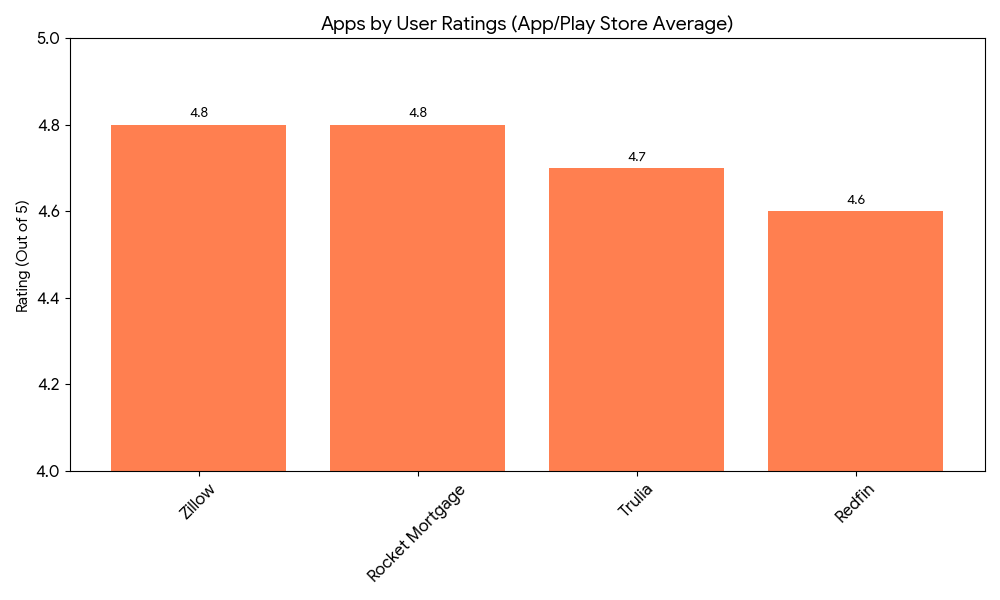
    Real estate applications with the highest ratings on Google Play and Apple Store

    Check app tour videos 

    to have a detailed idea of what features the app includes and what the user flow is like. If you have to return to the video multiple times to understand the user flow, the app is likely too complex and not worth using. 

    Pick the right app for your region

    The right app for real estate agents depends on the region you are looking to grow your real estate business in. For example, Bayut.com operates in the GCC region. It has separate applications for KSA and UAE. So using it only makes sense if your properties are listed in the same region. 

    Vet for reliability and performance

    Apps that crash, freeze, or show outdated data are a professional liability. If a listing appears available when it’s already under contract, or your automated follow-up quietly fails, the damage isn’t just internal; it’s visible to clients. Before committing to any platform, look at what actual users say in App Store and Google Play reviews. If reviews aren’t available, then use the ‘free-trial’ version before committing to any payment. 

    Pick the platforms with the largest number of users
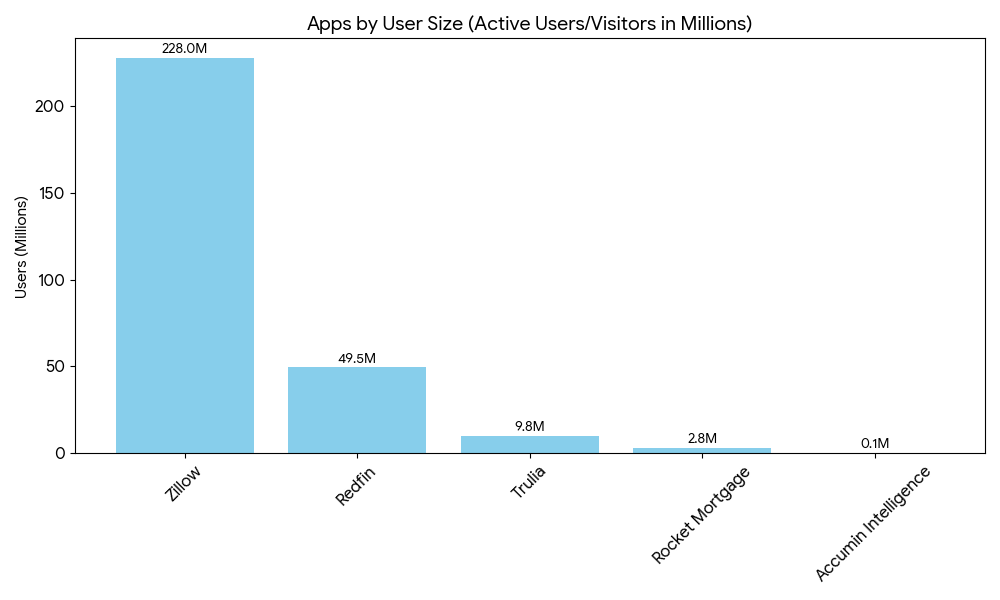
    Real estate applications with the most users in the US

    Finally, pay attention to what functionalities are available in the app you are considering onboarding. A top-tier app for real estate agents must have these features:

    • Listing management

    How easy is it to add, edit, and update listings? Can you upload high-resolution photos, video walkthroughs, and virtual tours without friction? Does the platform syndicate to other listing portals automatically, or do you have to publish to each one separately?

    • Lead capture and follow-up

    Where do leads come in, how are they tracked, and how easy is it to set up automated follow-up sequences? The difference between a lead that converts and one that goes cold is often just timing and consistency. A platform that automates reminders and follow-up messages turns one of the most discipline-heavy tasks in the business into a system.

    • Communication tracking

    Every conversation with a prospect or client is context you’ll need later. When your tools log emails, calls, and messages against the right contact or deal record, you stop relying on memory and start working from an accurate picture of where each relationship stands.

    • Readable analytics

    Not every agent needs forecasting tools. But knowing which lead sources are converting, which listings are getting traction, and where your pipeline is thin versus healthy is information worth having. The question is whether your platform surfaces it clearly or buries it in charts that require their own learning curve to interpret.

    • Integration with tools you already use

    Calendar syncing, email integration, and compatibility with your brokerage’s systems are practical requirements. A CRM that doesn’t connect to your email creates double entry. Double-entry creates errors. Errors eventually cause you to stop using the tool entirely.

    Best Real Estate Marketplace Apps for Lead Generation

    The first category of apps for real estate agents that every agent must know about is the marketplace platforms. These are the consumer-facing platforms where buyers and renters search for homes. For agents, they serve two purposes: lead generation and listing visibility. Understanding each platform’s audience and business model helps you decide where to spend your advertising budget and how to set realistic expectations for the leads that come in.

    Zillow

    Zillow is the most used real estate platform in the United States. It averaged 228 million active users across its app and website in 2024, generating 9.3 billion visits over the course of the year. The Zillow app has been downloaded over 50 million times on Google Play and holds a 4.7-star rating from 1.22 million reviews. On the Apple App Store, 7.1 million users give it 4.8 stars.

    Coverage is primarily in the US, with a growing presence in Canada. 65% of all real estate mobile app traffic in the US runs through Zillow, which tells you clearly where buyers are spending their time.

    For agents, Zillow’s value is reach. The platform has two agent programs. Premier Agent is a paid advertising arrangement where agents pay to have their profile appear on relevant listings. Zillow Flex routes pre-screened leads directly to participating agents. Zillow generated 16.9 million leads for agent advertisers in a single year, which reflects the scale of traffic the platform commands.

    The downside

    That same massive audience creates heavy competition. When a buyer inquires on a listing, multiple Premier Agent advertisers in that area may receive the same lead simultaneously. Lead quality varies, and speed of response is one of the biggest factors in whether a Zillow lead converts. Agents who invest in Zillow advertising need a fast, consistent follow-up process in place, or the spend won’t perform. 

    Redfin

    Redfin is structured differently from Zillow. It operates as a full-service real estate brokerage, reaching approximately 49.5 million monthly average users across its apps and websites, primarily in the US and Canada. That distinction matters: Redfin is not just a listing portal; it is a competing brokerage that connects buyers with its own salaried agents.

    Redfin serves more than 100 markets across the US and Canada and helped customers buy or sell more than 61,000 homes in 2023. In early 2025, Redfin was acquired by Rocket Companies, deepening its connection with Rocket Mortgage.

    The app is well-regarded for data accuracy. MLS listings refresh frequently, and the platform includes sold-home pricing data, agent tour notes, and detailed neighborhood information on schools, commute times, and walkability. The Apple App Store rating sits at 4.8 stars.

    Where Redfin is genuinely useful for all agents is as a market research tool. Its sold-price data, days-on-market tracking, and price reduction alerts are reliable and easy to access. For building CMAs and staying current on local conditions, it is one of the better free resources available.

    The drawback

    For independent agents, the key thing to understand is that Redfin is designed to route buyers to its own agents, not to outside practitioners. Unlike Zillow’s Premier Agent program, there is no advertising arrangement for independent agents to purchase placement. Your listings may appear on Redfin through MLS syndication, but lead flow from those listings goes to Redfin agents by default.

    Trulia

    Trulia was acquired by Zillow Group in 2015 and now operates within that ecosystem. It is the third most visited online real estate brand in the US, attracting approximately 9.8 million average monthly visitors. On Android, Trulia’s apps have accumulated an estimated 30 million installs.

    Where Trulia differs from Zillow is in its focus on neighborhood context. The app includes more than 30 map overlays covering schools, commute times, nearby amenities, crime data, and natural disaster risk. It also features local resident reviews, which give buyers a ground-level perspective that listing data alone can’t provide.

    Trulia launched in 2005 and built its reputation by going beyond standard listing aggregation, layering in geospatial data including crime statistics, school ratings, local businesses, commute maps, and neighborhood characteristics.

    The limitation 

    For agents, Trulia works as a complementary visibility channel. Because it sits within the Zillow Group, listings published to Zillow typically syndicate to Trulia automatically. Agents already on Zillow get Trulia exposure at no additional effort. Its neighborhood data is also a useful resource to point buyer clients toward when they’re comparing areas and want context beyond price and square footage.

    Other Marketplace Platforms

    In addition to the four mentioned above, there are several other marketplace platforms that should be on the radar of realtors looking to grow in the North American market. These include:

    These can be used for market intelligence purposes to figure out property prices, listings, and reviews. 

    Best Real Estate Data and Analytics Apps

    Marketplace applications, although the most essential, aren’t the only type of real estate apps for agents. As an agent eying growth, applications that help you gather market knowledge are equally necessary. The tools mentioned below help you accomplish exactly that. 

    Accumin Intelligence

    Accumin Intelligence is a European real estate data and analytics platform formed through the merger of several Spanish companies: Tinsa Digital, Deyde, DataCentric, and urbanData Analytics. The platform consolidates data quality, geolocation, geomarketing, and AI-driven real estate analytics into two core products. AccuMate handles real estate portfolio management with integrated market analytics. Accumin Data House provides access to the company’s full data library and AI valuation models in real time.

    Accumin’s focus is on reducing market opacity by applying AI capabilities, including natural-language search, predictive price modeling, and automated property image analysis to turn complex data into usable insights.

    To be clear about who this platform is built for: Accumin’s client base is primarily institutional. Its current users include major corporations such as Vodafone, IKEA, Allianz, and Santander. It is not a practical tool for an independent US-based agent. It is included here because it represents the leading edge of what AI-driven property analytics looks like, and that context is useful.

    For agents who want market intelligence tools built for individual practitioners, the more practical US-based options include HouseCanary (automated valuation data and market forecasting), PropStream (which aggregates MLS records and public property data for sales and investment analysis), and Altos Research (which tracks active listing trends, price reductions, and supply conditions in real time). These platforms serve the same purpose as Accumin, turning market data into a competitive advantage, but at a scale and price point designed for working agents.

    Best Mortgage and Financing Apps for Real Estate Agents

    An agent who understands financing options is more useful to clients at every stage of a transaction. When a deal slows down because a buyer doesn’t understand their loan options or hits an unexpected approval delay, the agent who can clearly explain what’s happening and point them toward the right resource keeps the deal alive. 

    Rocket Mortgage

    Rocket Mortgage is the largest mortgage lender in the United States by origination volume and has set the standard for digital mortgage applications. It operates in all 50 US states and has an average closing time of 22 days, against an industry average of 42 days. It ranked first in J.D. Power’s 2025 US Mortgage Origination Satisfaction Survey and holds an A+ rating from the Better Business Bureau.

    For borrowers with standard W-2 employment, the entire application process can be completed online. The mobile app lets users get preapproved, upload documents, and sign digitally from their phone. The Overnight Underwrite program can produce a fully verified approval in as little as two hours for qualifying borrowers.

    For agents, the practical value is clear: clients with a Rocket Mortgage preapproval letter move faster and make stronger offers. Clients who buy through a Redfin or Compass-affiliated agent and finance with Rocket Mortgage can receive either a 1% interest rate reduction for the first year of their loan or a lender credit of 0.75% of the loan amount, up to $6,000. That is a meaningful incentive for eligible buyers and worth raising in the right conversations.

    The honest limitation: some borrowers report that Rocket Mortgage’s origination fees run above the industry average, and the platform requires you to submit contact details before showing a personalized rate. Encourage clients to get loan estimates from at least two or three lenders before deciding. Rocket Mortgage is a strong recommendation for speed and user experience, but it is not always the lowest-cost option.

    Best CRM Apps for Real Estate Agents

    A CRM is where lead generation converts into closed deals. Marketplace platforms bring leads in. Your CRM determines what happens after.

    The most widely used options among US agents are Follow Up Boss for high lead volume and teams, LionDesk for solo agents on a budget, and kvCore for agents whose brokerage provides platform access. For a full comparison of pricing, ratings, and fit by business size, see our guide to the best CRM for real estate agents.

    Best E-Signature Apps for Real Estate Agents

    Every real estate transaction involves contracts, disclosures, addenda, and closing documents. Agents who still coordinate in-person signatures for routine paperwork lose hours on every deal. The two platforms below handle the majority of e-signature and transaction document workflows across US residential real estate.

    DocuSign

    DocuSign is the most widely adopted e-signature platform across industries, and real estate is no exception. DocuSign holds a 4.8-star rating on the App Store from over 400,000 reviews and 4.7 stars on Google Play. Documents are sent, signed, and returned from any device in minutes. DocuSign integrates with most major real estate CRMs and transaction management platforms without additional configuration, which means DocuSign slots into an existing workflow rather than requiring agents to rebuild around it.

    For individual agents, the real estate plan covers unlimited document sending, standard fields, and mobile signing. There is no steep learning curve on the client side either — buyers and sellers receive a signing link by email and complete the process without creating an account.

    The limitation worth noting is that DocuSign handles signatures and basic document routing. DocuSign is not a transaction management platform. If you need document storage, task checklists, and a full deal timeline in one place, Dotloop is the more complete option.

    • iOS: 4.8 stars | Android: 4.7 stars
    • Pricing: From $15/month
    • Best for: Any agent sending contracts, disclosures, or agreements regularly

    Dotloop

    Dotloop goes beyond e-signature into full transaction management. Every document, communication, and signature related to a deal is stored inside a single loop that both the agent and client can access at any point. Dotloop eliminates the version control problems that come with emailing documents back and forth and gives brokerages a clean audit trail for compliance purposes.

    Dotloop is owned by Zillow Group and integrates natively with the Premier Agent ecosystem, which makes Dotloop a natural fit for agents already running lead generation through Zillow. Many brokerages have standardized on Dotloop precisely because of its compliance and record-keeping functionality. If your brokerage already uses Dotloop, the individual plan cost may be covered or reimbursed.

    The tradeoff compared to DocuSign is pricing. At $31.99/month for an individual plan, Dotloop costs more than a standalone e-signature tool. For agents who also need transaction management, that cost is justified. For agents who only need signatures, DocuSign at $15/month is the leaner option.

    • iOS: 4.7 stars | Android: 4.5 stars
    • Pricing: $31.99/month for an individual. Team plans available.
    • Best for: Agents who want document storage and transaction management in one platform

    Best Showing Management App for Real Estate Agents

    ShowingTime

    ShowingTime is the closest thing US residential real estate has to a universal operational standard. ShowingTime integrates directly with most MLS systems, which means the entire showing coordination process runs automatically. Buyers’ agents request a showing through the app. The listing agent or seller receives the request, confirms or declines, and the appointment is logged. After the showing, ShowingTime collects feedback from the buyer’s agent automatically, without the listing agent having to follow up manually.

    ShowingTime holds a 4.8-star rating on the App Store and 4.6 stars on Google Play. In active discussions on Reddit’s r/RealEstateTechnology, agents consistently list ShowingTime alongside DocuSign as one of the tools their business cannot function without. The reason is straightforward: showing coordination without ShowingTime means phone calls, text chains, and missed confirmations. With ShowingTime, the entire process runs in the background.

    In most markets, ShowingTime access is covered by the MLS membership fee. There is no additional cost for individual agents.

    • iOS: 4.8 stars | Android: 4.6 stars
    • Pricing: Free in most markets through MLS coverage
    • Best for: All listing agents. If you are managing more than a handful of active listings at any time, ShowingTime is not optional.

    Best MLS Mobile App for Real Estate Agents

    Homesnap Pro

    Homesnap Pro provides full MLS access from a mobile device. Agents can pull up real-time listing data, off-market properties, agent contact information, and driving directions to any property from a single app. Homesnap Pro’s most distinctive feature is photo search: an agent or buyer can photograph any home from the street and Homesnap Pro surfaces the full property record instantly, including ownership history, tax data, and listing status.

    Homesnap Pro is used by over 1 million real estate professionals across the US. Homesnap Pro is built specifically for agents, not consumers, which means the data Homesnap Pro surfaces — including off-market records and agent-to-agent contact details — is not available on standard consumer portals like Zillow or Redfin.

    Among MLS mobile apps, Homesnap Pro is the most user-friendly MLS mobile app for real estate agents in 2025 and 2026.

    Access to Homesnap Pro is free for agents whose MLS has an active Homesnap partnership. Most major boards in the US are covered, though it is worth confirming with your local MLS before relying on Homesnap Pro.

    • iOS: 4.7 stars | Android: 4.3 stars
    • Pricing: Free with participating MLS membership
    • Best for: Buyer’s agents who need full MLS access on the go and agents working with clients searching off-market properties

    Best Marketing and AI Apps for Real Estate Agents

    Canva

    Canva is a browser and mobile-based design tool that requires no graphic design background. Real estate agents use Canva for listing flyers, just listed and just sold social posts, open house materials, buyer and seller presentation decks, and email headers. Canva’s real estate template library covers most standard formats, and the brand kit functionality lets agents save their logo, color palette, and fonts once and apply them consistently across every piece of material they produce.

    Canva Pro adds background removal, a premium template library, and a content scheduler that publishes directly to Instagram, Facebook, and LinkedIn on a set schedule. For agents managing their own social media presence, the Canva Pro scheduler alone is worth the monthly cost. The free tier covers most individual agent needs without the scheduler or premium templates.

    • iOS: 4.9 stars | Android: 4.7 stars
    • Pricing: Free tier available. Canva Pro at $15/month
    • Best for: Agents managing their own social media and marketing materials who want professional output without hiring a designer

    ChatGPT

    ChatGPT has become a standard productivity tool among producing agents over the past two years. The primary use cases in real estate are listing description drafts, client email templates, follow-up message sequences, buyer and seller presentation outlines, and social media captions. A well-prompted ChatGPT produces a complete listing description draft from basic property notes in under two minutes.

    ChatGPT output is a starting point, not a finished product. Local nuance, specific property details, accurate square footage, and feature callouts, and any compliance language required by your state or brokerage need to be added and verified before anything goes to a client or MLS. What ChatGPT removes is the blank page problem — agents who write 20 to 30 listing descriptions a year reclaim meaningful time at this stage of the workflow.

    • iOS: 4.7 stars | Android: 4.6 stars
    • Pricing: Free tier available. ChatGPT Plus at $20/month
    • Best for: Agents writing frequent listing descriptions and anyone producing high volumes of client-facing written content

    What agents use daily: Active discussions in Reddit’s r/RealEstateTechnology show consistent agreement on the tools agents consider non-negotiable: ShowingTime, DocuSign, Follow Up Boss, Canva, and ChatGPT. This guide covers each of them.

    What if the applications on the list don’t satisfy your needs? 

    If there’s no single app that has all the functionalities you require, it’s best to use multiple as a stack, where each tool has a specific role, and those roles don’t overlap.

    Option 1 – Use multiple applications that work together
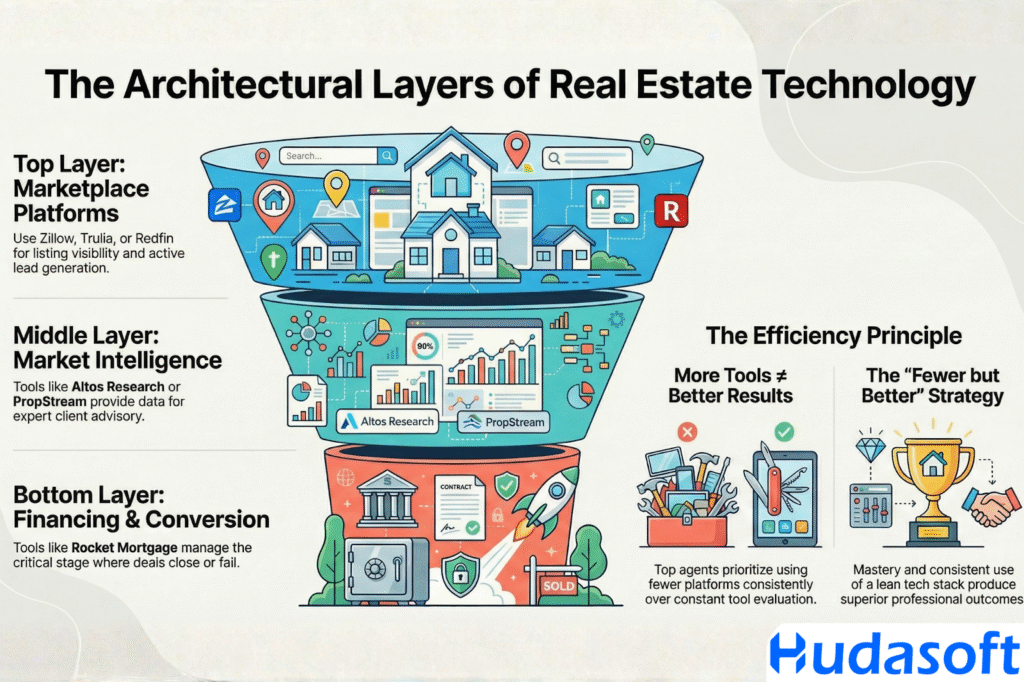
    Real estate Technology

    Think of it in layers. The marketplace platforms, Zillow, Trulia, and Redfin, sit at the top of the funnel. They are where buyers search, and where your listings need to be visible. For active lead generation, Zillow’s Premier Agent program is the most direct route for most agents, though it requires both a realistic budget and a responsive follow-up system.

    Market intelligence tools sit beneath that. Whether you use an enterprise-grade platform like Accumin or a practitioner-focused tool like Altos Research or PropStream, having reliable data on price trends, inventory levels, and days-on-market conditions is what enables you to advise clients rather than just relay information back to them.

    Financing tools like Rocket Mortgage sit at the conversion layer: the point where a deal closes or falls apart. Knowing what’s available and being able to guide a client quickly makes a material difference at that stage.

    One principle worth stating plainly: more tools do not produce better results. The agents who use technology most effectively tend to use fewer platforms, not more. They know what each tool does, they use it consistently, and they are not in a constant cycle of evaluating something new.

    If, like most real estate agents, you are also managing property development gigs, then it is worth knowing the top accounting software for property developers. The top apps include: Bricks ERP, Morta, and Accumatica. These are full-scale ERPs for managing development projects. 

    Option 2 – Build a custom real estate application

    The other alternative to using multiple applications is to opt for custom real estate application development. This allows you to combine all your desired functionalities into one single, easy-to-use application. 

    Generally, custom apps are a lot costlier compared to SaaS-based applications discussed above. However, the advantages of going custom are undeniable. 

    The application you develop is your asset, and you do not have to pay for a subscription. Additionally, you own the data entirely with no risk of compromised privacy. On top of that, you can also opt to monetize your real estate application. This involves allowing other businesses in your space to use the platform against a fee, rather than using it just for your business. 

    Best Real Estate App by Business Size: Solo Agents, Teams & Investors

    Solo agents building their practice should focus on two things: visibility on a platform where real buyers are actively searching, and a reliable follow-up system for the leads that come in. Zillow is the defensible choice for reach. The most common mistake solo agents make is investing in visibility without having any follow-up process in place. The benefits of CRM in real estate become most visible at this stage, traffic without follow-up produces nothing.

    Agents building a small team need to shift focus toward systems. You need tools that can track multiple client pipelines, assign leads to specific people, and give you a clear view of activity across the team. This is when investing in the best real estate CRMs for small teams, such as Follow Up Boss, LionDesk, or Wise Agent, becomes worth its monthly cost. Connectivity between tools also becomes more critical at this stage: calendar syncing, shared communication records, and consistent email integration prevent leads from slipping through the gaps.

    Agents working with investor-focused buyers need stronger analytics than standard residential search provides. Understanding cap rates, rental yields, off-market inventory, and emerging market trends requires different tools than a basic listing portal offers. PropStream and BiggerPockets’ data tools are practical starting points for this type of work.

    Common Mistakes When Choosing Real Estate Apps

    Choosing based on features instead of usability

    A platform with dozens of features you’ll never touch is less valuable than one with ten you’ll use every single day. Before committing, run any new tool inside your actual workflow for at least two weeks. The question isn’t whether it has the capability; it’s whether it fits how you work.

    Underestimating onboarding complexity

    Some platforms are genuinely difficult to set up, and that friction has a real cost: not just in time, but in the motivation to follow through. A tool that requires a full day of configuration before it does anything useful has a high abandonment rate, and for good reason.

    Skipping integration checks

    Before adopting any new tool, confirm that it connects to what you already use. A CRM that doesn’t sync with your calendar, or a lead platform that doesn’t connect to your email, creates manual data entry. Manual data entry creates gaps. Gaps cause deals to fall through.

    Ignoring future scale

    A tool that fits your current situation may become a problem as your business grows. Understand a platform’s pricing at higher user counts and its limitations for team use before you build your workflow around it. Switching CRMs after two years of data entry is an expensive disruption.

    Using tools that don’t talk to each other

    A lead comes in through Zillow, gets logged manually in a spreadsheet, gets an email from your personal inbox, and then gets forgotten when you get busy. That’s not a technology problem; it’s a system problem that technology can either solve or make worse. Integration between your tools is what turns individual apps into an actual workflow.

    Conclusion

    The real estate industry in 2026 has more software options than ever, and that abundance makes clarity more important. 

    If you are just looking to grow your business, then start with a basic marketplace app like Zillow. As your business grows and you need more advanced tools, you can move to other applications and integrate them together, or you can choose to build a custom real estate app. In case you opt for the latter, then partner with the right technology company that has experience in developing apps for real estate agents. Hudasoft has a portfolio of high-performing applications developed specifically for the real estate sector. This means the backend architecture is likely figured out, and you will get an application delivered within a significantly less amount of time than choosing a partner that builds the app from scratch.

    Frequently Asked Questions

    What is the best CRM app for real estate agents?

    Follow Up Boss is the most widely recommended CRM among producing agents and team leaders. It aggregates leads from 200+ sources, includes built-in calling and texting, and integrates directly with Zillow Premier Agent. For solo agents on a tighter budget, LionDesk covers the core needs at $25/month.

    Which apps do most realtors use daily?

    The apps that appear most consistently in active agent workflows are ShowingTime for showing scheduling, DocuSign or Dotloop for e-signatures, a CRM such as Follow Up Boss or kvCore for pipeline management, and Zillow for listing visibility and lead generation.

    What is the best free app for real estate agents?

    ShowingTime is free in most markets through MLS coverage and handles showing coordination automatically. Homesnap Pro is free with a participating MLS membership and provides full mobile MLS access. Canva’s free tier covers most individual agent marketing needs.

    What app do real estate agents use to schedule showings?

    ShowingTime is the standard. It integrates with most MLS systems, automates confirmation and feedback collection, and is used by the majority of US residential agents. Access is typically included in MLS membership fees.

    What is the best e-signature app for real estate agents?

    DocuSign is the most widely adopted e-signature tool in real estate and works across all transaction types. Dotloop is the better choice if you also want transaction management and document storage in the same platform.

    Do real estate agents use AI tools?

    Yes. ChatGPT is the most commonly used AI tool among agents currently, primarily for writing listing descriptions, drafting client emails, and preparing presentation content. It does not replace local market knowledge or compliance review; it reduces the time spent on first drafts.
  • Top Android App Development Companies in the US (2026 Updated List)

    Top Android App Development Companies in the US (2026 Updated List)

    The U.S. mobile market is predominantly skewed toward Apple users, but Android still holds a significant share at around 40%. For businesses looking to develop apps, building native Android applications remains crucial, especially if the goal is to expand beyond the U.S., where Android adoption is more widespread across global markets.

    So when it comes to developing an Android application, it’s important to partner with the right app development agency to handle your project. That’s where this blog comes in. It lists the top Android app development companies in the U.S.

    Key takeaways:

    • Each agency has its own set of expertise and operates at a different budget range. 
    • All of the agencies mentioned in the list have proven expertise in Android app development, verified from third-party sources and their claimed case studies. 
    • When partnering with an Android app development agency, it’s best to match their expertise, hourly rates, and promised delivery time with your project’s specific requirements. 
    • For vetting an agency’s expertise, see their portfolio, compliance practices, complexity they are used to handling, their collaboration, and the quality of support they offer. 
    • Testimonials, third-party reviews, and in-person discussions are the best way to uncover these details about your shortlisted Android app development companies. 

    An Overview of the Best Android App Development Companies in the US

    CompanyClutch RatingPricing (EST.)Team SizeDelivery Timeline (MVP)
    1. Hudasoft4.9 / 5$40k – $85k50 – 2494 – 6 months
    2. Appinventiv4.7 / 5$100k – $200k1,000 – 4,9996 – 9 months
    3. Fueled4.8 / 5$150k – $300k350+6 – 9 months
    4. 10Pearls4.9 / 5$80k – $180k1,500+4 – 8 months
    5. Blue Label Labs4.8 / 5$100k – $250k100 – 2004 – 7 months
    6. Simpalm4.9 / 5$25k – $65k10 – 503 – 5 months
    7. Tekrevol4.8 / 5$50k – $120k250 – 9994 – 8 months
    8. Orangemantra4.7 / 5$30k – $80k250 – 5004 – 6 months
    9. Zazz5.0 / 5$40k – $150k50 – 2493 – 6 months
    10. Hyperlink InfoSystem4.9 / 5$20k – $80k1,200+3 – 6 months

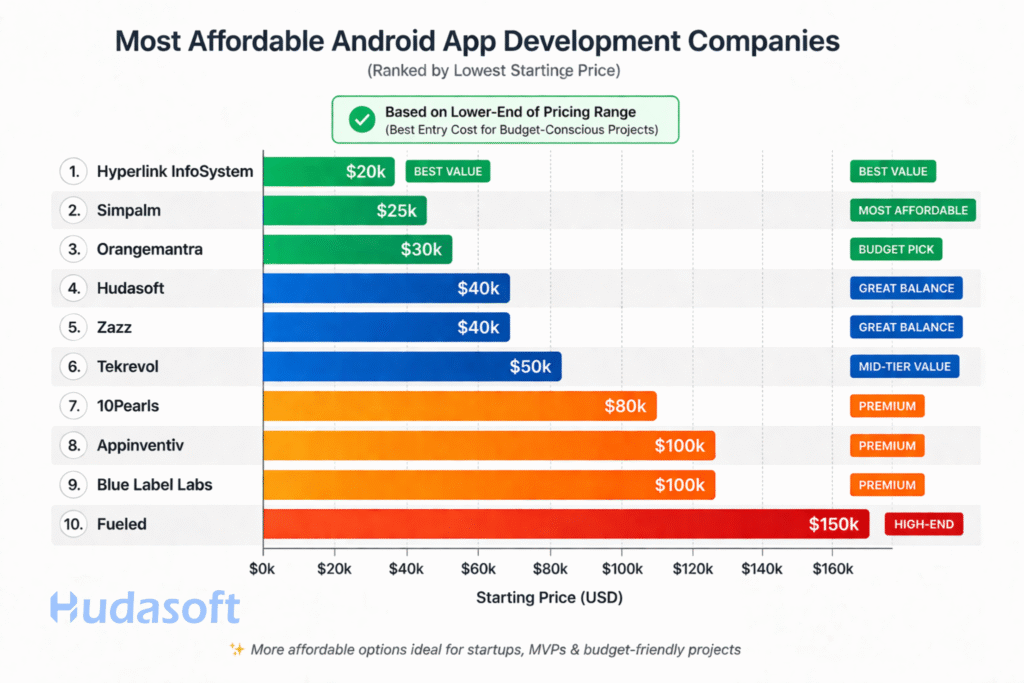
    US-based Android App Development Companies with Accessible Pricing

    The companies mentioned here are not the most affordable in the US, but the most affordable among the ones included in this list. So here you have the top US companies that handle Android development, ranked by affordability. 

    US-based Android App Development Companies with Accessible Pricing

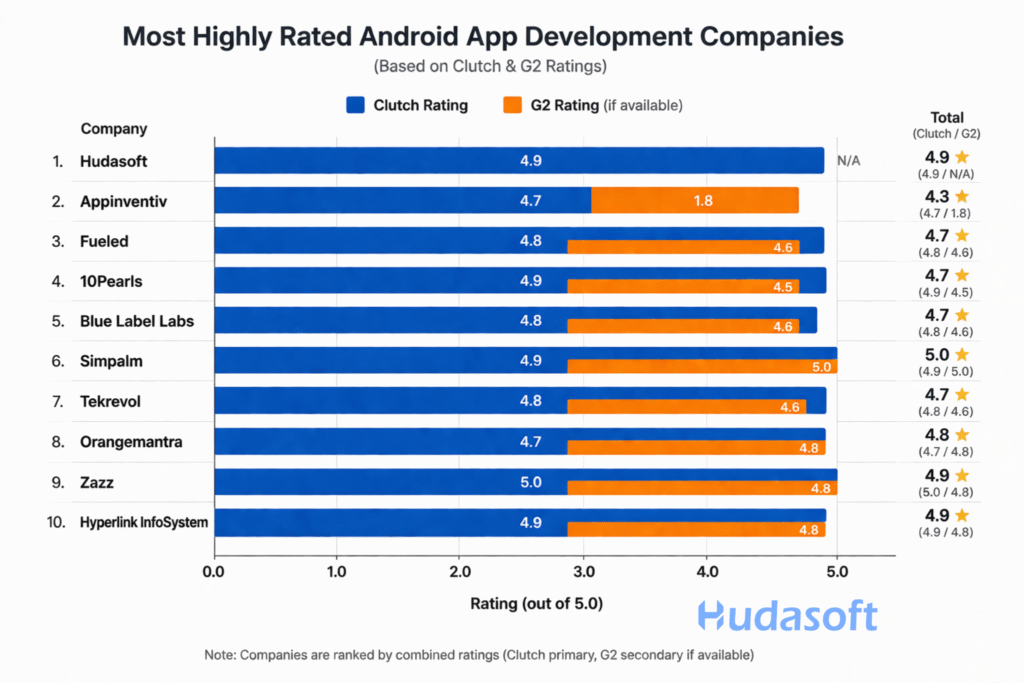
    US Android App Development Companies Ranked based on Clutch and G2 Ratings 

    Here’s the graphical representation of the marketplace ratings (Clutch and G2) of US-based Android app development companies. 

    US Android App Development Companies Ranked based on Clutch and G2 Ratings

    Which Company is the Best for Android App Development in the US?

    For an agency to be called a top Android app development company, it requires expertise in Android frameworks (Kotlin, Ionic, Java), a clear understanding of user behavior, and proven experience building apps that are stable, scalable, and ready for real market conditions.

    Hudasoft stands out across these areas. It combines solid technical execution with practical experience in delivering Android applications that perform reliably and align with business objectives.

    In addition, you get competitive pricing and a dedicated engineering team that stays closely involved throughout the development process and continues to provide support after launch.

    So if you’re looking for a straightforward answer, this is why Hudasoft ranks as one of the best Android app development companies in the U.S.

    The List of Best Android App Development Companies in the US

    When you’re searching for a digital agency to partner with, the list below brings together the top Android application development agencies in the U.S., based on multiple independent platforms.

    However, not all of them will be the right fit. Each agency has its own area of expertise and a distinct positioning in the market. That’s why it’s important to understand what each one specializes in before deciding which partner aligns with your goals.

    1. Hudasoft

    • Team Size: 50 – 249 employees
    • Located in: Missouri City, TX (Houston area)
    • Pricing: $40,000 – $85,000
    • Delivery Timeline (for MVP): 4 – 6 months

    Hudasoft has 20+ actively deployed Android apps in the US. 

    They work across industries, with particular depth in building Android solutions that require custom architecture rather than template-based approaches.

    Hudasoft‘s primary strength is in building scalable, custom Android solutions for businesses with specific technical or operational requirements. 

    Their pricing positions them in the mid-market tier, which makes them suitable for companies that need quality engineering without the overhead costs of a large enterprise agency. 

    Their 4 – 6 month MVP timeline is competitive for the scope of work in their price range.

    2. Appinventiv

    • Team Size: 1,000 – 4,999 employees
    • Located In: New York, NY (Manhattan)
    • Pricing: $100,000 – $200,000
    • Delivery Timeline (for MVP): 6 – 9 months

    Appinventiv is a large-scale digital product agency with offices across the U.S. and international delivery teams. 

    They serve high-growth startups and enterprise clients, with a portfolio spanning healthcare, fintech, logistics, and e-commerce. 

    The company has won consecutive Deloitte Tech Fast 50 awards in 2023 and 2024.

    When it comes to the value businesses get by partnering with Appinventiv, here are their main strong points:

    • The company brings large engineering capacity to complex Android projects. 
    • Their global delivery model gives organizations access to substantial team bandwidth without building an in-house function. 

    3. Fueled

    • Team Size: 350+ employees
    • Located In: New York, NY; Chicago, IL; Los Angeles, CA
    • Pricing: $150,000 – $300,000
    • Delivery Timeline (for MVP): 6 – 9 months

    Fueled is a design-led product agency based in New York, with a client list spanning consumer brands in media, lifestyle, and consumer technology. 

    They are positioned at the premium end of the market, with project minimums that reflect their focus on high-production-value work.

    Their strong points that earn fueled a position in this list is their UX. The quality of user experience that fueled offers is levels above the competition. Their development process is anchored in a structured product design phase, which typically produces more polished end results than an engineering-first agency. 

    The tradeoff is cost: at $150k–$300k for an MVP, this is among the most expensive options on this list. 

    Businesses at this budget level should have a clear monetization or enterprise deployment strategy to justify the investment.

    4. 10Pearls

    • Team Size: 1,500+ employees
    • Located In: Vienna, VA (HQ); New York, NY; Chicago, IL
    • Pricing: $80,000 – $180,000
    • Delivery Timeline (for MVP): 4 – 8 months

    10Pearls is a digital transformation company with experience in large enterprises and regulated industries. 

    They operate U.S.-based project management alongside offshore delivery centers, which keeps costs below pure U.S.-development rates while maintaining oversight close to the client. 

    Their work covers complex integrations, security-sensitive systems, and compliance-heavy environments.

    When it comes to the value businesses get from Android apps developed by 10Pearls, the company is best suited for organizations that need enterprise-grade Android development.

    They place strong emphasis on security architecture, regulatory compliance (HIPAA, SOC 2, PCI-DSS), and integration with legacy backend systems.

    If your project requires connecting an Android front end to an ERP, EHR, or other regulated data infrastructure, their technical depth in this area helps reduce delivery risk.

    5. Blue Label Labs

    • Team Size: 100 – 200 employees
    • Located In: New York, NY (Manhattan)
    • Pricing: $100,000 – $250,000
    • Delivery Timeline (for MVP): 4 – 7 months

    Blue Label Labs is a full-service product development agency serving startups and mid-sized companies. 

    Their engagement model covers product strategy, UX/UI design, and engineering within a single team structure. This reduces the handoff problems that arise when strategy, design, and development are split across vendors.

    The core value that businesses get with this agency is that their team handles the full product lifecycle from defining scope through post-launch iteration. 

    For companies without an internal product function, this is a practical advantage. Rather than coordinating between a strategy consultant, a design firm, and a development agency, you work with one team accountable for the complete outcome.

    6. Simpalm

    • Team Size: 10 – 50 employees
    • Located In: North Bethesda, MD; Chicago, IL; New York, NY
    • Pricing: $25,000 – $65,000
    • Delivery Timeline (for MVP): 3 – 5 months

    Simpalm is a mobile and web development agency based in the Washington, DC area. Their client base includes government contractors, nonprofits, and private businesses. 

    As per the available data, they hold the shortest estimated timeline on this list at 3 – 5 months for an MVP, and their pricing is the most accessible among US-headquartered agencies here.

    That’s ideal for businesses with time and budget constraints. Talking of constraints, the businesses positioned best to benefit from partnering with Simpalm are those with clear-cut and narrow requirements.  

    Think of internal-use tools, proof-of-concept builds, or applications with a focused feature set, designed for particular roles. Simpalm will deliver those without delay, within budget, and without any performance issues. 

    7. Tekrevol

    • Team Size: 250 – 999 employees
    • Located In: Houston, TX (HQ); San Francisco, CA; New York, NY
    • Pricing: $50,000 – $120,000
    • Delivery Timeline (for MVP): 4 – 8 months

    Tekrevol is a mobile app development company with U.S. offices and development teams in Pakistan. 

    They focus on consumer-facing apps and offer mobile development alongside branding and digital marketing services. Their primary client segment is growth-stage startups.

    For companies building consumer apps where visual presentation and brand identity need to be consistent across product and marketing channels, Tekrevol’s integrated approach keeps design language coherent from app UI through to campaign assets. 

    The offshore delivery component keeps its pricing below comparable U.S.-only agencies, though clients should confirm communication protocols and project management structure during the scoping process.

    8. Orangemantra

    • Team Size: 250 – 500 employees
    • Located In: San Jose, CA (U.S. Operations)
    • Pricing: $30,000 – $80,000
    • Delivery Timeline (for MVP): 4 – 6 months

    Orangemantra is a digital transformation company with a services portfolio covering mobility, web, and enterprise software. 

    Their experience is concentrated in established businesses, modernizing existing systems or extending them to mobile platforms.

    Orangemantra’s strength is in integration work. If your Android app needs to connect to legacy ERP systems, existing databases, or complex backend infrastructure, they have relevant experience managing that technical complexity alongside mobile development.

    For greenfield consumer apps with no backend integration requirements, other agencies on this list may be a better fit.

    9. Zazz

    • Team Size: 50 – 249 employees
    • Located In: Dallas, TX; Nashville, TN
    • Pricing: $40,000 – $150,000
    • Delivery Timeline (for MVP): 3 – 6 months

    Zazz is a mobile app development agency positioned toward technology-driven startups.

    They work across iOS, Android, and cross-platform frameworks and are flexible on the tech stack based on project requirements. Their 5.0/5 Clutch rating is the highest on this list.

    Zazz’s pricing range is wider than most agencies here ($40k – $150k), which reflects flexibility in project scope rather than inconsistency in pricing. 

    They are a practical choice for startups that want a technically current team, comfortable with modern Android development patterns, including Jetpack Compose, Kotlin Coroutines, and modern MVVM architecture.

    10. Hyperlink InfoSystem

    • Team Size: 1,200+ employees
    • Located In: New York, NY; San Jose, CA
    • Pricing: $20,000 – $80,000
    • Delivery Timeline (for MVP): 3 – 6 months

    Hyperlink InfoSystem is one of the larger independent app development companies, with U.S. offices and a substantial development workforce in India. 

    They handle high volumes of projects across a wide range of categories and platforms.

    The agency’s combination of low pricing and large team capacity gives it a structural advantage for organizations that need to develop multiple apps simultaneously or require large development throughput at a managed cost. 

    The tradeoff is that high-volume agencies typically operate with more standardized processes. If your app has highly specific technical requirements or demands close collaboration on architecture decisions, confirm their project management structure and team assignment practices before signing.

    When Is Native Android Development the Right Call?

    It’s one thing to know which companies to partner with for building Android applications, and it’s useful. But what’s more important is to know whether Android is the right platform to target. Here are the scenarios where Android app development might be the right choice. 

    1. Android-First Organizations

    If your business issues Android devices to employees (field teams, logistics crews, retail operations, construction workers), native development gives you a real operational advantage. You get tighter device integration, lower hardware costs at scale, and cleaner device management. The investment pays off when the platform is already central to how your team works.

    2. Performance-Critical Applications

    Apps with real-time processing requirements, heavy animations, or continuous hardware interactions (GPS tracking, sensor data, camera pipelines) benefit significantly from native development. There’s a ceiling to what abstraction layers can deliver, and for performance-sensitive products, native code is simply faster and more reliable.

    3. Deep Device Integration

    IoT-connected apps, wearables, and embedded Android systems need direct access to native APIs. Cross-platform frameworks have improved considerably, but they still operate within constraints that native development doesn’t face. If your app needs to talk directly to hardware, native is the right foundation.

    4. Targeting Emerging Markets

    Android commands dominant market share in cost-sensitive regions across South Asia, Southeast Asia, Africa, and Latin America. If your user base lives in these markets, native Android development gives you the broadest device compatibility and the smoothest experience across a wide range of hardware.

    5. Long-Term Product Scalability

    For complex products that will evolve significantly over time, native apps tend to be more maintainable. You stay aligned with Google’s ecosystem updates, Jetpack library improvements, and Kotlin language advancements without worrying about whether your framework of choice has kept up.

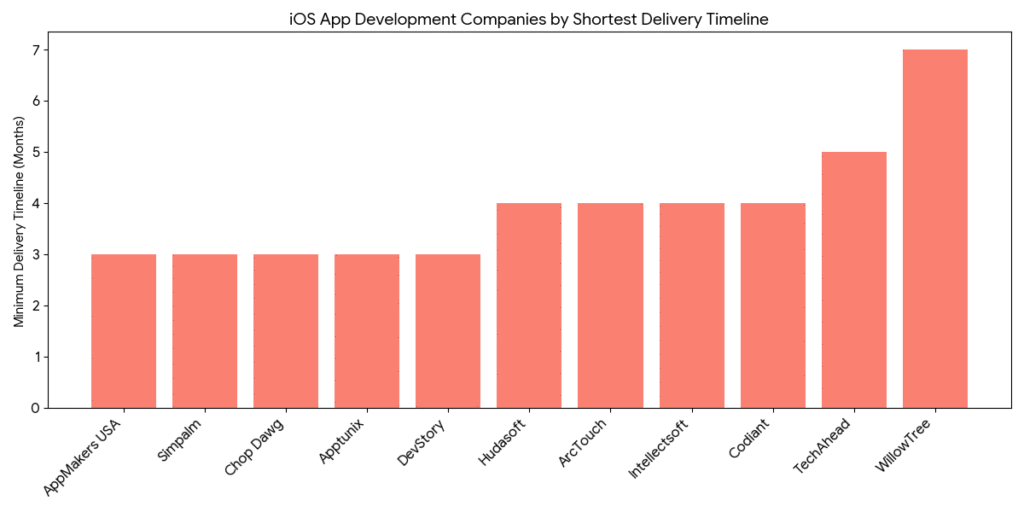
    In other scenarios, where you are building for a professional workforce in the US, or a consumer-facing app for the North American market, iOS development might be the right option. In this case, it pays to know the top iOS app development companies in the US.  

    What Technologies are Android Apps Built On?

    Modern native Android development centers on Kotlin as the primary language, with Java still present in legacy systems. Android Jetpack libraries handle UI, navigation, and lifecycle management. Firebase covers authentication, real-time databases, and analytics for most backend needs.

    For testing, Android’s built-in emulators handle basic simulation, while Genymotion provides faster, more scalable environments. CI/CD pipelines, typically built on GitHub Actions, Bitrise, or GitLab CI, automate testing and deployment, which matters more than most early-stage teams realize.

    Top IDEs agencies use for developing Android applications

    Integrated development environments (IDEs) are developer interfaces that they use to code, build features, and eventually create applications. For Android, the top IDEs are:

    Android Studio is the standard for pure native development. Built on IntelliJ IDEA, it includes advanced emulators, Jetpack Compose support, and a Gradle-based build system.

    IntelliJ IDEA suits Kotlin-heavy projects and teams where backend and Android developers share a codebase.

    VS Code is the practical choice for cross-platform frameworks like Flutter and React Native, largely because of its lightweight footprint and extensions ecosystem.

    Visual Studio with Xamarin fits C#/.NET teams building across Android, iOS, and Windows from a shared codebase.

    How to Vet the Android App Development Companies for Partnership?

    A shortlist of agencies is only the starting point. The real work is in the evaluation. Most businesses settle on a partner too quickly, anchoring on Clutch ratings or pricing alone. The five factors below cut through the noise and surface what actually determines whether a partnership succeeds.

    1. Evaluate Their Industry-Specific Portfolio

    A general portfolio doesn’t tell you much. What matters is whether the agency has built apps in your specific domain. A fintech app demands familiarity with PCI-DSS compliance, secure data flows, and regulatory nuances that a logistics app doesn’t. 

    Ask the agency to walk you through a case study from a project that mirrors yours in terms of industry, complexity, and user base size. If they can’t produce one, that’s useful information. If they can, pay close attention to how they describe the problems they solved, not just the features they shipped. Execution detail in a case study is a strong proxy for depth of expertise.

    2. Assess Technical Compliance and Security Practices

    Security and compliance are non-negotiable for certain verticals, and optional for none. For healthcare apps, ask about HIPAA-compliant data handling, encryption at rest and in transit, and audit logging. For financial applications, probe their experience with OAuth 2.0 flows, tokenization, and fraud detection integration.

    For any app collecting user data, ask how they handle GDPR or CCPA requirements. A capable agency will answer these questions fluently, without needing to look anything up. Beyond the technical aspects, verify whether the agency conducts code reviews, penetration testing, or third-party security audits as standard practice. Agencies that treat security as an afterthought tend to create problems that are expensive to fix post-launch.

    3. Understand Their Team Structure and Communication Model

    Who actually works on your project matters as much as who sells it to you. Ask directly: will the team presented in the proposal be the team building the product? Some agencies use senior engineers for the sales process and hand off to junior staff once the contract is signed. 

    Find out whether your dedicated point of contact is a project manager or a technical lead, since there’s a significant difference in what each can offer. For agencies with offshore delivery models, ask how time zone overlap is managed, what the escalation path looks like when blockers arise, and how sprint reviews are conducted. The quality of communication infrastructure is a reliable signal of project management maturity.

    4. Scrutinize Post-Launch Support and Maintenance Terms

    The project doesn’t end at launch, and neither should the agency relationship. Android OS updates, Google Play policy changes, and new device form factors (foldables, large-screen tablets) mean your app will need ongoing attention. 

    Before signing anything, clarify what the post-launch support window looks like: how long does the agency cover bug fixes at no additional cost? What is the SLA for critical issues? Is there a retainer model available for continued development? A reputable agency will have clear, documented answers to these questions. Vague or verbal-only commitments on post-launch support are a red flag worth taking seriously before the contract is finalized.

    5. Cross-Verify Ratings Across Multiple Platforms

    Single-platform ratings are easy to game. Clutch reviews, for instance, can be solicited at project completion when client satisfaction is highest, which inflates scores relative to overall service quality. 

    A more reliable picture emerges when you triangulate across platforms: Clutch, G2, GoodFirms, and even LinkedIn recommendations from client-side employees (not just the agency’s account managers). Pay attention to the content of reviews, not just the star count. Negative reviews that describe communication breakdowns or scope creep are patterns worth investigating further. You can also ask the agency directly for two or three client references you can contact by phone. 

    Any agency confident in its work will accommodate that request without hesitation.

    Which Agency Fits Your Budget, Timeline, and Project Type?

    The agencies in this list span a wide range of budgets, team sizes, and specializations. Rather than treating them as interchangeable options, use the three filters below to narrow the field based on your actual situation.

    Filter by Budget Range

    If your budget sits below $65,000, Simpalm and Hyperlink InfoSystem are the practical options. Both deliver functional Android products at accessible price points without sacrificing professional project management. 

    Between $65,000 and $120,000, Hudasoft, Tekrevol, and Orangemantra offer a strong middle tier with good depth in custom and integration-heavy work. For projects budgeted above $120,000, Fueled, Blue Label Labs, Appinventiv, and 10Pearls are better equipped to handle the complexity, scale, and design expectations that come with larger investments. Zazz spans a wide range and can flex upward or downward depending on the scope.

    Filter by Project Type

    For consumer apps where the user experience is the product, Fueled and Blue Label Labs are the strongest candidates given their design-led approach. For enterprise and regulated-industry projects involving complex integrations or strict compliance requirements, 10Pearls and Appinventiv have the technical infrastructure to manage that complexity. If you’re building something custom from the ground up with specific architectural requirements, Hudasoft’s focused approach to bespoke development makes it a natural fit. Startups that need to move quickly and prefer a technically agile team should look at Zazz or Tekrevol. If you need deep backend and legacy system integration, Orangemantra has particular experience in that area.

    Filter by Timeline Urgency

    If you need an MVP within three to five months, Simpalm, Zazz, and Hyperlink InfoSystem have the fastest delivery timelines on this list. Agencies like Appinventiv and Fueled tend toward longer engagements, which reflects the scale and rigor of their process rather than inefficiency. For mid-range timelines of four to seven months, Hudasoft, Blue Label Labs, 10Pearls, and Tekrevol all sit comfortably in that window. It’s worth noting that accelerated timelines typically require either a tighter scope or additional resources, so build that conversation into your initial briefing rather than discovering it after contracts are signed.

    Closing Thoughts

    The list above mentions ten of the best Android app development companies that you can find in the US region. 

    The list is broad and diverse, with agencies having different specialties. So before finalizing one, match the agency’s expertise with your app’s specifications. 

    Have clear answers to who your target users are, what your budget ceiling is, and how much internal product management capacity you have.

    For organizations building their first Android app without an internal technical team, agencies like Hudasoft, Blue Label Labs or Fueled that cover the full product lifecycle from strategy through engineering reduce coordination overhead. For businesses with well-defined requirements and budget constraints, Simpalm or Hyperlink InfoSystem offer solid delivery at lower price points. For enterprise projects with compliance requirements or complex backend integration, 10Pearls and Orangemantra have more relevant experience in that domain. 

    Lastly, before committing to a contract, verify each shortlisted agency’s work directly, speak with their past clients, and evaluate their proposed technical approach.

    Why is the “Discovery Phase” a critical differentiator among top-tier Android app development companies?

    The Discovery Phase is not merely a preliminary chat; it is a strategic deep-dive where the development partner aligns your business objectives with technical feasibility. Top firms use this stage to conduct market research, define user personas, and create a technical roadmap. By investing in discovery, you mitigate risks early, prevent “scope creep” during development, and ensure that the final product addresses a specific market gap rather than just being a functional app. 
    Among agencies that place emphasis on thorough discovery, Hudasoft particularly stands out. The initial discovery session involves all the right questions that give the team awareness of the context, a deep understanding of the app’s idea, and enable them to visualize the development roadmap in detail.

    How do these companies ensure app performance across the fragmented Android device ecosystem?

    Android development is uniquely challenging due to “fragmentation”. The vast variety of screen sizes, hardware specifications, and OS versions makes Android a particularly challenging platform. Leading US firms tackle this through rigorous testing protocols. They utilize automated testing suites and physical device labs (rather than just emulators) to ensure the UI is responsive and the performance is optimized for both high-end flagship phones and budget-friendly devices. This ensures a consistent user experience regardless of the hardware.

    What role does UI/UX design play in distinguishing a “premium” app from a standard one?

    A premium Android app adheres to Google’s Material Design guidelines while injecting a unique brand identity. Probing deeper, the best firms focus on “Micro-interactions” and accessibility. They don’t just make an app look good; they focus on intuitive navigation and minimizing cognitive load for the user. A well-designed app increases retention rates by making the interface feel familiar yet modern, ensuring users can achieve their goals with the fewest possible taps.

    Beyond the initial launch, what should a comprehensive maintenance and support plan include?

    A common misconception is that the project ends at the Play Store launch. In reality, OS updates (like new Android versions) and security patches require ongoing attention. Articulate firms provide post-launch support that includes:
    Bug Monitoring: Real-time tracking of crashes.
    Performance Optimization: Updating the code to keep the app fast as data grows.
    Iterative Updates: Adding new features based on actual user feedback and analytics collected after the launch.
    This lifecycle approach ensures the app remains competitive and secure in a rapidly evolving digital market. 
    Hudasoft is one of the agencies that ensures top-tier post-launch support that includes performance optimization, updates, and even technical support with onboarding and maintenance.

  • Top AI Agent Development Companies in the US (2026 Updated List)

    Top AI Agent Development Companies in the US (2026 Updated List)

    Most businesses evaluating AI agent development companies end up comparing Clutch ratings and pricing decks without knowing what separates firms with production deployments from those with polished pitches. Over 3,600 firms on Clutch claim expertise in building AI agents. Most added “agentic AI” to their service list in the past 12 months. The ones that have shipped production-ready agents are a shorter list.

    At Hudasoft, we build and deploy AI agents for automotive and proptech businesses. That experience shapes this guide. The 10 AI agent development agencies below were selected based on production deployments, platform ratings, industry specialization, and technical depth.

    How the Top 10 Companies Compare

    Not every firm on this list suits every business. The table below gives you a quick view of cost, timeline, and rating so you can shortlist before reading the full entries.

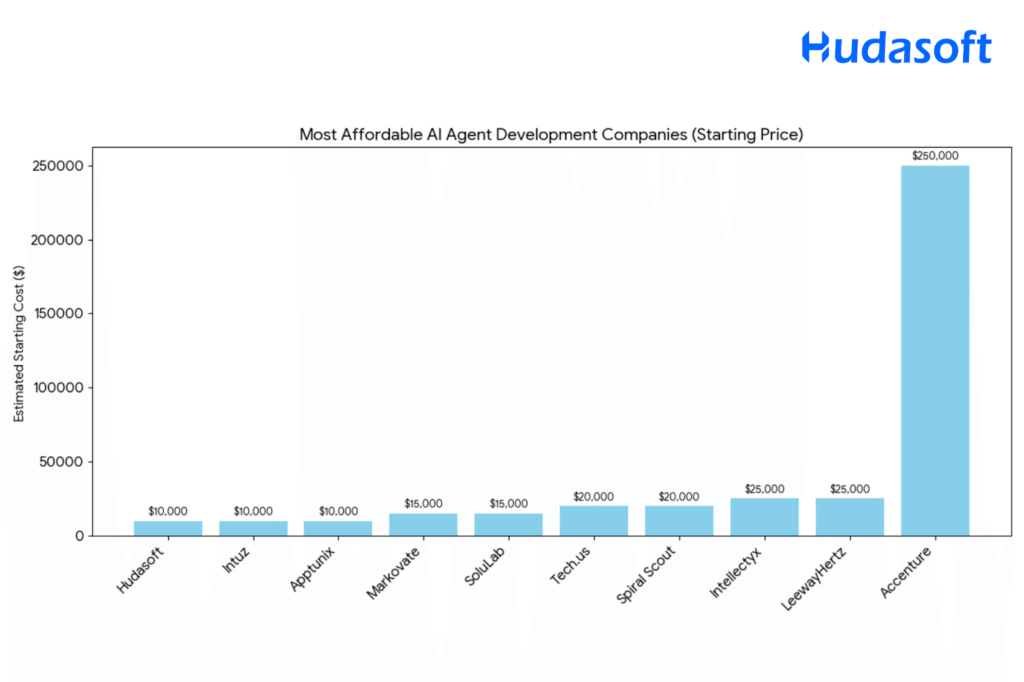
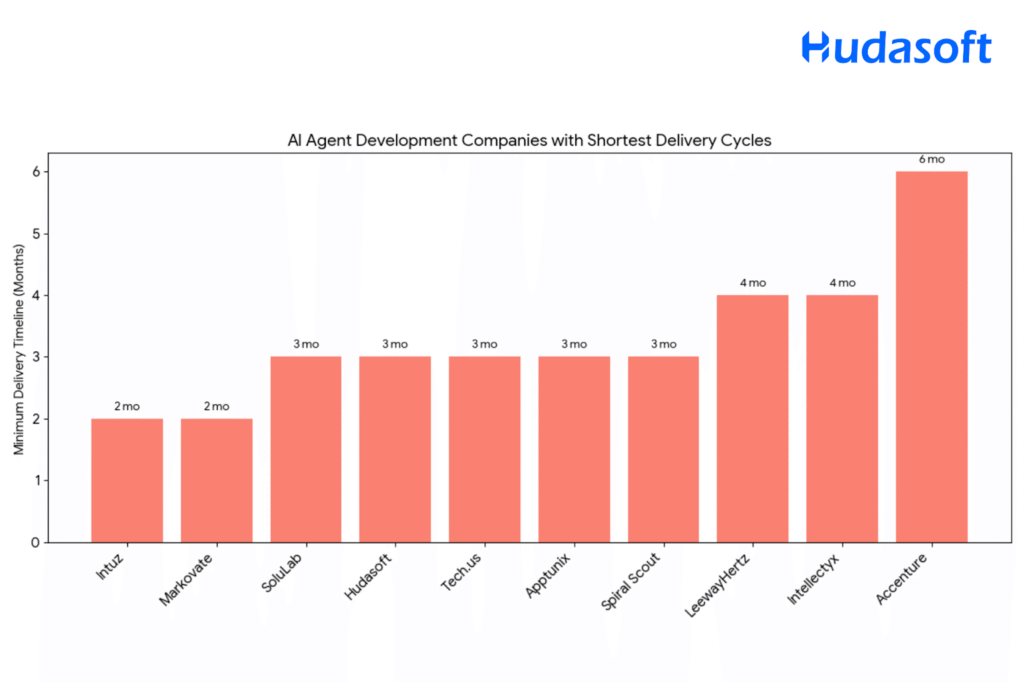
    CompanyBest ForStarting CostDelivery TimelineRating
    HudasoftAutomotive and proptech AI agents$10,000+3-6 months5/5 Clutch
    IntellectyxEnterprise multi-agent systems, GovTech, healthcare$25,000+4-8 months4.8/5 Clutch
    AccentureGlobal enterprise deployments at scale$250,000+6-12+ months3.9/5 Gartner
    LeewayHertzApplication-layer AI agent integration$25,000+4-6 months4.7/5 Clutch
    MarkovateMid-market fintech and healthcare automation$15,000+2-5 months5/5 Clutch
    Tech.usCustom automation for marketing and HR$20,000+3-6 months4.4/5 Techreviewer
    SoluLabArchitecture-first agent builds, Web3, fintech$15,000+3-5 months4.9/5 Clutch
    IntuzAI-first workflow automation, legal, hospitality$10,000+2-4 months4.8/5 Clutch
    ApptunixProduction-ready agents for fintech and healthtech$10,000+3-6 months4.5/5 Clutch
    Spiral ScoutAgentic workflow implementation, e-commerce$20,000+3-6 months4.9/5 Clutch

    Companies were selected based on production deployments, platform ratings, industry specialization, and technical depth.

    What Makes an AI Agent Valuable?

    Before comparing vendors, it helps to agree on what to evaluate. Four dimensions separate agents that deliver results from those that create expensive demos.

    1. Integrations

    An AI agent that cannot connect to your existing tools is not an agent. It is a chatbot. Real agent value comes from:

    • the ability to read from and write to your CRM 
    • trigger actions in your ERP 
    • Query your internal databases
    • browse the web for real-time information 
    • communicate across platforms like Slack or email 

    The best development partners build these integrations through secure, well-documented APIs, and they architect the agent so it can be given new tools over time without requiring a full rebuild.

    2. Trainability

    LLMs know a lot about the world but nothing about your business. Trainability refers to how well a development partner can adapt an agent to your specific context. This includes Retrieval-Augmented Generation (RAG), which feeds the agent your proprietary documents, SOPs, and data at runtime. 

    It also includes fine-tuning, which rewires a model’s behavior for specialized tasks where general-purpose responses create friction. The right AI agent development companies know when to use each approach and can implement both cleanly.

    3. Compatibility

    Compatibility answers the question: Will this agent work within our existing technology landscape? That includes cloud infrastructure (AWS, Azure, GCP), communication and identity layers, data warehouses, and security protocols. A development partner with narrow compatibility forces you to restructure your stack around the agent instead of embedding the agent into your stack. The former approach is costly and organizationally disruptive.

    4. Effectiveness (and What It Actually Means)

    Effectiveness is the most important dimension and the most commonly misrepresented one. It breaks down into five distinct properties:

    • Task Completion Rate: Does the agent finish what it starts? An agent that fails to complete multi-step tasks 40% of the time creates more work than it saves.
    • Accuracy and Hallucination Control: Does the agent produce outputs that are factually correct and grounded in your data? Guardrail systems (such as NeMo Guardrails) are essential here, as is proper RAG implementation that anchors the agent to verified sources.
    • Latency: Speed matters in production. An agent built with right-sized models for each subtask will consistently outperform one that routes every decision through a slow, expensive frontier model.
    • Autonomy with Appropriate Oversight: The best agents handle routine decisions independently and escalate high-stakes ones to humans. This Human-in-the-Loop (HITL) design is not a limitation. It is a feature that keeps businesses safe while still capturing the efficiency gains of automation.
    • Observability: Can you see what the agent did and why? Without tracing tools like LangSmith, debugging agent failures is guesswork. Effective agents come with monitoring infrastructure built in.

    With those four criteria as the benchmark, here is how the top 10 AI agent development companies in the US measure up.

    Which Are the 10 Best AI Agent Development Companies in the US?

    1. Hudasoft

    Marketplace Rating5/5 (Clutch)
    Number of Reviews1-10
    Years in Business7+
    US HQ / Primary HubCarrollton, TX
    Team Size50–249
    Estimated Cost$10,000+
    Delivery Timeline3–6 months
    Industry ExpertiseAutomotive and Proptech

    Hudasoft is an ISO 27001-certified AI agent development company with production-deployed agents in the automotive and proptech sectors. 

    ISO 27001 is an internationally recognized information security standard, and in the context of agentic AI, it carries weight beyond a badge. Agents, by design, read from and write to sensitive systems: inventory databases, customer records, financial transactions, and property management platforms.

    A firm that holds this certification has implemented documented controls around data access, encryption, audit logging, and incident response. That infrastructure is a prerequisite for deploying agents responsibly in any environment where data breaches carry legal or reputational consequences.

    Integrations 

    Domain-specific integration depth in automotive and proptech gives Hudasoft an edge in operationally complex, non-standard environments.

    • Builds against dealer management systems (DMS), telematics APIs, OEM data pipelines, and property listing platforms, not generic API connectors.
    • Engineers understand both the API layer and the underlying business logic, essential when data schemas are non-standard and action consequences are high-stakes.
    • Sector-specific experience transfers directly to other regulated or operationally complex industries that demand the same integration precision.

    Trainability 

    Proven ability to ground agents in private, structured, and often messy proprietary data that no public training dataset covers.

    • Works with internal assets like vehicle configuration databases, dealer-specific pricing rulebooks, and regional property valuation models, entirely absent from any public LLM training corpus.
    • Builds retrieval systems that surface the right internal documents at the right moment, rather than relying on general-purpose model knowledge.
    • Has navigated fine-tuning requirements to make agents reason correctly within domain-specific constraints, which is the central trainability challenge most businesses face.

    Effectiveness 

    Production deployments in two operationally demanding verticals provide evidence of real-world agent durability beyond controlled demos.

    • Automotive and proptech deployments have survived noisy data, unexpected user behavior, edge cases, and integration failures: conditions that break prototype-quality agents.
    • Agents demonstrate task completion under ambiguous instructions, tool failure recovery, appropriate escalation, and sustained accuracy as underlying data changes.
    • Production track record in high-stakes environments is a more credible signal of effectiveness than any benchmark score or demo video.

    For businesses specifically evaluating automotive use cases, the cost of automotive AI agent development is a key variable to understand before committing to a development partner.

    2. Intellectyx Inc.

    Marketplace Rating4.8/5 (Clutch)
    Number of Reviews1-10
    Years in Business15+
    US HQ / Primary HubDenver, CO
    Team Size50–249
    Estimated Cost$25,000+
    Delivery Timeline4–8 months
    Industry ExpertiseGovTech, Healthcare & Finance

    Intellectyx specializes in enterprise-grade agentic AI systems with a focus on multi-agent orchestration and ROI-driven proof-of-concept development. Multi-agent systems are architecturally distinct from single-agent deployments.

    Rather than routing every task through one agent, multi-agent architectures assign specialized sub-agents to distinct parts of a workflow, a researcher, an analyst, a writer, a reviewer, coordinated by an orchestrator. This design reduces hallucination risk on complex tasks, improves throughput, and allows the system to parallelize work.

    Building these systems reliably is significantly harder than building a single-agent solution.

    Integrations 

    Multi-agent orchestration demands a more complex integration topology, and Intellectyx builds the plumbing to manage shared state across specialized sub-agents.

    • Designs integration architecture for multi-agent systems where each sub-agent accesses distinct tools and the orchestrator maintains a consistent view across shared state.
    • Intellectyx uses frameworks, including AutoGen for multi-agent orchestration, which handles agent-to-agent communication, task delegation, and shared memory across specialized sub-agents in complex workflows.
    • Builds tool routing logic and API governance layers to prevent sub-agent conflicts, duplication of work, and state inconsistency across parallel agents.
    • Suited to cross-functional workflows where no single agent can own the entire process, and integration surface spans multiple business systems simultaneously.

    Effectiveness 

    Intellectyx’s multi-agent architecture also improves accuracy on complex tasks by distributing cognitive load, reducing reasoning chain failure points, and isolating sub-task failures.

    • Specialized sub-agents (researcher, analyst, writer, and reviewer), each optimized for one function, outperform single-agent chains on multi-step tasks with many failure points.
    • Failures are easier to isolate and fix in a distributed architecture because each sub-agent’s output is independently observable and correctable.
    • ROI-oriented delivery framing ensures effectiveness is evaluated against business outcomes (cost saved, throughput gained) rather than just model performance scores.

    3. Accenture

    Marketplace Rating3.9/5 (Gartner)
    Number of Reviews50+
    Years in Business35+
    US HQ / Primary HubNew York, NY
    Team Size700,000+
    Estimated Cost$250,000+
    Delivery Timeline6–12+ months
    Industry ExpertiseEnergy & Retail

    Accenture is a global professional services firm with one of the largest AI practices in the world. Their AI agent work sits within a broader intelligent automation capability that spans strategy, implementation, change management, and ongoing optimization.

    For global enterprises deploying agents across multiple business units and geographies, Accenture’s scale and delivery infrastructure are genuine advantages. For smaller or mid-market businesses, the engagement model, including staffing ratios, billing structures, and governance overhead, may introduce costs and timelines that exceed the scope of the project.

    Integrations 

    Unmatched depth across the enterprise software platforms that dominate large organizations, built on decades of direct implementation experience.

    • Deep integration expertise with SAP, Salesforce, ServiceNow, Workday, and the full Microsoft ecosystem: not the out-of-the-box versions, but the client-configured instances that vary significantly in practice.
    • Scale of engagements across thousands of enterprise clients produces an integration knowledge base that smaller firms cannot replicate through any reasonable volume of projects.
    • Preferred partner status with AWS, Azure, and Google Cloud means certified architects across all three major cloud platforms.

    Trainability 

    Frontier model partnerships and decades of proprietary industry data create a trainability advantage that is structurally difficult for smaller firms to match.

    • Early access to OpenAI, Google, and Microsoft model capabilities and fine-tuning infrastructure before general availability gives Accenture a lead on applying the latest model improvements.
    • Proprietary industry data assets accumulated across decades of client work allow agents to be grounded in sector-specific knowledge that no public dataset provides.
    • The combination of frontier model access and deep domain data is most significant for industries where agent accuracy depends on specialized knowledge, including financial services, healthcare, and supply chain.

    Effectiveness 

    Validated at an operational scale across thousands of enterprise processes globally, providing a uniquely large observability dataset on production agent failure modes.

    • Dedicated AI operations teams actively manage deployed agents and track performance against business KPIs over time, not just at delivery.
    • Monitoring infrastructure built from global deployments produces actionable insights about production failure modes that inform ongoing agent improvements.
    • Practical constraint: the operational support model that drives this effectiveness level comes at a cost that may be disproportionate for focused, single-function agent deployments.

    4. LeewayHertz

    Marketplace Rating4.7/5 (Clutch)
    Number of Reviews1-10
    Years in Business15+
    US HQ / Primary HubSan Francisco, CA
    Team Size50–249
    Estimated Cost$25,000+
    Delivery Timeline4–6 months
    Industry ExpertiseFintech, Logistics & Manufacturing

    LeewayHertz builds custom AI agent solutions that embed autonomous decision logic directly into existing business applications. The architectural philosophy here is meaningfully different from firms that build agents as standalone systems. Embedding decision logic at the application layer means the agent operates where the work already happens, inside the software your team uses daily, rather than requiring users to switch contexts to interact with a separate AI interface.

    Integrations 

    Application-layer integration, working within event flows and state management rather than just API surfaces, produces agents that feel native rather than bolted on.

    • Engineers integrate at the application logic level, embedding agents within the event flows, state management, and user interaction patterns of existing software.
    • The team builds on frameworks, including LangChain, which enables modular tool-use, memory management, and chain-of-thought reasoning within the application layer rather than through external API calls.
    • Agents respond to application-level triggers (a user action, a status change, or a threshold crossed) rather than waiting for explicit commands, enabling genuinely reactive behavior.
    • Integration depth means agents have access to the full range of actions a software product supports internally, not just those exposed through its external API.

    Trainability 

    Application-layer access provides richer contextual signals, including user behavior, full record state, and application metadata, that improve training data quality and agent reasoning accuracy.

    • Agents embedded in applications observe user behavior patterns, full record state, and metadata (user role, account tier, and workflow stage) that API-layer agents cannot access.
    • Training examples built on full application context, rather than just retrieved data fields, produce agents that reason more accurately about the right action in each situation.
    • Contextual richness reduces the gap between training-time examples and production-time inputs, improving generalization on real-world edge cases.

    Compatibility 

    Compatibility is evaluated at the application architecture level (framework, data model, and event system) before design begins, preventing late-stage deployment failures.

    • Upfront architectural analysis of each application’s framework, data model, and event system ensures the agent design fits the host application before a line of code is written.
    • Avoids the compatibility failures common when agents are built independently and connected through a thin API layer that cannot support the agent’s full action range.
    • Trade-off: the depth of architectural analysis adds time to the early engagement stages, making this approach less suited to clients requiring rapid initial deployment.

    Effectiveness 

    Embedded application-layer architecture directly improves latency and task completion rate, the two effectiveness dimensions most sensitive to integration depth.

    • Latency improves because the agent accesses context already present in the application rather than making external API calls to retrieve it at task time.
    • Task completion rates are higher because the agent executes actions through native application functions, not an external API that may not expose every capability the software supports.
    • Well-suited to scenarios where agents need to take fast, precise actions within a specific software product with minimal external dependencies.

    5. Markovate

    Marketplace Rating5/5 (Clutch)
    Number of Reviews10+
    Years in Business9+
    US HQ / Primary HubSan Francisco, CA
    Team Size10–49
    Estimated Cost$15,000+
    Delivery Timeline2–5 months
    Industry ExpertiseMid-Market Fintech & Healthcare

    Markovate builds custom agentic workflows and intelligent automation solutions with a primary focus on mid-market clients. Their positioning fills an important gap in the market.

    Large consultancies bring the resources and reputation that enterprise procurement teams require, but their engagement structures, minimum project sizes, staffing ratios, and governance overhead often make them impractical for growing businesses that need capable agents built efficiently.

    Markovate’s mid-market focus means its delivery model is designed to operate at a scale that matches most businesses’ actual needs.

    Integrations 

    Mid-market specialization produces an integration library tuned to the SaaS tools growing businesses actually run, with fewer edge cases because the same platforms are connected repeatedly.

    • Integration experience is concentrated in mid-market SaaS (HubSpot, QuickBooks, Slack, Shopify, and industry-specific platforms) rather than enterprise Oracle and SAP environments.
    • Repeated connections to the same platforms across many client engagements mean the team understands each API’s quirks, rate limits, and data structures in practical detail.
    • Faster integration and delivery with fewer surprises because the team is not encountering these platforms for the first time on each new client project.

    Trainability 

    Custom workflow orientation requires genuine process understanding before agent design begins, producing training that reflects a client’s specific decision rules and exception patterns.

    • Agents are trained on the client’s actual process steps, decision rules, and exception handling patterns, rather than average workflows that perform adequately on generic tasks but fail on high-value specific ones.
    • Custom approach surfaces the idiosyncratic workflows that represent the most valuable automation opportunities for any given business, rather than optimizing for the common case.
    • The agile delivery model allows training iterations to be fast, incorporating client feedback without routing through heavy change management processes.

    Effectiveness 

    Specialization in autonomous decision-making workflows addresses one of the harder agent design problems: calibrating where the agent decides independently versus where it escalates.

    • Focus on autonomous decision-making requires developing a methodology for correctly setting autonomy boundaries, a design problem where errors in either direction create significant operational problems.
    • Custom workflow design means agents are optimized for the specific, high-value decision points in a client’s process rather than generic task completion across average cases.
    • Mid-market orientation keeps delivery timelines and costs proportionate to the value of the automation being built, reducing the ROI pressure that over-engineered deployments create.

    6. Tech.us

    Marketplace Rating4.4/5 (Techreviewer)
    Number of Reviews50+
    Years in Business10+
    US HQ / Primary HubSanta Clara, CA
    Team Size50–249
    Estimated Cost$20,000+
    Delivery Timeline3–6 months
    Industry ExpertiseMarketing & Human Resources

    Tech.us focuses on custom AI agent development and agentic AI solutions for business automation. Their customer-first philosophy means each engagement starts from the client’s specific automation goals rather than from a pre-built agent template. This approach takes more upfront design work but produces agents that are directly matched to the workflows a business needs to automate, rather than being adapted from a general-purpose framework that may not fit cleanly.

    Integrations 

    Custom-first development unlocks every capability a tool’s API exposes, including endpoints, webhooks, and write operations that pre-built connectors restrict or omit.

    • Custom-built agents can use every endpoint a tool’s API exposes, including those that pre-built framework connectors do not cover, and write operations that standard connectors often restrict.
    • Webhook triggers enable real-time responsiveness to tool events, rather than the polling-based integrations that pre-built connectors typically support.
    • Best suited to automation targets requiring complex, multi-step actions within a specific tool, where the functional limitations of pre-built connectors become blockers.

    Trainability 

    Bespoke build process extends to training: data curation, prompt architecture, and retrieval design are all built to serve the client’s specific workflows, not generalized use cases.

    • Training data curation, prompt architecture, and retrieval system design are built from scratch around the client’s workflows, eliminating the problem of agents trained broadly and performing poorly on high-value, specific tasks.
    • Custom training pipelines require more time and client involvement in data preparation, but the investment produces measurably higher accuracy on the tasks the client actually needs automated.
    • Bespoke approach makes it possible to build training pipelines around proprietary data formats, unusual document structures, or domain-specific reasoning patterns that general-purpose training cannot address.

    Effectiveness 

    Automation-focused mandate grounds effectiveness evaluation in operational throughput, including tasks completed, human correction rate, and time saved, rather than abstract model capability metrics.

    • Effectiveness is measured in terms of automation throughput and task success rate relative to the manual process being replaced, not benchmark performance on standardized tests.
    • Custom automation orientation means agents are optimized for the client’s specific high-value workflows rather than general-purpose performance across average tasks.
    • The development process is organized around the metrics that determine business value (completion rate, accuracy, and time savings), which produces agents calibrated for real-world performance from the start.

    7. SoluLab

    Marketplace Rating4.9/5 (Clutch)
    Number of Reviews50+
    Years in Business10+
    US HQ / Primary HubLos Angeles, CA
    Team Size250–999
    Estimated Cost$15,000+
    Delivery Timeline3–5 months
    Industry ExpertiseWeb3, Fintech & Digital Marketing

    SoluLab specializes in AI agent architecture and autonomous agent development. Architecture is the discipline that determines how an agent system is structured: how its components communicate, how its memory is organized, how its tools are invoked, how its failures are handled, and how it scales under load.

    Poor architectural decisions made at the start of an agent project create technical debt that compounds. Agents built on weak foundations are hard to debug, hard to extend, and often require significant rework when they fail in production.

    SoluLab’s architectural focus suggests their teams prioritize these structural decisions rather than optimizing for fast initial delivery at the expense of long-term stability.

    Integrations 

    Architecture-first thinking produces tool-use layers designed to grow: modular, extensible, and structured to add new integrations without re-engineering the agent’s core.

    • Modular connector design with standardized tool interfaces and clean separation between tool logic and agent reasoning makes adding new integrations a configuration task, not a re-architecture.
    • Avoids the common problem of agent integration layers that work for the initial tool set but require significant re-engineering when new integrations are needed later.
    • Long-term integration extensibility reduces the total cost of ownership for clients who expect their agent’s tool set to expand as automation needs evolve.

    Trainability 

    Architectural competency applied to RAG and fine-tuning pipelines produces retrieval systems with a proper chunking strategy, domain-tuned embeddings, and re-ranking rather than basic semantic search.

    • RAG systems are designed with chunking strategies appropriate to the document type, embedding models tuned for the domain, and re-ranking layers that surface contextually relevant results for specific queries.
    • Fine-tuning pipelines are treated as architectural components, with the same design rigor applied to versioning, rollback, and retraining as to the agent’s core logic.
    • Architecture-level RAG design reduces hallucination risk by ensuring the retrieval system surfaces the right context consistently, not just on average.

    Effectiveness 

    Sound architecture improves all five effectiveness dimensions simultaneously: completion rate, accuracy, latency, autonomy calibration, and observability are each strengthened by good structural design.

    • Task completion rates are higher because cleanly separated reasoning and tool-use layers produce fewer cascading failures than monolithic agent implementations.
    • Latency improves through a modular architecture that routes simple subtasks to lightweight models rather than through slow, expensive frontier models.
    • Observability is structurally stronger when dedicated tracing and logging layers are built into the architecture from the start rather than added after deployment to debug scattered log outputs.

    8. Intuz

    Marketplace Rating4.8/5 (Clutch)
    Number of Reviews50+
    Years in Business15+
    US HQ / Primary HubSan Francisco, CA
    Team Size50–249
    Estimated Cost$10,000+
    Delivery Timeline2–4 months
    Industry ExpertiseLegal, Hospitality & E-commerce

    Intuz operates as an AI-first development firm offering advanced AI agents and workflow automation. The AI-first designation is substantive when it reflects how a firm is organized, not just how it markets itself.

    An AI-first team structures its hiring, tooling, and delivery processes around AI capabilities. Engineers are evaluated on LLM integration skills, not just general software development proficiency.

    The firm’s internal processes use the same AI tools they build for clients, which accelerates learning and improves the quality of recommendations. Intuz’s AI-first orientation suggests their team is embedded in the current state of the field in a way that firms treating AI as a practice area within a broader software organization are not.

    Integrations 

    AI-first teams track emerging integration standards, including Model Context Protocol (MCP), and apply them as they mature, producing integration architectures that are more capable and easier to maintain.

    • Current with emerging integration patterns like MCP, which significantly expands tool access through a unified interface compared to bespoke per-tool connectors.
    • AI-first orientation means engineers are building to the current frontier of agent integration infrastructure, not applying patterns that were best practice two years ago.
    • Integration architectures built on modern standards are easier to extend as new tools are added and more maintainable when underlying APIs change.

    Trainability 

    Exclusive focus on AI work builds strong practical intuitions about RAG vs. fine-tuning tradeoffs, embedding model selection, and prompt reliability: intuitions that broad-scope teams lack.

    • Practitioners working exclusively in this domain develop calibrated judgment about when RAG is sufficient versus when fine-tuning is necessary, a decision that generalist developers routinely get wrong.
    • Deep familiarity with which embedding models perform well for which document types and which prompt patterns produce reliable behavior versus brittle behavior that breaks on edge cases.
    • AI-first learning loops, where teams use the same tools internally that they build for clients, accelerate practical knowledge accumulation across a wide range of trainability challenges.

    Effectiveness 

    Workflow automation delivery orientation keeps effectiveness evaluation grounded in operational benchmarks (error rates, throughput, and time-to-completion) throughout development, not just at delivery.

    • Agents are evaluated against operational benchmarks continuously during development, producing better calibration to production conditions before deployment begins.
    • AI-first team structure reduces the knowledge gap between what is technically possible and what is actually built, enabling more sophisticated effectiveness optimizations earlier in the project.
    • Focus on workflow automation ensures effectiveness measurement stays tied to the business process being automated, not abstract model performance metrics.

    9. Apptunix

    Marketplace Rating4.5/5 (Clutch)
    Number of Reviews50+
    Years in Business11+
    US HQ / Primary HubAustin, TX
    Team Size50–249
    Estimated Cost$10,000+
    Delivery Timeline3–6 months
    Industry Expertise Mobile-First Fintech & Healthtech

    Apptunix is recognized for delivering custom, production-ready agentic AI capabilities. The production-ready distinction is one of the most important differentiators in the AI agent market right now, because the gap between demo performance and production performance is wider for agents than for almost any other category of software.

    Agents in production face noisy real-world data, users who interact with them in unpredictable ways, tool failures, rate limits, authentication timeouts, and edge cases that no demo environment replicates.

    A firm that emphasizes production readiness is telling you that its delivery process includes the hardening work required to survive these conditions.

    Integrations 

    Production-ready integration code includes the full suite of resilience engineering (authentication handling, retry logic, graceful degradation, and rate limit compliance) that demo integrations omit.

    • Every integration includes authentication token refresh, exponential backoff retry logic, graceful degradation when external services are unavailable, and detailed interaction logging for post-failure diagnosis.
    • Rate limit compliance is built into the integration layer rather than treated as a deployment concern, preventing agent task flow from breaking under production load patterns.
    • Production-hardened integration code separates integrations that hold up under real conditions from those that fail quietly and create hard-to-diagnose agent behavior.

    Trainability 

    Production-ready delivery extends to training infrastructure: versioning, rollback, and triggered retraining pipelines are built for ongoing operation, not just initial deployment.

    • Training pipelines can be triggered when underlying data evolves, ensuring agent accuracy does not degrade as the business’s data changes after deployment.
    • Versioning systems track model and prompt changes over time, enabling controlled updates and performance comparisons between training iterations in production.
    • Rollback mechanisms allow performance regressions caused by training updates to be reversed quickly without extended downtime or manual re-deployment.

    Effectiveness 

    Production readiness directly strengthens three effectiveness dimensions: task completion, latency, and observability, all of which are most sensitive to real-world infrastructure conditions.

    • Task completion rates improve because agents are tested against the full range of inputs they will encounter in production, not just representative samples from a controlled environment.
    • Latency is optimized using production load testing, which reveals bottlenecks that development-environment testing consistently misses.
    • Monitoring infrastructure is deployed as part of delivery, not added after problems arise, enabling continuous observability from the agent’s first day in production.

    10. Spiral Scout

    Marketplace Rating4.9/5 (Clutch)
    Number of Reviews50+
    Years in Business15+
    US HQ / Primary HubSan Francisco, CA
    Team Size50–249
    Estimated Cost$20,000+
    Delivery Timeline3–6 months
    Industry ExpertiseE-commerce & Capital Markets

    Spiral Scout is a US-based firm providing AI implementation and agentic workflow automation. Their positioning as an implementation partner is strategically distinct. While many firms on this list offer a full spectrum of strategy through build, Spiral Scout focuses on the execution phase. This is valuable for businesses that have already completed their AI agent strategy and need a technically capable team to implement it correctly and efficiently, without paying for strategic advisory work they have already done.

    Integrations 

    Implementation-focused engagements across many clients produce wide, practical API knowledge (undocumented behaviors, rate limit structures, and authentication edge cases) that accumulates through volume.

    • Each engagement requires connecting to the specific tools the client already uses, building practical knowledge of API idiosyncrasies that no documentation captures.
    • Accumulated integration knowledge across many engagements is a practical asset: the workarounds, edge case handling, and reliability patterns that make integrations hold up in production are learned through volume.
    • Implementation orientation means integration work is execution-focused and delivery-accountable, not exploratory; the team has done this before and knows how to do it efficiently.

    Trainability 

    Workflow automation focus shapes training work around downstream process steps so that agents produce outputs in the right format and at the right granularity for what comes next in the workflow.

    • Training considers not just whether the agent produces accurate outputs, but whether those outputs are shaped correctly for the downstream workflow step they feed into.
    • Workflow-aware training prevents the common problem of technically accurate agents whose outputs are in the wrong format or at the wrong granularity for the next process step.
    • Implementation experience across multiple client workflows builds practical knowledge about the training patterns that translate most reliably to operational performance.

    Effectiveness 

    Implementation-focused accountability structure incentivizes building agents that work as specified in production; delivery quality is the primary competitive signal for an execution-oriented firm.

    • The primary value proposition is execution quality, creating direct accountability for production task completion rates and reliability rather than strategic advisory work that precedes delivery.
    • Implementation orientation incentivizes production-hardened agent builds, as the team is evaluated on whether deployed agents work rather than on whether the strategy was sound.
    • Well-suited to businesses with a clear specification that need faithful, efficient execution rather than strategic discovery and iterative redefinition of requirements.

    How to Choose the Right Partner for Your Business

    The companies on this list are all capable. The right choice depends on your specific situation. Here are the questions that will focus your evaluation:

    • What industry are you in? 

    Regulated industries (finance, healthcare, logistics) need partners with security certifications and compliance experience. Hudasoft’s ISO 27001 certification and Intellectyx’s enterprise focus are relevant starting points.

    • What is the scale of your deployment? 

    Enterprise-wide rollouts across global operations suit Accenture’s scale. Mid-market businesses with defined automation goals will likely get better outcomes from more focused partners like Markovate or Apptunix.

    • Do you need strategy or execution? 

    If you are still designing your agent strategy, Hudasoft’s consulting capability and Intellectyx’s POC methodology provide a safe way to learn before committing to full development.

    • How complex is your existing tech stack? 

    Businesses with many legacy systems should prioritize partners with demonstrated compatibility experience. Hudasoft’s and SoluLab’s architecture expertise and LeewayHertz’s native integration approach are strong choices here.

    Final Thoughts

    AI agents are moving from being a novelty to becoming an essential component of a modern business’s tech infrastructure. The businesses that deploy them well in 2026 will compound significant operational advantages over those that wait. But deployment quality depends almost entirely on the development partner you choose.

    Evaluate partners on the four dimensions that determine long-term agent quality. Integrations that connect agents to the tools your business already runs on, trainability that grounds agents in your specific data and workflows, compatibility that ensures smooth deployment in your existing infrastructure, and effectiveness measured across task completion, accuracy, latency, autonomy, and observability.

    Beyond those dimensions, industry alignment is the deciding factor. Every company on this list has demonstrated technical capability. The right choice is the one whose domain experience matches where you operate. 

    Match their capabilities to your requirements, and you will be well-positioned to build agents that deliver results rather than reports.

    Frequently Asked Questions

    What should I look for when evaluating AI agent development companies?

    Look beyond Clutch ratings and pricing decks. The most important signals are production deployments in your industry, not demo videos or case study PDFs. Ask any firm you shortlist for evidence of agents running in live environments, how they handle tool failures and edge cases, and what their RAG and fine-tuning methodology looks like for your specific data. Security certifications like ISO 27001 matter for regulated industries where agents access sensitive systems. Hudasoft holds ISO 27001 certification, one of the few firms on this list that does.

    Which are the top AI agent development companies in the USA in 2026?

    The 10 strongest options for US-based businesses in 2026 are Hudasoft, Intellectyx, Accenture, LeewayHertz, Markovate, Tech.us, SoluLab, Intuz, Apptunix, and Spiral Scout. Each serves a different segment. Hudasoft and Intuz start at $10,000 and suit focused deployments in specific verticals. Accenture starts at $250,000 and suits global enterprise rollouts. The right choice depends on your industry, deployment scale, and tech stack complexity.

    What makes the best AI agent development companies different from generalist software firms?

    The gap shows up in production. Generalist firms treat AI agents as a feature addition to standard software development. Specialist firms design reasoning loops, context memory, tool-use layers, and evaluation pipelines from the ground up. The difference matters most when agents face noisy real-world data, unexpected user behavior, and integration failures that controlled development environments never expose.

    Which AI agent development companies in the USA work best for enterprise deployments?

    Accenture and Intellectyx are the strongest options for enterprise-scale deployments. Accenture brings global delivery infrastructure, preferred partnerships with AWS, Azure, and Google Cloud, and deep integration experience across SAP, Salesforce, and Workday environments. Intellectyx specializes in multi-agent orchestration using AutoGen, which suits complex cross-functional workflows where no single agent can own the entire process.

    How do top AI agent development companies handle production deployment?

    Production deployment requires hardening work that most development timelines underestimate. The strongest firms build authentication token refresh, retry logic, graceful degradation, and rate limit compliance into every integration. They deploy monitoring infrastructure from day one rather than adding it after problems surface. Apptunix and SoluLab specifically emphasize production-ready delivery, which means agents are tested against the full range of real-world inputs before go-live.

    What is the difference between AI agent development companies that build custom systems versus those using off-the-shelf platforms?

    Custom development gives full control over the agent’s data model, tool-use layer, reasoning architecture, and training pipeline. It is the right approach when your workflows are unique, your data is proprietary, or your competitive advantage depends on capabilities that shared SaaS infrastructure cannot support. Off-the-shelf platforms deploy faster but cap what the agent can do at the boundaries of the vendor’s product. For businesses with standard automation needs, platforms like Zapier or Make are sufficient. For businesses with complex, domain-specific workflows, custom development from firms like Hudasoft or SoluLab produces more durable results.

    Which AI agent development companies are best suited for mid-market businesses?

    Markovate and Apptunix are the strongest options for mid-market businesses. Both are designed to operate at a scale that matches growing businesses rather than global enterprises. Markovate’s delivery model is built around mid-market fintech and healthcare workflows, with agile iteration cycles that avoid the governance overhead of larger consultancies. Apptunix emphasizes production-ready delivery at a starting cost of $10,000, which keeps the ROI calculation manageable for businesses that cannot absorb enterprise-level project budgets.

    How long does it take to build and deploy an AI agent?

    Timeline depends on complexity. A focused single-function agent for one workflow typically takes 2 to 4 months from scoping to production. Mid-complexity deployments involving multiple integrations and custom RAG pipelines run 4 to 6 months. Enterprise-grade multi-agent systems with compliance requirements, legacy system integration, and change management can take 6 to 12 months. Firms like Intuz and Markovate consistently deliver in the shorter range. Accenture and Intellectyx operate in the longer range by design. For a full breakdown of timelines by project type, our AI agent development cost guide covers this in detail.

    What data does an AI agent need access to, and how is that data kept secure?

    Agents need access to the data sources relevant to the tasks they automate, which typically includes CRM records, internal databases, product catalogues, SOPs, and communication platforms. The security question is more important than most businesses realize at the scoping stage. Agents that read from and write to sensitive systems require documented access controls, encryption at rest and in transit, audit logging, and incident response protocols. ISO 27001 certification is a reliable baseline indicator that a development firm has implemented these controls formally rather than informally.

    Should we start with a proof of concept or go straight to full development?

    Start with a proof of concept if your use case is unproven, your data readiness is uncertain, or your internal stakeholders need to see results before committing to a full budget. A well-scoped POC runs 4 to 8 weeks and tests one narrow workflow against real data. Intellectyx specifically structures its engagements around ROI-driven POC development for this reason. Go straight to full development only when you have a clearly defined use case, clean data access, and internal alignment on what success looks like.

    How do we know if an AI agent is actually working after it goes live?

    Observability is the discipline that answers this question. A well-built agent deployment includes tracing tools that show what the agent perceived, what actions it took, and why it made each decision. Without this infrastructure, debugging agent failures is guesswork. Key metrics to track post-deployment include task completion rate, error rate, average handle time compared to the manual process it replaced, and cost per interaction. SoluLab and Apptunix both build monitoring infrastructure into their delivery scope rather than treating it as a post-launch add-on.

  • 11 Best iOS App Development Companies in the US (2026 Updated List)

    11 Best iOS App Development Companies in the US (2026 Updated List)

    11 iOS app development companies operating in the US are evaluated in this post by Clutch rating, project pricing, MVP delivery timeline, and vertical specialization, using verified data from Clutch.co and G2 as of Q1 2026.

    Apple held 69% of the US smartphone market in Q4 2025, its highest recorded share, according to Counterpoint Research. iOS users spend 2.5x more per user on in-app purchases than Android users, with the App Store generating $117 billion against Google Play’s $49 billion in 2025, according to Business of Apps.

    The 11 iOS app development firms reviewed here cover the full Apple device ecosystem, including iPhone, iPad, and Apple Watch, across every budget tier from $25,000 MVP builds to $250,000-plus enterprise engagements. Each company is assessed on 6 criteria: team size, US location, verified Clutch rating, project pricing, MVP delivery timeline, and the buyer profile each agency serves best.

    Build native for iOS when your target audience is US-based, your monetization model runs on subscriptions or in-app purchases, and design quality is a measurable retention factor. The company list is ordered by Clutch rating. The selection criteria section immediately below explains how to match your project to the right agency before reviewing the full rankings. 

    Which 11 iOS App Development Companies in the US Are Worth Hiring in 2026?

    This list compiles the 10 best iPhone app development companies that operate within the US region. Each has its own unique strengths. So review the list, evaluate the strengths and specialties and then shortlist the ones whose specialty match your project’s requirements. 

    AgencyTeam SizeLocation(s)Pricing (MVP/Project)Delivery TimelineClutch RatingBest For
    Hudasoft50 – 249Missouri City, TX$40k – $85k4 – 6 Months5.0Custom business apps & long-term Apple ecosystem support.
    TechAhead250 – 500Agoura Hills, CA$60k – $140k5 – 7 Months4.8Enterprise-grade apps & complex system integrations.
    WillowTree1,000+Charlottesville, VA$250k+7 – 10 Months4.9Premium consumer brands where design is a core asset.
    ArcTouch200 – 500San Francisco, CA$100k – $200k4 – 6 Months4.9Experience-first apps with high-end UI/UX requirements.
    AppMakers USA10 – 49LA, NY, San Diego$40k – $85k3 – 5 Months5.0SMBs & startups needing reliable, full-cycle delivery.
    Intellectsoft250 – 500Palo Alto, CA$75k – $160k4 – 7 Months4.9Regulated industries (Finance, Healthcare) & high security.
    Simpalm10 – 50N. Bethesda, MD$25k – $65k3 – 5 Months4.9Budget-conscious orgs needing professional quality.
    Chop Dawg50 – 200Philadelphia, PA$30k – $60k3 – 4 Months4.9Early-stage founders and rapid MVP validation.
    Apptunix200 – 500Austin, TX$30k – $110k3 – 6 Months4.8On-demand marketplaces and delivery service platforms.
    Codiant250 – 500East Moline, IL$40k – $95k4 – 6 Months4.7Full-stack platforms requiring custom backend/API layers.
    DevStory70 – 150Santa Clara, CA$30k – $75k3 – 5 Months5.0Tech-forward startups with unconventional product needs.

    Note: the delivery timelines and prices are estimates aggregated based on data shared by the companies and available on third-party platforms like Clutch and G2. 

    Top iOS app development companies by shortest delivery timeline
    Affordable iOS app development companies

    1. Hudasoft

    • Team Size: 50 – 249 employees.
    • Located In: Missouri City, TX (Houston area).
    • Pricing: $40,000 – $85,000 (Average hourly rate: $50–$75).
    • Delivery Timeline (for MVP): 4 – 6 months.

    Hudasoft builds custom iOS applications at $40,000 to $85,000 per project with a 4 to 6 month MVP timeline, covering the full Apple ecosystem, including iPhone, iPad, Apple Watch, and macOS through its iOS app development services. Their process is oriented toward understanding how a business works before writing a single line of code, which results in apps that fit naturally into existing workflows.

    Their team stays engaged past the launch date, offering ongoing support and iterative improvement as the product evolves and usage grows.

    This approach suits businesses that view their app as a long-term product investment rather than a one-time build. Clients who anticipate needing feature expansions, performance tuning, or architectural changes over time will find a reliable partner here.

    What Does Hudasoft’s Post-Launch Support Cover Across the Apple Ecosystem?

    Hudasoft‘s agile, iterative development model means the product is continuously shaped by real feedback rather than fixed assumptions made at the outset. 

    Businesses benefit from App Store Optimization (ASO) built into the delivery process, which increases organic discoverability and conversion without additional agency spend. Their post-launch maintenance and compatibility management also protect the investment over time, ensuring the app keeps functioning correctly as Apple releases new iOS versions. 

    For businesses that have faced the hidden cost of rebuilding apps that were never designed to scale, Hudasoft’s architecture-first approach directly mitigates that risk.

    Best for: Businesses that need a purpose-built app and a development partner committed to long-term product growth.

    2. TechAhead

    • Team Size: 250 – 500 employees.
    • Located In: Agoura Hills, CA.
    • Pricing: $60,000 – $140,000 (Focuses on enterprise-grade architecture).
    • Delivery Timeline (for MVP): 5 – 7 months.

    TechAhead builds enterprise iOS applications that connect to ERP systems, legacy infrastructure, and enterprise APIs, handling the backend complexity that corporate environments require as a standard delivery scope. Their technical depth covers system integration, security compliance, and the kind of backend complexity that enterprise environments typically require. They are experienced in building apps that connect to legacy infrastructure, ERP systems, and enterprise APIs.

    For organizations where the iOS app is one component of a larger technology ecosystem, TechAhead brings the architectural understanding to make those integrations work reliably.

    How Does TechAhead’s ISO 27001 and SOC 2 Type II Certification Reduce Enterprise Risk?

    TechAhead is ranked #1 globally in Clutch’s Spring 2025 App Development Awards TechAhead and holds ISO 27001 certification alongside SOC 2 Type II compliance, both of which are meaningful credentials for enterprises operating in regulated environments. The company has served over 1,200 global brands, and 500 million-plus daily active users rely on the apps and platforms they have built.

    Businesses gain a partner with genuine enterprise-grade delivery capacity, transparent pricing, and dedicated teams spanning the US and India. Their approach emphasizes long-term scalability, security, and performance so that custom solutions continue to deliver value as the organization grows. 

    For enterprises that have experienced the disruption of vendors who over-promise and under-deliver on complex integrations, TechAhead’s structured systems-level methodology offers a credible alternative.

    Best for: Enterprise organizations building iOS apps that need to integrate with existing corporate systems at scale.

    3. WillowTree

    • Team Size: 1,000+ employees.
    • Located In: Charlottesville, VA (HQ); New York, NY; Columbus, OH.
    • Pricing: $250,000+ (Premium agency; rarely takes projects under $200k).
    • Delivery Timeline (for MVP): 7 – 10 months (Extensive discovery and strategy phases).

    WillowTree builds iOS apps for established consumer brands where the product experience is a primary revenue variable, running UX research, interaction design, and product strategy as mandatory phases before development begins.

    Their pricing reflects this level of investment, and the agency is best suited for organizations that understand design quality as a business asset. For consumer apps where how the product feels is as important as what it does, WillowTree delivers at a high standard.

    WillowTree positions itself at the premium end of the market and produces digital products for established, recognizable brands. Their work reflects a serious investment in user experience research, interaction design, and product strategy alongside the development itself. The result is consumer-facing apps where the experience itself carries brand value.

    Their pricing reflects this level of investment, and the agency is best suited for organizations that understand design quality as a business asset. For consumer apps where how the product feels is as important as what it does, WillowTree delivers at a high standard.

    What Results Have WillowTree’s iOS Apps Delivered for Brands Like Marriott and PepsiCo?

    WillowTree partners with the world’s most customer-centric brands to help them orchestrate winning experiences that are personalized, on-brand, and consistent across channels and platforms, driving customer delight while reducing operating costs. 

    Their client roster includes T-Mobile, Marriott, PepsiCo, FOX Sports, and Domino’s. A concrete example of the results they produce: after WillowTree developed an interactive app for National Geographic, the publication saw a 600% increase in the amount of time visitors spent watching videos. WillowTree carries an industry-leading Net Promoter Score of 70+, and clients consistently highlight the value delivered through strong project management and quality outputs. For brands where the digital product is directly tied to customer loyalty and revenue, this caliber of outcome justifies the investment.

    Best for: Premium consumer apps where design excellence and brand experience are central to the product’s success.

    4. ArcTouch

    • Team Size: 200 – 500 employees.
    • Located In: San Francisco, CA (HQ); New York, NY; Austin, TX.
    • Pricing: $100,000 – $200,000 (Known for high-end UI/UX focus).
    • Delivery Timeline (for MVP): 4 – 6 months.

    ArcTouch eliminates the interface-implementation mismatch that occurs when design and engineering run as separate sequential handoffs by operating both disciplines inside a single integrated team throughout the build. This integrated structure reduces the friction that typically occurs when visual design and technical implementation are handled by different groups, producing a more cohesive final product.

    Their focus on experience-driven development makes them particularly well-suited to apps where the interface complexity is high, where user interaction patterns are nuanced, or where the quality of the UI directly affects retention and engagement metrics.

    What Makes ArcTouch’s Integrated Design and Engineering Model Different from Sequential Handoffs?

    ArcTouch develops product strategies through user research and technology assessments, then applies its expertise in UX and UI design and software development to create native mobile applications, responsive websites, custom APIs, and other products that meet the specific software needs of each client. 

    ArcTouch is a long-term partner of 3M, HP, and Salesforce, and is part of the WPP network, which gives clients access to global resources and organizational stability. Their work with Audi and Hawaiian Airlines demonstrates the range of their portfolio, from automotive digital experiences to travel and hospitality platforms. 

    Their development process is driven by design thinking and agile methodologies, which allows them to respond quickly to changes and deliver high-quality results within tight deadlines. Businesses that have launched apps with poor UI coherence and suffered the consequence in user retention will recognize the structural advantage of ArcTouch’s integrated model.

    Best for: Experience-first apps where UI and UX quality are primary measures of product success.

    5. AppMakers USA

    • Team Size: 10 – 49 employees.
    • Located In: Los Angeles, CA; New York, NY; San Diego, CA.
    • Pricing: $35,000 – $80,000 (Competitive for boutique service).
    • Delivery Timeline (for MVP): 3 – 5 months.

    AppMakers USA operates as a 30-person boutique covering the full iOS project lifecycle from discovery through App Store submission within a single fixed-scope engagement. Their process is built around predictable delivery timelines and clear communication, which makes them a practical fit for smaller businesses and startups that need to ship on schedule without the overhead of managing a large agency relationship.

    Their scope covers the full project lifecycle, so clients work with one team from initial requirements through to a live product, reducing the coordination burden on the client side.

    How Does AppMakers USA Deliver Dual Platform iOS and Android Builds Within a Single Budget?

    AppMakers USA is an award-winning firm of 30 experts that specializes in delivering quality apps on time and on budget, with engineers holding backgrounds from MIT, Stanford, and UCLA.  Their client portfolio spans from enterprise-level companies like CVS Pharmacies and the NFL to early-stage founders, which signals genuine range across project types and budgets. AppMakers USA specializes in building cross-platform apps for both iOS and Android, effectively offering two-platform delivery for the price of one, and brings technical transparency into the decision-making process throughout the engagement. 

    For small and mid-sized businesses where budget control is a real constraint and scope creep is a common fear, AppMakers’ fixed-scope, on-time model directly addresses those concerns.

    Best for: SMBs and startups that need reliable, full-cycle development with predictable timelines.

    6. Intellectsoft

    • Team Size: 250 – 500 employees.
    • Located In: Palo Alto, CA (HQ); Miami, FL; New York, NY.
    • Pricing: $75,000 – $160,000 (High focus on security and compliance).
    • Delivery Timeline (for MVP): 4 – 7 months.

    Intellectsoft builds iOS apps for organizations where data handling requirements, security governance, and system integration complexity exceed what standard development processes are designed to handle. Their strengths include security standards compliance, backend system integration, and building applications that meet the governance requirements of industries like finance, healthcare, and logistics.

    For products that need to connect with complex existing infrastructure or that operate under strict data handling requirements, Intellectsoft brings relevant experience and a development approach calibrated to those constraints.

    What Compliance Frameworks Does Intellectsoft Support for Regulated Industry iOS Apps?

    Intellectsoft’s client portfolio includes brands like Eurostar, Harley-Davidson, and Universal Pictures, and their strength lies in translating complex technological possibilities into tangible business benefits, ensuring that innovative features enhance rather than complicate the user experience. 

    They operate an Enterprise Innovation Lab where clients can prototype experimental features before committing to full-scale development, reducing the risk of costly course corrections after production has begun. Intellectsoft designs native and cross-platform iOS and Android apps, providing UX design and automated testing services, and can tailor its approach to help businesses complete software integrations, embrace new technologies, and manage mobile devices across the organization. 

    For enterprises in regulated industries where a security breach or compliance failure carries serious legal and reputational consequences, Intellectsoft’s specialized posture provides tangible risk reduction.

    Best for: Corporations and well-funded startups with complex integration requirements or regulated industry compliance needs.

    7. Simpalm

    • Team Size: 10 – 50 employees.
    • Located In: North Bethesda, MD (HQ); Chicago, IL; Tysons, VA.
    • Pricing: $25,000 – $65,000 (Best value for small to mid-market).
    • Delivery Timeline (for MVP): 3 – 5 months.

    Simpalm applies multi-industry development experience across healthcare, government, logistics, and retail to reduce the discovery overhead and learning curve that typically inflate project costs at the start of an engagement. Their work spans multiple industries, and they have built a track record for consistent delivery and client communication.

    Their breadth of industry experience also means they bring relevant context to a wide variety of project types.

    How Does Simpalm Deliver Professional-Grade iOS Apps at the $25,000 to $65,000 Price Point?

    Simpalm delivers professional-grade iOS development at accessible pricing, which makes the economics of app development viable for organizations that would otherwise struggle to justify the cost of a larger agency. Their multi-industry experience means they enter most engagements with relevant prior context, which shortens the learning curve and reduces the discovery overhead that often inflates project costs elsewhere. 

    For budget-conscious businesses, the combination of reliable delivery and quality output is the core value proposition: they get a finished, functional iOS product that meets professional standards without paying for premium-agency overhead they do not need.

    Best for: Organizations with constrained budgets that require dependable, professional-quality iOS development.

    8. Chop Dawg

    • Team Size: 50 – 200 employees.
    • Located In: Philadelphia, PA.
    • Pricing: $30,000 – $60,000 (Typically operates on a fixed monthly “pay-as-you-go” model).
    • Delivery Timeline (for MVP): 3 – 4 months (Agile-first, MVP focus).

    Chop Dawg structures every iOS engagement around the specific challenges of early-stage product development: moving fast, making pragmatic technical decisions, and helping founders validate assumptions before committing to full-scale architecture. They are experienced in building MVPs and first-version products, which requires a particular mindset: moving quickly, making pragmatic technical decisions, and helping founders validate assumptions before investing in full-scale development.

    Beyond the build, they offer product guidance that is valuable for founders who are still shaping their product as they go. This combination of speed, flexibility, and strategic input makes them a natural fit for the early stages of a startup’s product journey.

    How has Chop Dawg maintained a 92% Client Retention Rate Across 500 iOS Apps Since 2009?

    Since 2009, Chop Dawg has launched over 500 apps that have impacted more than a billion users worldwide, and their 92% client retention rate reflects the long-term partnerships they build, with most clients continuing to work with them well beyond the initial project. Every project includes a dedicated project manager, daily Slack communication, weekly Zoom meetings, and comprehensive documentation, and clients always know exactly what to expect through fixed-monthly-rate pricing and clear timelines.  

    For first-time founders, the strategic guidance Chop Dawg provides alongside the build is often as valuable as the product itself. Multiple clients have cited Chop Dawg’s ability to think through business implications, ask insightful questions, and improve the product beyond the technical scope of the original brief. Chop Dawg Founders who have wasted development budgets on agencies that built without understanding the business will recognize the difference this orientation makes.

    Best for: Early-stage startups building MVPs and founders who need both execution and product input in parallel.

    9. Apptunix

    • Team Size: 200 – 500 employees.
    • Located In: Austin, TX.
    • Pricing: $30,000 – $110,000 (Specialized in marketplaces and on-demand).
    • Delivery Timeline (for MVP): 3 – 6 months.

    Apptunix has resolved the recurring architectural challenges of on-demand iOS development, including real-time tracking, driver-rider and vendor-buyer matching logic, and the infrastructure required to handle peak demand, across multiple deployed platforms. This specialization means they have already worked through many of the architectural and feature challenges that are common to this type of product, including real-time tracking, dynamic pricing logic, and multi-sided user flows.

    For teams building in the on-demand space, Apptunix brings proven patterns and solutions rather than building from scratch.

    Best for: Consumer apps in the on-demand and marketplace space that need to scale efficiently.

    What On-Demand iOS App Features Does Apptunix Build as Standard Delivery Components?

    Apptunix’s deep focus on the on-demand category means businesses benefit from a team that has already solved the hard problems specific to this type of product: real-time geolocation, driver-rider or vendor-buyer matching, dynamic pricing, and the infrastructure needed to handle peak demand. Apptunix deploys apps with real-time geolocation, dynamic pricing logic, and multi-sided user flows as standard delivery components. 

    For businesses entering competitive on-demand verticals where time to market directly affects market share, partnering with a team that already knows this product category eliminates the costly experimentation that generalist agencies would require.

    10. Codiant

    • Team Size: 250 – 500 employees.
    • Located In: East Moline, IL.
    • Pricing: $40,000 – $95,000 (Comprehensive full-stack pricing).
    • Delivery Timeline (for MVP): 4 – 6 months.

    Codiant owns the full technical stack on every iOS engagement, building the mobile front-end, server architecture, database layer, and API infrastructure within one team rather than distributing those responsibilities across separate vendors. This includes server architecture, database design, and API development alongside the mobile application itself. Having a single team own the full stack reduces integration risk and simplifies communication throughout the build.

    For businesses that need a complete, deployable platform rather than a mobile app that connects to separately managed infrastructure, Codiant provides a coherent end-to-end solution.

    How Does Codiant’s Full Stack Model Eliminate Integration Risk Between iOS Frontend and Backend?

    Codiant is known for its full-cycle development approach covering everything from ideation and design through deployment, maintenance, and continuous feature updates, and their strength lies in listening to user feedback and translating it into actionable improvements, helping mid-market companies stay competitive with platforms that remain fresh, user-friendly, and scalable. 

    By managing the entire stack, Codiant eliminates the finger-pointing and integration failures that commonly occur when separate vendors own the front-end and the backend. A client testimonial captured in verified reviews summarizes the practical outcome: Codiant’s ongoing support has been described as invaluable, with the platform improving continuously based on user feedback and market changes. For businesses that have experienced the operational disruption of managing multiple vendors for a single product, consolidating under one team carries significant organizational value.

    Best for: Businesses that require a complete integrated platform, including backend infrastructure and API layers, alongside the mobile app.

    11. DevStory

    • Team Size: 70 – 150 employees.
    • Located In: Santa Clara, CA (US Operations).
    • Pricing: $30,000 – $75,000 (Flexible startup-friendly pricing).
    • Delivery Timeline (for MVP): 3 – 5 months.

    DevStory takes on iOS projects that fall outside standard development templates, where the product sits in an emerging category, requires original architectural thinking, or does not map cleanly to the established playbooks most agencies default to. Their emphasis is on flexibility, creative technical problem-solving, and a willingness to work outside standard templates. They are suited to projects that require original architectural thinking or that sit in emerging product categories where established playbooks are limited.

    For founders building something that does not fit a familiar mold, DevStory brings the adaptability and technical creativity that those projects demand.

    What Types of Non-standard iOS Projects Has DevStory Successfully Delivered?

    DevStory’s primary value is architectural flexibility, the ability to make technology decisions based on what the product requires rather than what the team already knows how to build. Startups building in emerging categories often find that standard development workflows create friction rather than reducing it: rigid processes, fixed feature scopes, and technology choices driven by familiarity over fit. 

    DevStory’s orientation toward innovation means that architectural decisions are driven by the product’s actual needs, not by what a team already knows how to build. For founders whose product sits at the edge of what existing platforms support, this orientation directly affects whether the final product actually works as intended at scale.

    Best for: Startups with non-standard or technically complex product requirements that call for a flexible, innovation-oriented development team.

    Which iOS App Development Companies Deliver the Fastest MVP Timelines in 2026?

    5 iOS app development companies on this list deliver verified MVP builds within 3 to 6 months, making them the strongest options for businesses that need to reach the App Store within a defined window.

    Chop Dawg delivers MVPs in 3 to 4 months on a fixed monthly pricing model, making it the fastest option on this list for founders who need to validate a product concept before committing to a full-scale build.

    AppMakers USA completes full-cycle iOS builds in 3 to 5 months, covering discovery, design, development, and App Store submission within a single engagement.

    Simpalm delivers iOS MVPs in 3 to 5 months at the lowest starting price point among the 11 companies reviewed here, making it the strongest option for budget-conscious businesses that need professional quality within a tight timeline.

    DevStory targets a 3 to 5 month delivery for non-standard and technically complex iOS projects that fall outside the scope of standard development templates.

    Hudasoft delivers MVPs in 4 to 6 months, covering the full Apple ecosystem, including iPhone, iPad, and Apple Watch, within that timeline. The additional scope relative to single-device MVP accounts for the extended delivery window.

    For comparison, enterprise-tier iOS app development companies on this list, including WillowTree and TechAhead, run 5 to 10 month timelines due to UX research phases, product strategy sessions, and enterprise integration requirements. These timelines reflect the complexity of the projects they take on, not delays in delivery.

    Which iOS App Development Companies Provide Reliable Post-Launch Maintenance and iOS Update Support?

    Apple releases 2 to 3 major iOS updates annually. Each update requires app compatibility testing, API reviews, and in some cases, architectural changes to maintain App Store compliance. iOS app development companies that do not offer structured post-launch support transfer that cost and risk directly back to the client after delivery.

    3 companies on this list include explicit post-launch maintenance as a verified component of their delivery model.

    Hudasoft offers ongoing support and iterative improvement as a named service, covering iOS version compatibility management across iPhone, iPad, and Apple Watch as Apple releases new system updates.

    Chop Dawg structures all engagements on a fixed monthly model that extends naturally into post-launch support. Its 92% client retention rate across 500-plus apps since 2009 is the most verifiable indicator of long-term client relationships on this list.

    Codiant includes continuous feature updates and iterative improvements based on user feedback as part of its delivery approach, with client reviews citing ongoing support as a primary reason for continued engagement.

    Before signing with any iOS app development companies, confirm 3 post-launch terms in writing: who is responsible for iOS version compatibility on each major Apple release, what the response time is for critical bug fixes, and whether maintenance is included in the project price or billed separately at an hourly rate.

    How to Select the Right Agency for iOS Development?

    Choosing the right iOS app development companies is essential for building successful, user-centric applications. 

    The criteria for evaluating and selecting the right agency ultimately come down to a few key specifics: the industries a particular agency specializes in, the regions it has developed apps for (every region has different compliance regulations), the complexity of the applications they develop, and what customers find the most valuable in that agency. 

    Which Industry Portfolios Should You Verify Before Hiring iOS App Development Companies?

    iOS app development companies without prior deployments in your vertical carry measurably higher delivery risk than those with 10 or more completed projects in your sector. A fintech iOS app operates under different compliance requirements, data handling obligations, and user behavior patterns than a healthcare platform or an on-demand marketplace. Reviewing the wrong portfolio during shortlisting is the single most common cause of misaligned agency selection.

    Verify 3 things in each agency’s portfolio before shortlisting: completed iOS apps in your specific vertical, not adjacent ones; named clients with verifiable App Store listings; and post-launch performance data such as retention rates, download volume, or revenue outcomes if the agency discloses them.

    Among the 11 iOS app development companies reviewed here, Intellectsoft covers finance, healthcare, and logistics with ISO 27001 and SOC 2 Type II certification as standard. Apptunix specializes in on-demand marketplaces and delivery platforms. TechAhead covers enterprise mobility across corporate and institutional clients. Hudasoft covers custom business applications with long-term Apple ecosystem support across multiple industries.

    How Does Regional Portfolio Experience Affect iOS App Compliance and Delivery Quality?

    iOS apps targeting US users must comply with Apple’s App Store Review Guidelines, App Tracking Transparency requirements introduced in iOS 14.5, and any sector-specific regulations such as HIPAA for healthcare apps and PCI-DSS for payment-enabled platforms. iOS app development companies without a US-market delivery record may not have resolved these compliance requirements in a live App Store submission context.

    All 11 iOS app development companies reviewed in this post have delivered verified projects for US-based clients. If your app targets international markets beyond the US, verify each agency’s portfolio for deployments in your specific target regions before shortlisting. European deployments require GDPR compliance. Healthcare apps in Canada operate under PIPEDA. Financial apps in the UK fall under FCA guidelines.

    Ask each agency directly: how many App Store submissions have you completed for apps targeting this specific market, and what compliance frameworks did those submissions satisfy?

    How Do You Match Your Project Complexity to the Right iOS App Development Companies?

    iOS app complexity falls into 3 categories, each requiring a different agency capability profile.

    Simple apps include single-function tools, content display apps, and basic booking or scheduling platforms with no backend integration. These projects suit agencies in the $25,000 to $60,000 range with 3 to 4 month delivery timelines.

    Mid-complexity apps include multi-sided platforms, apps with real-time functionality such as geolocation or live tracking, and products requiring third-party API integrations. These projects require agencies with verified backend development capability and delivery experience in your product category.

    Complex apps include enterprise platforms connecting to ERP systems or legacy infrastructure, regulated industry apps with security certification requirements, and premium consumer products requiring extensive UX research and product strategy phases before development begins. These projects require agencies with ISO 27001 or SOC 2 Type II credentials, dedicated project management, and delivery timelines of 5 months or more.

    Match your project to the right complexity tier first. Then use the comparison table above to identify which iOS app development companies operate within that tier before requesting a scoping call.

    How Do Pricing Tiers Differ Across US iOS App Development Companies?

    iOS app development companies in the US operate across 3 distinct pricing tiers. Each tier maps to a specific project type, compliance requirement, and delivery scope. The comparison table above shows the verified price ranges for all 11 companies reviewed in this post.

    Tier 1: MVP Builds and Custom Business Applications

    This tier covers standard feature sets with no enterprise-scale architecture requirements. It suits startups validating a product concept, SMBs building a first iOS app, and businesses that need a functional, deployable product within a defined budget. Delivery timelines at this tier run 3 to 5 months.

    Tier 2: Complex Integrations and Regulated Industry Platforms

    This tier covers iOS apps with multi-sided user flows, backend system integrations, or compliance requirements specific to finance, healthcare, and logistics. Security credentials such as ISO 27001 and SOC 2 Type II are standard at this tier. Delivery timelines extend to 4 to 7 months.

    Tier 3: Enterprise Grade Platforms and Premium Consumer Apps

    This tier covers projects where design quality, brand experience, and system integration are primary business requirements. Agencies at this tier include extensive UX research, product strategy, and discovery phases before a single development sprint begins. Delivery timelines run 7 to 10 months.

    Select a pricing tier based on 3 variables: your app’s feature complexity, the compliance requirements of your industry, and whether post-launch support is included in the project price or billed separately. Confirm all three with each agency before the scoping call.

    Final Thoughts

    Selecting from a shortlist of verified iOS app development companies is faster than evaluating the entire market. Use the 4 criteria above to eliminate agencies whose specialization, regional portfolio, or complexity range does not match your project. Take the remaining two or three to a scoping call and ask each one for iOS-specific code samples, App Store submission history, and client references within your vertical and budget range.

    Every company on this list holds a verified Clutch rating of 4.7 or above. The differentiator between them is not quality but fit.

    Businesses building custom iOS apps in the $40,000 to $85,000 range, with a need for post-launch support and full Apple ecosystem coverage across iPhone, iPad, and Apple Watch, are the specific buyer profile Hudasoft is built for. That fit, combined with a 5.0 Clutch rating and a 4 to 6 month MVP delivery timeline, is why it sits at position 1 on this list. If your project requires a broader mobile strategy beyond iOS, review Hudasoft’s mobile app development services to evaluate cross-platform scope and delivery model.

    Frequently Asked Questions About iOS App Development Companies in the US

    How much do iOS app development companies in the US charge in 2026?

    iOS app development companies in the US charge between $25,000 and $250,000-plus per project in 2026, based on verified pricing data from Clutch.co. The $25,000 to $85,000 range covers MVP builds and custom business applications. Regulated industry platforms and enterprise-grade iOS apps with complex integrations start at $85,000 and scale above $160,000 for premium consumer products.

    Which are the best iOS app development companies in the USA?

    The best iOS app development companies in the USA differ by project type. Hudasoft leads for custom business apps at $40,000 to $85,000 with a 5.0 Clutch rating. WillowTree leads for premium consumer brands at $250,000-plus. Chop Dawg leads for early-stage MVPs at $30,000 to $60,000. Intellectsoft leads for regulated industries requiring ISO 27001 and SOC 2 Type II certification.

    How long do iOS app development companies take to build an app?

    iOS app development companies in the US deliver MVPs in 3 to 6 months and full enterprise platforms in 7 to 10 months. Chop Dawg and Simpalm deliver in 3 to 4 months. Hudasoft, AppMakers USA, and DevStory deliver in 4 to 6 months, covering the full Apple ecosystem, including iPhone, iPad, and Apple Watch. WillowTree and TechAhead require 7 to 10 months for enterprise-grade projects with extensive UX research and system integration phases.

    What should I look for when comparing iOS app development companies?

    Evaluate iOS app development companies on 4 criteria: industry portfolio depth in your vertical, Apple technology stack proficiency in Swift and SwiftUI specifically, post-launch iOS version compatibility coverage, and security credentials for your compliance requirements. Verify each criterion with iOS-specific code samples, App Store submission history, and client references before shortlisting.

    Which iOS app development companies provide post-launch maintenance?

    Hudasoft, Chop Dawg, and Codiant include verified post-launch maintenance as part of their delivery model among the 11 iOS app development companies reviewed here. Chop Dawg holds a 92% client retention rate across 500-plus apps since 2009. Confirm post-launch terms in writing before signing: iOS version compatibility, ownership, critical bug fix response times, and whether maintenance is included or billed separately.

    Which iOS app development companies work with startups?

    5 iOS app development companies on this list serve startups specifically: Chop Dawg ($30,000 to $60,000, 3 to 4 months), AppMakers USA ($35,000 to $80,000, 3 to 5 months), Simpalm ($25,000 to $65,000, 3 to 5 months), DevStory ($30,000 to $75,000, 3 to 5 months), and Hudasoft ($40,000 to $85,000, 4 to 6 months) for startups that need full Apple ecosystem coverage and post-launch support built into the engagement from day one.

    Do iOS app development companies also build for iPad and Apple Watch?

    Not all iOS app development companies cover the full Apple device ecosystem by default. Among the 11 companies reviewed here, Hudasoft explicitly covers iPhone, iPad, Apple Watch, and macOS within a single engagement. Confirm ecosystem scope, including watchOS and iPadOS coverage, with each agency before scoping, as multi-device development adds to both timeline and cost.

  • Top Mobile App Development Companies in the USA (2026 Updated List)

    Top Mobile App Development Companies in the USA (2026 Updated List)

    If you are looking for the top mobile app development companies in the USA in 2026, this guide gives you a verified, data-backed list to help you make the right choice. The mobile app development industry in the USA has evolved significantly in 2026, with AI integration, cross-platform frameworks, and MVP-first delivery becoming the new standard expectations from any serious development partner.

    Around 83% of U.S. enterprises have already adopted mobile apps. For small businesses, the adoption percentage is still fairly low, around 30%. The main reason behind this hesitation is the perceived complexity. They associate app development with immense timelines and heavy budget allocation and a need for in-house technical expertise, all of which feels impossible within the resources small businesses typically have at hand.

    But businesses that adopted mobile apps report up to a 40% increase in efficiency and productivity, along with a reduction in overheads. So if you are a small business considering it, 2026 is the right time to get started. 

    So if you are a small business considering it, now is the time to get started. But how do you go about developing an app? You have the option to hire an in-house team. But this is expensive and time-consuming, and if technology offerings aren’t your primary revenue source, the ROI is often not justifiable.

    Freelancers are also impractical. Why? Because app development is a complex project. It requires a team of project managers, engineers, QAs, developers, and UI/UX designers. This means you have to independently hire and vet each resource. That in itself is a challenge. But to make it even harder, you also have to make them work together. Sounds next to impossible! 

    So the only practical option is to work with mobile application development companies in the USA. However, not all development agencies are the same. When you are investing your capital into a project, you need to make sure you are choosing the right option. 

    This blog will help you do exactly that. It lists the best development companies that you can collaborate with if your business is based in the USA or you are looking to expand into the US market. Go over the list to discover your options.

    Why Rely on This List?

    We have compiled this list of app development companies in the USA after rigorous evaluation across criteria that matter for businesses. The evaluation relies on publicly verifiable data and platform-authenticated reviews. Here are the main metrics that each of the mentioned companies is evaluated on:

    Clutch and G2 Ratings and Reviews 

    This gives you the user’s perspective and gives you the feel of what it is like to work with them as a client. 

    They are pulled directly from their respective platforms. Both platforms verify reviews through LinkedIn authentication or structured phone interviews with clients, which makes them considerably more reliable than open review aggregators.

    Location (City and State) 

    It tells you where the company is based, so you know if they are aware of the local compliance practices. The data for this metric was confirmed via the “Contact” pages of each firm’s official website.

    Team Size 

    The team size, on the other hand, tells you about the pace you can expect the company to deliver at. It is directly tied to their commitment to deadlines, because having enough resources is key to delivering on time. It also determines the quality, because with enough diversity in resources, better quality can be expected, especially if there is expertise in the team for every requirement that your software requires.

    It was sourced from LinkedIn and Clutch profiles. Companies report these figures themselves, typically in ranges (e.g., 50 to 249 employees) rather than exact headcounts.

    Common Positive Points 

    These were identified by scanning the Pros sections and full review text of the 10 to 50 most recent reviews on Clutch and Google. A theme was only highlighted if it appeared consistently across the majority of reviews, not just in a few outliers.

    Specialty 

    The specialty tells you what the company’s main area of expertise is, and whether you should contact that company for your specific application idea. Despite the positive reviews, clients, and everything else, if what you want is not what they specialize in, you must move on to the next prospect.

    Hourly Rates

    Hourly rates help you estimate the cost of development. The values mentioned in this guide are estimated ranges. The figures here are drawn from the verified ranges these firms self-report to industry directories like Clutch and GoodFirms, and they represent typical billing rates for standard contracts. Actual costs may shift based on the seniority mix of the team assigned to your project.

    The list also mentions how long each company has been in business, to help you evaluate the experience, and the major clients these mobile app development companies have served, for added social proof. 

    Top Mobile App Development Companies in the USA — At a Glance 

    CompanyRatings (Clutch/Google)Location & Team SizeHourly RateMajor ClientsBest For…Target Client Size
    Hudasoft4.9 / 4.9Dallas/Houston, TX (50–199)$25–$49Uber Sheets, QaryaFast-tracked MVPs and AI-driven automation.Small Business & Mid-Sized
    Appinventiv4.8 / 4.7NY (1,000+)$25–$49KFC, Adidas, IKEAScalable AI, blockchain, and high-volume digital engineering.All (Startups to Enterprise)
    App Makers USA5.0 / 4.9San Diego, CA (10–49)$100–$149NFL, CVS, LA ApparelStraightforward consumer apps and custom CRM integrations.Small Business
    ArcTouch4.9 / 4.8San Francisco, CA (250+)$100–$149NBC, 3M, SalesforceIoT, voice integration, and high-fidelity connected experiences.Mid-Sized & Enterprise
    GojiLabs5.0 / 5.0Los Angeles, CA (10–49)$100–$149WHO, RooterStrategic product thinking for Healthcare and Fintech.Small Business & Mid-Sized
    Liquid Tech5.0 / 4.6Houston, TX (50–249)$50–$99Fortune 500 PartnersAI automation and complex backend systems for logistics.Mid-Sized & Enterprise
    Fueled4.8 / 4.5New York, NY (250–999)$150–$199Apple, Disney, NYTPremium, design-first consumer brands and e-commerce.Mid-Sized & Enterprise
    WillowTree4.9 / 4.7Charlottesville, VA (1,000+)$150–$199HBO, Fox, PepsiCoHigh-traffic platforms requiring extreme reliability at scale.Enterprise
    ScienceSoft4.8 / N/AMcKinney, TX (750+)$50–$99NASA, IBM, WalmartLegacy integration and highly regulated (HIPAA) software.Enterprise
    Mercury Dev5.0 / 4.9Stuart, FL (450–500)$50–$99Fitbit, Google, TonalHardware integration, BLE, and native mobile performance.Mid-Sized & Enterprise

    Most Affordable mobile app development agencies in the US

    If you are looking to find budget-friendly mobile app development companies, then here are your options, organized from the lowest (leftmost) to the highest(rightmost) hourly rates. 

    Affordable mobile app development agencies in the US

    Top-Rated Mobile App Development Companies in the USA

    Best-rated mobile app development companies in the US

    What Technologies Do Top Mobile App Development Companies in the USA Use?

    Before picking a development partner, it helps to know what technology they will actually use to build your app. The top mobile app development companies in the USA typically work with one of two approaches: native development or cross-platform development.

    Native Development means building a separate app for iOS and Android using platform-specific languages. iOS apps are built in Swift or Objective-C, and Android apps are built in Kotlin or Java. Native apps deliver the best performance and the most seamless user experience, but they cost more because you are essentially building two apps at the same time.

    Cross-Platform Development means writing one codebase that runs on both iOS and Android. Flutter and React Native are the two leading frameworks for this in 2026. Cross-platform development is faster and more affordable, making it a strong choice for startups and MVPs. The performance gap between native and cross-platform has narrowed significantly with modern frameworks.

    FactorNative DevelopmentCross-Platform Development
    LanguagesSwift, Kotlin, JavaFlutter, React Native
    CostHigherLower
    PerformanceBest in classVery good, near-native
    Time to MarketSlowerFaster
    Code ReusabilityNone, separate codebasesUp to 90% shared code
    Best ForComplex, high-performance appsMVPs, startups, budget-conscious projects

    If your app requires heavy processing, AR/VR, or deep hardware integration, native development is the right call. If you are validating a product idea or need to launch quickly across both platforms, cross-platform is the smarter starting point.

    Technology Stack Breakdown for 2026

    Beyond the choice between native and cross-platform, the specific tools and technologies a company uses directly affect the long-term maintainability and scalability of your product. Here is what to expect from a reliable mobile app development company in the USA in 2026.

    For iOS App Development, Swift is the industry standard. It is fast, safe, and actively maintained by Apple. Objective-C is still used for maintaining older codebases, but is rarely chosen for new projects.

    For Android App Development, Kotlin has largely replaced Java as the preferred language. It is more concise, less error-prone, and fully supported by Google. Java is still common in enterprise environments where legacy systems are involved.

    For Cross-Platform Development, Flutter and React Native are the two dominant frameworks in 2026. Flutter uses the Dart language and is known for its high performance and consistent UI across platforms. React Native uses JavaScript, making it a natural fit for teams that already have web development experience. If you’re interested in understanding how these two frameworks compare in more detail, check out our in-depth discussion on Flutter vs React Native.

    For Backend Development, the most common technologies used by top US mobile app development agencies include Node.js, Python, Ruby on Rails, and Java Spring Boot. The backend handles authentication, data storage, business logic, and third-party integrations, all of which are invisible to the end user but critical to the stability of the product.

    For Cloud Infrastructure, Amazon Web Services, Google Cloud Platform, and Microsoft Azure are the three platforms most commonly used by US-based agencies for hosting, scaling, and managing mobile app backends.

    When evaluating a mobile app development company, always ask for its preferred tech stack and the reasoning behind it. A company that recommends a technology without understanding your specific requirements is a red flag.

    List of Top Mobile App Development Companies in the USA

    Below is our top 10 list of mobile app development companies in the USA that you can contact for developing business applications. Each has slightly different areas of expertise, so make sure to check what your shortlisted agency is actually known for before handing them your project. 

    1. Hudasoft

    Clutch Rating: 4.9/5 stars 

    G2 Rating: 4.5/5 stars 

    Based In: Missouri City/Houston, TX 

    Team Size: 50 to 199 employees 

    Years in Business: 7 years (founded 2019) 

    Hourly Rate: $25 to $49/hr 

    Major Clients: ZT, Ibizi, various regional Texas enterprises

    Hudasoft is a Texas-based agency that recognizes the future trend. They are known for AI-driven automation applications for businesses spanning multiple industries. However, the industries Hudasoft has served with the most success are automotive and real estate. 

    Their development approach is built around an MVP-first philosophy, prioritizing the fastest viable path to a launchable product over exhaustive pre-launch feature completeness.

    Hudasoft is recognized for its expertise in the real estate and automotive sectors, with solutions deployed across the U.S. They work with businesses of all sizes, and their hourly rates are accessible for small businesses with tighter budgets.

    Hudasoft is a mobile app development company in the USA with expertise at an affordable cost. Their development method is agile and involves close collaboration with the client side. They often deliver high-quality solutions within committed deadlines. 

    What Do the Clients Say?

    Agility and speed are the terms that appear most often in their reviews. Startups in particular praise the ability to go from concept to a launchable product in weeks rather than months, which is directly tied to their MVP-focused development methodology.

    Who Should Partner With Them? 

    Early-stage startups and mid-sized growing businesses in the automotive and real estate space that need to validate a product quickly without committing to a large upfront investment. 

    Their low hourly rate also makes them a practical option for regional businesses and businesses within Texas that want a local partner with relevant industry experience. They are less suited to projects requiring deep enterprise integration or highly regulated compliance environments.

    2. Appinventiv

    Brightlocal (Google) Rating: 4.7/5 stars (450+ reviews) 

    Clutch Rating: 4.8/5 stars (150+ reviews)

    Based In: New York, NY Team Size: 1,000+ employees 

    Years in Business: 11 years (founded 2015) 

    Hourly Rate: $25 to $49/hr 

    Major Clients: KFC, Pizza Hut, Adidas, IKEA, KPMG

    Appinventiv describes its core offering as “digital product engineering,” which covers the full lifecycle from discovery and design through development and post-launch support. Their technology focus sits firmly in the next-generation space: blockchain, AI, and machine learning, and on-demand service applications. They work with both enterprises running large-scale transformation programs and startups building mobile-first products.

    What Do the Clients Say?

    The most frequently cited strength across their reviews is problem-solving at scale. Clients working on high-complexity, high-volume projects specifically mention their ability to bring in additional resources quickly when project requirements expand, without the quality degradation that often comes with rapid team scaling.

    Who Should Partner With Them? 

    Organizations that need a large, technically deep team at a price point well below U.S. domestic rates. Their New York office means there is a domestic point of contact, but the core engineering work runs out of India. If your project requires heavy AI/ML integration or blockchain architecture and your budget is tighter than what West Coast agencies charge, Appinventiv is worth evaluating.

    3. App Makers USA

    Brightlocal (Google) Rating: 4.9/5 stars (30+ reviews) 

    Clutch Rating: 5.0/5 stars (97 reviews) 

    Based In: San Diego, CA (HQ); New York, NY 

    Team Size: 10 to 49 employees 

    Years in Business: 12 years (founded 2014) 

    Hourly Rate: $100 to $149/hr 

    Major Clients: NFL, CVS Pharmacies, Los Angeles Apparel

    App Makers USA is a boutique agency focused on Flutter and React Native development. Their typical project profile includes e-commerce platforms, food ordering systems, and custom CRM integrations. They work heavily with small businesses and startups that need a functional, well-built app without the overhead costs that come with a large enterprise agency.

    What Do the Clients Say?

    Communication and transparency are the most repeated themes in their reviews. Clients specifically describe project managers who are easy to reach, give clear status updates without technical jargon, and keep the client genuinely informed throughout the build rather than surfacing issues only at delivery.

    Who Should Partner With Them? 

    Small businesses, early-stage startups, and companies building straightforward consumer applications. With a team of under 50, they are not the right fit for enterprise-scale projects with complex backend requirements, but for a startup that needs an experienced partner who will actually communicate well, their rating record speaks for itself.

    4. ArcTouch

    Clutch Rating: 4.9/5 stars 

    G2 Rating: 4.5/5 stars 

    Based In: San Francisco, CA 

    Team Size: 250+ employees (part of Grey Group/WPP) 

    Years in Business: 18 years (founded 2008) 

    Hourly Rate: $100 to $149/hr 

    Major Clients: NBC, Honeywell, 3M, Salesforce, Audi

    ArcTouch occupies a distinctive position in the market: a design-forward agency with serious engineering depth, operating inside one of the world’s largest communications groups (WPP). They specialize in iOS and Android native development and have built a strong reputation in connected experiences, particularly IoT and voice integration (including Amazon Alexa and smart home device ecosystems). Their UX/UI work targets complex enterprise interfaces, the kind of product that needs to hold up under large user bases and strict accessibility requirements.

    What Do the Clients Say?

    The phrase that appears most often is “extension of our team.” Unlike agencies that treat client relationships as transactional, ArcTouch clients describe a collaborative working model where the agency genuinely invests in understanding the product strategy, not just the feature list.

    Who Should Partner With Them? 

    Mid-to-large enterprises building connected or IoT-enabled products, and organizations that need a design partner capable of producing Fortune 500-caliber interfaces. The WPP affiliation brings additional resources in brand strategy and marketing integration, which is an advantage if your product roadmap includes consumer-facing campaigns alongside the technical build.

    5. GojiLabs

    Clutch Rating: 5.0/5 stars (84 reviews) 

    G2 Rating: 4.8/5 stars

    Based In: Los Angeles

    Team Size: 10 to 49 employees 

    Years in Business: 12 years (founded 2014) 

    Hourly Rate: $100 to $149/hr 

    Major Clients: World Health Organization (WHO), Rooter, various VC-backed startups

    GojiLabs is a product strategy and UI/UX studio with engineering capabilities in React Native and Ruby on Rails. Their sectoral focus is notably specific: healthcare, fintech, and non-profit organizations. Working with the WHO is a meaningful credential in the healthcare and non-profit space, since it demonstrates the ability to navigate the compliance requirements, stakeholder complexity, and performance expectations that come with high-visibility public health products.

    What Do the Clients Say?

    The standout quality mentioned across their reviews is strategic product thinking. Clients specifically note that GojiLabs does not simply execute what they are handed. They analyze the product requirements, ask questions about market positioning, and suggest functional or architectural changes that strengthen the product. For founders who want a thought partner rather than a build shop, this is a meaningful differentiator.

    Who Should Partner With Them? 

    Healthcare and fintech startups that need both strategic input and solid execution. Also well-suited for non-profits that need to build mission-critical digital products with limited margin for error and a partner who takes the mission seriously.

    6. Liquid Technologies

    Clutch Rating: 5.0/5 stars 

    G2 Rating: 4.5/5 stars (estimated)

    Based In: Houston, TX 

    Team Size: 50 to 249 employees 

    Years in Business: ~11 years (founded circa 2015) 

    Hourly Rate: $50 to $99/hr 

    Major Clients: Multiple Fortune 500 partners in logistics and retail (specific names are not publicly disclosed)

    Liquid Technologies focuses on AI and automation integration within enterprise mobile and software products. Their core offering includes custom enterprise software, AI agent workflows, and admin dashboards built to handle the data volumes and operational complexity of large organizations. They operate a distributed team across the U.S. and Pakistan, which gives them the cost structure to compete below the rates of purely domestic agencies.

    What Do the Clients Say?

    Technical proficiency is the theme that dominates their reviews. Specifically, clients highlight the team’s ability to manage enterprise-grade backend complexity, including complex data pipelines and system integrations, without compromising front-end performance. This is a meaningful point of distinction, since many agencies that excel at design struggle when the backend architecture becomes complicated.

    Who Should Partner With Them? 

    Enterprise teams building internal tools, custom dashboards, or AI-assisted workflow applications. If you are a logistics or retail company that needs custom software at a mid-range price point and has little tolerance for technical shortcuts, Liquid Technologies fits that profile. Clients looking for a consumer-facing brand or marketing-heavy product may find the offering more narrowly focused than they need.

    7. Fueled

    Clutch Rating: 4.8/5 stars (37 reviews) 

    G2 Rating: 4.6/5 stars 

    Based In: New York, NY 

    Team Size: 250 to 999 employees 

    Years in Business: 19 years (founded 2007) 

    Hourly Rate: $150 to $199/hr 

    Major Clients: Apple, Microsoft, Disney, The New York Times, Warby Parker

    Fueled is one of the best-known names in high-end consumer app development. Their client list reads like a cross-section of the most design-conscious brands in the world, and that is not accidental. The agency has built its reputation specifically on delivering UI/UX work that competes with in-house design teams at the largest technology companies. Their technical stack emphasizes React Native for cross-platform development and Shopify Plus for mobile commerce, with a particular focus on luxury and lifestyle brands.

    What Do the Clients Say?

    Award-winning design is the phrase that appears consistently in their reviews. Clients in the consumer goods, media, and retail categories repeatedly cite the visual quality and polish of the final product as the primary reason they chose Fueled and the primary reason they would return.

    Who Should Partner With Them? 

    Consumer-facing brands where the visual experience is a core part of the product value. If you are building a premium lifestyle app, a high-end e-commerce experience, or a media product where design quality directly affects retention, Fueled is one of the few agencies that consistently delivers at that level. The higher hourly rate is a real cost, and it reflects a genuine investment in design talent and process. Companies prioritizing purely functional utility over aesthetics may not need to pay for that level of craft.

    8. WillowTree

    Brightlocal (Google) Rating: 4.7/5 stars (50+ reviews) 

    Clutch Rating: 4.9/5 stars (110+ reviews) 

    Based In: Charlottesville, VA (HQ); Columbus, OH 

    Team Size: 1,000+ employees 

    Hourly Rate: $150 to $199/hr 

    Major Clients: HBO, Fox, Domino’s, PepsiCo, Marriott

    WillowTree is a full-cycle digital engineering firm, meaning they take products from initial discovery through to post-launch growth, including data analytics and growth marketing integrated directly into the development process. They specialize in high-traffic platforms, the kind of apps that need to perform under millions of concurrent users with zero tolerance for instability. Their client history in media and hospitality reflects this: products like a streaming platform or a hotel booking system have to work correctly at scale, every time.

    What Do the Clients Say?

    End-to-end reliability is what stands out in their reviews. Clients specifically mention rigorous QA and testing processes, and the delivery of apps that remain stable under the kind of usage volumes that would expose architectural weaknesses in a lesser-built product. For enterprises that cannot afford a high-profile failure at launch, this track record matters.

    Who Should Partner With Them? 

    Large enterprises building high-traffic consumer or enterprise applications where performance, stability, and scalability are non-negotiable. WillowTree is not the right partner for an early-stage startup that needs speed and flexibility on a tight budget. They are the right partner for an organization that needs to be confident their product will hold up the day it goes live at scale.

    9. ScienceSoft

    Clutch Rating: 4.8/5 stars (40+ reviews) 

    Based In: McKinney, TX

    Team Size: 750+ IT professionals 

    Years in Business: 37 years (founded 1989) 

    Hourly Rate: $50 to $99/hr 

    Major Clients: Walmart, Nestlé, eBay, NASA, IBM

    ScienceSoft is the oldest firm on this list by a significant margin. Founded in 1989, it has built substantial expertise in legacy system integration and regulated industry software. Their mobile development practice sits within a much broader IT services portfolio that covers enterprise software, data analytics, cybersecurity, and cloud infrastructure. For mobile, their focus is on HIPAA-compliant healthcare applications and complex fintech portals built on Java, .NET, and Python, technologies that are well-suited to the stability and maintainability requirements of large enterprise environments.

    What Do the Clients Say?

    Deep technical knowledge is the primary theme in their reviews, with particular praise for their ability to work with complicated legacy systems and navigate the compliance requirements of heavily regulated industries. This kind of expertise is not common among newer agencies, and it is difficult to fake. Their 37 years in business give them a legitimate claim to having seen and solved problems that younger firms have not encountered yet.

    Who Should Partner With Them? 

    Healthcare organizations building HIPAA-regulated applications, financial institutions with complex compliance requirements, and enterprises that need to integrate a new mobile product with an existing legacy infrastructure. They are not positioned as a cutting-edge design studio, and their work is not primarily aimed at the consumer lifestyle market. Their strength is technical correctness in high-stakes environments.

    10. Mercury Development

    Clutch Rating: 5.0/5 stars (29 reviews) 

    G2 Rating: 4.8/5 stars 

    Based In: Stuart, FL (HQ); Miami, FL; Aventura, FL 

    Team Size: 450 to 500+ employees 

    Years in Business: 27 years (founded 1999) 

    Hourly Rate: $50 to $99/hr 

    Major Clients: Google, HSBC, Fitbit, Burger King, Kensington, Tonal

    Mercury Development is one of the more technically specialized firms on this list. Rather than competing on design aesthetics or product strategy, their differentiation is native performance and hardware integration. They develop in Swift and Kotlin for iOS and Android, respectively, avoiding cross-platform frameworks when native performance is a requirement. Their technical depth includes Bluetooth Low Energy (BLE) integration, IoT device connectivity, wearable technology on watchOS and Tizen, and on-device machine learning models for mobile. Their client history with Fitbit and Tonal reflects exactly this kind of work: hardware-connected products where the app is part of a broader physical device ecosystem.

    What Do the Clients Say?

    Technical versatility and quality are the consistent themes. Clients specifically call out their ability to handle complex hardware integrations, including BLE and IoT, without sacrificing app stability or performance. This is a narrow but important capability that many general-purpose agencies simply do not have.

    Who Should Partner With Them? 

    Hardware companies, wearable technology firms, and IoT product teams need a development partner with genuine embedded and hardware integration experience. If your app needs to pair with a physical device, collect sensor data in real time, or run machine learning inference on the device itself rather than in the cloud, Mercury Development is one of the few agencies in this list built to handle that work well.

    How to Choose the Best Mobile App Development Company in the USA

    Knowing that a company has a 4.9 rating on Clutch is useful, but it is not enough information to make a hiring decision. Here is a structured way to evaluate any agency on this list, or any firm you encounter outside of it.

    Define your project requirements before you start talking to vendors. 

    The single most common reason a client and agency relationship goes wrong is that the client did not know what they wanted precisely enough to evaluate whether the agency could deliver it. Before you reach out to anyone, document the core functionality, the target platform (iOS, Android, or both), the expected user volume at launch, any compliance requirements (HIPAA, PCI-DSS, SOC 2), and your budget range.

    Match the Agency’s Specialty to Your Product Type 

    A firm that excels at consumer lifestyle apps is not automatically well-equipped for a HIPAA-regulated healthcare platform. Look at the “Major Clients” section for each firm. If their portfolio contains products that are structurally similar to yours in terms of industry, compliance environment, and user scale, that is a meaningful positive signal.

    Understand Their Development Methodology 

    Agile development, Scrum, Kanban, and milestone-based delivery all produce different client experiences. Ask specifically how they handle scope changes, how sprint reviews work, and what their escalation process looks like when something goes off track. Agencies that cannot answer these questions clearly either do not have a reliable process or are not accustomed to transparent client communication.

    Ask About Team Composition and Continuity 

    On a project that runs six to twelve months, the people you meet during the sales process are often not the people who build your product. Ask who specifically will be on your team, what their seniority levels are, and what happens to your project if a key team member leaves. This question alone will tell you a great deal about how an agency operates.

    Evaluate Their QA and Testing 

    Many agencies treat testing as the final stage of a project, which means it gets compressed when timelines slip. Agencies with strong QA practices build testing into every sprint, maintain automated test coverage throughout the build, and have dedicated QA engineers on the project, not developers who also test. Ask them directly what percentage of their team on a typical engagement is dedicated to QA.

    Check References Instead of Just Ratings

    Platform ratings reflect averages across many different types of projects and clients. A direct conversation with two or three past clients who built something similar to your product will tell you more than a 4.9 average. Ask the agency for references from projects that match your scope and industry, and ask those references specifically about what went wrong and how the agency handled it, not just what went well.

    Treat the Discovery Process as a Test

    How an agency writes and presents a proposal is a reasonable proxy for how they will run your project. A proposal that is vague about timeline, light on technical detail, and heavy on marketing language suggests a team that is better at selling than delivering. A detailed proposal that breaks down phases, identifies technical risks, and asks clarifying questions before submitting is a better signal.

    Conclusion

    That concludes our curated list of the best mobile app development companies in the USA. The list is diverse, and it’s best to evaluate these firms systematically instead of picking just any one, because they are in the list. 

    The right choice comes down to what you are building, at what scale, for which industry, and with what budget. 

    WillowTree is an outstanding choice for a Fortune 500 company building a high-traffic consumer platform. Hudasoft is a practical choice for an early-stage automotive startup that needs to test a concept quickly. Mercury Development is the right partner if your product involves hardware integration. GojiLabs makes sense if you need strategic product input alongside execution capability in healthcare or fintech.

    The firms on this list represent a genuine cross-section of the U.S. market, covering a wide range of price points, team sizes, technical specialties, and industry focuses. Use the data here as a starting point for evaluation, ask the right questions during the selection process, and you will have a substantially better chance of choosing a partner that actually delivers the product you need.

    Frequently Asked Questions

    What are the most affordable mobile app development agencies?

    Yes, there are affordable mobile app development agencies, but affordability depends on hourly rates and delivery approach rather than just labels. Agencies like Hudasoft fall in the lower range of $25 to $49 per hour, making them practical options for small businesses and startups. They keep costs lower through distributed teams and MVP-focused development, allowing you to build and launch without committing to a large upfront investment.

    How to find highly-rated mobile app development companies?

    You can find highly-rated mobile app development companies by relying on platforms like Clutch and G2, where reviews are verified through structured processes. These ratings give you a reliable view of client experience. Or if you are short on time, you can just glance at graph 1.1.

    What are the typical costs for custom mobile app development?

    The cost of custom mobile app development in the USA depends on four main factors: app complexity, platform choice, the agency you hire, and the region they operate from.
    A simple app with basic features on a single platform typically costs between $10,000 and $30,000. A mid-complexity app with custom UI, third-party API integrations, and support for both iOS and Android usually falls between $30,000 and $80,000. Complex apps involving AI features, real-time functionality, or enterprise-level integrations can range from $80,000 to $300,000 or more.
    Hourly rates also vary significantly by agency type. Affordable US-based agencies like Hudasoft charge between $25 and $49 per hour, making them a practical choice for startups and small businesses. Mid-range agencies typically bill between $50 and $99 per hour. Premium agencies like Fueled and WillowTree charge between $150 and $199 per hour, which reflects their focus on high-end consumer products and enterprise-scale platforms.
    Several factors drive the cost up, including real-time functionality like live chat or GPS tracking, third-party API integrations, compliance requirements like HIPAA or PCI-DSS, and post-launch maintenance. Starting with an MVP, choosing cross-platform development over native, and working with agencies that have distributed teams typically bring costs down without sacrificing quality.
    For small businesses with tight budgets, a functional MVP can be launched for as little as $10,000 to $15,000 when working with an affordable agency.