
Table of Contents
The shift to Artificial Intelligence (AI) is changing how businesses operate, promising massive improvements in everything from customer service to operational speed. However, moving from an exciting idea to a fully working AI system in a large company is tough. Many organizations find that the journey to adopting AI is full of unexpected bumps and roadblocks.
This blog post breaks down the most common challenges and barriers that companies face when trying to implement AI. We’ll use simple language and real statistics from trusted sources to help you understand why these projects often get stuck.
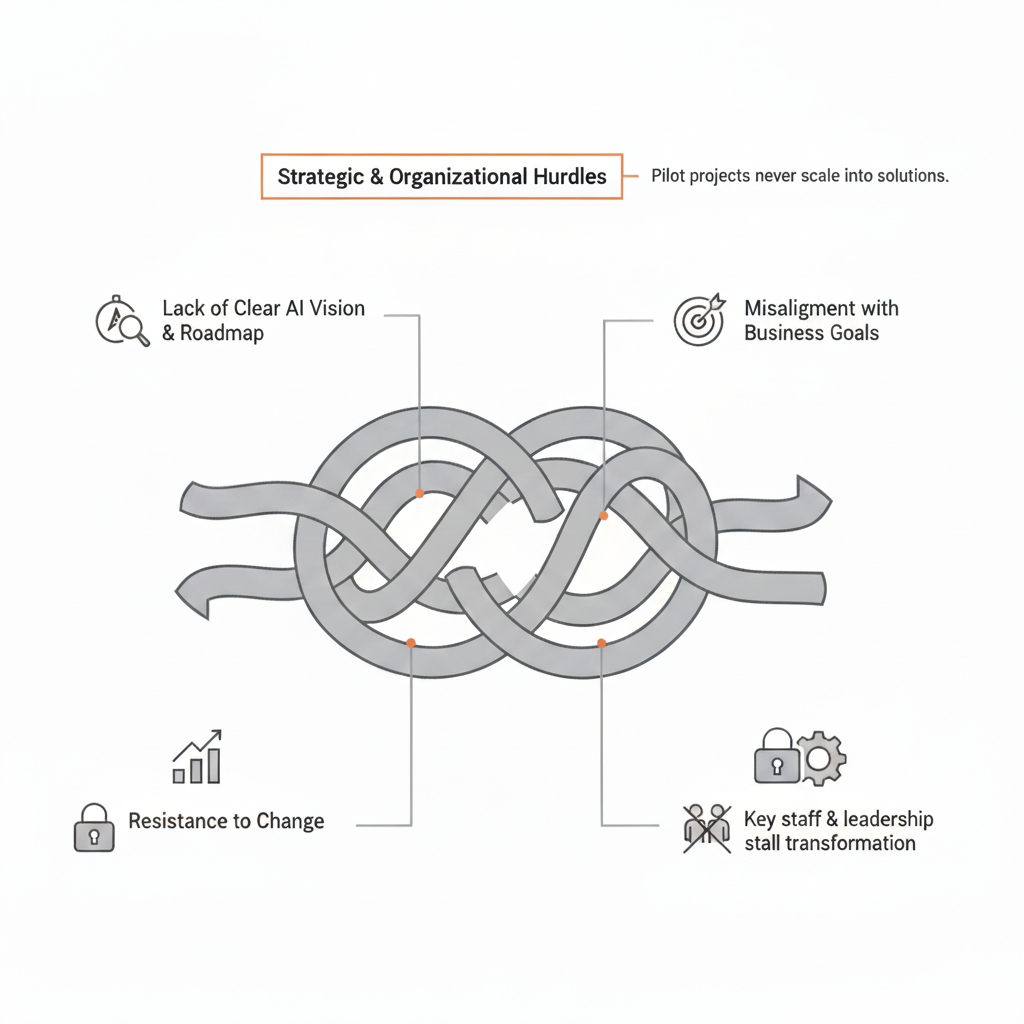
1. Strategic & Organizational Hurdles
The first set of challenges often isn’t about the technology itself, but about having a clear plan.
Lack of Clear AI Vision and Roadmap: Many companies jump into AI without a clear idea of why they are using it or how it fits into their big picture. They start small “pilot” projects that never grow into company-wide solutions.
Misalignment with Business Goals: AI initiatives must solve real business problems. If an AI project doesn’t clearly support a major company goal, like reducing costs or improving sales, it won’t get the necessary funding or attention.
Resistance to Change: People naturally resist changes to how they work. This resistance, especially from key staff or leadership, can quickly stall an AI project. Leadership, not employees, is often the biggest barrier to AI success because they don’t steer the transformation fast enough
2. Data-Related Roadblocks
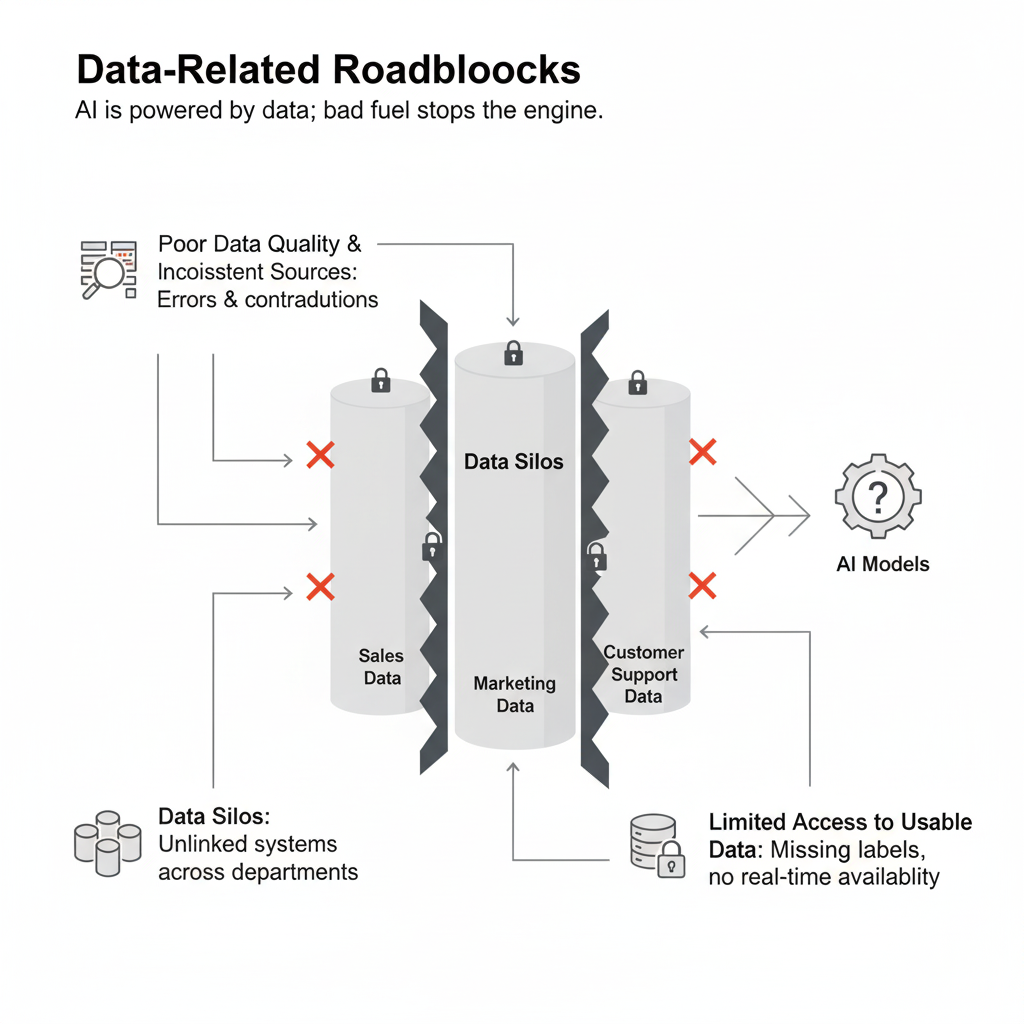
AI is powered by data; it’s the fuel for the engine. If the fuel is bad, the engine won’t run. This is a critical barrier, with research from top firms showing that data problems are the number one cause of AI failure.
Poor Data Quality and Inconsistent Sources: AI models need clean, accurate, and consistent data. If your data is full of errors or contradictions, the AI’s results will be useless. This is a crucial problem: Gartner predicts that 60% of AI projects will be abandoned by the end of 2026 if they are not supported by “AI-ready data”.
Data Silos: Data often sits in separate, unlinked systems across different departments. AI needs to see the whole picture, but these “data silos” make it impossible to gather the unified dataset needed for training.
Limited Access to Usable Data: Finding data that is properly labeled (meaning the data has tags that tell the AI what it is) or available in real-time can be a huge headache.
3. Integration & Infrastructure Challenges
Once you have the idea and the data, you need the right technology to make it work.
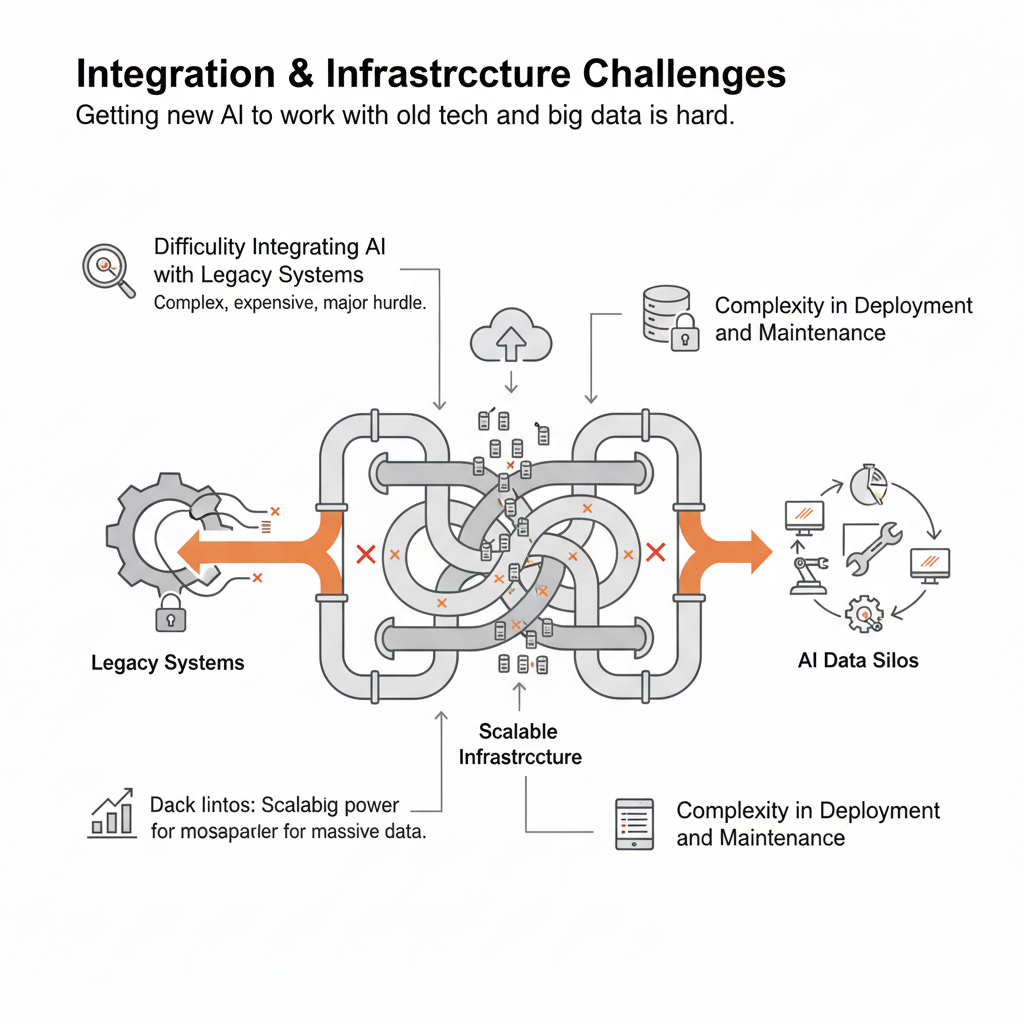
Difficulty Integrating AI with Legacy Systems: Most large companies rely on older computer systems (legacy systems) that weren’t built with AI in mind. Getting new, advanced AI tools to work with these older systems is often technically very complex and expensive.
Integration is a huge barrier: 55% of leaders cite the challenge of integrating AI with existing technology as a major hurdle to adoption.
Lack of Scalable Infrastructure: Running and training complex AI models requires huge computing power. Companies need a robust, flexible infrastructure (like cloud computing) that can handle massive data growth.
Complexity in Deployment and Maintenance: Getting an AI model working is one thing; deploying it to users and then continuously monitoring and updating it is a complex, ongoing process.
4. Cost & Return on Investment (ROI) Issues
AI isn’t cheap, and the financial side is a major barrier for adoption.
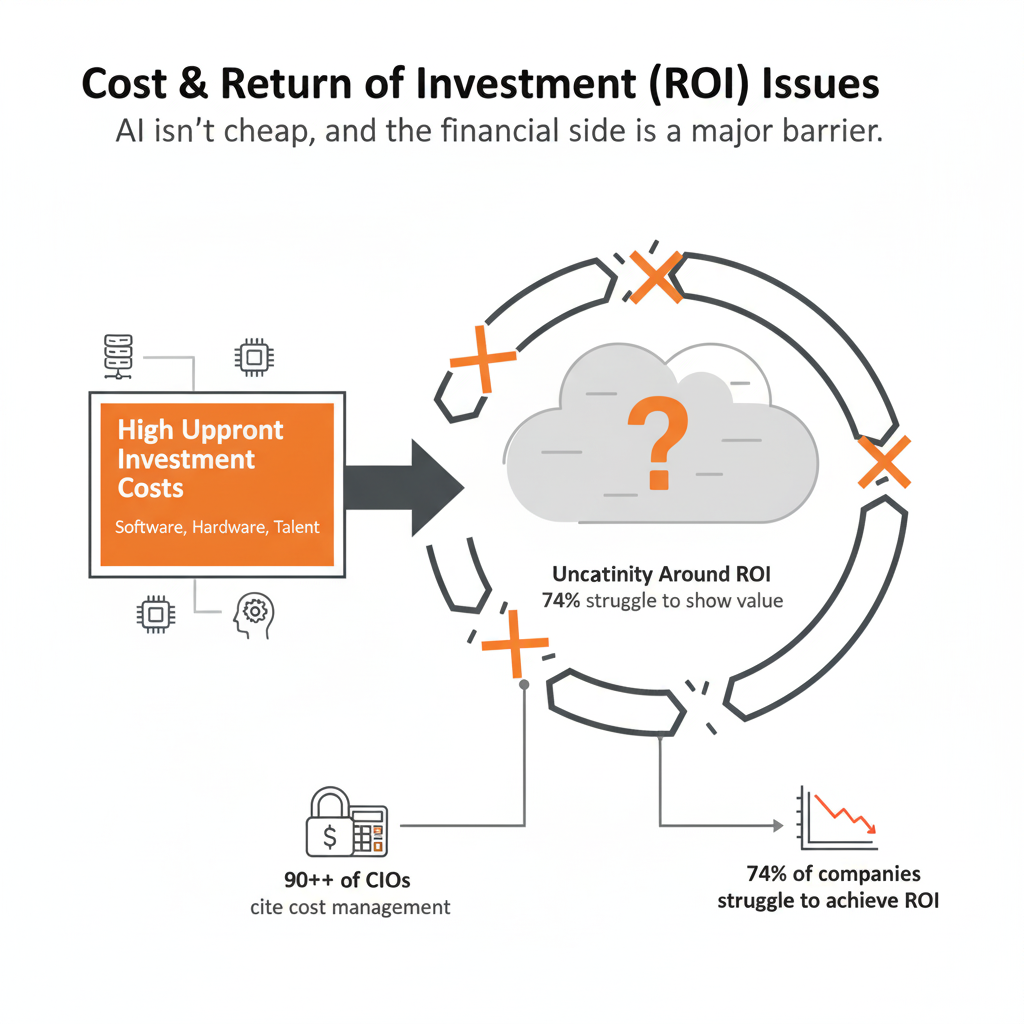
High Upfront Investment Costs: The initial costs for AI, covering specialized software, powerful hardware, and hiring expert talent, are substantial.
Uncertainty Around ROI: It’s often hard to clearly measure how much money an AI project will save or generate. Research shows that 74% of companies struggle to achieve and scale tangible value from their AI initiatives.
Hidden Costs: The costs don’t stop after launch. More than 90% of CIOs cite managing cost as limiting their ability to get value from AI.
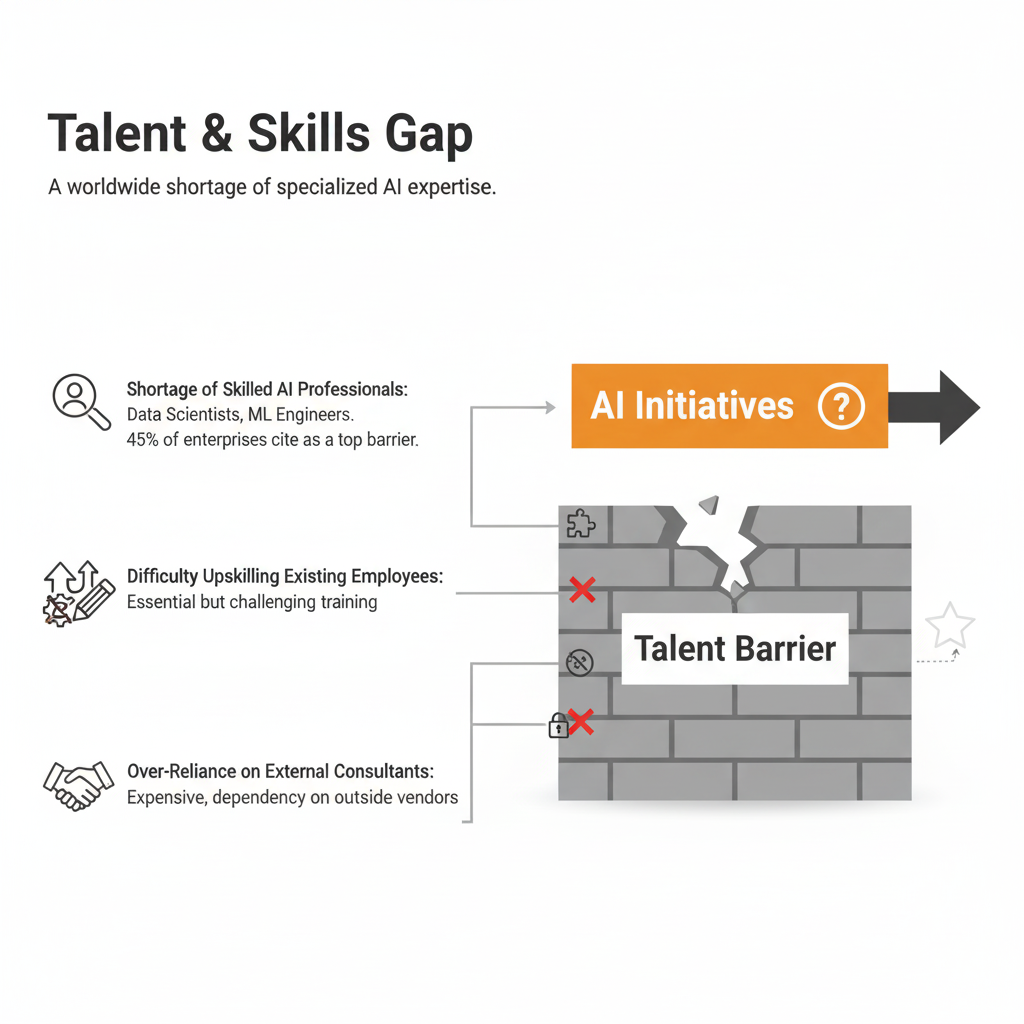
5. Talent & Skills Gap
AI requires highly specialized knowledge, and there’s a worldwide shortage of this expertise.
Shortage of Skilled AI Professionals: There simply aren’t enough qualified data scientists, machine learning engineers, and AI architects. A 2023 Gartner survey found that 45% of enterprises cite a shortage of AI-skilled workers as a top barrier.
Difficulty Upskilling Existing Employees: Training current employees to work with AI is essential, but challenging.
Over-Reliance on External Consultants: Many companies become overly dependent on expensive outside consultants or vendors because they lack internal expertise.
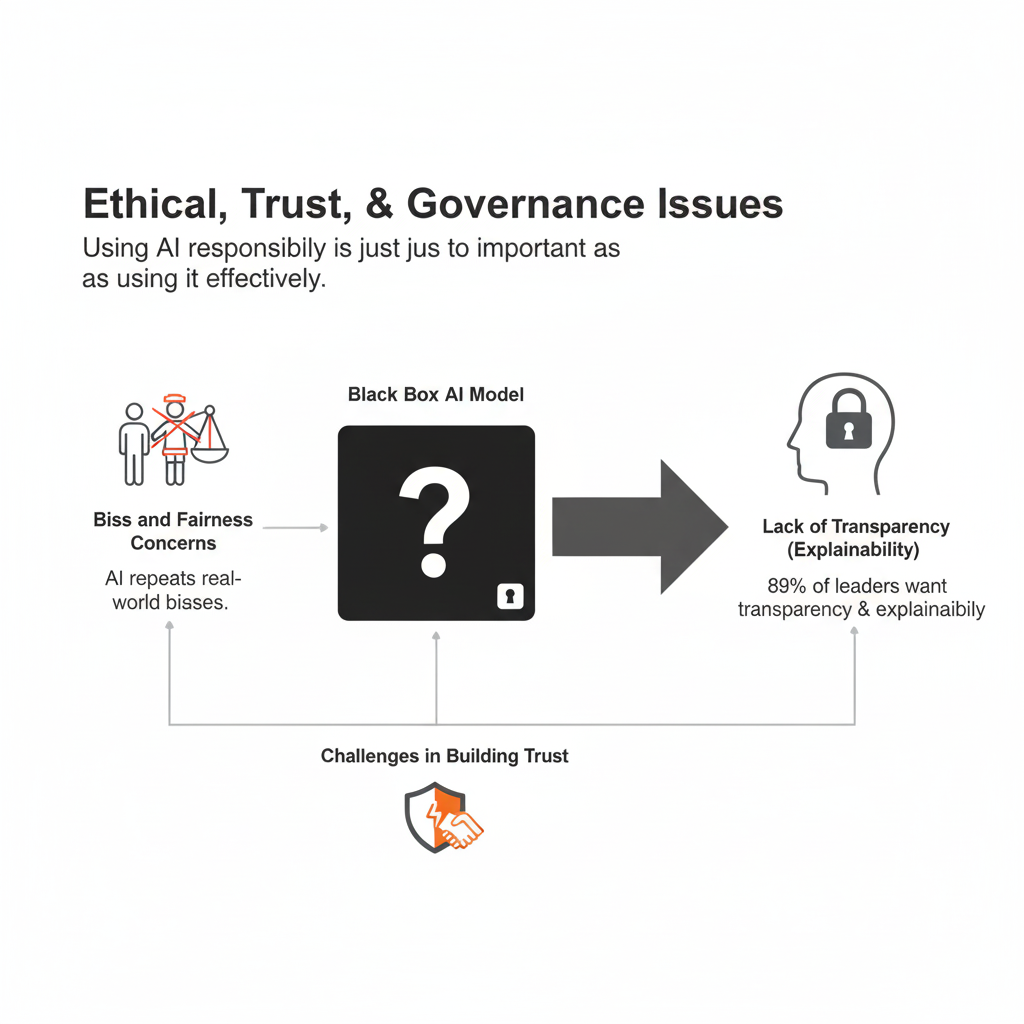
6. Ethical, Trust, & Governance Issues
Using AI responsibly is just as important as using it effectively.
Bias and Fairness Concerns: If the data used to train an AI model reflects real-world biases, the AI will learn and repeat that bias.
Lack of Transparency (Explainability) is a Major Concern: Many advanced AI models work like a “black box”; you can’t easily see why the AI made a specific decision. This is a critical barrier to trust, with 89% of leaders saying it is very important that AI solutions are both transparent and explainable.
Challenges in Building Trust: Users and stakeholders need to trust that the AI is fair, secure, and used appropriately.
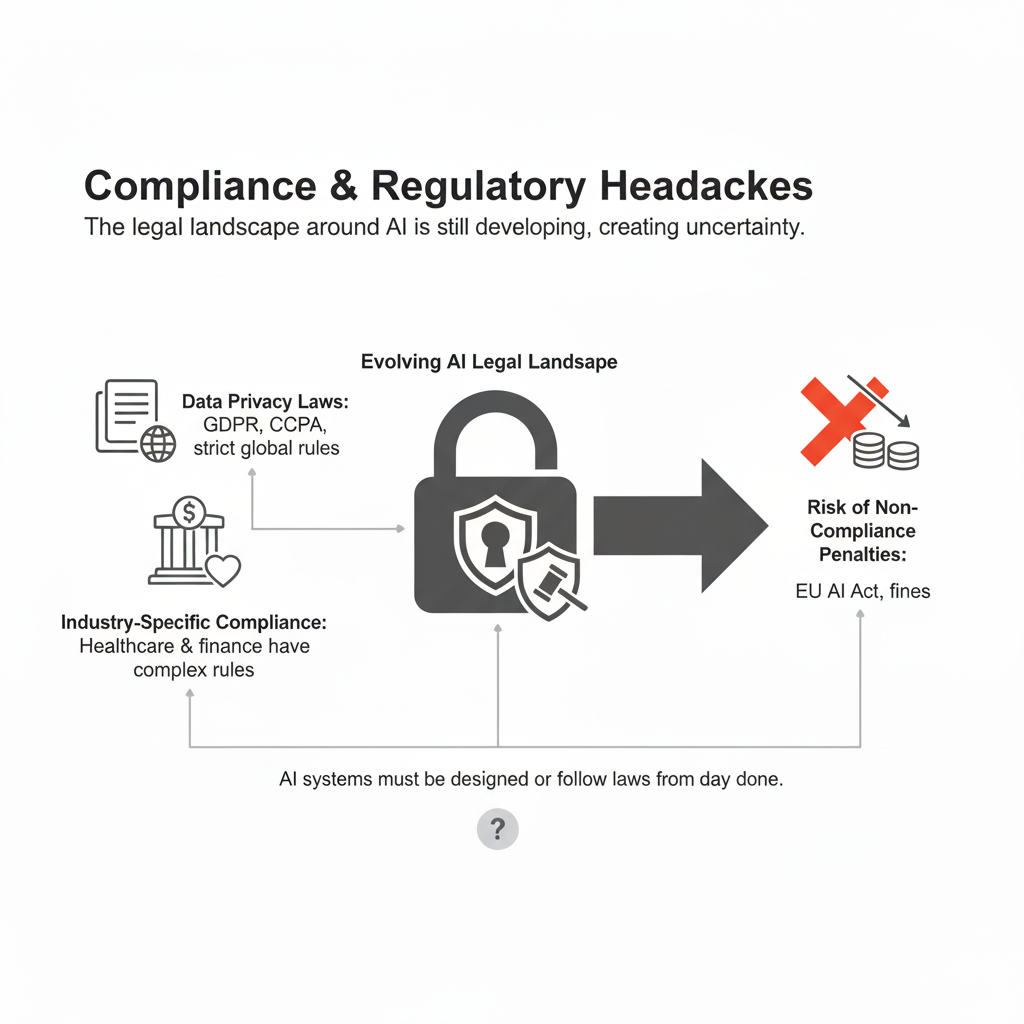
7. Compliance & Regulatory Headaches
The legal landscape around AI is still developing, creating uncertainty.
Data Privacy Laws: Strict global rules like GDPR and CCPA dictate how data must be handled. AI systems must be designed to follow these laws from day one to avoid heavy penalties.
Industry-Specific Compliance: Regulated industries like healthcare and finance have their own complex rules that AI must comply with.
Risk of Non-Compliance Penalties: The evolving laws, such as the EU AI Act, impose new compliance burdens and the risk of fines.
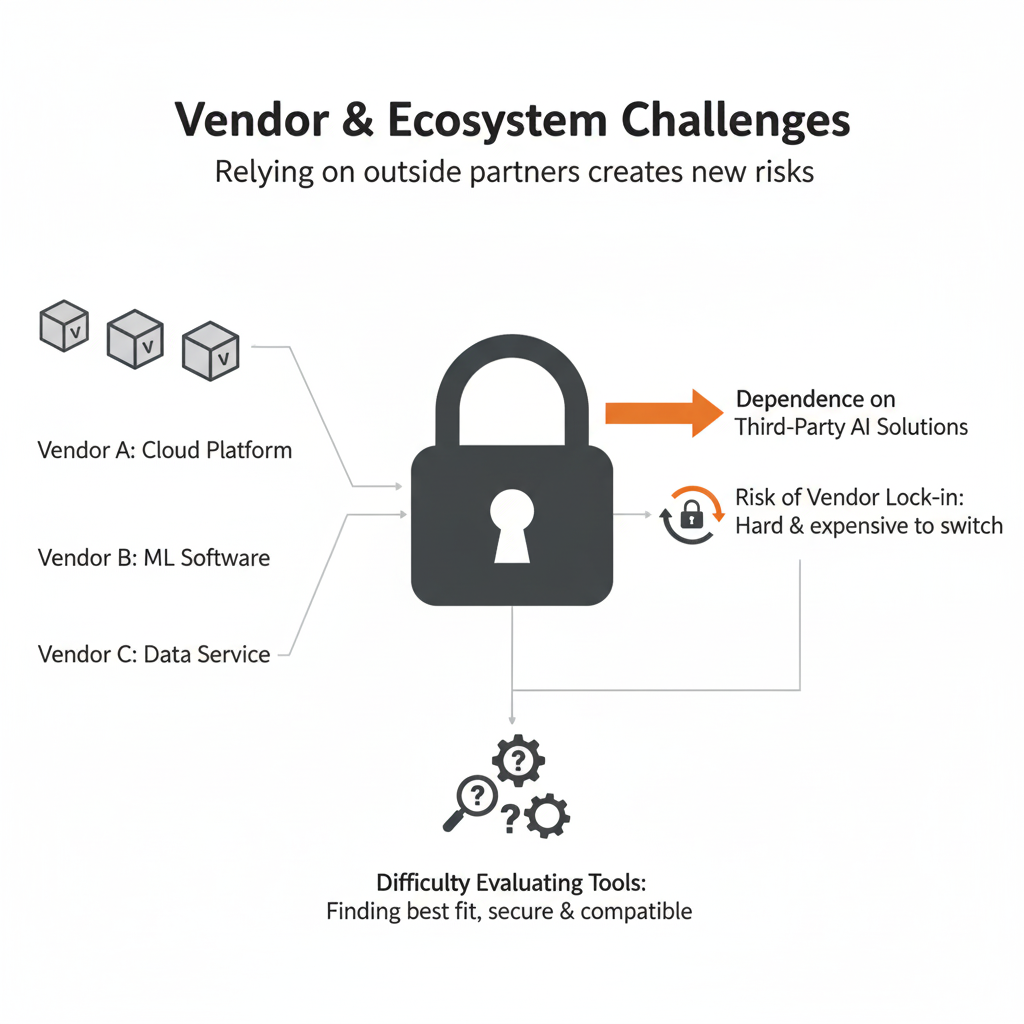
8. Vendor & Ecosystem Challenges
Since few companies build all their AI from scratch, they rely on outside partners, which creates new risks.
Dependence on Third-Party AI Solutions: Relying heavily on one vendor’s tools can make a company vulnerable.
Risk of Vendor Lock-in: If a company builds its whole system on one vendor’s platform, it becomes tough and expensive to switch later, a situation known as vendor lock-in.
Difficulty Evaluating Tools: It’s a big job to figure out which of the many AI tools available is the best fit, secure, and compatible with existing systems.
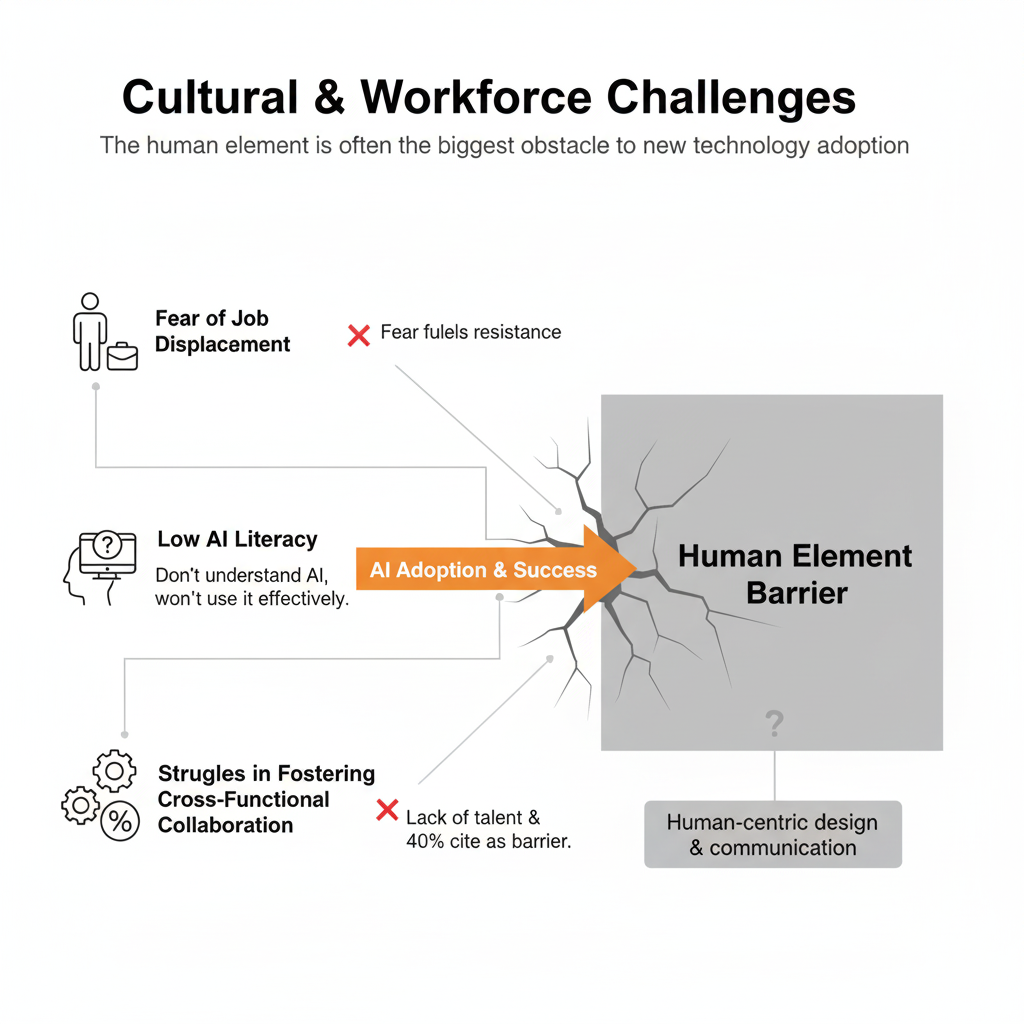
9. Cultural & Workforce Challenges
The human element is often the biggest obstacle to new technology adoption.
Fear of Job Displacement: Many employees worry that automation will eliminate their jobs. This fear fuels resistance.
Low AI Literacy: If employees and decision-makers don’t understand what AI is and what it can do, they won’t use it effectively.
Struggles in Fostering Cross-Functional Collaboration: Successful AI requires close teamwork between technical experts and business experts. The core challenge here is talent: 40% of organizations cite a lack of talent and skills as a key reason for not embedding AI capabilities more broadly across the company.
10. Scaling Issues (Moving Beyond the Pilot)
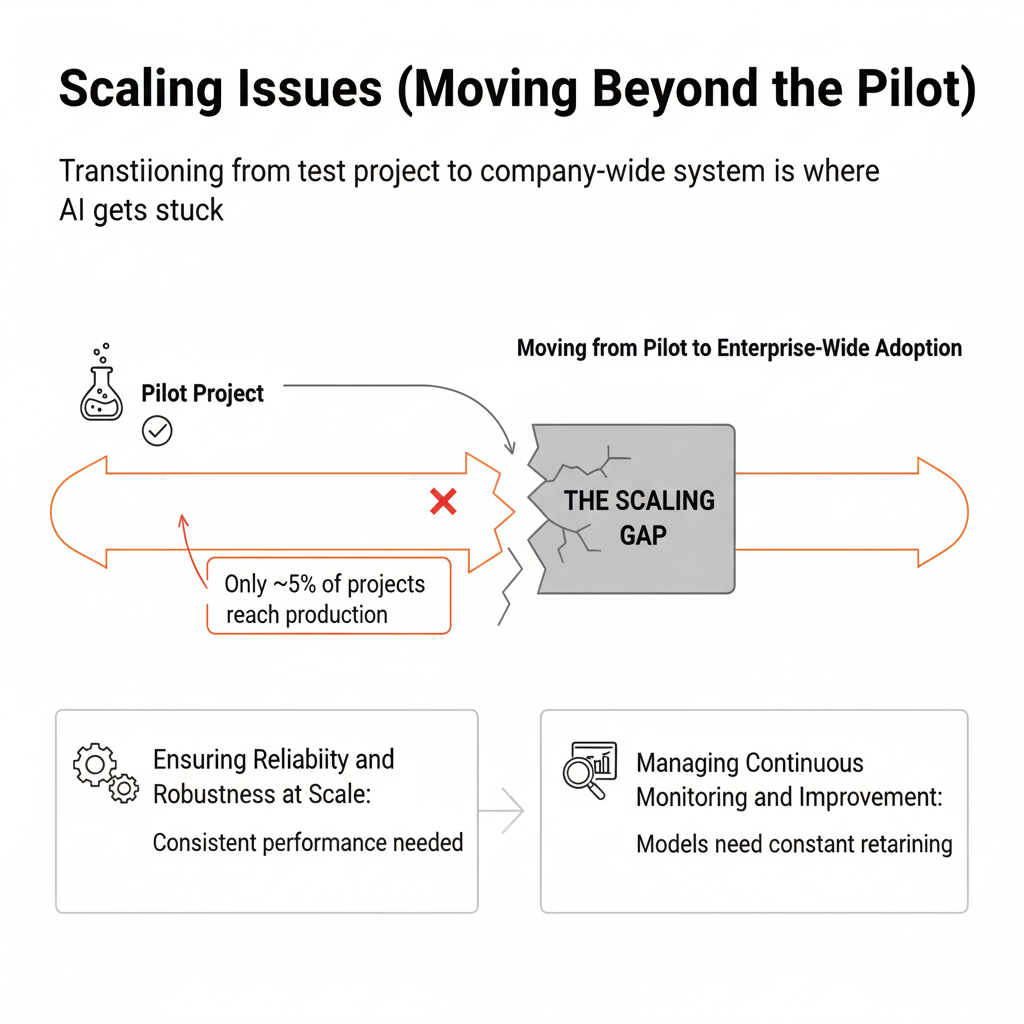
The transition from a small, successful test project (pilot) to a full, company-wide system is where many AI initiatives get stuck.
Moving from Pilot to Enterprise-Wide Adoption: A small pilot might work perfectly with a controlled dataset, but scaling it up to handle millions of transactions across the entire organization is different. Only about 5% of Generative AI pilot projects successfully reach full production with measurable ROI.
Ensuring Reliability and Robustness at Scale: The AI model needs to perform consistently and accurately, regardless of the volume or type of data it encounters.
Managing Continuous Monitoring and Improvement: AI models are not “set and forget.” They need constant monitoring and retraining to stay effective.
Final Words
Adopting AI is not just a technology upgrade; it’s a business transformation. The challenges, from data quality to culture change, are real, but understanding them is the first step toward success. Companies that tackle these issues head-on, with a clear strategy, smart data governance, and a commitment to training their people, will be the ones that truly unlock the transformative power of AI.
If your organization requires specialized support to navigate these complex integration or governance hurdles, consulting a dedicated technology partner like Hudasoft can provide the necessary expertise and roadmap to accelerate your AI adoption journey.
FAQs
What are the concerns of AI adoption?
Main concerns include poor data quality, high costs, privacy risks, lack of skilled talent, and employee resistance.
What are the ethical challenges in AI adoption?
Key challenges are bias, lack of transparency, accountability issues, and data privacy concerns.
What are the factors affecting the adoption of AI?
Adoption depends on strategy, leadership, technology, skilled staff, and financial investment.
Leave a Reply