Table of Contents
I remember the first time I really saw the difference AI was making in retail. I was browsing online, just casually looking for a new jacket. I didn’t click anything, didn’t type a brand, just scrolled.
But the next day? Everything changed.
I opened a different website, and right there, front and center, was a recommendation for a jacket that was perfect exactly for my style, in the right color, and even close to my usual price range. I thought, “How did they know that?”
That moment was when I stopped just reading about AI and started seeing the real, powerful AI use cases in retail. I realized this wasn’t future technology anymore; it was the engine running every smart store right now.
I started doing some research, looking into how the biggest companies were using these smart systems. What I found wasn’t science fiction; it was smart business.
Why Smart Technology is the Foundation of Modern Retail
Smart computer systems, often called AI, are fundamentally changing how every part of a store operates. It’s not just a nice add-on; it’s the core system that helps businesses move from simply guessing what customers want to knowing it
Simply put, AI helps retailers do two main things brilliantly:
- Understand You Better: It turns massive amounts of shopper data into clear steps to give you a personalized experience.
- Run Smoother: It handles boring, repetitive tasks like managing stock, freeing up human workers for important customer interactions.
The Retail AI Boom: Context by the Numbers
This isn’t just a trendy idea; it’s a massive shift with significant financial backing.
The global Artificial Intelligence in Retail market is exploding, with projections showing it will reach over $40 billion by 2030.
This rapid growth is driven by retailers realizing that adopting AI can both cut operating costs and boost annual revenue by creating a much better shopping experience.
Let’s dig into this blog, which is your easy-to-read guide on how smart computer systems (AI) are changing shopping. We’ve cut out the complex talk to show you the simple, powerful ways this technology works daily.
We’ll dive into the best AI use cases in retail. You’ll see how AI helps manage stock so shelves are never empty and how AI in retail examples creates personal shopping experiences. Plus, discover how retail AI technology handles customer questions instantly, any time of day.
Customer-Facing AI Use Cases: An In-Depth Analysis
The deployment of Artificial Intelligence (AI) and Machine Learning (ML) has fundamentally reshaped customer engagement across various sectors. This report details four primary customer-facing AI use cases, outlining the underlying methods, illustrative examples, and the critical business benefits derived from these technologies.
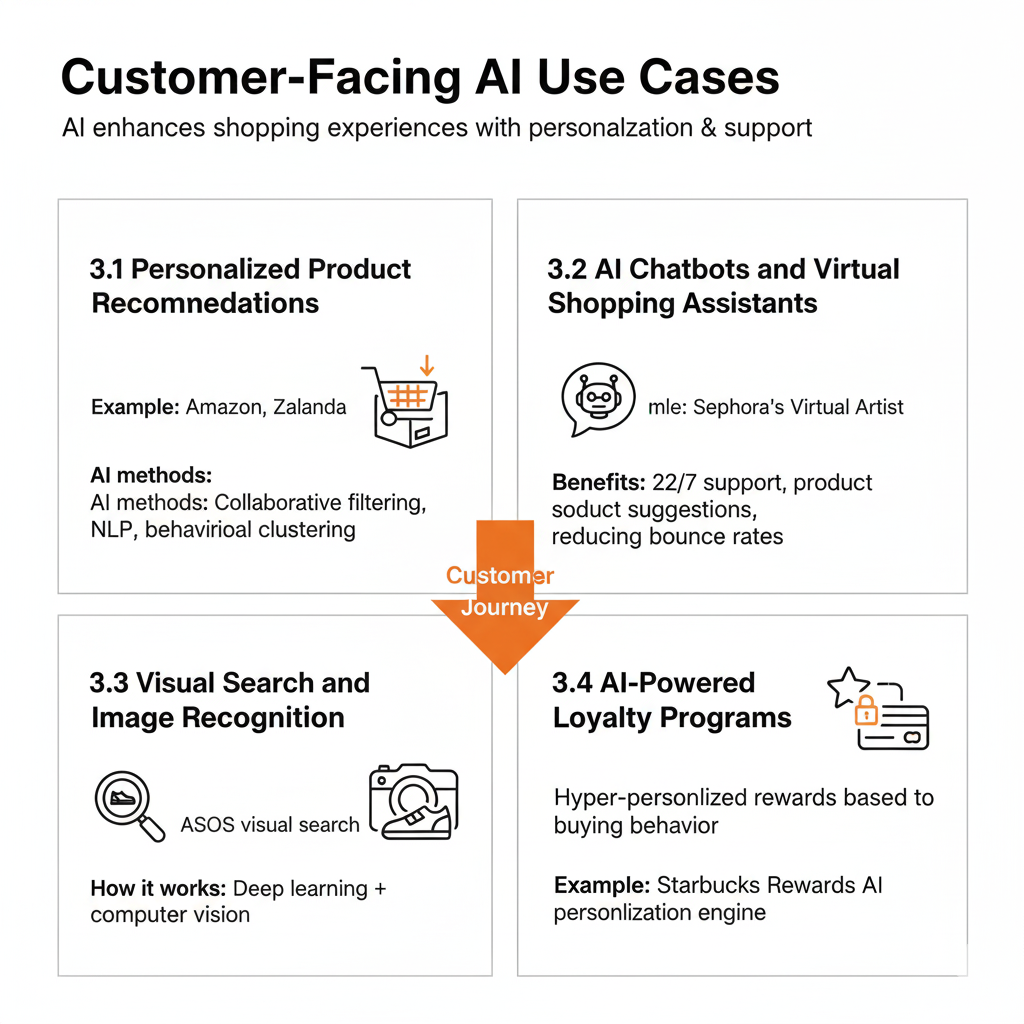
3. Customer-Facing AI Use Cases
3.1 Personalized Product Recommendations
This category moves beyond simple rule-based suggestions to offer truly individualized product pathways, directly influencing discovery and conversion rates.
Example: Amazon, Zalando (Amazon’s approach is exemplified by Amazon Personalize).
AI Methods: Collaborative filtering (predicting preferences based on similar users), Natural Language Processing (NLP) (analyzing product descriptions and reviews), and Behavioral Clustering (grouping users based on real-time and historical interaction patterns).
Deep Dive (Amazon): Amazon Personalize utilizes real-time user activity, item metadata, and user profiles to train custom, private ML models. Recently, this has been augmented by Generative AI (Large Language Models) to not only suggest what to buy, but also to dynamically personalize the description of the recommended item, highlighting features most relevant to the individual customer (e.g., changing a generic title to “Gluten-Free Cereal for Your Morning Routine”).
Impact: This drives critical business outcomes, including increased click-through rates, higher average order value, and improved customer loyalty by reducing “choice paralysis.”
3.2 AI Chatbots and Virtual Shopping Assistants
These tools provide instant support and interactive, guided shopping experiences, bridging the gap between digital and physical interaction.
Example: Sephora’s Virtual Artist.
AI Methods: This often involves a blend of technologies. Chatbots use NLP and NLG (Natural Language Generation) for conversation. Virtual assistants like Sephora’s employ Augmented Reality (AR) integrated with Computer Vision and Facial Geometry Analysis.
Deep Dive (Sephora): The Virtual Artist uses AI algorithms to analyze a user’s facial geometry and real-time lighting conditions to apply a digital makeup overlay with high precision. This allows users to virtually try on thousands of products, such as lipstick shades or eyeshadows.
Benefits:
- 24/7 Support and immediate product suggestions significantly reduce customer friction.
- Reduced Bounce Rates by instantly engaging users with interactive content.
- Quantifiable Results: Customers who used Sephora’s Virtual Artist were reported to be 3 times more likely to complete a purchase, and the tool contributed to a 30% reduction in returns for makeup products, proving the value of virtual product confidence.
3.3 Visual Search and Image Recognition
This technology allows consumers to use the world around them as a search query, transforming the shopping funnel.
Example: ASOS visual search.
How it works: Visual search relies on powerful Deep Learning models, specifically Convolutional Neural Networks (CNNs), trained on massive image datasets. These networks power the Computer Vision process, which breaks down an input image (uploaded photo or screenshot) to identify key visual features like shape, color, texture, and pattern. The system then uses Content-Based Image Retrieval (CBIR) to match these features to similar products in the inventory database.
Benefits:
- Intuitive Discovery: Users bypass complex keywords and search barriers.
- Speed: The human brain processes images much faster than text, leading to quicker product identification.
- Increased Conversion: By accurately matching inspiration photos to purchasable items, the likelihood of a successful sale significantly increases.
3.4 AI-Powered Loyalty Programs
Loyalty programs transition from offering blanket discounts to delivering highly specific, timely, and relevant rewards and incentives that maximize customer lifetime value.
Example: Starbucks Rewards AI personalization engine (powered by the Deep Brew platform).
AI Methods: Reinforcement Learning (to optimize the timing and type of offer), Predictive Modeling (to forecast inventory and staffing needs), and Data Analytics (processing huge volumes of transactional, geographic, and temporal data).
Deep Dive (Starbucks): The Deep Brew platform analyzes numerous factors, including a user’s historical purchases, time of day, weather conditions, local store inventory, and even community tastes. It then generates Hyper-personalized Rewards (e.g., a BOGO offer on a cold drink specifically for a customer who buys cold drinks on rainy Mondays).
Impact: This micro-targeting is designed to nudge “occasional customers” into becoming habitual visitors. Starbucks has reported that the AI initiatives have led to a 30% Return on Investment (ROI) and a notable increase in customer visit frequency and transaction size, bolstering the Starbucks Rewards membership base.
This report provides an executive summary of modern AI applications in the customer-facing domain, demonstrating how sophisticated machine learning and generative technologies are directly tied to measurable business value.
4. Backend & Operational AI Use Cases
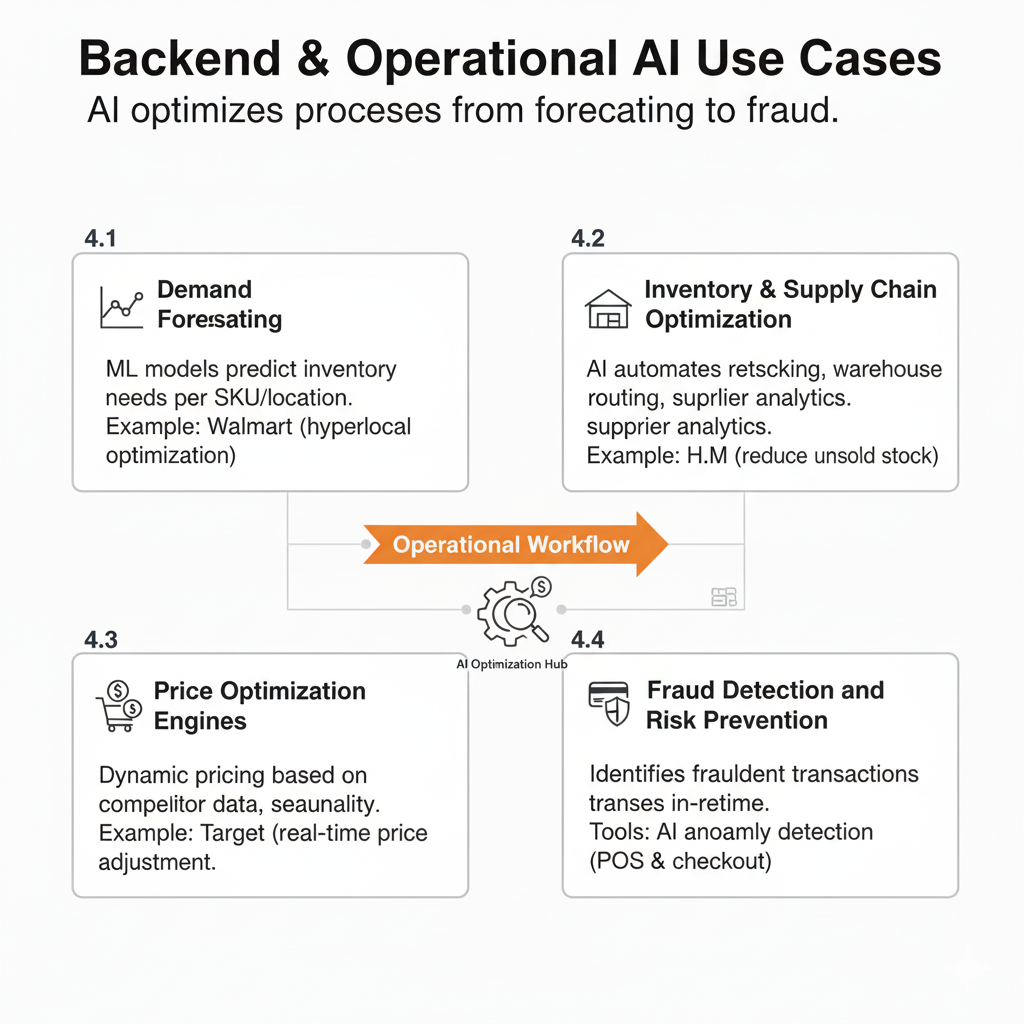
This is where the real cost savings and efficiency gains happen. These AI use cases in the retail industry help stores run smarter, faster, and with way less waste. They don’t directly talk to you, but they make sure your favorite products are always available at a good price.
4.1 Demand Forecasting (The Fortune Teller)
No one likes an empty shelf or a pile of wasted, unsold products. AI fixes that. This is a crucial use case in retail for profitability.
How it works: Smart machine learning models look at sales history, weather, local events, and holiday schedules to predict exactly how many of a specific item (SKU) will sell at a specific store. It’s like a retail fortune teller for inventory, giving highly precise numbers.
Big Example: Walmart uses this smart retail AI technology for hyperlocal inventory optimization, predicting needs store by store.
The Benefits:
- Less money wasted on storing or tossing unsold goods.
- More profit from ensuring customers always find what they need.
- Fewer stockouts (empty shelves), which frustrate shoppers.
4.2 Inventory & Supply Chain Optimization
This is the power of AI, making sure things move quickly and cheaply from the factory to the shelf.
How it works: AI takes over the boring, repetitive tasks: automating restocking orders, finding the fastest routes for items inside the warehouse, and analyzing which suppliers are the fastest and most reliable. This is a core AI use case in the retail industry for efficiency.
Big Example: H&M uses AI to get a better handle on its stock, helping reduce unsold stock, which saves millions and makes the business more sustainable.
The Benefits:
- Lowers shipping costs and speeds up delivery times.
- Reduces environmental waste from excess products.
- Automates complex ordering and routing decisions.
4.3 Price Optimization Engines (The Dynamic Price Tag)
Prices used to change only when a human manager decided. Now, it’s instant and driven by data.
How it works: These systems watch competitor prices, how quickly items are selling, and whether a promotion is running. They then dynamically adjust prices in real-time. This technology ensures the store is always competitive while maximizing profit.
Big Example: Target uses these real-time price adjustment models to react instantly to competitor price drops and stay competitive.
The Benefits:
- Never leaving money on the table when demand is high.
- Quickly clearing out old stock when demand is low.
- Avoids slow, manual changes by reacting instantly to the market.
4.4 Fraud Detection and Risk Prevention
AI is the silent, super-fast security guard for every transaction, protecting both the store and the customer.
How it works: AI anomaly detection models learn what a “normal” purchase looks like. If a purchase suddenly appears from a new city, with a huge value, or with odd timing, the AI flags it instantly as suspicious. This is one of the most vital AI in retail examples for financial health.
The Tools: These technology tools are used at every checkout (POS Point of Sale) to identify fraudulent transactions in real-time.
The Benefits:
- Stops theft and fraud right when it happens.
- Minimizes financial losses and chargeback fees.
- Protects customer data by keeping the security system adaptive.
5. In-Store AI Use Cases
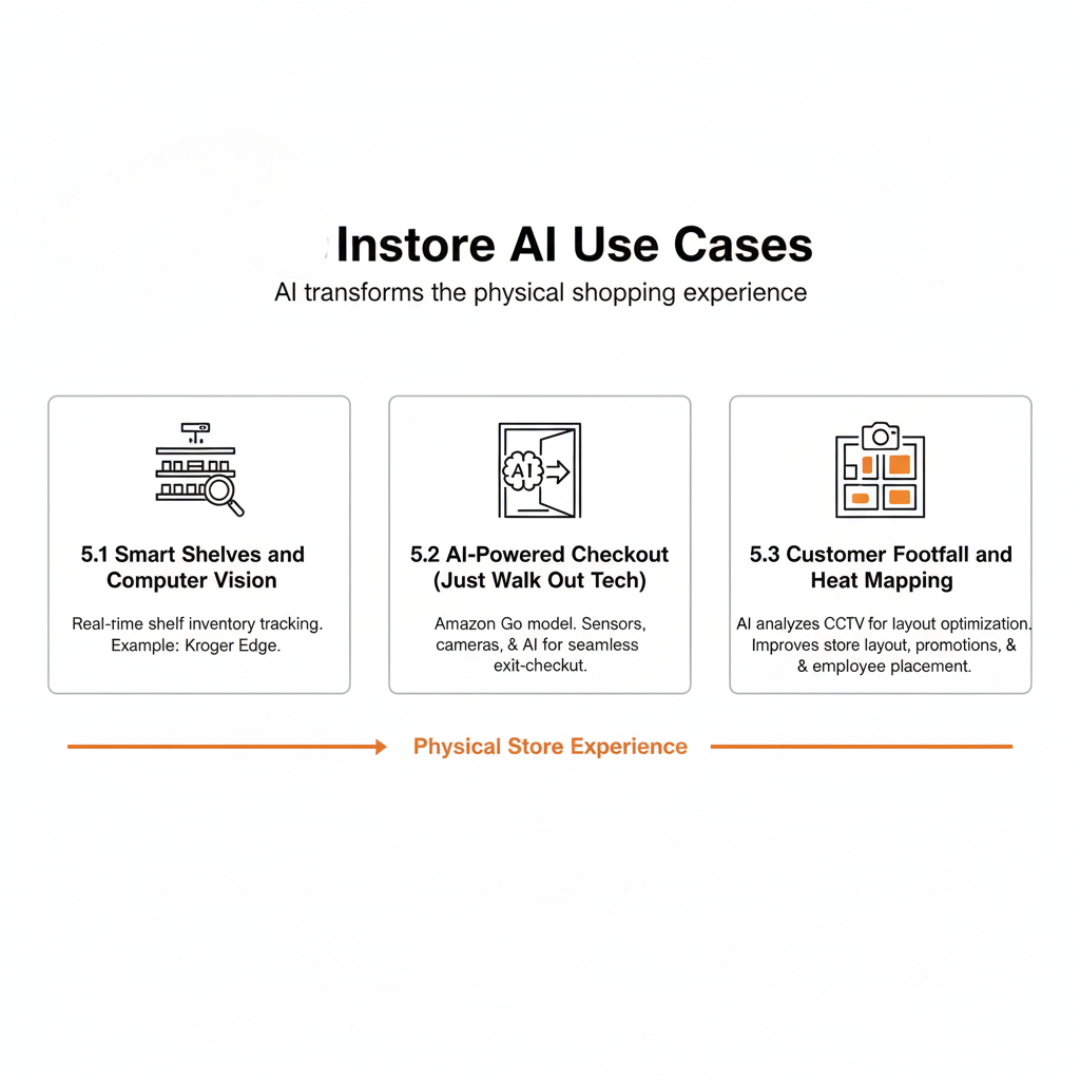
The store itself is now getting smarter. AI in retail examples aren’t just in the backend anymore; they’re in the aisles, at the checkout, and watching the shelves. These applications are designed to make your shopping trip smoother, faster, and more convenient.
5.1 Smart Shelves and Computer Vision (The Digital Shelf Manager)
This technology ensures the shelves are always full and helps staff find things immediately.
How it works: Computer vision technology, using small cameras or sensors embedded on the shelf edges, constantly monitors the inventory. It tracks products in real-time and alerts staff the moment a shelf is running low or if items are placed incorrectly. It’s essentially an automatic, always-on inventory counter.
Big Example: Kroger Edge utilizes smart shelving systems that not only track inventory but also display real-time pricing and personalized offers to customers standing in front of the shelf.
The Benefits:
- Eliminates empty shelves (reducing lost sales).
- Frees up employee time previously spent manually counting stock.
- Reduces waste by monitoring product dates and ensuring proper stock rotation.
5.2 AI-Powered Checkout (Just Walk Out Tech)
This is the holy grail of convenience: skipping the checkout line entirely.
How it works: This system uses a sophisticated network of overhead cameras, weight sensors in the shelves, and AI to track every item you pick up and put down. The system creates a virtual shopping cart for you. When you simply walk out, the system automatically charges your connected payment method.
Big Example: The Amazon Go model pioneered this frictionless shopping experience, proving that sensors, cameras, and AI can facilitate a truly seamless exit-checkout process.
The Benefits:
- Zero wait time at checkout is the ultimate convenience.
- Higher customer satisfaction and speed.
- Better data on shopping behavior (which items are browsed but not bought).
5.3 Customer Footfall and Heat Mapping (The Store Strategist)
Every minute you spend in a store is data that AI can use to improve the layout for the next shopper.
How it works: AI analyzes anonymous data from existing in-store CCTV cameras or Wi-Fi signals to map customer movement. This creates a “heat map” that shows which areas are most visited (hot spots) and which are ignored (cold spots). This information is then used for layout optimization.
Big Example: Retailers globally use this technology to see if customers are noticing promotional displays or finding the items they came for easily, optimizing the entire store flow.
The Benefits:
- Improved store layout for logical, easy shopping.
- Optimal placement of high-margin products and new promotions.
- Smarter employee placement in the busiest areas to help customers quickly.
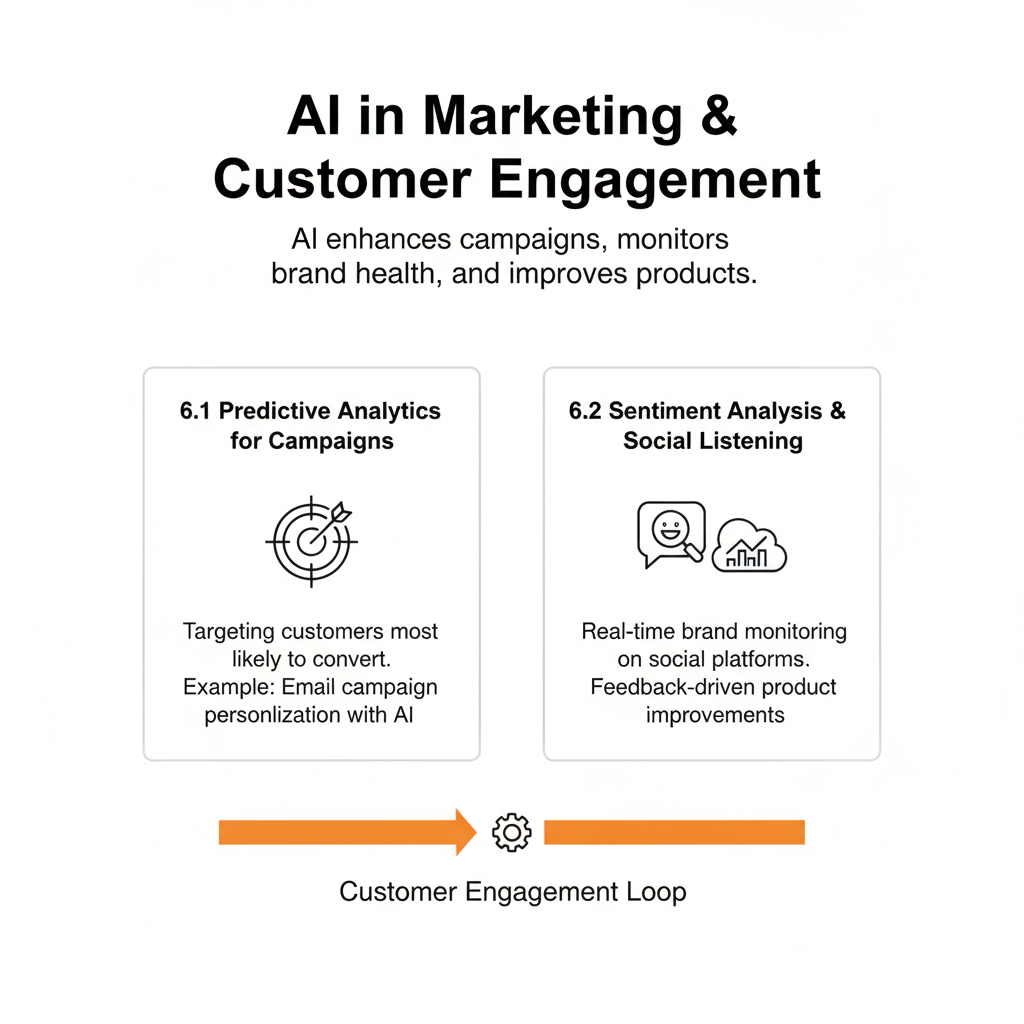
6. AI in Marketing & Customer Engagement
This section focuses on how retailers use AI to understand what you want, when you want it, and how you feel about them. This is the difference between annoying marketing and helpful marketing.
6.1 Predictive Analytics for Campaigns (The Smart Campaign Planner)
Marketing used to be about blasting messages to everyone. Now, AI uses data to figure out exactly who will buy what, and when. This is the ultimate tool for avoiding annoying your customers with irrelevant ads.
How it works: Predictive analytics models chew through purchase history, browsing data, and demographic information to score customers based on their likelihood to convert. This allows marketers to create highly specific segments and target the customers most likely to convert with tailored messages.
Big Example: Email campaign personalization with AI is a perfect example. Instead of sending a generic “20% off everything” email, a customer who bought running shoes last month might get an email specifically about new smartwatches or accessories, maximizing the chances of the offer being relevant.
The Benefits:
- Higher Return on Investment (ROI) for marketing spend.
- Reduced “spam fatigue” for customers by sending only relevant offers.
- Deeper understanding of customer purchasing cycles.
6.2 Sentiment Analysis & Social Listening (The Brand Barometer)
Every customer review, tweet, or Facebook comment about a brand is valuable, but manually reading them all is impossible. AI does the listening for you, 24/7, providing real-time brand monitoring.
How it works: Sentiment analysis uses Natural Language Processing (NLP) to automatically read and categorize vast amounts of text from social media and review platforms. It determines the emotional tone (positive, negative, or neutral) of customer feedback, allowing retailers to see what people truly feel about a product or service.
Big Example: A retailer can use this to spot a sudden flood of negative comments about a faulty zipper on a new jacket line in minutes, not weeks. This instant feedback loop drives feedback-driven product improvements much faster than traditional surveys.
The Benefits:
- Instant crisis detection before a small problem becomes a PR disaster.
- Direct, honest feedback for product development and quality assurance.
- Better customer service by quickly routing urgent negative mentions to a response team.
Wrapping It Up
The simple truth is that AI use cases in retail are no longer a choice; they are the new standard for doing business. Companies like Hudasoft are driving this change, providing the essential retail AI technology that makes smart shopping possible.
From the moment you start browsing online (thanks to smart recommendations) to the moment you walk out of a store without queuing, AI is quietly making everything smoother, faster, and much more personal.
It’s clear that the future of AI in the retail industry belongs to the businesses that use this technology not just to save money on the back-end (inventory, pricing), but also to genuinely delight the customer on the front-end. By building smart, adaptive systems with partners like Hudasoft, retailers are ready to thrive in the changing world of shopping!
FAQS
What are the best AI tools for retail?
Popular tools include Shopify Magic, Google Cloud AI, Salesforce Einstein, Microsoft Azure AI, and Amazon Personalize for inventory, sales, and customer insights.
Is AI affordable for small retail businesses?
Yes. Many AI tools offer affordable, scalable plans or integrations with existing POS and eCommerce systems.
How do I start implementing AI in my store?
Begin by identifying key areas like inventory, marketing, or customer service. Then choose a simple AI tool and integrate it gradually.
What kind of data is needed for AI in retail?
Sales records, customer behavior data, inventory levels, and marketing performance metrics are essential for effective AI insights.
Leave a Reply