
Table of Contents
Artificial intelligence (AI) is rapidly transitioning from a theoretical concept to a non-negotiable component of modern business strategy. The true measure of its impact, however, lies not in the sophistication of the technology itself, but in the effectiveness of its integration.
Why is it more than just installing algorithms?
Successfully adopting AI is much more profound than simply “installing algorithms.” While the underlying code and models are critical, true artificial intelligence implementation is fundamentally a strategic and organizational challenge. It involves:
Data Strategy: AI is only as effective as the data it’s trained on. This requires comprehensive data governance, cleaning, and preparation, a massive undertaking often consuming up to 80% of project time.
Process Redesign: AI augments or automates human tasks, which necessitates overhauling existing workflows and business processes, not just adding a new tool.
People and Culture: It requires significant change management, employee training, and fostering a culture that trusts and collaborates with AI systems, addressing understandable concerns about job displacement.
Ethical Governance: Establishing ethical guidelines for fairness, transparency, and accountability is essential to mitigate bias and maintain public trust.
The growing importance across industries
The increasing strategic necessity of AI is reflected in its pervasive adoption across the global economy. Every major sector is leveraging AI to gain a competitive edge:
In Healthcare, AI accelerates drug discovery, aids in diagnostics (e.g., analyzing medical images), and personalizes treatment plans.
In Finance, it is critical for real-time fraud detection, algorithmic trading, and personalized customer risk assessment.
Retail utilizes AI for predictive demand forecasting, optimizing inventory, and creating hyper-personalized customer recommendations.
Manufacturing uses it for predictive maintenance, analyzing sensor data to anticipate equipment failure, reducing downtime, and saving millions.
What is AI implementation?
AI implementation is the comprehensive and systematic process of transforming an organization’s strategic AI objectives into functional, scalable, and value-generating systems integrated into daily operations.
It is the execution phase of the AI life cycle, moving a trained machine learning model from a test environment (proof-of-concept) into a production environment where it can interact with real-world data and directly impact business outcomes. This involves technical steps, like system integration and model monitoring, as well as strategic steps, like establishing governance and measuring the business impact against initial goals.
Key Components of an AI Implementation Framework
A powerful AI implementation framework is the structured backbone for translating AI potential into tangible business results. It provides a cyclical, multi-faceted AI implementation process that addresses technical, organizational, and strategic needs. The following seven steps represent the critical phases required for a successful artificial intelligence implementation plan.
1. Define Business Objectives
This foundational step answers the “why” of your AI initiative. It’s the moment to specifically align AI initiatives with key business goals. Without clear, measurable goals, AI projects risk becoming mere proof-of-concepts that never deliver value.
Align AI initiatives with key business goals: Focus on high-level objectives like increasing revenue, reducing operational costs, or enhancing customer satisfaction.
Identify high-impact, measurable use cases: Prioritize projects that offer a clear path to return on investment (ROI), such as using predictive maintenance to minimize equipment downtime or leveraging natural language processing (NLP) to automate customer service responses.
2. Assess Data Readiness
Data is the fuel for AI, making data readiness a non-negotiable step in the AI implementation process. This phase determines if the organization possesses the necessary data assets to support its objectives.
Audit existing data (quality, availability, structure): Conduct a thorough inventory to confirm data is accurate, complete, relevant, and in a format usable for model training. Poor data quality is the most common reason for AI project failure.
Establish data governance, privacy, and compliance standards: Define clear policies for data handling, storage, and access, ensuring strict adherence to regulations (like GDPR, HIPAA, etc.) and maintaining ethical use.
3. Build the Right Team & Capabilities
AI requires specialized human capital and cross-functional collaboration. The people component is vital for sustaining the artificial intelligence implementation plan beyond the initial deployment.
Define roles: Data Scientists, Engineers, Product Owners: Create a cross-functional team that bridges the gap between business needs (Product Owner), data expertise (Data Scientist), and production readiness (Data/ML Engineer).
Upskill internal teams or onboard external expertise: Invest in training existing staff on new tools and AI concepts (AI literacy) or strategically hire experienced professionals to rapidly accelerate capabilities.
4. Select Technology & Infrastructure
Choosing the correct technology stack ensures the AI system is scalable, secure, and cost-effective. This decision impacts the entire AI implementation process and future agility.
Decide on AI platforms (cloud vs on-premise): Evaluate the trade-offs between the flexibility and scalability of cloud-based services (AWS, Azure, GCP) and the control of on-premise solutions.
Set up scalable infrastructure and MLOps pipelines: Implement MLOps (Machine Learning Operations) practices to automate, manage, and govern the development, testing, and deployment of models. This ensures the system can handle growth and be updated efficiently.
5. Develop & Test AI Models
This is the technical heart of the process, where the algorithms are built and refined. The goal is to create a model that meets the business KPIs defined in Step 1.
Choose the right algorithms based on use case: Select appropriate machine learning techniques (e.g., deep learning for image recognition, random forests for classification) based on the problem type and available data.
Train, validate, and evaluate models with business KPIs: Rigorously test the model’s performance on unseen data. Crucially, the evaluation metrics (e.g., accuracy, precision) must be linked back to the desired business outcomes (e.g., cost savings, efficiency gains).
6. Deploy & Integrate
Deployment is the transition from a technical success to a business solution. This step ensures the AI is operational and seamlessly integrated into existing business workflows, a key challenge in implementing AI in business.
Move from PoC to production: Establish stable APIs and endpoints to serve predictions in real-time or batch mode.
Integrate AI with existing systems (CRM, ERP, etc.): Ensure the AI model can effectively receive data and feed its predictions directly into the operational systems that frontline users rely on.
7. Monitor, Improve & Scale
AI systems are dynamic, requiring continuous attention. This final, cyclical step ensures the long-term value and relevance of the investment.
Continuously monitor model performance: Track key metrics to detect model drift (when accuracy degrades over time due to changing real-world data) and technical failure.
Iterate with feedback loops and scale to new use cases: Use performance data and user feedback to retrain and refine the model, completing the lifecycle and setting the stage to apply the learned framework to new, more ambitious projects.
The effective execution of the seven-step AI implementation framework hinges on selecting the right technical tools. Once an organization has defined its strategy, secured its data, and built its team, the next critical step (Steps 4 and 5) in the artificial intelligence implementation plan involves choosing the software and libraries that will enable model development and deployment. These are the engines that power the AI implementation process.
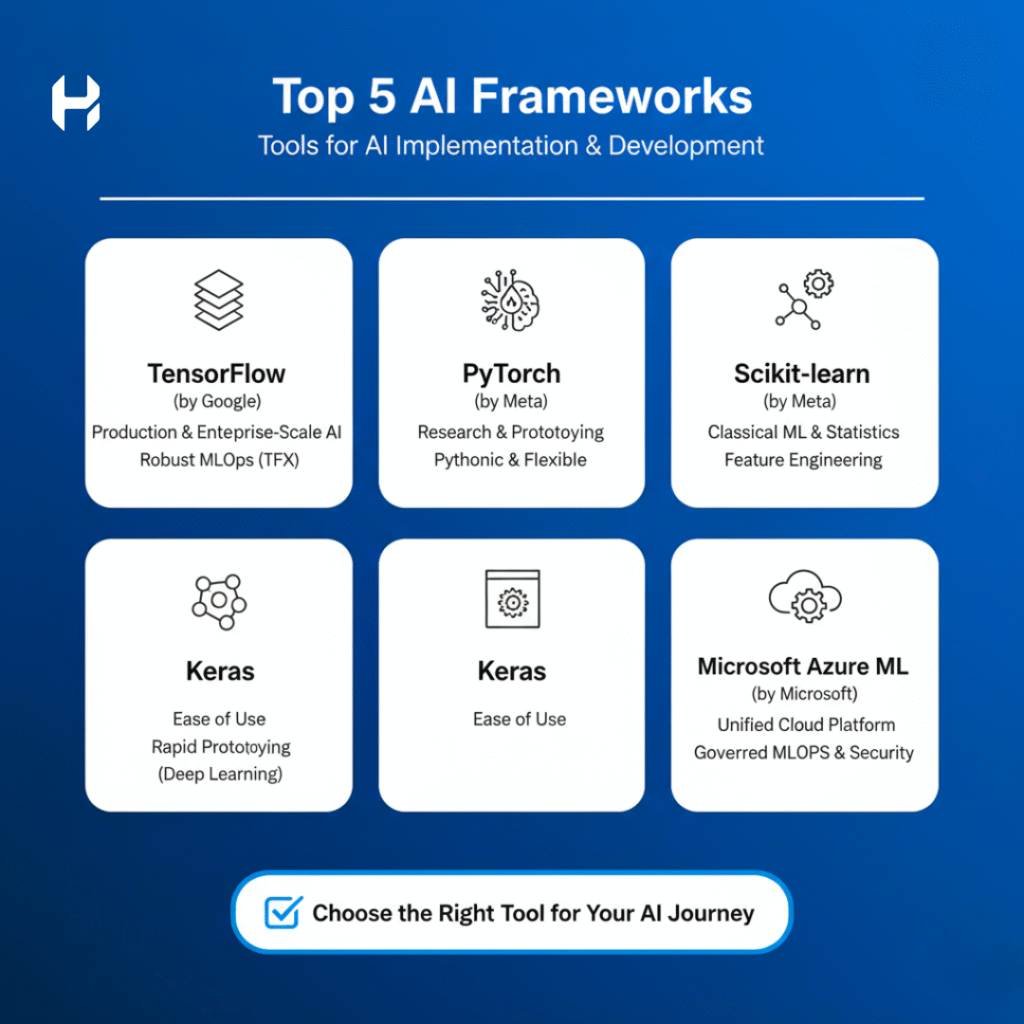
Top 5 AI Frameworks
When executing an artificial intelligence implementation plan and moving into the development phase (Step 5 of the framework), the choice of the correct software and library is paramount. These platforms provide the tools, libraries, and APIs necessary to handle the complex computations involved in model training and deployment, significantly streamlining the AI implementation process.
Here are five leading AI frameworks and platforms widely used by organizations and data scientists to execute their artificial intelligence implementation:
1. TensorFlow (by Google)
An open-source, end-to-end platform for machine learning. TensorFlow is renowned for its production readiness and deployment capabilities, allowing models to be easily deployed across various platforms, including servers, edge devices, and mobile devices.
Key Strength: Excellent for large-scale, enterprise-level AI implementation due to its robust tooling for production (TensorFlow Extended – TFX) and its versatility in handling deep learning and classical ML tasks.
2. PyTorch (by Meta)
An open-source machine learning library primarily used for applications utilizing the Python programming language. It is characterized by its dynamic computation graph, which offers greater flexibility and ease of debugging during experimentation and development phases.
Key Strength:
Highly favored by the research community and for rapid prototyping because of its Pythonic nature and flexibility, making it a powerful tool for initial development within the AI implementation process.
3. Scikit-learn
The most popular open-source library for traditional machine learning tasks in Python. It includes a vast collection of algorithms for classification, regression, clustering, and dimensionality reduction.
Key Strength:
While not a deep learning framework, Scikit-learn is essential for the initial stages of many projects and is a core component of how to implement AI for classical statistical modeling and feature engineering. It integrates seamlessly with Python’s scientific computing stack (NumPy, SciPy).
4. Keras
A high-level API written in Python and designed for fast experimentation. Keras can run on top of several deep learning frameworks, including TensorFlow, simplifying the user interface and reducing the cognitive load of building neural networks.
Key Strength:
Ease of use and rapid prototyping. Keras makes building deep learning models highly intuitive, allowing data scientists to quickly iterate and test ideas, speeding up the development stage of the artificial intelligence implementation plan.
5. Microsoft Azure Machine Learning (Azure ML)
Unlike the first four (which are primarily open-source libraries), Azure ML is a cloud-based platform offering a comprehensive set of services, tools, and infrastructure for managing the entire machine learning lifecycle (MLOps), from data preparation to deployment and monitoring.
Key Strength:
Provides a unified, governed environment for the entire AI implementation process. It is a strategic choice for businesses focused on how to implement AI in business within the Microsoft ecosystem, emphasizing compliance, security, and integration with other enterprise services.
The selection of a framework largely depends on the organization’s existing technology stack, the complexity of the use case, and the stage of the AI implementation process (e.g., PyTorch for research vs. TensorFlow or Azure ML for deployment).
Final Words
The successful execution of artificial intelligence implementation is the key differentiator for modern enterprises. It requires more than algorithms; it demands a robust AI implementation framework and a detailed artificial intelligence implementation plan that governs data, talent, and ethical use. The goal is to successfully answer the challenge of how to implement AI in business by consistently translating technical capability into measurable value.
For organizations navigating this complex AI implementation process, specialized partners can be invaluable. Companies like Hudasoft provide comprehensive support, offering expertise from initial AI Consulting and Model Development to full-scale AI Implementation and system integration. By benefiting from their specialization, particularly in custom software and emerging sectors, businesses can accelerate their time-to-value and ensure their AI strategy yields consistent, powerful results.
The future of business lies in viewing AI not as a product, but as a continuous, strategically managed process of innovation.
FAQS
Q: What is the implementation process of AI?
A: The AI implementation process involves defining goals, collecting and preparing data, selecting algorithms or models, training and testing the model, deploying it into production, and continuously monitoring and improving its performance.
Q: What are the AI frameworks?
A: Common AI frameworks include TensorFlow, PyTorch, Keras, Scikit-learn, MXNet, and Caffe tools used to build, train, and deploy AI and machine learning models.
Leave a Reply