
Table of Contents
After spending a few hours, I just thought: For years, we’ve had AI that could answer questions. But what if AI didn’t just answer questions, it actually solved problems?
That’s the shift happening right now. We’re moving beyond static chatbots and simple large language models (LLMs) to AI Agents: autonomous, goal-directed systems that can reason, plan, use tools, and execute multi-step tasks all on their own.
This isn’t just an upgrade; it’s a paradigm shift in software, and it’s about to change how every business operates.
Why the Rise of Agent-Based AI Now?
The surge of interest in autonomous AI agents isn’t a random trend—it’s the logical next step driven by three breakthroughs:
Smarter Core Models: The latest generation of LLMs (such as GPT-4, Claude 3, and Gemini) has remarkable reasoning and planning capabilities. They aren’t just predicting the next word; they can break down a complex, high-level goal into a series of smaller, executable steps. This “cognitive layer” is the agent’s brain.
The Tool-Use Breakthrough: Agents are no longer trapped in the virtual world of their training data. Frameworks have enabled them to use external tools, from browsing the web and running Python code to interacting with APIs, databases, and enterprise systems like Salesforce or Jira. This gives them the hands to actually do things in the real world.
The Need for Autonomy: Businesses are hitting the ceiling of what traditional automation (like Robotic Process Automation or simple scripts) can handle. We need systems that can adapt when things go wrong, search for missing information, and coordinate with other systems, exactly what an autonomous agent is built to do.
It’s the combination of a powerful brain, a toolset, and a self-correcting workflow that makes agentic AI a viable solution for complex, real-world problems today.
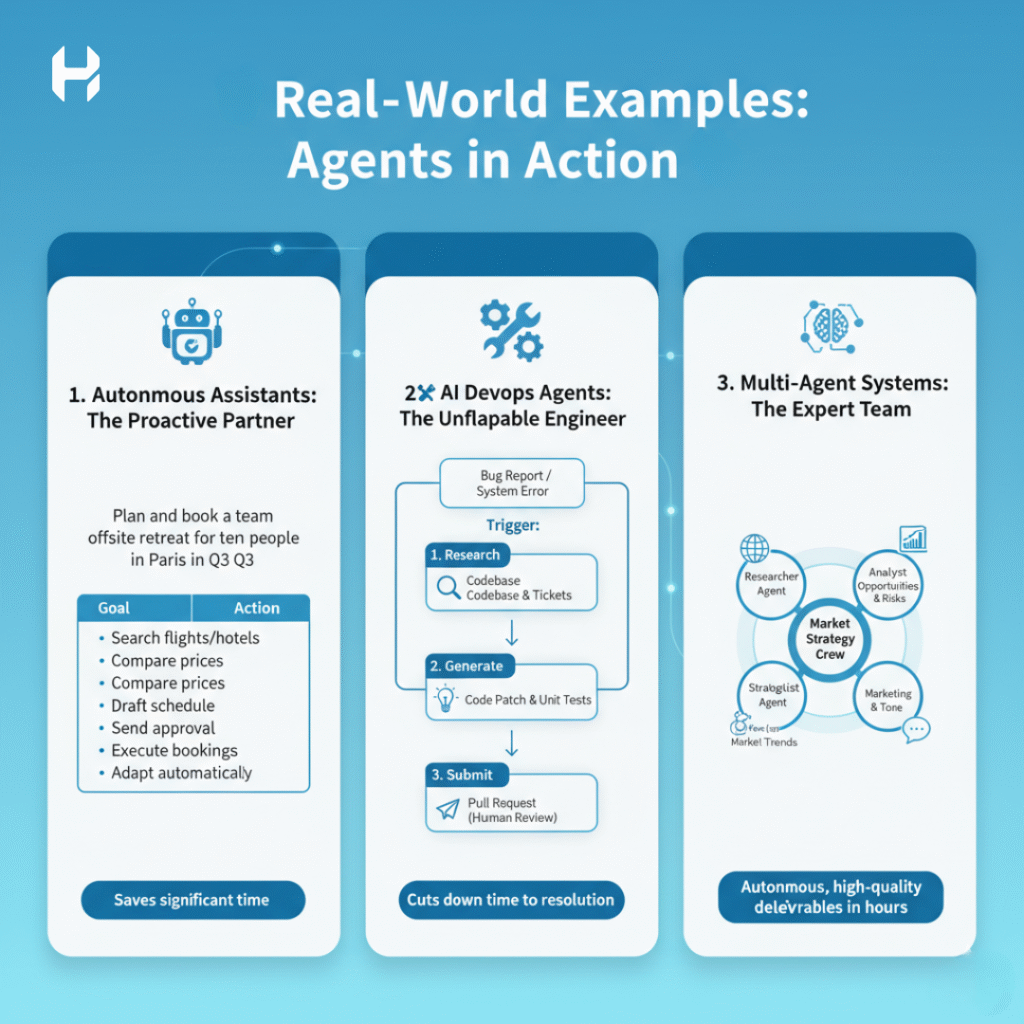
Real-World Examples: Agents in Action
The concept of an AI agent is already moving from research labs to mission-critical business applications. Here’s where they are delivering undeniable value:
1. Autonomous Assistants (The Proactive Partner)
Forget your voice assistant that just sets a timer. A true autonomous assistant takes a high-level goal and runs with it.
Goal: “Plan and book a team offsite retreat for ten people in Paris in Q3.”
Agent Action: The agent doesn’t just suggest hotels; it searches for flights, checks hotel availability in real time, compares prices against a budget, drafts a schedule, sends a summary email for approval, and then executes the bookings, all with minimal intervention, and adapts if a flight is suddenly sold out.
2. AI DevOps Agents (The Unflappable Engineer)
In the fast-paced world of software development and IT, agents are taking over routine and troubleshooting tasks.
Use Case: Self-Healing Codebase: An AI DevOps agent constantly monitors application performance. If a user submits a bug report or the system logs an error, the agent’s workflow kicks in:
- It researches the bug in the codebase and past ticket history.
- It generates a fix (code patch).
- It writes unit tests for the fix.
- It submits a pull request for human review, documenting all its steps. This dramatically cuts down the time from bug detection to resolution.
3. Multi-Agent Systems in Enterprise AI (The Expert Team)
The most exciting use case is when specialized agents work together, often called a “crew” or “multi-agent system.” Each agent has a focused role, and they collaborate to achieve a goal far too complex for a single AI.
- Use Case: Market Strategy Crew:
“Researcher Agent” searches the web and financial databases for current market trends.
“Analyst Agent” takes the data and identifies key opportunities and risks.
“Strategist Agent” uses the analysis to draft a detailed marketing plan and executive summary.
“Reviewer Agent” checks the final output for consistency and tone before presentation.
This collaborative model is fundamentally changing workflows, transforming a manual, week-long project into an autonomous, high-quality deliverable in hours.
What Are AI Agent Frameworks?
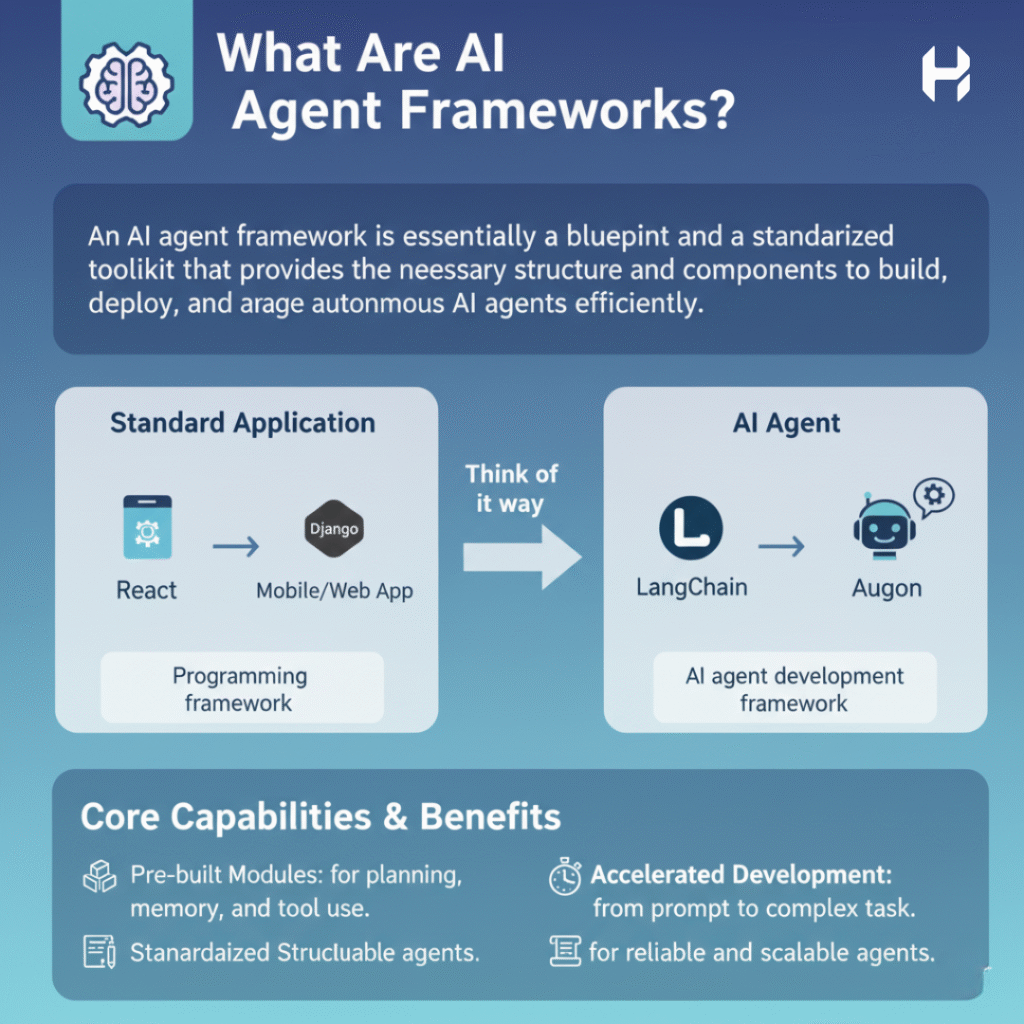
An AI agent framework is essentially a layout and a standardized toolkit that provides the necessary structure and components to build, deploy, and manage autonomous AI agents efficiently.
Think of it this way: building a standard application requires a programming framework (like React or Django). Building a self-directing, reasoning AI requires an AI agent development framework (like LangChain or AutoGen).
These frameworks accelerate development by offering pre-built modules for the core capabilities an agent needs to move from a simple prompt to a complex, executed task.
7 Popular AI Agent Frameworks (with Comparison)
The landscape of building AI agents’ autonomous programs that can plan, use tools, and execute complex tasks is defined by a handful of powerful frameworks. Choosing the right one is crucial for your project, whether you’re building a single workflow or an entire team of collaborating agents.
Here is a breakdown of the most popular AI agent frameworks and their ideal use cases:
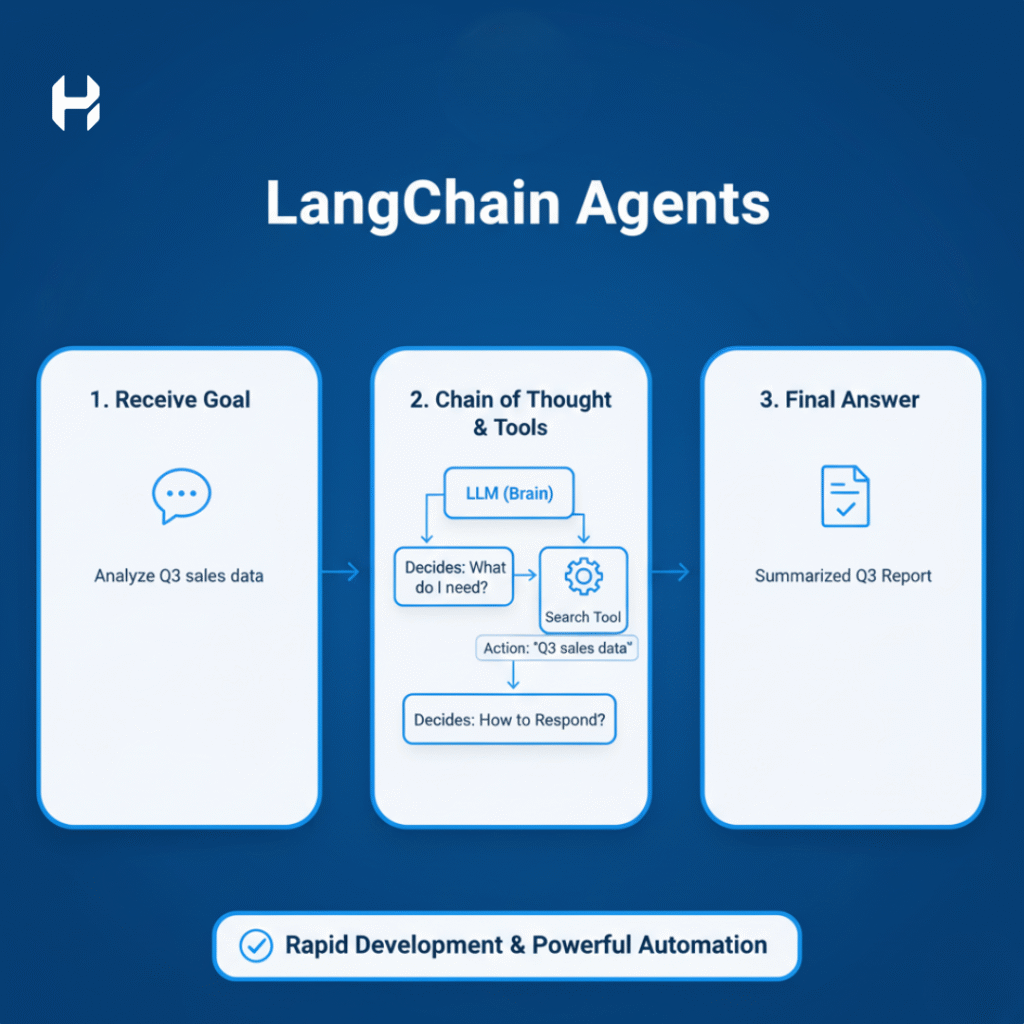
1. LangChain Agents
The Pioneer and Modular Toolkit
Overview: LangChain was instrumental in popularizing the concept of LLM-powered agents using the ReAct (Reasoning and Action) loop. It is a massive ecosystem designed for high flexibility and control.
Core Strength: It offers the largest ecosystem of components, tools, and connectors, making it the most versatile choice for integrating LLMs with external data sources (RAG) and APIs.
Ideal Use Cases: Building API-driven conversational assistants that require fine-grained control over prompt engineering and tool-use selection. Excellent for complex RAG applications requiring multi-step retrieval.
Multi-Agent Approach: Typically handles single-agent tasks, but its components can be used to manually construct multi-agent systems.
2. LangGraph
Structured, Stateful Multi-Agent Workflows
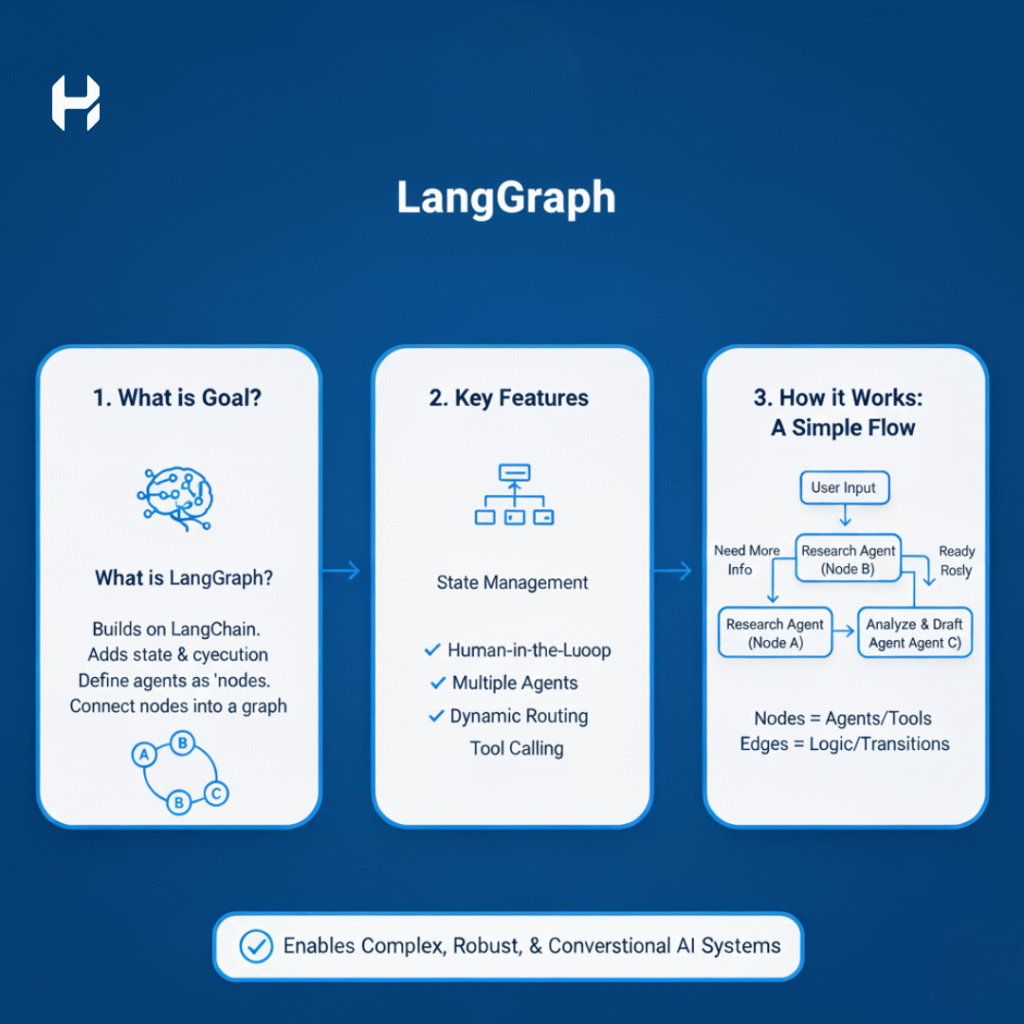
Overview: LangGraph is an essential extension of LangChain, developed specifically to handle complex, multi-step workflows that require cyclical or conditional logic.
Core Strength: It utilizes a graph-based architecture where agents and functions are nodes, and the workflow is defined by conditional edges. This allows agents to work together, pass information back and forth, and decide which agent should act next in a structured, stateful manner.
Ideal Use Cases: Creating strong multi-agent systems that need to review, revise, or escalate work. Perfect for stateful processes where agents need to loop back on a task (e.g., self-correction).
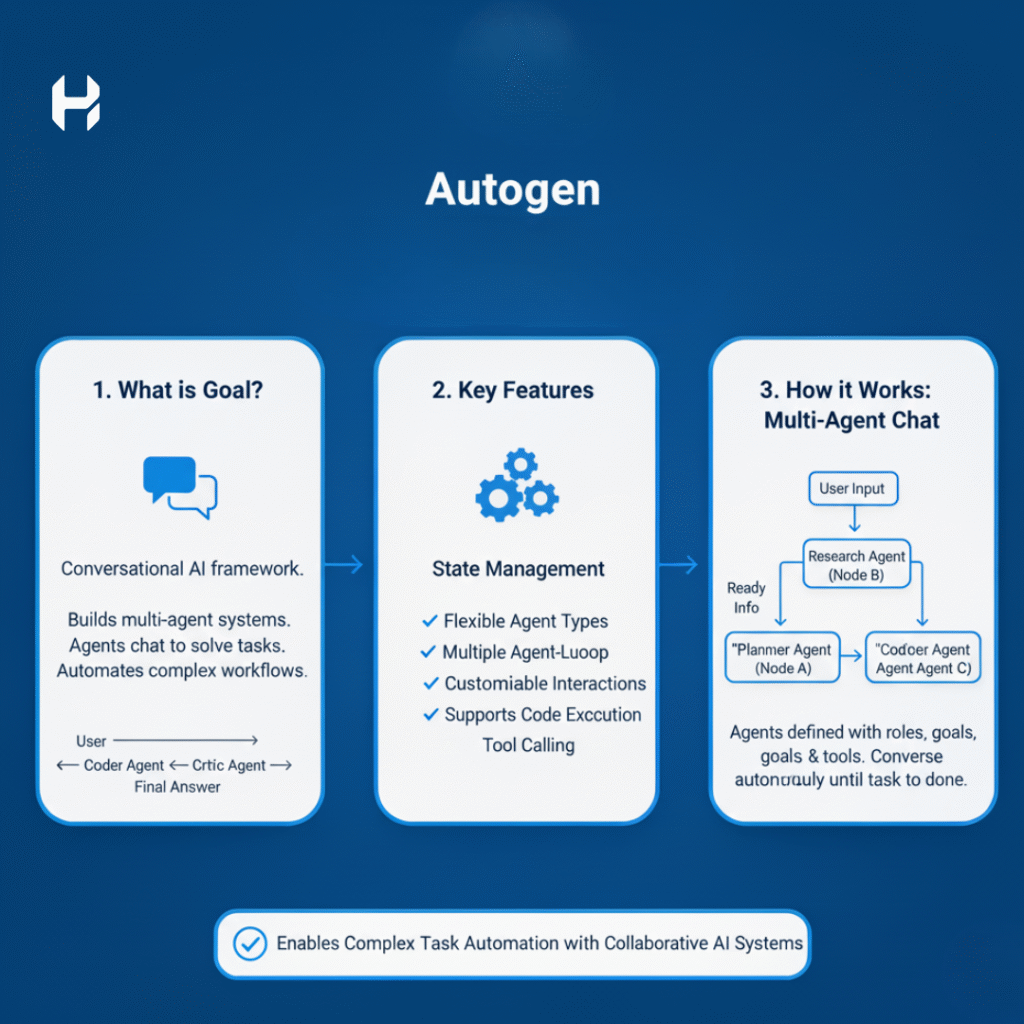
3. AutoGen (Microsoft)
Conversational Multi-Agent Systems
Overview: Developed by Microsoft, AutoGen excels at simulating natural, conversational collaboration between multiple agents, often featuring a User Proxy Agent to represent the human user.
Core Strength: Exceptional at conversational orchestration, allowing agents to “talk” to each other to solve a goal. It includes strong, built-in support for agents to write, execute, and debug code in a secure environment.
Ideal Use Cases: Automated software development tasks (from idea to coded, tested solution). Ideal for collaborative coding, research, and technical troubleshooting where agents need to discuss and iterate on a solution.
Multi-Agent Approach: Peer-to-peer conversation and task resolution.
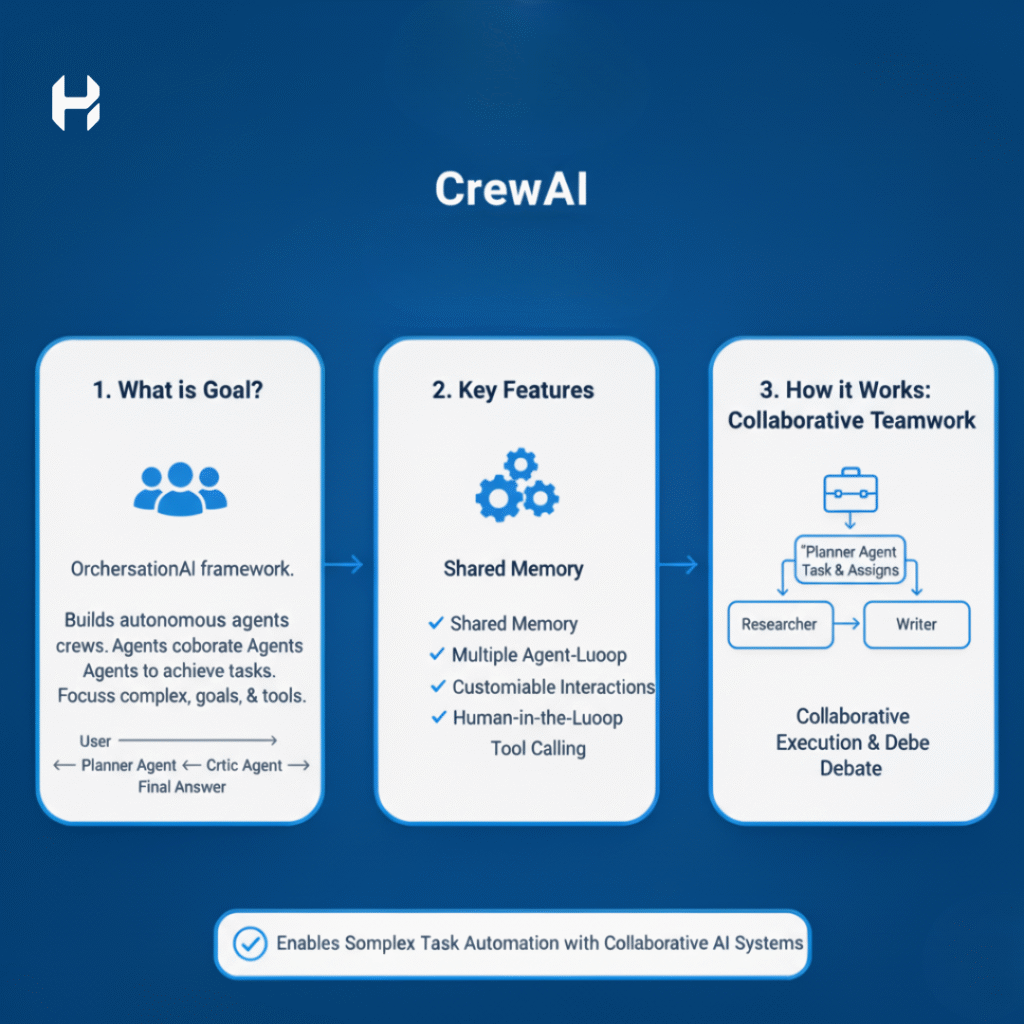
4. CrewAI
Role-Based Collaboration Framework
Overview: CrewAI simplifies the creation of collaborative “crews” by focusing heavily on assigning clear, specialized roles, goals, and tools to each agent (e.g., a “Researcher” and a “Writer”).
Core Strength: It has a clean, intuitive API and is designed to model team-like workflows quickly. It handles the structured collaboration, task delegation, and sequencing between agents seamlessly.
Ideal Use Cases: Automated content generation (blog posts, reports). Market research and analysis where defined inputs and outputs are needed from different expert roles within a strict, structured workflow.
Multi-Agent Approach: Defined roles with delegated tasks, strong focus on delivering a final, consolidated output.
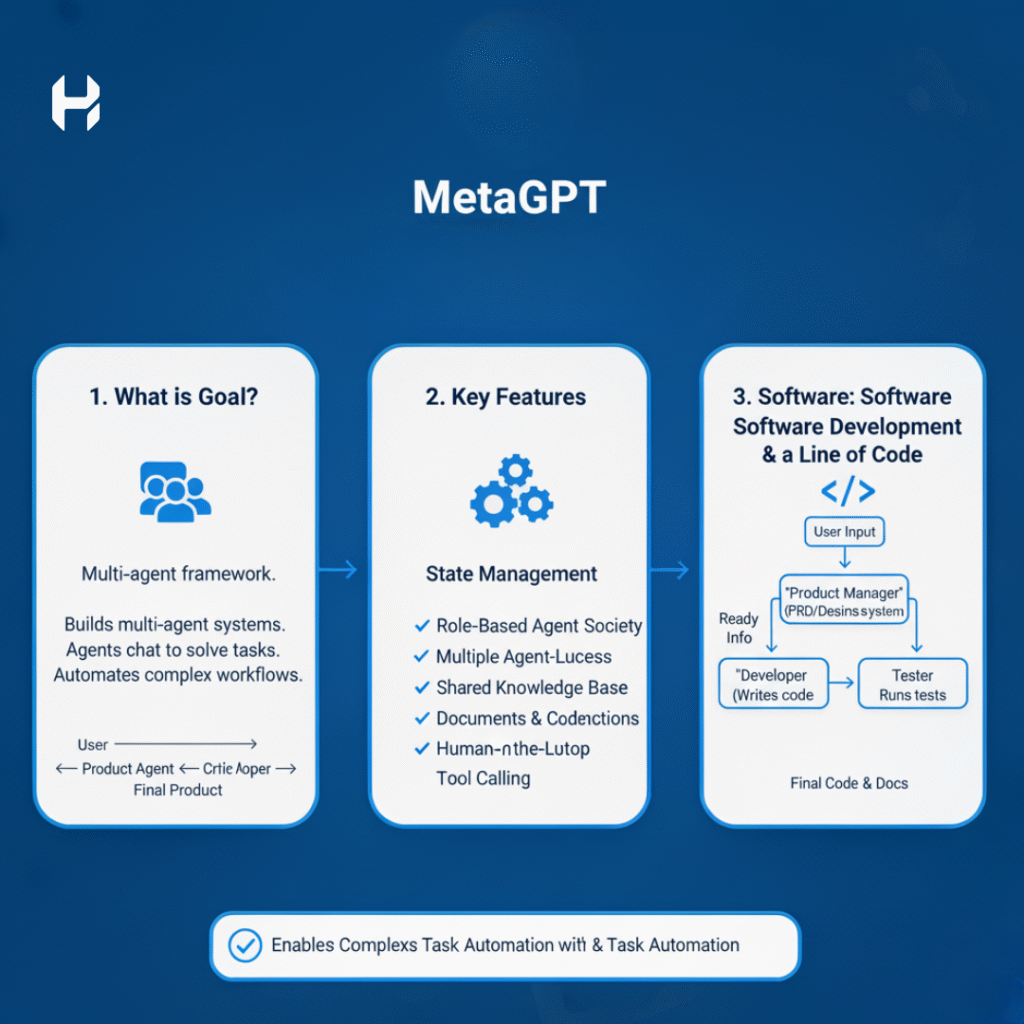
5. MetaGPT
The AI Software Company Simulator
- Overview: MetaGPT takes the multi-agent concept to the extreme by simulating an entire software company, with agents filling roles like Product Manager, Architect, and Engineer.
- Core Strength: It is driven by pre-defined Standard Operating Procedures (SOPs), which ensure the agents follow a disciplined, assembly-line process. It generates complete project artifacts (user stories, competitive analysis, API definitions, and final code) from a single user requirement.
- Ideal Use Cases: Automated software development project generation (creating a Minimum Viable Product from a simple prompt). Simulating complex, multi-component organizational workflows.
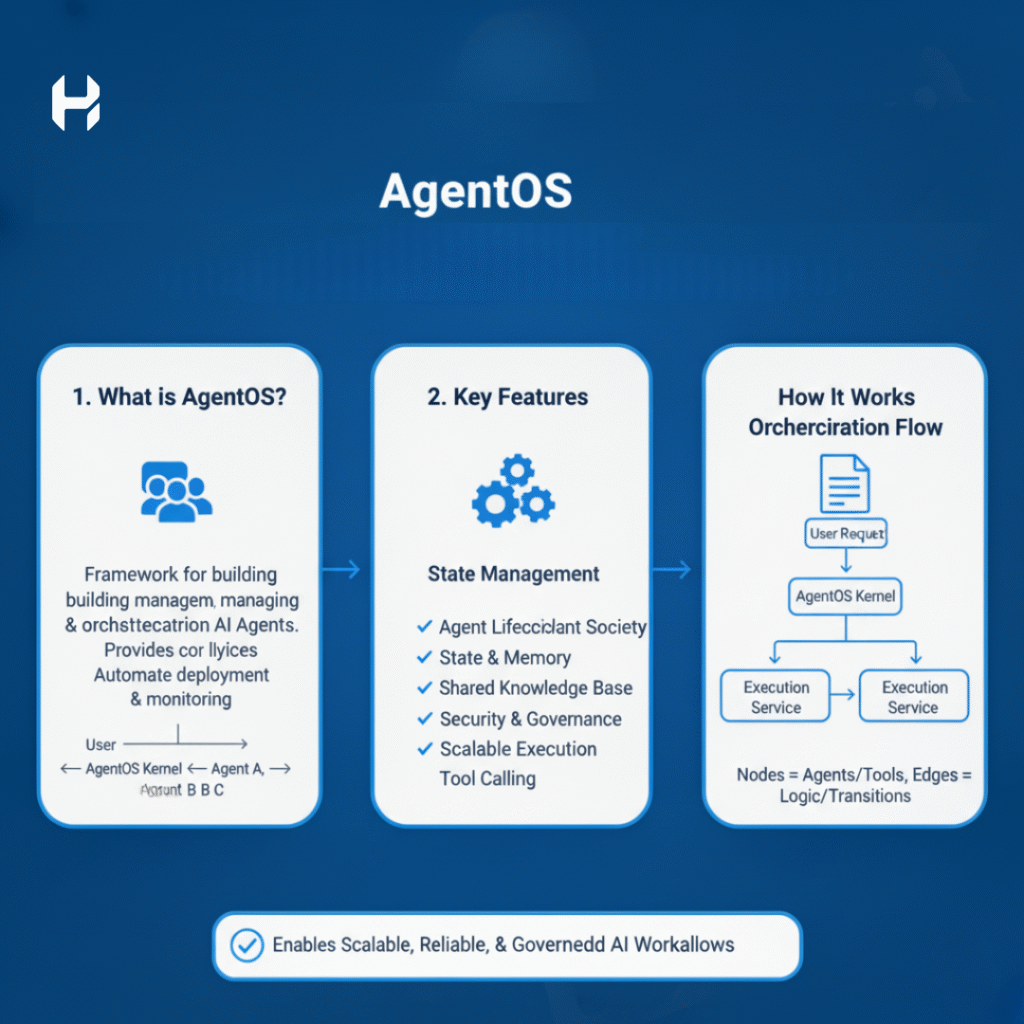
6. AgentOS (Microsoft Agent Framework)
Enterprise-Grade Stability and Control
- Overview: This refers to the evolution of Microsoft’s agent efforts, combining the best of AutoGen and Semantic Kernel into a more robust, enterprise-grade framework.
- Core Strength: Designed for production-ready systems with a focus on stability, type safety, and governance. It introduces explicit Workflows for complex multi-agent execution paths and provides excellent telemetry and observability.
- Ideal Use Cases: Mission-critical enterprise applications, long-running processes, and teams heavily invested in the Microsoft ecosystem that require auditing and monitoring.
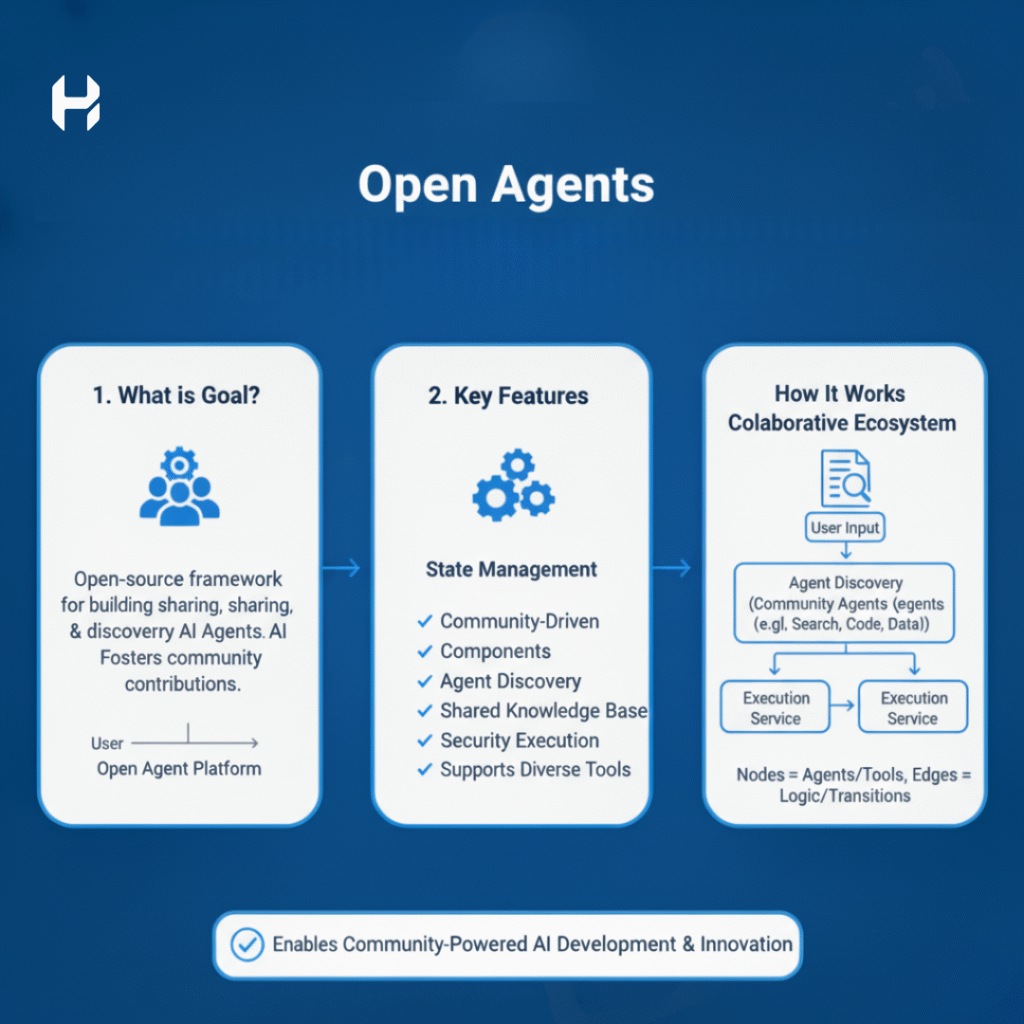
7. Open Agents (OpenAI Agents SDK)
Lightweight, Production Deployment
- Overview: Often referencing the official frameworks released by leading LLM developers like the OpenAI Agents SDK, this approach prioritizes simplicity, reliability, and minimal abstraction.
- Core Strength: Focuses on core, production-ready features like Handoffs (delegation to specialist agents), Guardrails (input/output validation), and Sessions (automatic state management). It is naturally integrated and optimized for its parent LLM models (e.g., GPT).
- Ideal Use Cases: Production-facing applications where reliability, a simple architecture, and minimal latency are critical. Teams that need Human-in-the-Loop (HITL) approval features.
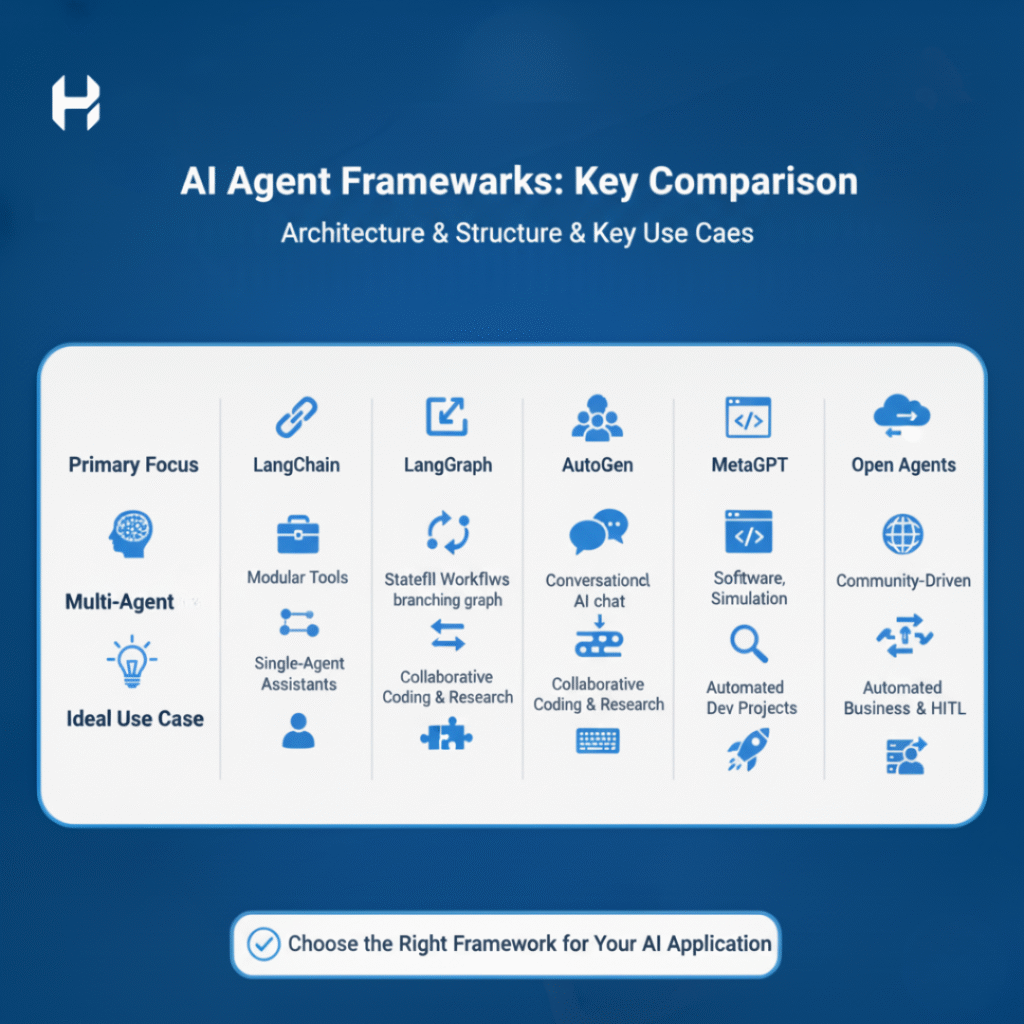
AI Agent Frameworks: Key Comparison
Here is a concise comparison table of the most popular AI agent frameworks, highlighting the distinctions in their architecture and primary use:
| Framework | Primary Focus | Multi-Agent Structure | Ideal Use Case |
| LangChain Agents | Modular Components & Tool Use | Low-level orchestration (linear) | Single-Agent RAG/API Assistants |
| LangGraph | Stateful Workflow Orchestration | Graph-based (cyclical, branching) | Complex, multi-step agentic processes |
| AutoGen (Microsoft) | Conversational Collaboration | Peer-to-peer conversation | Collaborative Coding & Research |
| CrewAI | Role-Based Delegation | Defined roles with delegated tasks | Structured Business Workflows/Content |
| MetaGPT | Software Company Simulation | SOP-driven assembly line | Automated Software Project Generation |
| AgentOS | Enterprise-Grade Stability & Control | Explicit graph workflows | Production systems, Auditing |
| Open Agents (SDKs) | Lightweight, Production Deployment | Primitives like ‘Handoffs’ | Reliability, HITL, Native GPT users |
What AI Agent Frameworks Do
AI agent frameworks are structured toolkits that provide the necessary architecture for a Large Language Model (LLM) to become a goal-directed, autonomous agent. They abstract away the complexity of making an LLM execute multi-step tasks in the real world.
These frameworks standardize the agent’s core capabilities:
Planning & Reasoning: Breaking down a complex, high-level user goal into a dynamic sequence of smaller, executable steps.
Tool-Use: Providing reliable mechanisms for the agent to select, call, and interpret results from external tools, APIs, code interpreters, and databases.
Memory Management: Handling both short-term conversation context and long-term knowledge retrieval (RAG) to ensure the agent acts with full context.
Orchestration: Managing the flow of decision-making and, in multi-agent frameworks, coordinating the specialized collaboration between different AI entities.
Factors to Consider When Choosing
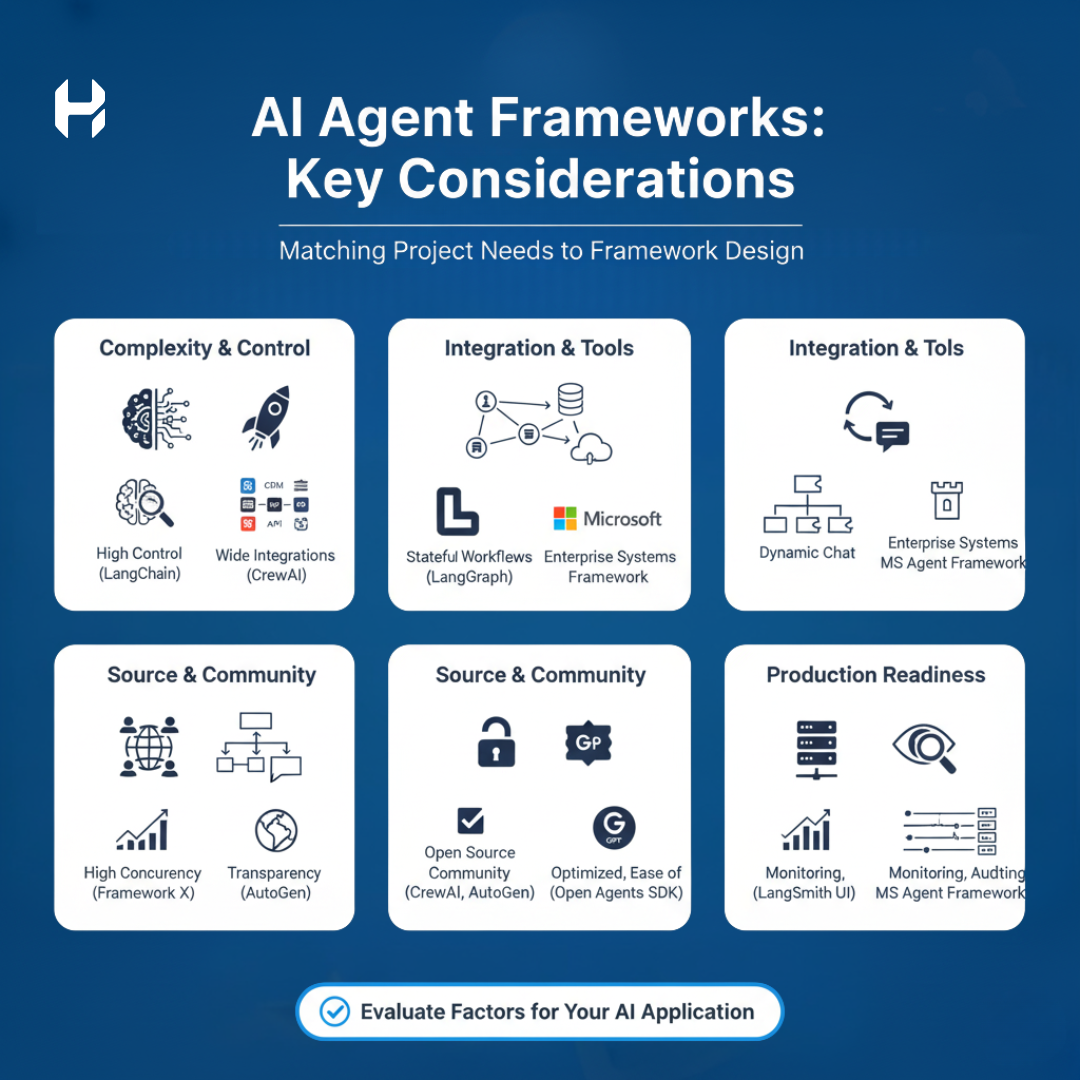
Selecting the best AI agent framework requires matching your project’s needs to the framework’s design philosophy. Evaluate these key factors:
Technical Complexity vs. Plug-and-Play
High Control (Complex): Frameworks like LangChain and LangGraph offer deep modularity, giving you granular control over every prompt and component. This requires more upfront engineering but provides maximum customization.
Plug-and-Play (Simplified): Frameworks like CrewAI and AutoGen abstract much of the complexity, offering a higher-level, more opinionated API for faster prototyping and easier definition of collaborative roles.
Integration with Internal Tools & APIs
The framework’s ability to seamlessly connect agents to your proprietary systems (CRMs, databases, internal code) is critical.
LangChain leads in ecosystem maturity and the sheer breadth of available integrations and tool connectors, while Microsoft Agent Framework focuses on robust integration within the enterprise environment.
Support for LLM Orchestration
- Orchestration is the framework’s method for guiding the agent’s behavior.
Graph-based Orchestration (e.g., LangGraph): Excellent for defining complex, stateful workflows with explicit loops, branching, and human-in-the-loop steps.
Conversational Orchestration (e.g., AutoGen): Best for dynamic, event-driven, peer-to-peer interactions where agents naturally converse until a goal is met.
Open-Source vs. Proprietary
Open Source: Frameworks like CrewAI, AutoGen, and LangChain offer full transparency, auditability, and massive community support, reducing vendor lock-in.
Proprietary/Vendor-Led: Frameworks like the Open Agents SDK (often closely tied to models like GPT) benefit from native optimization and simpler integration with their parent platform, often trading flexibility for ease of use and reliability.
Scalability and Observability
For production systems, you need features that ensure stability and easy debugging.
Scalability refers to the framework’s ability to handle high concurrency.
Observability (via tools like LangSmith or built-in logging) is crucial for tracing the agent’s step-by-step decisions, which is essential for auditing and improving autonomous systems. Frameworks designed for enterprise use, like the Microsoft Agent Framework, prioritize these features with built-in telemetry.
AI Agent Frameworks: Key Feature Comparison
The development of AI agents relies on specialized frameworks that provide the underlying architecture for autonomy, tool use, and multi-agent collaboration. This table offers a quick comparison of the most popular AI agent frameworks, highlighting their primary design focus and key features to help you determine the best fit for your development needs.
| Framework | Multi-agent | Tool Use | Memory | Open Source | Ideal For |
| LangChain Agents | Yes (via LangGraph) | Extensive (Vast Ecosystem) | Modular (RAG, Vector DBs) | Yes | Highly flexible RAG & API integration |
| LangGraph | Native (Graph-based) | Relies on LangChain | Stateful graph nodes | Yes | Complex, cyclical workflows & self-correction |
| AutoGen | Native (Conversational) | Strong (Code Execution) | Managed per conversation | Yes | Collaborative coding & dynamic research |
| CrewAI | Native (Role-based) | Good (Focus on delegation) | Contextual sharing between agents | Yes | Structured team-based workflows & content creation |
| MetaGPT | Native (SOP-based) | Focused on software tools | Managed per project lifecycle | Yes | Automated software development project generation |
| Microsoft Agent Framework | Native (Workflow-based) | Enterprise-grade | Robust, thread-based | Yes | Enterprise scalability and regulated environments |
| Open Agents (SDKs) | Limited (Handoffs) | Native integration | Managed per session | Varies | Simple, reliable, production-ready GPT apps |
Final Words
The global conversation around AI has fundamentally shifted. It’s no longer about simple chatbots or reactive models; it’s about autonomous, goal-driven AI agents. The frameworks we’ve analyzed from the flexible LangChain ecosystem to the collaborative CrewAI and the enterprise-focused Microsoft Agent Framework are not just libraries; they are the essential building blocks of the next wave of automation.
While specific platforms like Hudasoft (or similar enterprise/integration-focused solutions) may offer specialized tools, most advanced AI agent workflows ultimately rely on the core principles and architectures defined by these foundational frameworks.
The key takeaway is this:
- Focus on the Workflow, Not Just the Agent: The true value of agentic AI comes from redesigning entire business processes. The agent is the integrator, the orchestrator, and the self-correcting worker that connects systems, eliminates manual hand-offs, and drives efficiency.
- The Trend is Specialization and Interoperability: As the market matures, we will see highly specialized agents (e.g., a “compliance agent” for finance) that must collaborate seamlessly. The focus is shifting toward standardized protocols to allow agents built on different frameworks (and integrated through platforms like Hudasoft) to work together.
- Enterprise Adoption Demands Governance: For production use, features like Scalability, Observability, and Human-in-the-Loop (HITL) controls are paramount. Frameworks designed for enterprise use prioritize these features to ensure auditability and safe deployment, which is a core requirement for any platform like Hudasoft catering to large organizations.
By understanding the strengths of these AI agent frameworks and choosing the one that aligns with your complexity needs, be it the plug-and-play simplicity of CrewAI or the structured control of LangGraph, you are positioning yourself at the forefront of the AI rebellion.
FAQS
How is an AI agent different from a chatbot?
A chatbot is reactive and limited primarily to dialogue; it answers questions based on its knowledge. An AI agent is autonomous and goal-oriented, able to reason, plan multi-step actions, use external tools (like APIs), and execute complex tasks without continuous human intervention.
Can I use multiple frameworks together?
Yes. Combining frameworks is common. For instance, a high-level collaboration framework (like CrewAI) can be used to organize agents that rely on the deep RAG and tool features provided by a modular system (like LangChain). Frameworks like LangGraph are often used specifically to orchestrate and manage components from various sources.
Are AI agents safe for enterprise use?
Yes, but they require robust governance. Safety features built into modern frameworks include Guardrails to prevent harmful actions, Human-in-the-Loop (HITL) controls for sensitive tasks, and Observability (tracing and logging) to ensure every autonomous decision is fully auditable.
What skills do I need to build agent-based apps?
Key skills are Python proficiency and strong Prompt Engineering to guide the LLM’s reasoning. Additionally, developers need knowledge of API/Tool Integration to connect agents to real-world services and Workflow Design to structure the agents’ complex, multi-step autonomous processes.
Leave a Reply