Table of Contents
Why are the world’s leading automakers investing so heavily in artificial intelligence? The answer lies in a complete shift of the manufacturing process. From the moment a car is designed to the day it rolls off the assembly line, AI is at the heart of every decision.
This guide AI in Automotive Manufacturing provides a comprehensive look at how AI is not just a technological improvement, but the very engine of the next industrial era. We will explore the critical roles of AI in everything from optimizing the supply chain and detecting the most minute defects to building the autonomous vehicles of tomorrow. By the end, you will have a clear understanding of how AI is accelerating the industry into a smarter, more productive, and more progressive future.
II. Key AI Technologies Transforming Automotive Manufacturing
Practical AI that turns factories into faster, smarter, safer operations, raising throughput, caustic costs, and hardening supply chains with predictive maintenance, vision-led QC, digital twins, and real-time scheduling that ties PLM, MES, and ERP into one responsive loop.
1. Machine Learning and Predictive Analytics
Machine Learning algorithms analyze data from sensors, machines, and historical logs to detect patterns and predict outcomes. Whether forecasting part failures or optimizing energy use, predictive analytics helps automotive factories shift from reactive to proactive operations.
2. Computer Vision in Quality Control
AI driven computer vision systems inspect vehicle components with microscopic accuracy. They can identify scratches, alignment issues, or manufacturing defects at a speed and precision far beyond human capability. This reduces faulty units and improves overall product quality.
3. Robotic Process Automation (RPA)
RPA automates repetitive tasks on the assembly line from welding to part placement. Unlike traditional robots, AI-powered systems can adapt in real time to changes, reconfigure themselves for different vehicle models, and optimize speed and force based on the part.
4. Natural Language Processing (NLP)
AI is also streamlining backend and administrative tasks. NLP allows machines to understand and process human language, enabling voice activated commands, automated documentation, and AI chatbots that handle internal support or supplier communication.
5. Digital Twins and AI Simulation
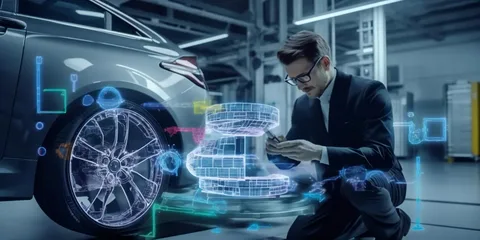
A digital twin is a virtual model of a physical process or machine. Paired with AI, digital twins allow manufacturers to simulate changes in the production process, test scenarios, and optimize outcomes without disrupting real operations. This is particularly useful in prototyping and process refinement.
III. Use Cases of AI in Automotive Manufacturing
Field-tested AI converts variability into throughput by reducing stoppages, raising first-pass yield, and smoothing flow with demand planning, smart sourcing, vision QC, and digital twins.
1. Predictive Maintenance
AI monitors machinery performance through sensors that collect data on vibration, temperature, and load. Algorithms predict failures before they happen, allowing scheduled maintenance instead of costly emergency repairs and minimizing downtime.
2. Visual Quality Inspection
Cameras powered by deep learning algorithms inspect vehicle parts in real time, identifying defects such as dents, scratches, or welding inconsistencies. This leads to faster inspections and dramatically reduces the chances of defective vehicles reaching consumers.
3. Production Line Automation
AI enables smarter robots that not only follow instructions but make autonomous adjustments. For instance, robots can detect inconsistencies in part placement and recalibrate instantly, resulting in smoother and faster operations.
4. Demand Forecasting and Inventory Optimization
AI models analyze sales trends, supply chain data, and seasonal shifts to predict demand for specific vehicle models or components. This helps manufacturers maintain lean inventory, reduce waste, and ensure that critical parts are always available.
5. Supply Chain Automation and Smart Vendor Matching
AI automates procurement workflows by analyzing supplier performance, delivery times, and cost fluctuations. This helps automotive manufacturers choose the best vendors and respond quickly to supply chain disruptions.
IV. Smart Operations and Connected Ecosystems
AI does not just enhance isolated factory functions, it transforms the entire production ecosystem. Automotive companies that operate multiple plants can now use AI to synchronize operations across facilities, making the entire manufacturing network more agile and transparent.
Key Advantages:
- Centralized dashboards provide real time visibility into every production unit
- AI powered coordination ensures optimized material flow and reduced bottlenecks
- Automated alerts empower teams to make instant, informed decisions
Much like how modern automotive factories are embracing integrated networks to streamline internal workflows, service coordination, and maintenance scheduling, an automotive app development company plays a critical role in enabling these transformations. By combining AI with resource and workforce management, manufacturers can build intelligent, self-correcting environments that drive productivity and reduce operational friction.
V. Benefits of AI Adoption in Automotive Manufacturing
As AI technologies continue to transform the automotive industry, their integration into manufacturing processes delivers significant strategic advantages. From reducing operational costs to enhancing safety and sustainability, the benefits of AI adoption are reshaping how vehicles are built.
1. Cost Savings Through Reduced Downtime and Defects
With predictive maintenance and automated inspections, manufacturers minimize machine breakdowns and avoid producing defective units, resulting in substantial savings.
2. Higher Throughput and Faster Time to Market
AI-optimized production lines increase the speed of manufacturing without sacrificing quality. This allows companies to release new models faster and meet market demand with agility.
3. Safer Workplace With Smart Risk Detection
AI systems monitor workplace conditions to prevent accidents. They can detect overheating, unsafe human-robot interaction, or equipment strain and trigger automatic safety protocols.
4. Greater Sustainability and Energy Efficiency
AI systems track and optimize energy use across production lines, lighting, HVAC systems, and more. This not only reduces costs but also aligns with environmental regulations and sustainability goals.
VI. Industry Stats and Market Outlook
- According to MarketsandMarkets, the AI in manufacturing market is expected to grow from USD 3.2 billion in 2023 to USD 20.8 billion by 2028
- 58 percent of automotive manufacturers have implemented AI in at least one function (Statista)
- Predictive maintenance enabled by AI can reduce unplanned downtime by up to 70 percent
- AI can improve manufacturing efficiency by as much as 30 percent through process optimization and real time decision making
VII. Real World Examples and Case Studies
Leading automotive manufacturers are already using AI to gain a competitive edge. These real-world examples demonstrate how companies like Tesla, BMW, and Toyota are using AI to enhance efficiency, ensure quality, and future-proof their operations through smart factory innovations.
Tesla
Tesla’s Gigafactories are often cited as a gold standard in AI first manufacturing. Their AI systems coordinate robotic arms, analyze welding quality, and manage energy consumption across the plant—all in real time.
BMW
BMW utilizes AI for real time quality control using camera systems trained with deep learning. The company has also deployed AI in logistics to forecast the arrival of parts and reduce assembly delays.
Toyota
Toyota applies AI in predictive maintenance and production simulation. Their smart factories use AI models to ensure operational consistency, manage workflows, and reduce waste.
These brands are also aligning their operations with Industry 4.0 and smart factory frameworks, creating scalable and future-proof environments.
VIII. Challenges and Considerations
While AI brings transformative potential to automotive manufacturing, its adoption is not without barriers. From steep upfront costs to integration hurdles and workforce adaptation, companies must guide a range of technical and organizational challenges to realize AI’s full benefits.
1. High Initial Investment
Implementing AI infrastructure, including hardware, data pipelines, and integration platform,s requires significant capital. For smaller manufacturers, this can be a barrier to entry.
2. Data Security Risks
With increasing connectivity comes vulnerability. AI systems depend on data making cybersecurity and data protection critical priorities in the manufacturing landscape.
3. Compatibility With Legacy Systems
Many manufacturers still rely on legacy ERP and production systems. Integrating AI tools into these environments requires careful planning and often custom middleware solutions.
4. Workforce Training and Change Management
AI introduces new workflows, dashboards, and automation layers. Workers must be trained to operate and collaborate with intelligent systems, which involves time and strategic upskilling.
IX. Future of AI in Automotive Manufacturing
As AI technologies continue to develop, the future of automotive manufacturing is poised for even greater change. From autonomous production systems to intelligent human-machine collaboration, the next wave of creation will redefine efficiency, flexibility, and global adaptivity in the factory of tomorrow, impacting everything from production lines to downstream systems like a dealership management solution.
1. Autonomous Production Cells
Future factories may operate self contained cells that handle entire production phases autonomously deciding, adjusting, and executing tasks based on real time data.
2. Synergy Between AI, IoT, and Edge Computing
Combining AI with the Internet of Things and edge computing allows decentralized data processing, enabling faster decisions and improving factory resilience.
3. Decentralized and Scalable Smart Factories
AI will support global manufacturers in building smaller, agile smart factories closer to demand centers, reducing logistics complexity and carbon footprint.
4. Human AI Collaboration
Rather than replacing humans, AI will augment them, enhancing decision making, improving safety, and enabling staff to focus on high value tasks that require creativity and judgment.
X. Conclusion
As the lines between digital intelligence and physical production continue to blur, businesses that involve AI will define the new benchmarks of success. To stay competitive, manufacturers must begin aligning with connected ecosystems, intelligent tools, and adaptive systems. The journey begins with data and ends with transformation, and for many in the automotive industry, that journey is made with a partner like Hudasoft.
Hudasoft specializes in delivering custom software solutions and AI tools that help automotive businesses, from manufacturers to dealerships, simplify operations, improve customer experiences, and open the full potential of their data. Their expertise in areas like dealership management systems, sales automation, and predictive analytics allows companies to efficiently implement the intelligent systems needed to arrive in this new industrial era.
FAQs
How is AI used in automotive manufacturing?
AI is used in predictive maintenance, quality inspections, robotic automation, process optimization, inventory management, and supply chain coordination.
What are the benefits of AI in automotive factories?
AI helps reduce costs, improve production quality, accelerate time to market, improve workplace safety, and increase sustainability.
Can AI reduce production costs in the automotive sector?
Yes. AI prevents equipment failure, reduces human error, optimizes resource use, and cuts unnecessary labor or energy expenses.
What is the future of AI in automotive manufacturing?
The future lies in autonomous production systems, smart factory ecosystems, AI integrated supply chains, and deeper collaboration between humans and machines.
Leave a Reply