AI for Dealership Management in UAE is changing how automotive businesses operate, compete, and grow. From intelligent inventory forecasting to personalized customer experiences, AI dealership management systems are helping UAE dealerships replace manual processes with predictive intelligence.
With the UAE automotive market becoming increasingly competitive, adopting AI dealership management software is no longer optional it is a strategic requirement.
Why AI for Dealership Management in the UAE Is a Business Necessity
This allows dealerships to maintain optimal stock levels, reduce excess inventory, and avoid stockouts. AI Dealership Inventory Management in the UAE directly improves cash flow and profitability.
AI Sales Forecasting for Dealerships
AI sales forecasting for dealerships predicts:
Monthly sales demand
Vehicle variant preferences
Regional buying behavior
This helps UAE dealerships plan procurement, marketing, and staffing with confidence.
This enhances customer experience while reducing operational workload.
AI Workshop Management System
An AI workshop management system optimizes:
Technician scheduling
Service time estimation
Parts availability
Maintenance prediction
This improves service efficiency and customer satisfaction.
AI Predictive Maintenance Automotive
AI predictive maintenance automotive solutions analyze vehicle data to predict failures before they occur, reducing downtime and increasing vehicle reliability.
AI Pricing Optimization Automotive
AI pricing optimization for automotive systems adjusts vehicle prices based on market demand, competition, and customer behavior, ensuring maximum margin without losing competitiveness.
AI Dealership ERP UAE: Unified Business Intelligence
UAE automotive digital transformation is driven by AI adoption. Dealerships using AI automotive software UAE gain a competitive advantage through smarter operations and better customer experiences.
AI for Dealership Management in the UAE is reshaping automotive retail. Dealerships that invest in AI dealership management systems today will lead the UAE automotive market tomorrow.
Hudasoft is your trusted partner for intelligent, scalable, and future-ready AI dealership solutions in the UAE.
FAQs
1. What is the best AI for car dealerships? The best AI for car dealerships is one designed specifically for automotive CRM and sales automation. It helps manage leads, customer interactions, and marketing campaigns efficiently.
2. How can AI benefit a Dealership Management System? AI improves a Dealership Management System by automating data analysis, inventory tracking, and customer insights. It helps increase sales performance and streamline daily operations.
3. Will AI replace human employees at my dealership? AI will not replace human employees but will support them. It enhances productivity, improves decision-making, and allows staff to focus on building customer relationships.
The automotive industry is moving faster than ever. With the market projected to hit nearly $7.44 billion by 2032, competition in hubs like Dubai and Abu Dhabi is at an all-time high. But as sales grow, so do the headaches.
If you are running a dealership or a service center, you know the drill. Managing multi-location operations feels like a balancing act. One branch has too many brake pads, while another is turning away customers because they’re out of stock.
Tracking spare parts inventory across different warehouses often leads to manual errors, and staying on top of after-sales service schedules can become a nightmare without the right tools. Plus, with the UAE’s advancing tax landscape, ensuring VAT compliance is no longer just a “nice-to-have”; it’s a legal necessity.
To stay ahead, local leaders are moving away from disconnected spreadsheets and embracing automotive business solutions in the UAE that actually talk to each other.
Key Challenges for Automotive Businesses in the UAE
Scaling a car brand in the Emirates is an exciting goal, but it often reveals deep gaps in traditional manual processes. Without a powerful automotive ERP software in the UAE, many businesses run into the same four major roadblocks:
The Inventory Blind Spot:
Managing multi-location operations is a high-stakes balancing act. Without a clear view of your stock, you might have an oversupply of high-value parts in Sharjah while your Dubai branch is losing sales because it is out of stock. This leads to tied-up cash and missed deals.
Complex Supply Chains:
The journey from global manufacturers to local warehouses involves massive procurement and shipping hurdles. Managing these logistics manually often results in delays that frustrate your workshop teams and your customers.
Rising Customer Demands:
Modern UAE car buyers expect a personalized experience. If your team isn’t using an integrated car dealership ERP in the UAE, it is nearly impossible to track service histories or offer the quick, tailored follow-ups that turn a one-time buyer into a loyal client.
The Regulatory Squeeze:
With the region’s focus on transparency, staying on top of VAT compliance, multi-currency reporting, and audit-ready financial statements is non-negotiable. Trying to manage these through spreadsheets is a major risk that can lead to costly errors.
How Dynamics 365 Business Central Solves These Challenges
To overcome these hurdles, you need a system that works as hard as your team does. Microsoft Dynamics 365 Business Central is designed as a specialized ERP for the automotive industry, turning chaotic data into a smooth, organized workflow. Here is how it solves your biggest pain points:
Financial Management & Compliance
In the UAE, financial precision is everything. Business Central simplifies VAT compliance by automating tax calculations and ensuring every transaction is recorded correctly for the FTA.
If you deal with international manufacturers, the automotive finance software capabilities within the system handle multi-currency transactions and exchange rates effortlessly.
You get real-time reporting, so you always know your exact profit margins across every branch.
Smart Inventory & Supply Chain
Stock issues can kill your momentum. This software provides advanced inventory management in the UAE, allowing you to track spare parts across multiple warehouses in real time.
Instead of guessing what to order, the system uses demand forecasting to predict what will sell, helping you avoid expensive stockouts or having too much capital tied up in slow-moving parts.
Streamlined Operations & Workshops
For businesses involved in assembly or heavy maintenance, the production planning and capacity automative scheduling software are valuable players.
You can manage your workshop floor more effectively, ensuring that technicians are assigned to the right jobs and that vehicles move through service bays without delays.
This level of organization is what makes it a top-tier automotive business solution in the UAE.
Better Customer Experiences
Modern buyers want to feel recognized. With built-in CRM features, your team can access a customer’s full service history and preferences in seconds.
Whether they are visiting a showroom in Abu Dhabi or a service center in Dubai, you can provide a personalized experience that builds trust.
This integrated approach is why many are moving toward cloud ERP for automotive to keep their data accessible from anywhere.
Data-Driven Insights with Power BI
Stop making decisions based on “gut feelings.” With Power BI dashboards, you can visualize your entire operation from sales trends to technician efficiency on one screen.
These analytics help you spot problems before they grow, ensuring your UAE automotive digital transformation is backed by hard facts and clear data.
Cloud & Integration Benefits
In the modern UAE business landscape, being tied to a single physical server in one office is a major disadvantage.
Moving to a cloud ERP integration for automotive changes the way your team works, providing flexibility that traditional systems simply can’t match.
Anywhere Access for Multi-Branch Dealerships
Whether your team is at a showroom in Ras Al Khaimah, a warehouse in Jebel Ali, or a corporate office in Downtown Dubai, everyone stays connected.
Because the system lives in the cloud, managers can check real-time sales data or stock levels from their phones or laptops at any time.
This “anywhere access” is the backbone of a successful UAE automotive digital transformation, ensuring that your multi-location operations run as one single unit.
A Unified Microsoft Ecosystem
One of the biggest perks of using Business Central is how well it plays with the tools you already use. It integrates perfectly with Microsoft 365 (Outlook, Excel, and Teams).
Imagine sending a quote directly from your email or exporting a complex inventory management software UAE report into Excel with one click.
Furthermore, by using the Power Platform, you can build custom apps or automate repetitive tasks like sending service reminders to customers without needing a team of developers.
Scalability for Future Growth
The UAE market is ambitious, and your software should be too. As your business grows from two locations to ten, you don’t want to go through the pain of switching systems again.
This automotive business solution in the UAE is built to scale. You can start with the features you need today and add more users, branches, or advanced manufacturing modules as your company expands. It’s a long-term investment that grows alongside your success.
Who Is the Best Dynamics 365 Consultant for Automotive
When it comes to navigating the specific technical needs of the Gulf market, Hudasoft stands out as the premier partner for your business. With deep expertise in automotive ERP software in the UAE, they don’t just install a system; they build a foundation for long-term growth.
Their team specializes in tailoring Microsoft Dynamics 365 to handle the unique local challenges of the region from ensuring your finance department is fully ready for VAT compliance to optimizing your spare parts inventory across multiple Emirates.
By choosing this expert team, you are investing in a complete dealership management solution that turns complex data into a clear, competitive advantage. They understand the nuances of the local market, making them the go-to choice for any company ready to lead a successful UAE automotive digital transformation.
Conclusion
The automotive landscape in the Emirates is shifting toward a digital-first approach. To stay ahead, businesses must move away from slow, manual processes and embrace the power of integrated technology. Transitioning to a cloud ERP for automotive isn’t just about staying organized; it’s about gaining the speed and insight needed to thrive in a competitive market.
By implementing a specialized automotive business solution in the UAE, like Microsoft Dynamics 365 Business Central, you can solve your biggest headaches, from spare parts inventory gaps to complex VAT compliance, all within a single platform. This digital shift allows your team to focus less on paperwork and more on delivering the high-quality service your customers expect.
If you are ready to streamline your multi-location operations and future-proof your growth, now is the time to act. A successful UAE automotive digital transformation starts with the right tools and the right partner to guide the way.
FAQS
What is Dynamics 365 Business Central?
Microsoft Dynamics 365 Business Central is a cloud-based ERP (Enterprise Resource Planning) solution that helps businesses manage finances, operations, inventory, and customer relationships in one platform. For automotive companies in the UAE, it streamlines processes, ensures VAT compliance, and improves overall efficiency.
How does Dynamics 365 help car dealerships?
Dynamics 365 helps car dealerships manage sales, track vehicles and spare parts, monitor service histories, and improve customer engagement. It provides real-time insights into operations, enabling dealerships to make faster, smarter decisions and deliver better customer experiences.
Can Dynamics 365 manage automotive inventory?
Yes, Dynamics 365 Business Central offers advanced inventory management tools that track vehicles, spare parts, and components in real-time. It helps UAE automotive businesses avoid stockouts, reduce excess inventory, and forecast demand accurately for smooth operations.
Is Dynamics 365 suitable for small UAE automotive businesses?
Absolutely. Dynamics 365 Business Central is scalable and cloud-based, making it ideal for small and mid-sized automotive businesses in the UAE. It offers a cost-effective solution to manage finance, inventory, sales, and customer service without the need for complex IT infrastructure.
It’s the announcement that’s sending shockwaves through the tech world. In a move that feels like two heavyweight boxers stepping out of the ring to build a gym together, Apple and Google have officially entered a massive AI partnership. This isn’t just a minor update; it’s a multi-year deal where Google’s Gemini models will become the backbone of “Apple Intelligence,” finally giving Siri the brain transplant users have been waiting for.
On January 12, 2026, the two giants issued a joint statement confirming that the next generation of Apple’s foundation models will be powered by Google’s cloud and Gemini technology. For Apple, it’s a pragmatic admission that building a world-class AI from scratch is hard; for Google, it’s a golden ticket to billions of iPhones. By choosing to collaborate instead of compete, these “frenemies” are reshaping the entire digital landscape in one of the most significant tech alliances of the decade.
What Is the Apple and Google Joint AI Announcement?
This isn’t just a small software update; it’s a major strategic shift. On January 12, 2026, Apple and Google announced a multi-year collaboration that fundamentally changes how your iPhone thinks.
After months of rumors, the two tech titans confirmed that they are joining forces to put the world’s most advanced AI directly into the hands of over 2 billion users.
According to a report by Business Today, this deal is estimated to be worth a staggering $5 billion, making it one of the largest commercial AI agreements in history.
Gemini: The New Brain for Apple Foundation Models
The core of this partnership is the integration of Google’s Gemini models as the primary engine for the next generation of Apple Foundation Models.
While Apple has always preferred to build everything in-house, they officially stated in their joint announcement that Google’s technology provides the “most capable foundation” for their AI ambitions. This means:
Smarter Siri: Gemini 3 will power a revamped Siri, giving it the ability to handle complex reasoning and multi-step tasks.
Seamless Integration: Instead of just being a third-party app, Gemini’s intelligence will be woven into the core logic of the iOS operating system.
Multimodal Skills: Siri will finally be able to understand not just text, but also images and on-screen context in real-time. be woven into the core logic of the iOS operating system.
The Power of Google’s Cloud Technology
One of the biggest hurdles for mobile AI is “horsepower.” Complex AI tasks require massive computing strength that a phone battery simply can’t handle alone. That’s where Google’s Cloud technology comes in.
To make this work, Apple is utilizing a hybrid approach. While simple tasks happen on your device, the heavy lifting is offloaded to Apple’s Private Cloud Compute, which is backed by Google’s high-scale infrastructure. As detailed by Associated Press, this allows the new Siri to tap into 1.2-trillion parameter models for “world knowledge” answers while keeping your personal data securely under Apple’s lock and key.
Why Apple chose Google’s Gemini AI
Apple doesn’t make big moves on a whim. The decision to hand over Siri’s “brain” to Google came after a brutal, high-stakes evaluation process. Apple’s team of engineers spent months stress-testing the world’s best AI models, including OpenAI’s ChatGPT and Anthropic’s Claude, to see which one could actually survive the demands of 2 billion iPhone users.
In the end, Apple released a joint statement calling Google’s technology the “most capable foundation” for the future of Apple Intelligence.
The Winning Edge: Performance and Scale
Why did Gemini win the rose? It wasn’t just about being “smart”; it was about being reliable at a massive scale. According to industry benchmarks from Kavout, Google’s Gemini 3 Pro outperformed its closest rivals in three key areas:
Reliability: Apple’s internal testing found that previous versions of Siri failed complex queries about 33% of the time. Gemini 3 essentially slashed that failure rate, providing a much smoother experience.
Multimodal Reasoning:Gemini is significantly better at “seeing” and “hearing”; it can understand a video or a complex image on your screen much faster than other models.
Mathematical Logic: In “MathArena” tests, Gemini crushed the competition, making it far more reliable for tasks like planning schedules or calculating expenses.
Innovation Without the “Creepiness”
Another huge factor was flexibility. Unlike other AI companies that wanted to “own” the experience, Google agreed to build a customized, white-labeled version of Gemini specifically for Apple.
This allowed Apple to keep its famous “walled garden” intact. As noted by the Washington Examiner, this wasn’t just a win for performance; it was a win for innovation.
Google provided the raw power (the engine), while Apple kept the steering wheel (the user interface and privacy controls). By choosing Gemini, Apple secured a partner that could provide world-class “agentic AI” that doesn’t just talk but actually does things for you across your apps.
How Gemini Will Power Apple Intelligence
To understand this deal, you first have to understand Apple Intelligence. Think of it as the personal assistant of your dreams, a system that knows your schedule, your emails, and your photos, and uses that info to make your life easier.
While Apple is great at making sleek gadgets, it needed a “super-brain” to handle the massive logic required for modern AI. That’s where Gemini comes in. It acts as the high-performance engine under the hood of Apple’s software.
The Hybrid Powerhouse: On-Device + Cloud
Apple uses a “best of both worlds” approach to keep your phone fast and smart:
Feature
How it Works
Powered By
Simple Tasks
Writing an SMS or summarizing a short note.
On-Device AI (Apple Silicon)
Complex Logic
Planning a 3-day travel itinerary based on your emails.
Google Gemini (via Apple’s Cloud)
World Knowledge
“Who won the game last night?” or “Explain quantum physics.”
Google Gemini
By using Gemini, Apple doesn’t have to slow down your phone. The heavy lifting happens in the cloud, while the quick, private stuff stays right on your device.
A More Personalized Siri: What to Expect
Let’s be honest: Siri has been a bit “behind the times” lately. This partnership is the ultimate glow-up. With Gemini’s reasoning capabilities, Siri is evolving from a voice-activated remote control into a true digital agent.
What’s Changing?
Real Conversation: You won’t have to repeat yourself. If you ask about “the weather in London” and then say “and what about Paris?”, Siri will actually know what you’re talking about.
On-Screen Awareness: Siri will finally be able to “see” what’s on your screen. You can look at a photo and say, “Send this to Mom,” and it will just do it.
Smart Summaries: No more scrolling through 50 unread messages. Siri can give you a “TL;DR” of your group chats and highlight the important parts.
The Timeline: You won’t have to wait years. The revamped, Gemini-powered Siri is expected to start rolling out with iOS 26.4 in the spring of 2026 (around March or April).
Privacy and Security: Apple’s Core Promise
The biggest question everyone has is: “Wait, if Google is powering the AI, can they see my data?”
The short answer is no. Apple is famous for its privacy “walled garden,” and they aren’t tearing it down for this deal. Even though Google provides the AI models, Apple has built a special “secure tunnel” called Private Cloud Compute (PCC).
How Your Data Stays Yours:
Stateless Processing: When you ask a complex question, your data is sent to Apple’s own servers, not Google’s.
No Data Mining: Unlike standard AI chatbots, your requests are never stored or used to train the AI. Once the task is done, the data is deleted instantly.
The “Lock and Key”: Apple’s system ensures that sensitive requests are processed securely, without giving Apple or Google access to your personal information.
In simple terms, Apple is using Google’s brainpower without giving them your identity. You get the smartest AI in the world, while your private life stays between you and your iPhone.
What This Partnership Means for Users
At the end of the day, tech specs don’t matter as much as the experience in your hand. For the average iPhone or Mac user, this partnership is like upgrading from a flip phone to a supercomputer.
By combining Apple’s sleek hardware with Google’s massive “brainpower,” your devices are about to get a whole lot more helpful.
As noted by Business Today, this deal embeds Gemini across a base of over 2 billion active devices, ensuring that world-class AI isn’t just a luxury, it’s a standard feature.
Smarter, Faster, and More Helpful
Zero-Effort Planning: Imagine saying, “Siri, plan a weekend trip to Tokyo based on the flights I emailed myself,” and having a full itinerary appear in seconds.
Seamless Multitasking: Siri will now be able to move data between apps, like grabbing a flight number from an email and tracking it in real-time without you lifting a finger.
Privacy Without Compromise: You get the speed of Google’s cloud without the creepy data tracking. According to Associated Press, your personal data stays on Apple’s secure servers, never touching Google’s advertising engines.
What This Means for the AI Industry
The Apple-Google deal is a massive “vibe shift” for Silicon Valley. It signals an end to the era of “everyone for themselves” and starts a new chapter of strategic collaboration.
When the two biggest players in mobile join forces, the ripples are felt everywhere. Following the announcement on January 12, 2026, Alphabet’s (Google’s parent company) market cap briefly soared past $4 trillion, proving that the market sees this as a total win for Google’s Gemini technology.
Competitor
Potential Impact
OpenAI
Moves from being a “star partner” to a secondary, optional feature for niche queries.
Samsung
Now shares the same core “Gemini brain” as Apple, moving the competition from who is smarter to who has the better features.
Microsoft
Faces a new, united front that combines the world’s most popular OS (Android) and the world’s most popular hardware (iPhone).
Apple and Google’s Long-Term AI Vision
This isn’t just a one-off deal to fix a broken assistant; it’s a multi-year roadmap for the future of computing. Apple and Google aren’t just looking at phones; they’re looking at how AI can live in your glasses, your car, and your home.
The Innovation Roadmap
Phase 1 (Spring 2026): The rollout of the revamped Siri with iOS 26.4, focusing on personal context and on-screen awareness.
Phase 2 (Late 2026): Expanding Gemini-powered features into the Apple Vision Pro, creating “spatial AI” that understands the room around you.
Phase 3 (2027 & Beyond): Moving toward “Agentic AI” where Siri doesn’t just answer questions but actively manages your digital life, from booking appointments to filing your expenses.
As reported by CNET, while Apple will eventually build its own massive models, this partnership gives it the “breathing room” to innovate without falling behind. For now, the future of AI is a team sport, and the Apple-Google duo is currently leading the league.
Conclusion
The partnership between Apple and Google marks the end of an era where tech giants worked in silos and the beginning of a “super-alliance” that prioritizes the user experience.
By merging Apple’s legendary commitment to privacy and hardware with Google’s unmatched AI processing power, the two have essentially set a new gold standard for what a smartphone should be. We are no longer just using devices; we are collaborating with intelligent agents that understand our world, our context, and our needs, all without compromising the security of our personal data.
From an industry perspective, this move is a masterstroke in pragmatism. According to insights from Hudasoft, a leading player in custom software and AI solutions, this collaboration is a clear signal that the future of tech lies in “Interoperable Intelligence.”
Hudasoft highlights that for businesses and developers, this partnership simplifies the ecosystem; rather than choosing between competing AI architectures, the industry can now align around high-performance models like Gemini that work seamlessly across the world’s most popular platforms. It’s a win for innovation, a win for privacy, and ultimately, a massive win for the billions of people who carry an iPhone in their pocket.
FAQS
What does the Apple-Google AI partnership mean for everyday users?
It means Siri will finally become far more capable, handling complex reasoning, multitasking across apps, and even understanding images or on-screen context. Users can expect a smoother, smarter, and more personalized experience without sacrificing privacy.
Will Google have access to my personal data through Siri?
No. Apple’s Private Cloud Compute ensures that your personal data never touches Google’s servers. All sensitive information is processed statelessly on Apple’s secure infrastructure, and requests are deleted instantly after completion.
When will the Gemini-powered Siri be available?
The rollout is expected to begin with iOS 26.4 in spring 2026 (around March or April). Additional features will expand later into Apple Vision Pro and other devices.
How does this partnership affect other AI companies like OpenAI or Microsoft?
OpenAI and Anthropic move into secondary roles, while Microsoft faces a united Apple-Google front. The industry is shifting toward collaboration, with Gemini becoming the standard AI backbone across billions of devices.
Property management looks easy from the outside, but every property manager knows the reality is different. The job comes with daily hurdles from tenant demands to rising costs, and these property manager challenges are only growing in 2026.
Whether you’re dealing with property management problems like late rent, constant repairs, or new legal rules, the pressure can feel endless. These property manager issues don’t just test your patience; they also affect your bottom line.
In this blog, we’ll break down the top 5 biggest property management challenges in 2026 and show you how to handle them with confidence. If you’re ready to stay ahead of the curve, keep reading.
What Do Residential Property Managers Do?
Residential property managers are the people who keep rental homes running smoothly. Their job goes far beyond just collecting rent. They deal with the everyday property management challenges that come with tenants, maintenance, and finances.
Here’s what they usually handle:
Rent Collection: Making sure payments come in on time and solving property manager issues when tenants fall behind.
Tenant Relations: Answering questions, handling complaints, and keeping communication clear to avoid property manager problems.
Maintenance & Repairs: Coordinating fixes quickly so property management problems don’t turn into bigger headaches.
Legal Compliance: Staying updated with housing laws and rules to prevent costly property management challenges.
Financial Management: Tracking expenses, planning budgets, and ensuring the property stays profitable.
In short, residential property managers take care of the hard work so owners don’t have to. They deal with property management challenges every day, making sure homes stay safe, tenants stay happy, and investments keep growing.
Common Challenges and How to Tackle Them
1. Finding and Keeping New Tenants
One of the biggest property manager challenges is filling vacancies fast and keeping tenants happy. Empty units mean lost income, and unhappy tenants lead to turnover.
How to tackle it: Focus on clear communication, quick maintenance, and fair pricing. A good tenant experience reduces property management problems and keeps your rental business steady.
2. Keeping Up With Technology
From online rent payments to smart home devices, technology is changing property management. Falling behind creates property manager issues like slower processes and frustrated tenants.
How to tackle it: Invest in simple property management software. Automating rent collection, maintenance requests, and communication saves time and reduces property manager problems.
3. Increasing Return on Investment (ROI)
Owners expect strong returns, but rising property management costs and market shifts make this one of the toughest property management challenges.
How to tackle it: Keep expenses under control, upgrade units wisely, and adjust rent based on market trends. Smart decisions help property managers avoid financial problems and boost ROI.
4. Staying On Top Of Rules And Regulations
Housing laws change often, and missing updates can lead to serious property management problems. Compliance is not optional; it protects both tenants and owners.
How to tackle it: Stay informed through local housing authorities or property management associations. Regular training helps property managers avoid legal issues and stay confident.
5. Hiring And Retaining Great Staff
Behind every successful property manager is a reliable team. But finding skilled staff and keeping them motivated is a common property manager problem.
How to tackle it: Offer fair pay, clear growth opportunities, and a positive work environment. When staff feel valued, property management challenges become easier to handle.
How Tech Makes Life Easier
Technology is changing the way property managers work. And ai for property management is helping simplify daily operations Tasks that once took hours can now be done in minutes. Online rent payments, digital maintenance requests, and smart home tools make life easier for both managers and tenants.
Instead of juggling endless phone calls or paperwork, property managers can rely on software to keep everything organized. A property management solution saves time, reduces stress, and helps managers focus on what really matters: keeping tenants happy and properties profitable.
With the right tech, property manager challenges like late payments, missed repairs, or poor communication become much easier to handle. The result? Less hassle, smoother operations, and more peace of mind.
Conclusion
Property management is never a smooth ride. From finding tenants to keeping up with new laws, property manager challenges are part of the job. The good news is that every property management problem has a solution when you stay proactive, use the right tools and property management features, and build strong relationships with tenants and staff.
By tackling property manager issues like technology upgrades, ROI growth, and staff retention head‑on, you set yourself apart from the competition. Remember, property management challenges don’t have to hold you back; they can be opportunities to improve and grow.
As 2026 unfolds, the property managers who succeed will be those who adapt quickly, stay informed, and embrace smart property management solutions. Keep learning, keep improving, and you’ll turn today’s problems into tomorrow’s wins.
FAQs
What are the top property management challenges in the UAE in 2026?
The biggest property management challenges in the UAE in 2026 include finding tenants, keeping up with technology, boosting ROI, staying compliant with local regulations, and managing staff effectively.
How can UAE property managers retain tenants?
Clear communication, fast maintenance, and fair pricing help UAE property managers retain tenants and reduce turnover.
Why is tech adoption a challenge for UAE property managers?
Many UAE managers struggle to adapt to new tools, but using modern software solves property management challenges by saving time and improving tenant satisfaction.
How do property managers stay compliant with new rules and regulations?
Regular training, following UAE housing laws, and joining local associations help managers avoid legal issues.
What tools help property managers solve staffing and workload challenges?
Management software, automation tools, and clear team processes reduce stress and improve efficiency for UAE property managers.
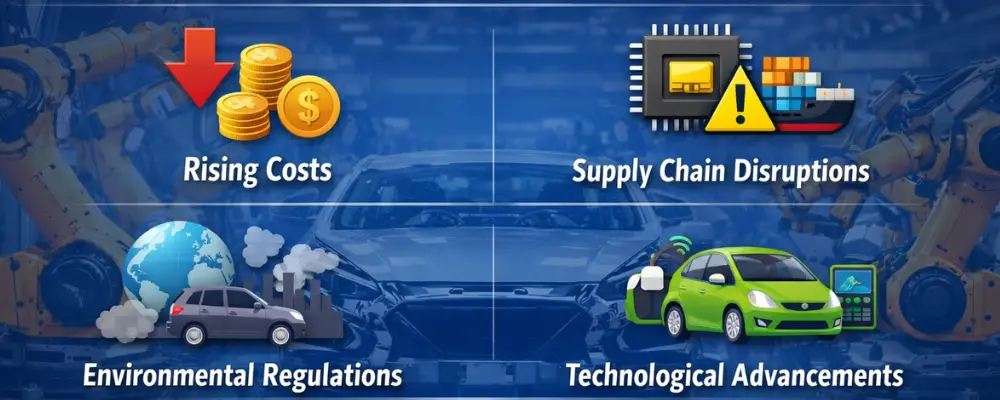
The road ahead for car makers is not smooth. The automotive industry challenges in 2026 are bigger than ever, and they affect everyone from global brands to local suppliers. Rising costs, new rules, and fast‑changing customer needs are creating serious automotive industry problems that demand quick action.
But here’s the good news: every challenge also opens the door to new opportunities. By looking closely at the top automotive industry issues, we can understand what’s holding the industry back and how smart solutions can drive it forward.
In this blog, we’ll break down the top 6 automotive industry problems and solutions for 2026, so you can see clearly what’s happening and how businesses can stay ahead.
The Core Automotive Industry Challenges
The automotive industry is entering one of its most critical phases in history. According to McKinsey, over 70% of auto executives believe the industry will face more disruption in the next five years than it did in the past fifty. This disruption is driven by rapid technological change, stricter environmental rules, rising Automotive costs, and shifting consumer expectations.
For automakers, these challenges are not just obstacles; they are turning points. Companies that adapt quickly will thrive, while those that fail to respond risk losing relevance. Below, we break down the top 6 automotive industry challenges for 2026, along with practical solutions that can help businesses stay ahead.
Speed to Market for New Vehicle Technologies
Innovation is moving faster than ever. Electric vehicles, autonomous driving, and connected car features are no longer futuristic ideas; they are becoming mainstream. Yet, consumers are impatient. Research published on ResearchGate shows that 62% of customers expect new car models or updates every year.
This expectation creates enormous pressure on automakers. Traditional development cycles, which often take years, are no longer acceptable. Companies must balance speed with safety, ensuring that new technologies meet regulatory standards while still reaching the market quickly.
Problem: Long testing and approval processes delay launches, frustrating customers and reducing sales.
Solution: Automakers can adopt agile design methods, invest in faster testing technologies, and form partnerships with tech firms to accelerate innovation. By streamlining development, they can meet consumer demand without compromising safety.
Cost Management
Managing costs has always been a challenge, but in 2026, it has become a crisis. Prices of raw materials such as steel, lithium, and semiconductors have surged. A ResearchGate study highlights that automotive manufacturers faced an 18% rise in raw material costs in 2024. Inflation, labour expenses, and energy costs add even more pressure.
For automakers, this means shrinking profit margins and higher car prices for consumers. If costs are not controlled, affordability becomes a major issue, limiting sales and slowing growth.
Problem: Rising costs reduce profitability and make vehicles less affordable for buyers.
Solution: Companies can adopt lean manufacturing, negotiate smarter supplier contracts, and explore cost‑sharing partnerships. By focusing on efficiency and smarter sourcing, automakers can protect margins while keeping cars affordable.
Compliance and Regulatory Pressures
Governments worldwide are tightening rules on emissions, safety, and sustainability. A ResearchGate analysis found that 90% of automakers are directly impacted by stricter global standards. These rules often require redesigning vehicles, investing in cleaner technologies, and meeting complex reporting requirements.
While compliance is essential, it adds high costs and slows production. Automakers must not only meet current standards but also anticipate future ones, especially as countries push toward net‑zero emissions.
Problem: Meeting new regulations requires costly redesigns and slows down production.
Solution: Early adoption of green technologies, proactive compliance planning, and investment in sustainable innovation can reduce risks. Companies that lead in sustainability will gain a competitive edge.
Supply Chain Disruptions
The supply chain remains fragile even after years of recovery efforts. McKinsey and AlixPartners estimate that the global chip shortage caused over $210 billion in losses between 2021 and 2022. Similar risks continue with batteries, rare earth materials, and shipping delays.
A single missing part can halt entire production lines, leaving customers waiting and companies losing billions. In a world where supply chains are global and complex, resilience is no longer optional; it is a survival strategy.
Problem: Delays in parts lead to production halts, lost revenue, and unhappy customers.
Solution: Automakers must diversify suppliers, invest in local manufacturing, and use predictive analytics to anticipate disruptions. Building stronger supply chains ensures stability and customer satisfaction.
Workforce & Talent Shortage
The automotive industry is not just about machines; it’s about people. Yet, finding skilled workers is harder than ever. A ResearchGate study on AI in automotive engineering shows that 65% of auto companies struggle to hire talent in areas like EV technology, robotics, and AI.
Without the right skills, innovation slows, costs rise, and companies risk falling behind competitors. The talent gap is one of the most overlooked but critical challenges facing the industry.
Problem: Lack of skilled talent slows innovation and increases costs.
Solution: Automakers can invest in training programs, partner with universities, and improve employee retention strategies. Building a strong workforce ensures long‑term competitiveness.
Digital Transformation
Digital change is reshaping every part of the automotive industry. From online car sales to AI‑driven factories, digital tools are no longer optional. McKinsey reports that 70% of auto firms believe digital adoption is the key to long‑term survival.
Companies that fail to embrace digital risk inefficiency, poor customer experiences, and missed opportunities. Digital transformation is not just about technology; it’s about creating a seamless experience for customers and improving operations across the board.
Problem: Slow adoption of digital systems creates inefficiency and lost opportunities.
Solution: Investing in cloud platforms, AI, and customer‑friendly digital tools ensures growth. Companies that embrace digital will be more agile, efficient, and competitive. A modern dealership management solution also supports this shift by helping automakers and dealers align operations and deliver better customer experiences.
3 Trends for the Automotive Industry
The automotive industry is changing fast. Three major trends are shaping how cars are bought, sold, and experienced in 2026.
Online Vehicle Sales
Car buying is moving online. Customers now browse, compare, and even purchase vehicles digitally, making convenience and transparency essential for car dealers.
Artificial Intelligence Assistants
AI development is transforming the driving and buying experience. From voice‑activated in‑car systems to AI chatbots guiding purchases, smarter tools are becoming standard.
Everybody Wants a Used Car
Demand for used cars is rising as new models get more expensive. Certified pre‑owned programs and digital platforms are helping meet this growing need.
Conclusion
The automotive industry is entering a period of rapid change. Challenges such as rising costs, stricter regulations, fragile supply chains, workforce shortages, and digital transformation are reshaping the way vehicles are designed, manufactured, and sold. These pressures may seem daunting, but they also open the door to innovation and new opportunities.
Automakers that respond quickly by embracing agile development, managing costs effectively, investing in sustainability, strengthening supply chains, building skilled teams, and adopting digital tools will be best positioned to thrive. The future of mobility will be defined not just by overcoming obstacles, but by reimagining how the industry serves customers and society.
2026 is not simply about survival it is about transformation. Companies that adapt now will lead the way into a smarter, greener, and more connected automotive future.
FAQs
What are the biggest challenges facing the automotive dealership industry in 2026?
Dealerships in the UAE face rising costs, stricter regulations, supply chain issues, and shifting consumer expectations. These challenges are especially pronounced in cities like Dubai.
How is digital transformation affecting the automotive industry?
It’s streamlining operations, enabling online sales, and improving customer experiences through smarter digital tools. UAE dealerships are increasingly adopting virtual showrooms and digital platforms to meet tech-savvy buyers’ expectations.
Why is cost management becoming a major problem for the automotive industry?
Raw material prices, labour costs, and inflation are squeezing margins, making affordability harder to maintain. Dealerships in the UAE must balance competitive pricing with premium service in a diverse market of locals and expatriates.
What role does AI play in solving automotive industry issues in 2026?
AI supports predictive analytics, automates processes, and enhances customer engagement both online and in‑car. UAE dealerships use AI to optimize inventory, forecast demand, and deliver more personalized buying experiences.
How are consumer habits changing in the automotive industry?
Buyers demand faster innovation, prefer online shopping, and increasingly choose affordable used or certified cars. In the UAE, there’s also a growing interest in flexible financing and sustainable vehicle options.
If you are running a business in the UAE nowadays, you already know that “business as usual” has changed.
The days of juggling different apps for your accounting, inventory, and sales are over. Between the nationwide rollout of mandatory E-invoicing, the latest VAT regulations, and the need for real-time data to stay competitive in a quick market like Dubai or Abu Dhabi, your choice of software is no longer just a technical detail; it is your growth engine.
Enter Microsoft Dynamics 365 Business Central UAE.
In 2026, this isn’t just an ERP; it’s a smart, AI-powered hub designed to take the “busy work” out of your day. Whether you are a growing startup in a free zone or an established distributor in JAFZA, staying ahead requires a system that understands the local landscape.
In this guide, we’ll break down why this is the preferred ERP implementation for small and medium businesses in the UAE and how it helps you stay compliant, efficient, and ready for whatever comes next.
What Is Microsoft Dynamics 365 Business Central?
Think of the automotive industry Microsoft Dynamics 365 Business Central UAE, as the “brain” of your company. It is an all-in-one business management solution often called an ERP (Enterprise Resource Planning) that connects your finance, sales, service, and operations teams into one single screen.
Instead of having your accounting in one app, your inventory in an Excel sheet, and your sales tracking in a notebook, Business Central brings them all together.
This means when a salesperson in Dubai closes a deal, the warehouse in Sharjah immediately sees the order, and the finance team in Abu Dhabi sees the invoice ready for VAT filing.
Problems It Solves for Growing Businesses
If you feel like your business is “hitting a wall,” it’s likely because of these common growing pains:
Data Silos: “The sales team says we have stock, but the warehouse says we’re out.” Business Central gives everyone the same “single version of the truth.”
Manual Entry Errors: Moving data from one system to another leads to mistakes. Automation here means you enter data once, and it flows everywhere.
Compliance Stress: With the UAE’s evolving tax laws, “guessing” your tax liability is a huge risk. Business Central automates Microsoft Business Central VAT compliance so you can sleep better at night.
Slow Decision Making: You shouldn’t have to wait three days for a report. You get real-time dashboards that show your cash flow right now.
Cloud vs. On Premise: The UAE Reality (2026)
In the UAE, the debate between Cloud and On-Premise has shifted. Here is how they compare for local businesses today:
Feature
Cloud (SaaS)
On Premise
Updates
Automatic (Microsoft handles everything).
Manual (Your IT team must install them).
Accessibility
Access from anywhere (Office, Home, or Site).
Usually requires a VPN or local office network.
AI Features
Full access to Microsoft Copilot and AI tools.
Limited or no access to built-in AI.
UAE Compliance
Updates for E invoicing/VAT are pushed instantly.
You must manually update for new laws.
While some large firms with strict data residency needs still prefer On-Premise, most ERPs for small and medium businesses in the UAE are choosing the Cloud. It’s faster to set up and costs much less upfront.
Real World Example: A Day in the Life of a UAE SME
Imagine a general trading company based in Dubai. Before Business Central, their morning was spent in meetings just to find out what was sold yesterday.
Today with Business Central:
8:00 AM: The manager opens a dashboard on their phone while at a coffee shop in Downtown. They see a real-time alert that the inventory for a popular product is low.
9:30 AM: Microsoft Copilot suggests a reorder quantity based on last month’s sales trends. The manager clicks “Approve.”
11:00 AM: A sales rep at a client meeting in JLT creates a quote directly in the system. The client signs it on a tablet.
2:00 PM: The system automatically generates a VAT-compliant invoice and prepares it for the upcoming E-invoicing requirements.
4:00 PM: The finance team does a one-click bank reconciliation, as the system is linked directly to their UAE bank account.
Why Microsoft Dynamics 365 Business Central Is Popular in the UAE
In a market as ambitious as the UAE, “good enough” software doesn’t cut it. Business owners are moving toward Microsoft Dynamics 365 Business Central UAE because it’s built for the speed of the Gulf.
Here is why it has become the go-to choice:
1. Built for the SME Growth Explosion
The UAE is a global hub for startups and scaling businesses. Whether you are expanding from a small office in Business Bay to a multi-warehouse operation or moving from a Free Zone to the Mainland, you need a system that grows with you.
Business Central is the top-rated ERP for small and medium businesses in the UAE because it allows you to start small and add features (like manufacturing or service management) only when you need them. No more outgrowing your software every two years.
2. VAT Digitization and the 2026 E-Invoicing Mandate
Compliance in the UAE is getting serious. With the Ministry of Finance rolling out the mandatory E-invoicing (PINT AE) system in phases starting July 2026, manual invoicing is becoming a legal risk.
Microsoft Business Central VAT Compliance is built in, meaning it handles the 5% VAT and tax return filings automatically.
It is already being updated to link with Accredited Service Providers (ASPs) so your invoices are validated and reported to the Federal Tax Authority (FTA) in real time.
3. Mastering Multi-Currency and Multi-Branch Needs
If your business operates in the UAE, you’re likely dealing with global suppliers and customers.
Multi Currency: Manage transactions in AED, USD, EUR, and GBP without worrying about manual exchange rate updates.
Multi-Branch: If you have one office in Dubai and another in Riyadh or London, Business Central lets you manage them all under one “tenant,” giving you a consolidated view of your global finances.
4. The “Microsoft Advantage” in the UAE
Almost every business in the UAE already uses Outlook, Excel, and Teams. Because Dynamics 365 Business Central UAE is part of the same family, the “learning curve” is almost zero.
Outlook Integration: You can literally send a quote or check a customer’s credit limit without ever leaving your email.
Excel Power: You can “Edit in Excel,” change 100 prices at once, and publish them back to the ERP with one click.
Local Data Power: With Microsoft’s massive investment in Dubai and Abu Dhabi data centers, your data stays in the country, ensuring low latency and high security.
Key Features of Microsoft Dynamics 365 Business Central
What makes Microsoft Dynamics 365 Business Central features UAE stand out in 2026 isn’t just that it “works,” it’s that it works specifically for the way we do business in the Emirates. Here is a breakdown of the core features and the real-world outcomes they deliver for your team.
Financial Management
This is the heartbeat of the system. In 2026, manual bookkeeping is a major bottleneck; Business Central turns your finance department into a strategic asset.
VAT Ready Accounting: The system comes pre-configured with UAE VAT laws. It calculates your 5% tax on every transaction and generates your VAT returns for the FTA with a few clicks.
AED & Multi-Currency Reporting: While you operate in Dirhams, you likely trade in Dollars, Euros, or Rupees. Business Central updates exchange rates automatically, so your “Profit and Loss” statement is always accurate, regardless of the currency used.
Faster Month-End Closing: By automating bank reconciliations and using AI to flag inconsistencies, businesses are cutting their month-end closing time by up to 50%.
Sales and Customer Management
In a competitive market like the UAE, speed wins deals.
Quote to Cash Automation: You can create a quote in Outlook, turn it into an order, and send the final invoice without ever re-typing a single piece of data.
Customer Insights: See exactly which customers in Abu Dhabi are your biggest spenders and who is falling behind on payments. Microsoft Copilot can even draft follow-up emails for you, keeping your cash flow healthy.
Inventory and Supply Chain Management
If you are in trading, distribution, or retail, your money is tied up in your warehouse.
Real Time Stock Visibility: Whether your stock is in JAFZA, DAFZA, or a retail store in Dubai Mall, you see exactly what is available in real time.
Trading and Distribution Support: Use AI-powered forecasting to know exactly when to reorder. No more “out of stock” heartaches or overpaying for warehouse space you don’t need.
Project and Job Management
Perfect for the UAE’s thriving construction, consultancy, and service sectors.
Cost Tracking: Track every man-hour and material cost against a specific project. You’ll know instantly if a project in Sharjah is going over budget before it becomes a problem.
Service-Based Use Cases: Manage service contracts and track equipment maintenance schedules, ensuring your field team is always where they need to be.
Reporting, Analytics & Power BI Integration
In 2026, data is the new oil. Business Central doesn’t just store data; it tells you what it means.
Real Time Dashboards: No more waiting for “the end of the week” reports. Your home screen shows live KPIs (Key Performance Indicators) tailored to your role.
Power BI Integration: For deeper dives, the built-in Power BI integration allows you to visualize your data in stunning, interactive charts. You can see sales heatmaps across the GCC or track delivery performance across different Emirates.
Microsoft Dynamics 365 Business Central UAE Compliance
In 2026, compliance in the UAE is no longer a “once a quarter” task; it is a real-time requirement.
The Federal Tax Authority (FTA) has moved toward a digital-first economy, and Microsoft Business Central VAT compliance is designed to keep you on the right side of these changes without the manual stress.
UAE VAT Compliance & 2026 E Invoicing
The biggest shift this year is the rollout of the mandatory E-invoicing system.
Structured Data: Starting July 2026, the FTA requires invoices in a specific XML format (PINT AE). Business Central generates these automatically, ensuring your B2B and B2G transactions are “machine-readable” and legal.
Real-time Validation: Through integration with an Accredited Service Provider (ASP), your invoices are validated and reported to the FTA almost instantly. No more sending PDFs via email and hoping for the best.
Automatic VAT Calculation: Whether it’s the standard 5% VAT or zero-rated exports from a Free Zone, the system applies the correct tax code to every line item.
Audit Readiness: Stay “Audit Proof”
If the FTA requests a review, you don’t want to be digging through paper files.
Digital Recordkeeping: UAE law now requires a 7-year digital archive for invoices. Business Central stores every transaction with a full audit trail showing exactly who created, approved, and posted every entry.
Accurate Tax Reporting: With one click, you can generate your VAT 201 return file. Because the data is pulled directly from your daily operations, the risk of “mismatched numbers” that trigger audits is drastically reduced.
Multi-Company & Multi-Currency Support
Many UAE businesses operate as groups with different trade licenses or branches in Saudi Arabia (KSA) and Oman.
Consolidated Reporting: View the financial health of your entire group in one dashboard while keeping the books for each legal entity separate.
AED & Global Currencies: While your base currency is AED, you can trade in USD, EUR, or GBP. The system automatically updates exchange rates and handles “unrealized gains/losses,” so your month-end balance sheet is always accurate.
Local Regulatory Alignment
Beyond VAT, Business Central is localized for the specific way the UAE works:
WPS Payroll Integration: Generate files ready for the Wage Protection System (WPS) to ensure your employee payments meet Ministry of Human Resources and Emiratisation (MOHRE) standards.
Post-Dated Checks (PDC): A unique part of UAE business culture. Business Central allows you to track and manage PDCs, so you always know when a check is due for deposit.
Benefits of Microsoft Dynamics 365 Business Central for UAE Businesses
Choosing the right ERP is about more than just software; it’s about finding a partner for your growth.
In the 2026 UAE market, where speed and precision are everything, Dynamics 365 Business Central UAE provides a clear competitive edge.
The table below summarizes the core benefits and the direct impact they have on your daily operations:
Benefit
How It Works in 2026
Business Outcome for UAE Firms
Improved Financial Control
Real-time tracking of cash flow, AED/multi-currency balances, and automated bank feeds.
Faster month-end closing and 100% clarity on your “true” profit margins.
Reduced Manual Processes
AI-powered automation (Copilot) handles data entry, invoice matching, and reconciliation.
Massive reduction in human error and hours saved on repetitive “busy work.”
Scalable for Growth
Start with basic finance and add modules for manufacturing or service as you grow.
A “future-proof” system that evolves from a startup phase to a multinational operation.
Microsoft 365 Integration
Work directly inside Outlook, export/edit data in Excel, and share live records in Teams.
Boosted team productivity, no more jumping between ten different apps to get one task done.
Built in UAE Compliance
Automatic updates for Microsoft Business Central VAT compliance and E-invoicing.
Total peace of mind with the FTA and zero risk of non-compliance fines.
Who Should Use Microsoft Dynamics 365 Business Central in the UAE?
Not every software is a one-size-fits-all solution. However, Microsoft Dynamics 365 Business Central UAE is specifically designed to bridge the gap between basic accounting apps (like QuickBooks or Tally) and high-end, complex enterprise systems.
If your business falls into one of these categories, Business Central is likely your best move for 2026:
Small and Medium Enterprises (SMEs)
In the UAE, SMEs are the backbone of the economy. If you have outgrown basic spreadsheets but aren’t ready for the million-dollar price tag of “Tier 1” ERPs, this is your “sweet spot.”
It is widely recognized as the best erp for small and medium businesses in the UAE because it offers enterprise-grade power at a price point that makes sense for a growing 20-person or 100-person team.
Trading, Manufacturing, Retail, and Service Companies
These industries have high complexity that “simple” software can’t handle:
Trading & Distribution: If you need to track shipments from Jebel Ali to customers across the GCC, the inventory and logistics tools here are lifesavers.
Manufacturing: Manage “Bills of Materials” (BOM), production schedules, and quality control in one place.
Retail: Seamlessly connect your physical stores in Dubai Mall or Yas Mall with your e-commerce backend.
Service-Based: If you are a consultancy or legal firm, use it to track billable hours and project profitability in real time.
Startups Planning Regional Expansion
Are you a tech startup in Abu Dhabi’s Hub71 or a fintech firm in DIFC? If you plan to expand into Saudi Arabia, Qatar, or Europe, you need a system that supports multi-company and multi-localization.
Business Central allows you to add a “KSA Branch” or a “UK Subsidiary” with their own tax laws and currencies in just a few clicks.
Companies Outgrowing Legacy Accounting Software
If your finance team is constantly saying, “I have to export this to Excel to get the report you want,” you have outgrown your current system.
The Sign You’re Ready: You have multiple entities, you’re struggling with manual Microsoft Business Central VAT compliance, or your inventory numbers never seem to match reality.
The Solution: Moving to a unified cloud platform ends the “Excel manual work” and gives you back hours of your week.
Microsoft Dynamics 365 Business Central Pricing in the UAE
Investing in a new ERP is a major step, and understanding the costs upfront helps you budget effectively. In 2026, Microsoft Dynamics 365 Business Central UAE follows a transparent, user-based subscription model.
This means you only pay for what you use, and you can scale your license count up or down as your business grows.
The following table breaks down the current licensing tiers and the variables that impact your final investment:
1. Subscription Licensing Model (Monthly per User)
License Type
Estimated Monthly Cost (AED)
Best For…
Key Features Included
Team Member
~AED 30
Staff who only need to read data, approve workflows, or enter timesheets.
Read-only access, basic approvals, and report viewing.
Essentials
~AED 295
Most erp for small and medium businesses in the UAE.
Finance, Sales, Inventory, Projects, and Warehouse Management.
Premium
~AED 405
Manufacturing and heavy service-based companies.
Everything in Essentials plus Manufacturing and Service Management.
Prices are estimates based on standard Microsoft global pricing converted to AED and may vary slightly depending on your Microsoft Dynamics partner in the UAE.
2. Factors Affecting Your Total Cost
While the monthly license is the most visible cost, your total “Go-Live” budget depends on several key factors:
Number of Users: Since the model is per-user, your monthly spend scales directly with your team size. Using “Team Member” licenses for non-core staff is a great way to save.
Customization Needs: If your business has unique workflows that “out-of-the-box” features don’t cover (like a specific custom dashboard for a JAFZA warehouse), this requires development time.
Industry Complexity: A simple trading company will have a faster, cheaper setup than a manufacturing plant that needs complex “Bills of Materials” and machine-center tracking.
Data Migration: Moving 10 years of messy historical data from an old system costs more than starting fresh with just your “opening balances.”
Implementation & Support: This is the one-time fee paid to your Microsoft Dynamics partner in the UAE to set up the system, train your staff, and ensure you meet Microsoft Business Central VAT compliance standards.
Pro-Tip: Many UAE businesses start with the “Essentials” license and only upgrade to “Premium” if they specifically need the Manufacturing or Field Service modules. This keeps your initial ROI high while leaving the door open for future growth.
Implementation of Microsoft Dynamics 365 Business Central in the UAE
Moving to a new ERP isn’t just about installing software; it’s about upgrading how your business breathes. In the UAE, where speed and precision are expected, a structured Microsoft Dynamics 365 Business Central UAE implementation ensures you don’t face downtime or “data headaches.”
Below is a breakdown of the process, timing, and strategy for a successful rollout.
Implementation Process & Timeline
Phase
What Happens?
Typical Duration (SMEs)
1. Discovery & Analysis
We map your current processes (Sales, Finance, Inventory) to Business Central and identify any “custom” needs for the UAE market.
1–2 Weeks
2. Design & Configuration
The system is set up with UAE localization this includes Microsoft Business Central VAT compliance, AED currency, and a local chart of accounts.
2–4 Weeks
3. Development
If you need specific reports or integrations with UAE banks or 3PL providers, this is where the “coding” happens.
4–8 Weeks
4. Testing (UAT)
Your team tests the system using real scenarios (e.g., “Can I generate a VAT invoice for a customer in Saudi Arabia?”).
2–3 Weeks
5. Go-Live & Support
The switch is flipped. Your Microsoft Dynamics partner in the UAE provides on-site or remote support to ensure the first “month-end” is perfect.
Ongoing
Data Migration and System Integration
One of the biggest fears for UAE businesses is “losing history” when moving from legacy systems like Tally, Sage, or old versions of Dynamics NAV.
The Strategy: Instead of moving 10 years of “messy” data, we recommend migrating “Master Data” (Customers, Vendors, Items) and “Opening Balances.”
Cleansing: This is the perfect time to clean up duplicate entries or old inventory codes. Clean data in Business Central means your AI-powered insights will be 100% accurate.
Integrations: Business Central 2026 thrives on connectivity. It can be Dynamics 365 Integrations with your UAE bank for automated bank feeds or with local e-commerce platforms like Shopify or Magento.
Training, Support, and Change Management
Even the best software fails if the team doesn’t use it. In a diverse workforce like the UAE’s, a human-centric approach is key:
Role-Based Training: We don’t teach everyone everything. The warehouse team learns “Bin Management,” while the finance team learns “VAT 201 Reporting.”
Change Management: We help your team understand that this isn’t “more work,” it’s a tool that eliminates the manual Excel tasks they currently hate.
Local Support: Working with a local Microsoft Dynamics partner in the UAE means you have experts who understand the time zone and local business culture, ensuring help is only a phone call away.
Business Central Essentials vs. Premium (2026)
In 2026, the main difference between the two tiers isn’t just the price; it’s the depth of operational control. While both include Microsoft Business Central VAT compliance and AI-powered Copilot, here is how they stack up:
Feature
Essentials License
Premium License
Ideal For
Trading, Retail, & Professional Services.
Manufacturing & Field Service companies.
Finance
Full (GL, Accounts Payable/Receivable, VAT).
Full (Everything in Essentials).
Sales & CRM
Quote-to-cash, Opportunity management.
Full (Plus Service Contract management).
Inventory
Real-time stock, Warehouse picks/put-away.
Advanced (Plus Production BOMs).
Manufacturing
Basic (Assembly & Kitting only).
Full (Production orders, Capacity planning).
Service Management
Not Included.
Full (Dispatching, Service tickets, Warranties).
AI (Copilot)
Included (Automation & Insights).
Included (Plus Manufacturing optimization).
Price (per user)
~AED 295 / month
~AED 405 / month
Microsoft Dynamics 365 Business Central vs Other ERP Solutions in the UAE
Choosing an automotive ERP integration is a high-stakes decision. In the UAE’s 2026 market, the competition often comes down to four major players: Microsoft Dynamics 365 Business Central, SAP Business One, Oracle NetSuite, and Odoo.
While all four can manage your books, they differ significantly in how they handle the unique pressures of the UAE business environment, from VAT compliance to regional scalability.
Comparison at a Glance (2026 Update)
Feature
Microsoft Business Central
SAP Business One
Oracle NetSuite
Odoo (Enterprise)
Primary Strength
Microsoft 365 Integration & AI (Copilot).
Deep Manufacturing & Industrial depth.
Multi-entity global consolidation.
Extreme modularity & lower entry cost.
UAE Compliance
Native FTA-compliant VAT & E-Invoicing.
Strong via local partner add-ons.
Built-in UAE localization/E-Invoicing.
Modular; requires partner setup for VAT.
Cost Model
Transparent per-user/month.
High upfront license or subscription.
Tiered; scales with modules/entities.
Low entry; pay-per-app/user.
SME Suitability
High (Best for fast-growth SMEs).
Medium (Best for stable mid-market).
Medium (Best for large/complex SMEs).
High (Best for startups/lean firms).
Implementation
2–6 Months.
4–8 Months.
4–6 Months.
3–8 Months (varies by apps).
Why Business Central Wins in 2026
For a business in Dubai or Abu Dhabi, Microsoft Dynamics 365 Business Central UAE offers the best “middle ground.” It provides the enterprise-level security of SAP and NetSuite but keeps the user-friendliness and affordability that SMEs actually need.
Plus, with the 2026 E-invoicing mandate, having a system that is updated automatically by Microsoft to meet UAE law is a massive weight off any business owner’s shoulders.
Why Hudasoft is the Strategic ERP Partner in the UAE
Choosing a local Dynamics 365 Development partner in the UAE isn’t just about getting the software installed; it’s about ensuring the system actually works for your specific business goals. At Hudasoft, we believe that ERP success depends entirely on execution, which is why we move beyond just “technical completion” to focus on real-world impact.
Our team follows a structured, business-first delivery model designed to minimize risk and maximize your return on investment. We start with Business Discovery & Vision Mapping to align the software with your long-term goals, followed by a detailed Solution Design & Configuration phase.
Before you go live, we conduct a Conference Room Pilot (CRP) and rigorous User Acceptance Testing (UAT) to ensure every workflow from VAT filing to inventory tracking is flawless.
Once you are ready, we manage the Go-Live & Transition smoothly, providing Continuous Support & Optimization to help you scale. Our consultants are unique because they speak both the language of business and technology, ensuring your ERP isn’t just a new tool, but a true growth engine for your company.
Conclusion
The UAE’s business landscape is evolving at breakneck speed. With the 2026 rollout of mandatory E-invoicing, the introduction of Corporate Tax, and the rising need for AI-driven efficiency, the software you use is no longer just a “back-office tool”; it is the foundation of your survival and growth.
Microsoft Dynamics 365 Business Central UAE offers more than just accounting; it provides a unified, cloud-based “brain” for your entire operation. It automates your Microsoft Business Central VAT compliance, streamlines your supply chain, and gives you the real-time insights you need to make winning decisions from Dubai to Abu Dhabi.
However, a powerful tool is only as good as the team that sets it up. As we’ve seen, the difference between an “expensive software headache” and a “growth-driving engine” is a structured, business-first implementation.
FAQs
Is Microsoft Dynamics 365 Business Central available in the UAE?
Yes, Microsoft Dynamics 365 Business Central is available in the UAE and is widely adopted across various industries. UAE businesses use it to manage finance, operations, and growth efficiently.
Is Business Central compliant with UAE VAT regulations?
Yes, Business Central supports UAE VAT regulations and aligns with Federal Tax Authority (FTA) requirements. It helps businesses manage VAT calculations, reporting, and compliance accurately.
Can small businesses in the UAE use Business Central?
Yes, Business Central is designed for small and medium-sized businesses looking to scale operations. It offers flexible features that grow with your business without increasing complexity.
Is Microsoft Dynamics 365 Business Central cloud-based?
Yes, Business Central is a cloud-based ERP solution hosted securely on Microsoft Azure. This allows UAE businesses to access real-time data anytime, anywhere, with high security standards.
How long does Business Central implementation take in the UAE?
Implementation typically takes a few weeks to a few months, depending on business size and requirements. The timeline is influenced by customization, data migration, and user training needs.
Why AI Agents in Automotive Are Replacing Manual Workflows Across the U.S. Automotive Industry
The Automotive Workforce Is Going Digital
The U.S. automotive industry is undergoing one of its most significant transformations since the introduction of automation on factory floors. While robotics and traditional automation streamlined physical processes, a new layer of intelligence is now redefining how decisions are made, workflows are executed, and customers are served. This shift is being powered by AI agentsautonomous, goal-driven software systems capable of reasoning, learning, and acting across complex automotive operations.
For U.S. OEMs, Tier-1 suppliers, dealerships, and mobility companies, AI agents represent a new digital workforce. Unlike traditional software or rule-based automation, AI agents can operate independently, collaborate with humans, and continuously optimize outcomes. As labor shortages, cost pressures, and data complexity increase, AI agents are rapidly replacing manual workflows across the automotive value chain.
This blog explores how AI agents are transforming the U.S. automotive industry, where they deliver the most value, and why forward-looking enterprises are investing in agent-based AI architectures.
What Are AI Agents?
AI agents are intelligent software entities designed to perform tasks autonomously to achieve specific objectives. Powered by large language models (LLMs), machine learning, and enterprise data systems, AI agents can:
Interpret natural language instructions
Retrieve and reason over large volumes of data
Make decisions based on business rules and learned patterns
Execute actions across enterprise systems
Learn and improve over time through feedback
Unlike chatbots or simple automation scripts, AI agents operate across workflows rather than isolated tasks. They can coordinate with other agents, escalate decisions to humans when required, and adapt to changing conditions—making them ideal for complex automotive environments.
Why the U.S. Automotive Industry Is Adopting AI Agents
The U.S. automotive sector faces a unique combination of challenges that make AI agents not just useful, but necessary:
Rising operational costs, skilled labor shortages, increasing product complexity, connected vehicle data explosion, and heightened customer expectations are pushing organizations to rethink how work gets done.
AI agents address these challenges by acting as intelligent digital workers that operate 24/7, scale instantly, and reduce dependency on manual intervention. For automotive enterprises managing thousands of SKUs, service requests, compliance requirements, and customer interactions, AI agents bring speed, consistency, and intelligence to operations.
AI Agents Across the Automotive Value Chain
AI Agents for Automotive Manufacturing
In U.S. manufacturing plants, AI agents are transforming production intelligence. These agents continuously analyze machine data, quality metrics, and production schedules to identify inefficiencies before they become costly issues.
AI agents support:
Predictive maintenance by identifying early signs of equipment failure
Quality control through real-time defect pattern detection
Production planning optimization based on demand signals
Root cause analysis for manufacturing anomalies
By autonomously monitoring and responding to production conditions, AI agents reduce downtime, improve yield, and support lean manufacturing initiatives.
AI Agents for Supply Chain and Logistics
Supply chain volatility has become a defining challenge for the U.S. automotive industry. AI agents enable proactive, data-driven supply chain management by continuously monitoring inventory levels, supplier performance, and logistics constraints.
These agents can:
Forecast demand with higher accuracy
Recommend supplier reallocations during disruptions
Optimize inventory levels across locations
Automate procurement and replenishment workflows
The result is a more resilient, adaptive supply chain that responds in real time to market and operational changes.
AI Agents in Automotive Dealership Operations
Dealerships are among the fastest adopters of AI agents in the U.S. automotive ecosystem. Manual processes in sales, inventory, financing, and customer follow-ups are increasingly being replaced by intelligent agents.
AI agents in dealerships handle:
Inventory optimization and pricing recommendations
Lead qualification and follow-up automation
Financing and credit pre-check workflows
Sales performance insights and forecasting
These agents help dealerships close deals faster, reduce operational overhead, and deliver a more personalized customer experience.
AI Agents in After-Sales and Service
After-sales service is a major revenue driver for U.S. automotive businesses. AI agents are redefining service operations by acting as intelligent service advisors.
Service-focused AI agents can:
Analyze vehicle data and maintenance history
Recommend service actions proactively
Schedule service appointments automatically
Assist technicians with diagnostics and repair guidance
By integrating Generative AI in Automotive systems with real-time vehicle and service data, AI agents improve first-time fix rates and customer satisfaction.
AI Agents vs Traditional Automation
Traditional automation relies on predefined rules and rigid workflows. While effective for repetitive tasks, it struggles with variability and complexity—both common in automotive operations.
AI agents, in contrast, are adaptive and context-aware. They reason over data, understand intent, and dynamically choose actions. This makes them better suited for scenarios involving exceptions, judgment calls, and cross-functional coordination.
For U.S. automotive enterprises, this shift means moving from static automation to intelligent orchestration of work.
Architecture Behind Automotive AI Agents
Modern automotive AI agents are typically built using a layered architecture:
Large Language Models for reasoning and interaction
Retrieval-Augmented Generation (RAG) for accessing real-time enterprise data
Business logic and policy engines for governance
Integration layers connecting ERP, DMS, PLM, CRM, and IoT systems
This architecture ensures that AI agents remain accurate, secure, and aligned with enterprise processes—critical for regulated and safety-sensitive automotive environments.
Security, Compliance, and Trust
For U.S. automotive organizations, trust is non-negotiable. AI agents must operate within strict security, compliance, and data governance frameworks.
Enterprise-grade AI agent deployments include:
Private or hybrid cloud environments
Role-based access controls
Audit logs and explainability layers
Human-in-the-loop approval mechanisms
These measures ensure AI agents augment human teams without introducing risk.
The Business Impact of AI Agents
Organizations deploying AI agents across automotive operations report measurable benefits:
Reduced operational costs through automation of knowledge work
Faster decision-making and response times
Improved customer satisfaction and retention
Increased scalability without proportional headcount growth
AI agents are no longer experimental—they are becoming a core component of digital transformation strategies across the U.S. automotive industry.
How Hudasoft Enables AI Agents for Automotive Enterprises
Hudasoft designs and implements enterprise-grade AI agent solutions tailored for the automotive sector. Our approach focuses on:
Identifying high-impact workflows for AI agent deployment
Designing scalable, secure AI architectures
Integrating agents with existing automotive systems
Ensuring compliance, governance, and long-term maintainability
From OEMs and suppliers to dealerships and mobility platforms, Hudasoft helps U.S. automotive organizations build AI agents that deliver real business value.
Conclusion: The Future of Automotive Work Is Agent-Driven
AI agents represent the next evolution of digital transformation in the U.S. automotive industry. As complexity increases and margins tighten, enterprises that adopt AI agents as a digital workforce will gain a decisive competitive advantage.
The question is no longer whether AI agents belong in automotive operations—but how quickly organizations can deploy them at scale.
Partner with Hudasoft to design and deploy enterprise-grade AI agents tailored for your automotive business in the USA.
The automotive dealership landscape is evolving faster than ever. To stay competitive, dealerships must shift from guesswork and outdated reporting to data-driven intelligence. This is where the fusion of a modern DMS like DealerERP and the transformative power of Snowflake’s AI Data Cloud in Automotive becomes a true industry game-changer.
For decades, dealerships operated with fragmented systems—sales data in one tool, service records in another, marketing analytics somewhere else. This siloed environment makes it nearly impossible to gain a unified view of operations. But what if all this data could come together, enriched, intelligent, and capable of predicting what happens next?
The Data Dilemma: From Silos to Strategy
A Dealership Management System (DMS) like DealerERP sits at the center of daily dealership operations—sales, F&I, parts, service, and inventory. But even advanced DMS platforms face challenges:
Key Limitations Dealers Face
Static, backward-looking reports: Traditional DMS reporting is rigid and cannot merge external data sources or perform LLM-based natural-language queries.
Data Silos: Website data, social media engagement, market trends, and CRM insights sit outside the DMS.
AI-unready data: Preparing dealership data for predictive analytics or machine learning is time-intensive.
This is exactly where Snowflake’s AI Data Cloud in Automotive steps in as the ultimate catalyst for transformation.
DealerERP + Snowflake: A Partnership for Intelligence & Profitability
The real power emerges when DealerERP seamlessly integrates with Snowflake’s AI Data Cloud.
1. DealerERP Becomes the Intelligent Data Engine
Real-time dealership transactions—every sale, service appointment, and customer touchpoint—flow from DealerERP into Snowflake. This turns your DMS into a living, dynamic data source.
2. A Unified Data Foundation
Snowflake aggregates data from:
DealerERP
CRM
Accounting
Digital marketing
Market intelligence sources
With Snowflake, dealerships get one unified source of truth—no more spreadsheets, manual merging, or endless data exports.
Next-Generation Reporting: Beyond the Basics
With DealerERP data flowing into Snowflake, dealerships unlock reporting capabilities far beyond “standard DMS reports.”
What Snowflake Enables
A complete operational view: Connect marketing spend → vehicle sales → service profitability → customer retention.
Lightning-fast ad-hoc analysis: Snowflake processes massive datasets in seconds.
Dynamic dashboards: Combine DMS data with web analytics, market trends, and digital ads for a true 360° dealership intelligence center.
AI for the Front Line: Real Insights, Real Impact
This is where AI Data Cloud in Automotive transforms operations.
1. Predictive Service & Parts Demand
Using DealerERP service history + customer vehicle data, AI predicts:
upcoming repairs
required parts
seasonal demand trends
This reduces costs and improves fill rates.
2. Sales Conversion & Churn Prediction
AI models identify:
high-intent leads
customers likely to defect
opportunities for targeted offers
3. Conversational BI (LLM-powered)
Imagine asking: “What was our average margin on used SUVs in Q3, and which channels contributed the most?”
Snowflake Cortex AI answers instantly—no data team required.
4. Dynamic Price Optimization
AI compares:
DealerERP inventory
competitor pricing
seasonal trends
historical performance
…and recommends the most profitable pricing in real time.
5. Insights Pushed Directly Into DealerERP
This is the most powerful value-add:
High-priority service customers appear right inside the system.
Recommended pricing adjustments show instantly.
Sales reps get real-time lead insights.
Future-Proofing the Modern Dealership
When you combine DealerERP with Snowflake’s AI Data Cloud in Automotive, you create a tech foundation built for the future:
AI-ready data pipelines
Advanced predictive analytics
Generative AI capabilities
Unified operations intelligence
Data-driven decision-making at every level
The dealerships that thrive in the coming decade won’t be the ones who simply sell more cars—they’ll be the ones who operate with real-time intelligence.
With DealerERP powering operations and Snowflake unlocking the full value of your data, you’re not just running a dealership—you’re building a smart, predictive, future-ready retail engine.
The real estate industry is rapidly evolving, driven by digital transformation, rising customer expectations, and the need for more efficient property operations. Whether you oversee residential buildings, commercial assets, mixed-use developments, or large gated communities, adopting a modern real estate CRM is no longer optional — it’s a necessity.
A powerful CRM designed specifically for the property sector can streamline communication, simplify facility management, and enhance community management. With more developers and property managers embracing technology, the right CRM can become the backbone of your entire real estate operation.
In this comprehensive guide, we explore how a real estate CRM boosts efficiency, improves resident satisfaction, automates workflows, and builds sustainable, tech-enabled communities.
What Is a Real Estate CRM?
A real estate CRM (Customer Relationship Management) system is a specialized digital platform that helps property developers, community managers, landlords, and real estate companies manage:
Leads and sales
Tenant data
Resident communication
Maintenance requests
Facility bookings
Community operations
Vendor and contractor tasks
Financial transactions
Asset performance
Unlike generic CRMs, a real estate CRM is built to meet the unique needs of property operations — from handling tenant lifecycle management to keeping large communities running smoothly.
Why the Real Estate Industry Needs a CRM
Real estate involves multiple stakeholders: residents, owners, tenants, investors, vendors, maintenance teams, and managers. Managing this ecosystem without a centralized system leads to:
Poor communication
Operational delays
Lost revenue
Mismanaged maintenance
Low resident satisfaction
Manual data errors
A real estate CRM solves all these problems by acting as the central digital hub for operations, communication, and service management.
1. How a Real Estate CRM Improves Community Management
Community management is one of the biggest challenges for residential and mixed-use developments. As communities grow, so does the need for:
Organized communication
Transparent updates
Accessible information
Structured workflows
Resident engagement tools
A digital community management system integrated within a real estate CRM helps achieve exactly that.
Centralized Communication
Instead of WhatsApp groups, phone calls, or scattered emails, a CRM provides:
In-app announcements
Push notifications
Event updates
Community guidelines
Emergency alerts
This ensures every resident stays informed.
Resident Self-Service Tools
A CRM allows residents to:
Submit maintenance requests
Pay dues and invoices
Download community documents
Book facilities
Check event calendars
Receive alerts
This reduces workload for management while increasing convenience for residents.
Transparency and Trust
When residents have access to clear communication and timely services, the community becomes more organized and trust increases. Transparency is one of the biggest benefits of digital community management.
2. Boosting Operational Efficiency Through Facility Management
Facility management is a core component of real estate operations. Buildings and communities often include:
Elevators
HVAC systems
Parking structures
Security systems
Gyms and recreational areas
Event spaces
Common areas
Landscaping
A real estate CRM with facility management capabilities ensures all assets remain functional, safe, and well-maintained.
Smart Maintenance Workflows
Instead of manual ticketing, the CRM automates:
Maintenance request creation
Team or vendor assignment
Priority setting
Progress tracking
Completion verification
This eliminates delays and ensures high-quality work.
Preventive Maintenance Scheduling
The system auto-generates maintenance schedules for:
Electrical systems
Plumbing
Air conditioning
Fire safety equipment
Generators
Shared facilities
Preventive care reduces downtime and extends asset lifespan.
Vendor and Contractor Coordination
A CRM simplifies vendor management by offering:
Digital work orders
Performance tracking
Payment history
Contract storage
Rating and review systems
With streamlined vendor coordination, repairs and operational tasks are completed faster and more efficiently.
Real-Time Facility Booking
Facilities like gyms, pools, halls, and sports courts can be booked digitally. This prevents double-booking and keeps operations smooth.
A real estate CRM goes beyond operations — it also strengthens the commercial side of real estate. Developers and sales teams can manage:
3. Integrating Sales, Leasing, and Tenant Management
Lead capture
Sales funnel tracking
Automated follow-ups
Rental inquiries
Contract management
Unit availability
Lease renewals
Lead Management and Automation
Real estate CRM systems capture leads from:
Websites
Social media
Property portals
Walk-ins
Email campaigns
They nurture leads using:
Automated messages
Scheduled follow-ups
Personalized interactions
This increases conversion rates and ensures sales teams never miss a potential tenant or buyer.
Tenant Lifecycle Management
The CRM manages the entire tenant journey:
Application
Screening
Move-in
Contract signing
Payments
Complaints
Renewals
Move-out
This delivers a smooth experience and increases retention.
4. Financial Management and Transparency
Finances are the backbone of real estate operations. A CRM simplifies and centralizes all financial workflows:
Digital invoicing
Rent collection
Community dues
Utility billing
Payment reminders
Online payment gateways
Automated receipts
Accounting reports
Benefits of Financial Tools
Fewer manual errors
Faster reconciliation
Clear financial history
Reduced late payments
Better planning and forecasting
This creates transparency for both management and residents.
5. Data, Reporting, and Decision Making
A modern real estate CRM provides dashboards and analytics that help decision-makers track:
Revenue
Expenses
Maintenance performance
Community engagement
Occupancy rates
Facility utilization
Vendor performance
Resident satisfaction
With data-driven insights, managers can make smarter decisions, optimize resources, and plan future improvements.
6. How a Real Estate CRM Enhances Customer Experience
Customer experience is a competitive advantage in modern real estate. A CRM achieves this through:
Faster Response Times
Residents get quicker service and timely updates.
Convenience
Everything is accessible from a mobile app.
Transparency
Clear communication builds trust.
Accessibility
Residents can interact with management anytime, anywhere.
Engagement
Polls, events, notices, and digital services improve community involvement.
A CRM transforms real estate from reactive to proactive — and residents feel the difference.
7. The Future of Real Estate Technology
Real estate CRM systems are becoming more intelligent with:
Artificial intelligence (AI) for predictive maintenance
Smart building integrations
IoT-based facility monitoring
Chatbots for resident queries
Automation of repetitive tasks
Cloud-based scalability
The future of real estate is digital, connected, and automated — and CRM systems are at the center of this shift.
Why You Need a Real Estate CRM Today
A powerful CRM provides:
Better resident communication
Streamlined facility management
Organized community management
Increased operational efficiency
Higher customer satisfaction
Stronger financial control
Data-driven decision-making
Faster sales and leasing cycles
It reduces manual work, boosts transparency, and enhances the entire property ecosystem.
Whether you manage a single building or a nationwide portfolio, a real estate CRM can transform your operations and elevate your brand.
Conclusion
The real estate industry is becoming increasingly competitive, and property managers must evolve to meet the expectations of modern tenants and residents. A well-designed real estate CRM is the cornerstone of efficient facility management and effective community management. With automation, digital communication, streamlined workflows, and data-driven tools, property teams can create safer, smarter, and more connected communities.
As technology continues to reshape the industry, investing in a real estate CRM is not just a strategic advantage — it is the future of real estate operations.
The Kingdom of Saudi Arabia is experiencing one of the fastest real estate transformations in the world. With Vision 2030 accelerating urban development, smart cities, and large-scale residential communities, the demand for a modern property management solution has never been greater.
As new residential compounds, mixed-use developments, and commercial properties rise across Riyadh, Jeddah, Dammam, and emerging cities like NEOM and The Red Sea Project, property owners are searching for a reliable solution for real estate that boosts efficiency, transparency, and resident satisfaction.
Why Saudi Arabia Needs Advanced Property Management Solutions
The expanding real estate sector in Saudi Arabia brings new challenges for developers and community managers:
Growing resident populations
Increased maintenance and facility demands
Higher expectations for smart living
A need for transparent financial management
Demand for digital-first communication
A modern property management solution helps overcome these challenges by integrating every aspect of community and asset management into one platform—aligned with the Kingdom’s digital transformation goals.
Key Features of an Effective Property Management Solution in KSA
1. Arabic & English Support
Saudi communities are diverse. A bilingual platform ensures smooth communication between residents, managers, vendors, and owners.
2. Digital Payment & E-Invoice Integration
With KSA pushing digital payments and compliance with ZATCA (Fatoora), an ideal system supports:
Online rent payments
Community dues
Automated invoice generation
Full e-invoice compliance
This supports financial transparency and makes payment collection effortless.
3. Smart Maintenance Management
For Saudi residential compounds and commercial buildings, maintenance is a constant priority. A powerful solution allows:
Residents to submit digital maintenance requests
Automatic assignment to vendors
Real-time progress tracking
Scheduled preventative maintenance
This dramatically reduces downtime for assets like elevators, HVAC systems, and community facilities.
4. Facility & Amenity Booking
Saudi communities often provide premium amenities—gyms, pools, lounges, sports courts, event spaces. A digital booking system ensures fair access and avoids overcrowding.
5. Gate & Security Management
Security is a key priority across KSA properties. A digital solution enhances:
Visitor access management
Digital gate passes
Real-time security notifications
Vehicle and personnel tracking
Perfect for gated communities and high-security compounds.
How a Digital Solution for Real Estate Supports KSA Developers
Saudi developers—from mega-projects to private real estate investors—benefit significantly from digital transformation.
In a competitive Saudi real estate market, these advantages help developers deliver smarter, more attractive living environments.
Why Property Management Tech Is Essential for Saudi Vision 2030
Saudi Vision 2030 places strong emphasis on:
Smart cities
Sustainability
High-quality residential communities
Improved efficiency in operations
Digital transformation
A modern property management solution aligns perfectly with these national goals—making it essential for any real estate project that aims to scale, modernize, or compete in today’s market.
The Future of Real Estate in Saudi Arabia
Saudi Arabia’s real estate boom is just beginning. As the Kingdom continues to grow, communities and commercial buildings will require advanced systems to remain efficient, transparent, and resident-focused.
A powerful property management solution is no longer optional; it is the backbone of modern real estate operations. And with the right solution for real estate, developers and managers in KSA can deliver world-class living experiences, reduce operational costs, and meet the rising expectations of tenants and residents.