Table of Contents
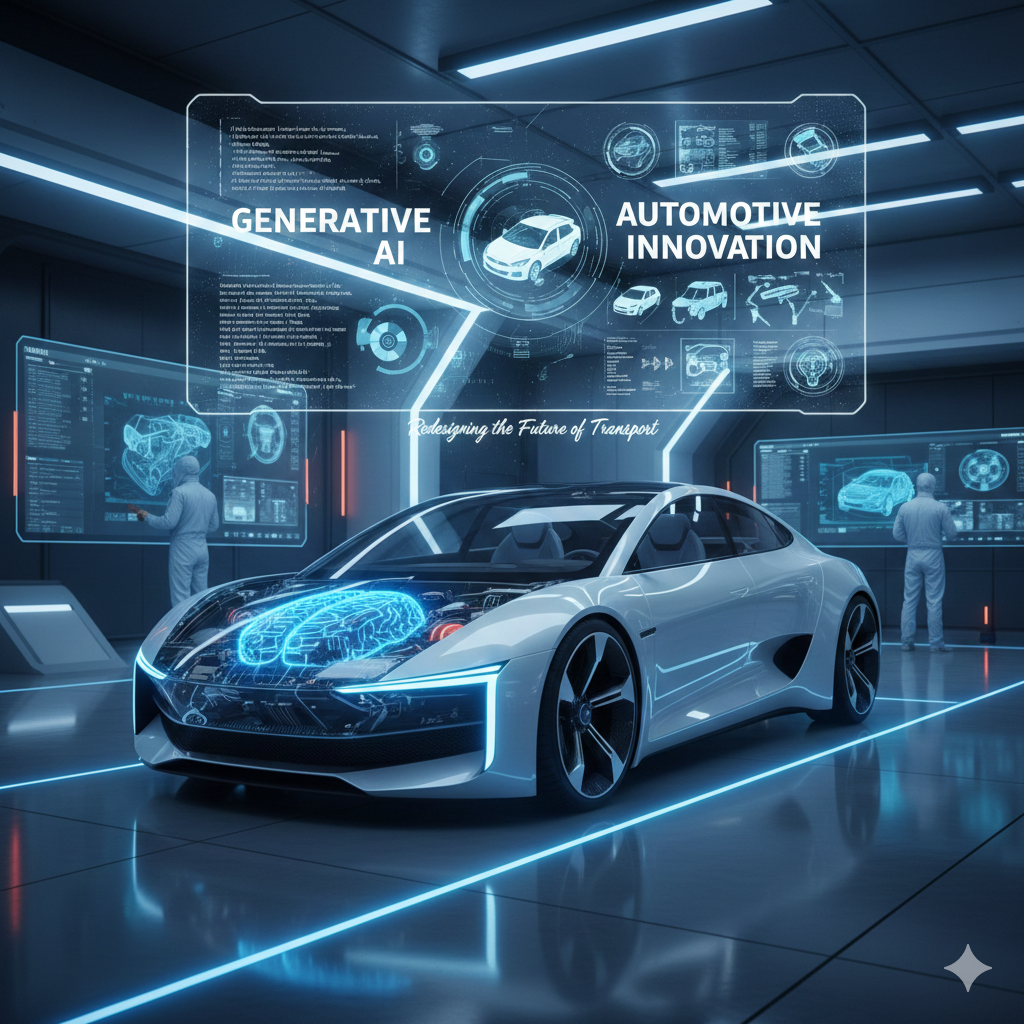
Generative AI in the Automotive is emerging as the next powerful force accelerating this transformation.
From vehicle design and manufacturing optimization to dealership intelligence and customer experience, Generative AI is redefining how automotive businesses operate, innovate, and scale. For OEMs, Tier-1 suppliers, dealerships, and mobility startups, Generative AI is no longer an experiment—it is becoming a strategic necessity.
This blog explores how Generative AI is transforming the automotive industry, its key use cases, business benefits, challenges, and what the future holds for AI-driven mobility.
What Is Generative AI? (Automotive Perspective)
Generative AI refers to advanced artificial intelligence models capable of creating new content, predictions, simulations, and insights rather than just analyzing historical data. These models can generate:
- Design concepts
- Synthetic data for simulations
- Predictive scenarios
- Automated responses and recommendations
- Intelligent workflows and decisions
In the automotive context, Generative AI goes beyond dashboards and reports. It creates possibilities, helping organizations:
- Design better vehicles faster
- Predict failures before they happen
- Optimize supply chains dynamically
- Personalize customer journeys at scale
Unlike traditional AI, which focuses on pattern recognition, Generative AI actively produces solutions, making it a powerful tool for innovation-heavy industries like automotive.
Why the Automotive Industry Is Adopting Generative AI Rapidly
Several industry pressures are driving the adoption of Generative AI:
- Increasing competition and shrinking margins
- Complex global supply chains
- Rising customer expectations for personalization
- Demand for faster product development cycles
- High costs associated with recalls and quality issues
Generative AI helps automotive businesses respond to these challenges by enabling speed, accuracy, intelligence, and automation, all at enterprise scale.
Key Use Cases of Generative AI in the Automotive Industry
1. Vehicle Design & Engineering Optimization
Generative AI is transforming how vehicles are designed and engineered.
How it helps:
- Generates multiple design variations based on constraints
- Optimizes aerodynamics, weight, and material usage
- Reduces design-to-prototype cycles
- Improves fuel efficiency and performance
Business impact:
- Faster innovation
- Lower R&D costs
- Reduced time to market
Design teams can now explore thousands of design possibilities in hours, something that previously took months.
2. Generative AI in Automotive Manufacturing & Smart Factories
AI in Automotive Manufacturing is one of the biggest beneficiaries of Generative AI.
Applications include:
- Production line optimization
- Automated process planning
- AI-generated schedules for machinery and labor
- Predictive quality inspection using vision models
Key benefits:
- Reduced downtime
- Improved yield and consistency
- Smarter resource allocation
- Lower operational costs
Generative AI enables self-optimizing factories that adapt in real time to production conditions.
3. Predictive Maintenance & Quality Control
Unexpected equipment failures and recalls are costly. Generative AI helps predict and prevent them.
Use cases:
- Predicting component failures before they occur
- Generating maintenance schedules dynamically
- Detecting defects through AI-powered vision systems
- Root-cause analysis using AI-generated insights
Outcome:
- Reduced warranty claims
- Lower maintenance costs
- Higher product reliability
- Improved customer trust
Predictive maintenance powered by Generative AI shifts automotive operations from reactive to proactive.
4. Autonomous Driving & AI Simulation Models
Training autonomous vehicles requires massive amounts of data. Generative AI plays a crucial role here.
How it’s used:
- Creating synthetic driving scenarios
- Simulating rare and dangerous situations
- Enhancing perception and decision models
- Accelerating autonomous testing cycles
Why it matters:
- Faster AV development
- Safer validation environments
- Reduced dependency on real-world testing alone
Generative AI enables autonomous systems to “learn” from millions of virtual experiences.
5. Generative AI in Dealership Operations & Sales
Dealerships are increasingly adopting AI-driven intelligence to remain competitive.
Applications:
- AI-generated sales forecasts
- Intelligent lead scoring and follow-ups
- Personalized vehicle recommendations
- Automated sales and finance workflows
Business value:
- Higher conversion rates
- Shorter sales cycles
- Better inventory turnover
- Improved dealer profitability
Generative AI turns dealerships into data-driven sales engines rather than intuition-based operations.
6. AI-Powered Customer Experience & Virtual Assistants
Modern automotive customers expect instant, personalized engagement.
Generative AI enables:
- Intelligent chatbots for sales and service
- Virtual assistants for vehicle queries
- Automated appointment scheduling
- Personalized ownership journeys
Result:
- 24/7 customer support
- Improved satisfaction and loyalty
- Reduced operational load on staff
AI-driven customer experience is becoming a differentiator for automotive brands.
7. Supply Chain & Inventory Optimization
Automotive supply chains are complex and highly sensitive to disruptions.
Generative AI helps by:
- Predicting demand fluctuations
- Generating optimal inventory strategies
- Identifying supplier risks early
- Automating procurement recommendations
Impact:
- Reduced stockouts and overstocking
- Improved supplier collaboration
- Greater resilience against disruptions
Generative AI brings real-time intelligence to automotive supply chains.
Business Benefits of Generative AI for Automotive Companies
Generative AI delivers measurable business value across the automotive ecosystem.
Key benefits include:
- Faster innovation cycles
- Reduced operational costs
- Improved product quality
- Higher customer satisfaction
- Better decision-making
- Scalable automation
For leadership teams, Generative AI is not just a technology upgrade—it is a strategic growth enabler.

Real-World Applications Across the Automotive Ecosystem
Automotive organizations worldwide are already leveraging Generative AI for:
- Smart factory transformation
- AI-driven dealership management systems
- Predictive fleet maintenance
- Connected vehicle intelligence
- Autonomous driving development
The most successful implementations focus on business outcomes, not just technology adoption.
Challenges & Risks of Generative AI in Automotive
While powerful, Generative AI comes with Automotive Industry Challenges that must be addressed.
Key concerns include:
- Data privacy and security
- Model bias and explainability
- Integration with legacy systems
- Regulatory and compliance requirements
- Talent and skill gaps
A responsible AI strategy is essential to ensure trust, compliance, and long-term success.
Integrating Generative AI with Legacy Automotive Systems
Most automotive organizations rely on existing ERP, DMS, CRM, and manufacturing systems.
Successful AI implementation requires:
- Seamless system integration
- Scalable cloud infrastructure
- Robust data pipelines
- Clear governance frameworks
A phased, use-case-driven approach minimizes risk and maximizes ROI.
The Future of Generative AI in the Automotive Industry
The future of automotive is AI-native.
What lies ahead:
- Fully autonomous, AI-driven factories
- Hyper-personalized vehicle ownership
- Self-learning connected vehicles
- AI-orchestrated mobility ecosystems
- Deeper integration of AI, cloud, and IoT
Generative AI will play a central role in shaping next-generation mobility.
How Automotive Companies Can Start with Generative AI
For organizations looking to begin their Generative AI journey, the key steps include:
- Identify high-impact use cases
- Assess data readiness and infrastructure
- Start with pilot projects
- Scale successful implementations
- Build AI governance and security frameworks
Partnering with experienced AI and digital transformation experts accelerates success.
Final Thoughts
Generative AI is redefining how the automotive industry designs vehicles, runs factories, engages customers, and plans for the future. Organizations that embrace this shift early will gain a significant competitive advantage in efficiency, innovation, and customer experience.
At Hudasoft, we help automotive businesses strategically implement Generative AI solutions—from intelligent manufacturing and dealership systems to AI-powered analytics and automation—ensuring measurable business impact and long-term scalability.
The road ahead is intelligent, connected, and AI-driven.
The question is no longer if Generative AI will transform automotive—but how fast companies choose to lead that Auto Dealership Digital Transformation.
FAQ’s
1. What is Generative AI in the automotive industry?
Generative AI is a type of artificial intelligence that creates new designs, simulations, and solutions. In the automotive industry, it helps design vehicles, improve manufacturing, and enhance driver experiences. It enables faster innovation and smarter decision-making.
2. How does Generative AI improve vehicle design and production?
Generative AI creates optimized vehicle designs based on performance and safety data. It helps engineers test multiple design variations quickly through simulations.
3. What are the benefits of Generative AI for automotive companies?
It improves efficiency across design, manufacturing, and supply chain operations. Companies can reduce costs and enhance product quality. It also enables personalized customer experiences and predictive maintenance.
4. What challenges come with adopting Generative AI in automotive?
Companies may face data security and privacy concerns. Integration with existing systems can be complex and costly. Skilled talent and regulatory compliance are also major considerations.
اترك تعليقاً