
Table of Contents
The road ahead for car makers is not smooth. The automotive industry challenges in 2026 are bigger than ever, and they affect everyone from global brands to local suppliers. Rising costs, new rules, and fast‑changing customer needs are creating serious automotive industry problems that demand quick action.
But here’s the good news: every challenge also opens the door to new opportunities. By looking closely at the top automotive industry issues, we can understand what’s holding the industry back and how smart solutions can drive it forward.
In this blog, we’ll break down the top 6 automotive industry problems and solutions for 2026, so you can see clearly what’s happening and how businesses can stay ahead.
The Core Automotive Industry Challenges
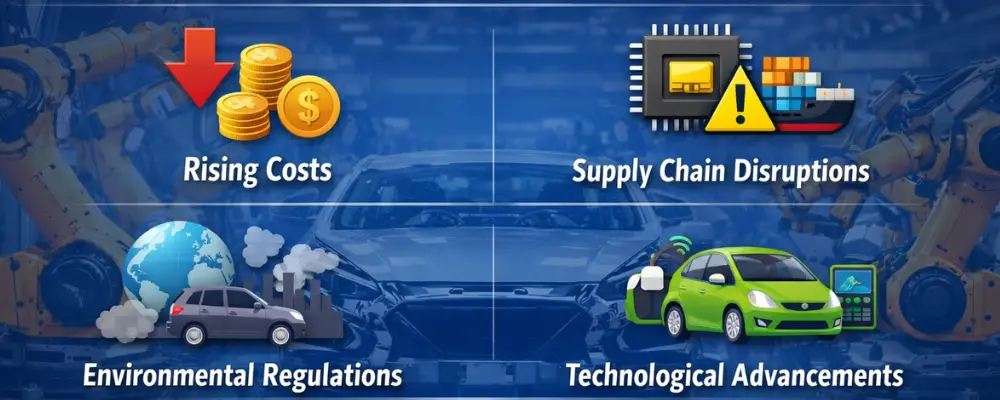
The automotive industry is entering one of its most critical phases in history. According to McKinsey, over 70% of auto executives believe the industry will face more disruption in the next five years than it did in the past fifty. This disruption is driven by rapid technological change, stricter environmental rules, rising Automotive costs, and shifting consumer expectations.
For automakers, these challenges are not just obstacles; they are turning points. Companies that adapt quickly will thrive, while those that fail to respond risk losing relevance. Below, we break down the top 6 automotive industry challenges for 2026, along with practical solutions that can help businesses stay ahead.
Speed to Market for New Vehicle Technologies
Innovation is moving faster than ever. Electric vehicles, autonomous driving, and connected car features are no longer futuristic ideas; they are becoming mainstream. Yet, consumers are impatient. Research published on ResearchGate shows that 62% of customers expect new car models or updates every year.
This expectation creates enormous pressure on automakers. Traditional development cycles, which often take years, are no longer acceptable. Companies must balance speed with safety, ensuring that new technologies meet regulatory standards while still reaching the market quickly.
- Problem: Long testing and approval processes delay launches, frustrating customers and reducing sales.
- Solution: Automakers can adopt agile design methods, invest in faster testing technologies, and form partnerships with tech firms to accelerate innovation. By streamlining development, they can meet consumer demand without compromising safety.
Cost Management
Managing costs has always been a challenge, but in 2026, it has become a crisis. Prices of raw materials such as steel, lithium, and semiconductors have surged. A ResearchGate study highlights that automotive manufacturers faced an 18% rise in raw material costs in 2024. Inflation, labour expenses, and energy costs add even more pressure.
For automakers, this means shrinking profit margins and higher car prices for consumers. If costs are not controlled, affordability becomes a major issue, limiting sales and slowing growth.
Problem: Rising costs reduce profitability and make vehicles less affordable for buyers.
Solution: Companies can adopt lean manufacturing, negotiate smarter supplier contracts, and explore cost‑sharing partnerships. By focusing on efficiency and smarter sourcing, automakers can protect margins while keeping cars affordable.
Compliance and Regulatory Pressures
Governments worldwide are tightening rules on emissions, safety, and sustainability. A ResearchGate analysis found that 90% of automakers are directly impacted by stricter global standards. These rules often require redesigning vehicles, investing in cleaner technologies, and meeting complex reporting requirements.
While compliance is essential, it adds high costs and slows production. Automakers must not only meet current standards but also anticipate future ones, especially as countries push toward net‑zero emissions.
- Problem: Meeting new regulations requires costly redesigns and slows down production.
- Solution: Early adoption of green technologies, proactive compliance planning, and investment in sustainable innovation can reduce risks. Companies that lead in sustainability will gain a competitive edge.
Supply Chain Disruptions
The supply chain remains fragile even after years of recovery efforts. McKinsey and AlixPartners estimate that the global chip shortage caused over $210 billion in losses between 2021 and 2022. Similar risks continue with batteries, rare earth materials, and shipping delays.
A single missing part can halt entire production lines, leaving customers waiting and companies losing billions. In a world where supply chains are global and complex, resilience is no longer optional; it is a survival strategy.
- Problem: Delays in parts lead to production halts, lost revenue, and unhappy customers.
- Solution: Automakers must diversify suppliers, invest in local manufacturing, and use predictive analytics to anticipate disruptions. Building stronger supply chains ensures stability and customer satisfaction.
Workforce & Talent Shortage
The automotive industry is not just about machines; it’s about people. Yet, finding skilled workers is harder than ever. A ResearchGate study on AI in automotive engineering shows that 65% of auto companies struggle to hire talent in areas like EV technology, robotics, and AI.
Without the right skills, innovation slows, costs rise, and companies risk falling behind competitors. The talent gap is one of the most overlooked but critical challenges facing the industry.
- Problem: Lack of skilled talent slows innovation and increases costs.
- Solution: Automakers can invest in training programs, partner with universities, and improve employee retention strategies. Building a strong workforce ensures long‑term competitiveness.
Digital Transformation
Digital change is reshaping every part of the automotive industry. From online car sales to AI‑driven factories, digital tools are no longer optional. McKinsey reports that 70% of auto firms believe digital adoption is the key to long‑term survival.
Companies that fail to embrace digital risk inefficiency, poor customer experiences, and missed opportunities. Digital transformation is not just about technology; it’s about creating a seamless experience for customers and improving operations across the board.
- Problem: Slow adoption of digital systems creates inefficiency and lost opportunities.
- Solution: Investing in cloud platforms, AI, and customer‑friendly digital tools ensures growth. Companies that embrace digital will be more agile, efficient, and competitive. A modern dealership management solution also supports this shift by helping automakers and dealers align operations and deliver better customer experiences.
3 Trends for the Automotive Industry

The automotive industry is changing fast. Three major trends are shaping how cars are bought, sold, and experienced in 2026.
Online Vehicle Sales
Car buying is moving online. Customers now browse, compare, and even purchase vehicles digitally, making convenience and transparency essential for car dealers.
Artificial Intelligence Assistants
AI development is transforming the driving and buying experience. From voice‑activated in‑car systems to AI chatbots guiding purchases, smarter tools are becoming standard.
Everybody Wants a Used Car
Demand for used cars is rising as new models get more expensive. Certified pre‑owned programs and digital platforms are helping meet this growing need.
Conclusion
The automotive industry is entering a period of rapid change. Challenges such as rising costs, stricter regulations, fragile supply chains, workforce shortages, and digital transformation are reshaping the way vehicles are designed, manufactured, and sold. These pressures may seem daunting, but they also open the door to innovation and new opportunities.
Automakers that respond quickly by embracing agile development, managing costs effectively, investing in sustainability, strengthening supply chains, building skilled teams, and adopting digital tools will be best positioned to thrive. The future of mobility will be defined not just by overcoming obstacles, but by reimagining how the industry serves customers and society.
2026 is not simply about survival it is about transformation. Companies that adapt now will lead the way into a smarter, greener, and more connected automotive future.
FAQs
What are the biggest challenges facing the automotive dealership industry in 2026?
Dealerships in the UAE face rising costs, stricter regulations, supply chain issues, and shifting consumer expectations. These challenges are especially pronounced in cities like Dubai.
How is digital transformation affecting the automotive industry?
It’s streamlining operations, enabling online sales, and improving customer experiences through smarter digital tools. UAE dealerships are increasingly adopting virtual showrooms and digital platforms to meet tech-savvy buyers’ expectations.
Why is cost management becoming a major problem for the automotive industry?
Raw material prices, labour costs, and inflation are squeezing margins, making affordability harder to maintain. Dealerships in the UAE must balance competitive pricing with premium service in a diverse market of locals and expatriates.
What role does AI play in solving automotive industry issues in 2026?
AI supports predictive analytics, automates processes, and enhances customer engagement both online and in‑car. UAE dealerships use AI to optimize inventory, forecast demand, and deliver more personalized buying experiences.
How are consumer habits changing in the automotive industry?
Buyers demand faster innovation, prefer online shopping, and increasingly choose affordable used or certified cars. In the UAE, there’s also a growing interest in flexible financing and sustainable vehicle options.
اترك تعليقاً