
Table of Contents
Where traditional software requires human commands to operate, an AI agent plans, reasons, and takes the exact sequence of actions required to produce a desired outcome. Moreover, the agent has the capability to learn, adapt, and improve over time in the specific task it is designed for.
The question now is: how do businesses deploy this technology in their operations? The simple answer is to find the right AI agent development companies in your industry and partner with them. This blog will help you with that by listing the top AI agent development companies in the U.S. as of 2026 that you can partner with to deploy AI agents and redefine the benchmarks for your business.
List of The Top AI Agent Development Companies in the US
Developing AI agents is a competitive niche, especially in the US region, with more than 3600 companies listed on Clutch claiming to have expertise in developing AI agents. So simply put, the list of the best US-based AI agent development companies is bound to change. But as of 2026, the companies listed below are among the best you can find.
The inclusion is based on proven expertise in agent development, ratings on review platforms, and technology expertise that would enable the company to create agents that will deliver business value.
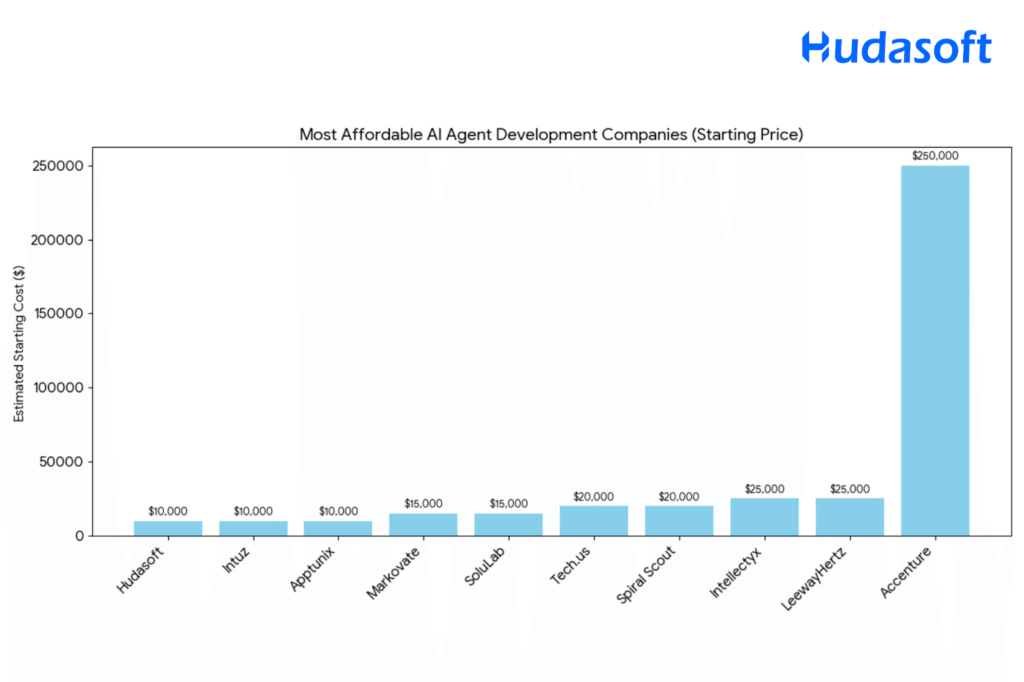
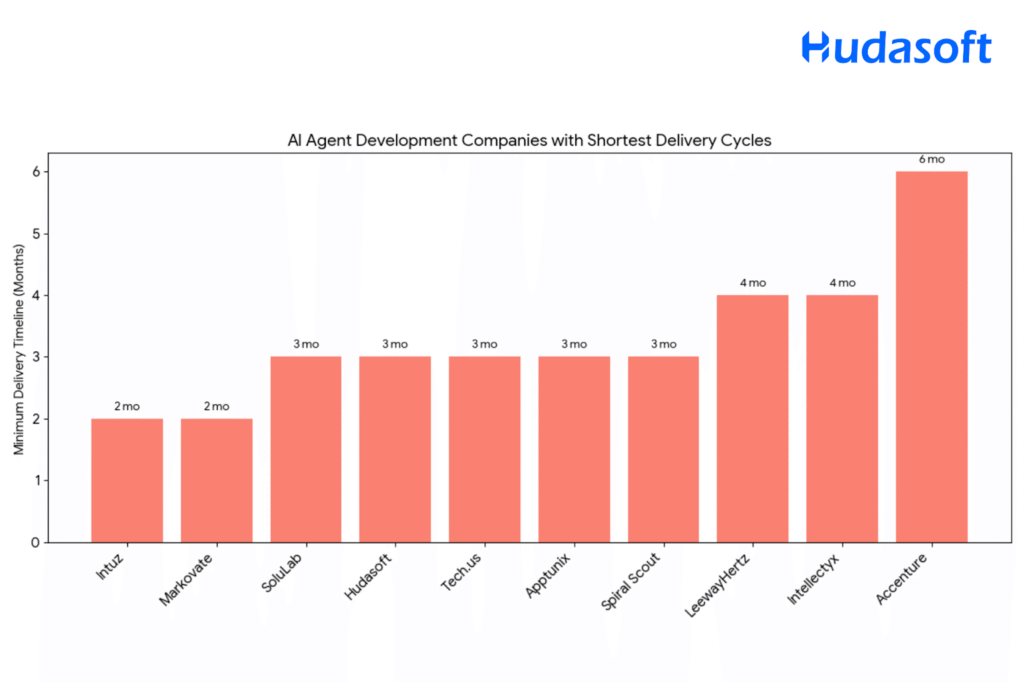
| Company | Marketplace Rating | Reviews | Years in Business | US HQ / Primary Hub | Team Size | Estimated Cost (Start) | Delivery Timeline |
| Hudasoft | 5/5 (Clutch) | 1-10 | 7+ | Carrollton, TX | 50–249 | $10,000+ | 3–6 months |
| Intellectyx | 4.8/5 (Clutch) | 1-10 | 15+ | Denver, CO | 50–249 | $25,000+ | 4–8 months |
| Accenture | 3.9/5 (Gartner) | 50+ | 35+ | New York, NY | 700,000+ | $250,000+ | 6–12+ months |
| LeewayHertz | 4.7/5 (Clutch) | 1-10 | 15+ | San Francisco, CA | 50–249 | $25,000+ | 4–6 months |
| Markovate | 5/5 (Clutch) | 10+ | 9+ | San Francisco, CA | 10–49 | $15,000+ | 2–5 months |
| Tech.us | 4.4/5 (Techreviewer) | 50+ | 10+ | Santa Clara, CA | 50–249 | $20,000+ | 3–6 months |
| SoluLab | 4.9/5 (Clutch) | 50+ | 10+ | Los Angeles, CA | 250–999 | $15,000+ | 3–5 months |
| Intuz | 4.8/5 (Clutch) | 50+ | 15+ | San Francisco, CA | 50–249 | $10,000+ | 2–4 months |
| Apptunix | 4.5/5 (Clutch) | 50+ | 11+ | Austin, TX | 50–249 | $10,000+ | 3–6 months |
| Spiral Scout | 4.9/5 (Clutch) | 50+ | 15+ | San Francisco, CA | 50–249 | $20,000+ | 3–6 months |
1. Hudasoft
| Marketplace Rating | 5/5 (Clutch) |
| Number of Reviews | 1-10 |
| Years in Business | 7+ |
| US HQ / Primary Hub | Carrollton, TX |
| Team Size | 50–249 |
| Estimated Cost | $10,000+ |
| Delivery Timeline | 3–6 months |
| Industry Expertise | Automotive and Proptech |
Hudasoft is an ISO 27001-certified AI agent development company with production-deployed agents in the automotive and proptech sectors.
ISO 27001 is an internationally recognized information security standard, and in the context of agentic AI, it carries weight beyond a badge. Agents, by design, read from and write to sensitive systems: inventory databases, customer records, financial transactions, and property management platforms. A firm that holds this certification has implemented documented controls around data access, encryption, audit logging, and incident response. That infrastructure is a prerequisite for deploying agents responsibly in any environment where data breaches carry legal or reputational consequences.
Integrations
Domain-specific integration depth in automotive and proptech gives Hudasoft an edge in operationally complex, non-standard environments.
- Builds against dealer management systems (DMS), telematics APIs, OEM data pipelines, and property listing platforms, not generic API connectors.
- Engineers understand both the API layer and the underlying business logic, essential when data schemas are non-standard and action consequences are high-stakes.
- Sector-specific experience transfers directly to other regulated or operationally complex industries that demand the same integration precision.
Trainability
Proven ability to ground agents in private, structured, and often messy proprietary data that no public training dataset covers.
- Works with internal assets like vehicle configuration databases, dealer-specific pricing rulebooks, and regional property valuation models, entirely absent from any public LLM training corpus.
- Builds retrieval systems that surface the right internal documents at the right moment, rather than relying on general-purpose model knowledge.
- Has navigated fine-tuning requirements to make agents reason correctly within domain-specific constraints, which is the central trainability challenge most businesses face.
Effectiveness
Production deployments in two operationally demanding verticals provide evidence of real-world agent durability beyond controlled demos.
- Automotive and proptech deployments have survived noisy data, unexpected user behavior, edge cases, and integration failures: conditions that break prototype-quality agents.
- Agents demonstrate task completion under ambiguous instructions, tool failure recovery, appropriate escalation, and sustained accuracy as underlying data changes.
- Production track record in high-stakes environments is a more credible signal of effectiveness than any benchmark score or demo video.
For businesses specifically evaluating automotive use cases, the cost of automotive AI agent development is a key variable to understand before committing to a development partner.
2. Intellectyx Inc.
| Marketplace Rating | 4.8/5 (Clutch) |
| Number of Reviews | 1-10 |
| Years in Business | 15+ |
| US HQ / Primary Hub | Denver, CO |
| Team Size | 50–249 |
| Estimated Cost | $25,000+ |
| Delivery Timeline | 4–8 months |
| Industry Expertise | GovTech, Healthcare & Finance |
Intellectyx specializes in enterprise-grade agentic AI systems with a focus on multi-agent orchestration and ROI-driven proof-of-concept development. Multi-agent systems are architecturally distinct from single-agent deployments. Rather than routing every task through one agent, multi-agent architectures assign specialized sub-agents to distinct parts of a workflow, a researcher, an analyst, a writer, a reviewer, coordinated by an orchestrator. This design reduces hallucination risk on complex tasks, improves throughput, and allows the system to parallelize work. Building these systems reliably is significantly harder than building a single-agent solution.
Integrations
Multi-agent orchestration demands a more complex integration topology, and Intellectyx builds the plumbing to manage shared state across specialized sub-agents.
- Designs integration architecture for multi-agent systems where each sub-agent accesses distinct tools and the orchestrator maintains a consistent view across shared state.
- Builds tool routing logic and API governance layers to prevent sub-agent conflicts, duplication of work, and state inconsistency across parallel agents.
- Suited to cross-functional workflows where no single agent can own the entire process, and integration surface spans multiple business systems simultaneously.
Effectiveness
Intellectyx’s multi-agent architecture also improves accuracy on complex tasks by distributing cognitive load, reducing reasoning chain failure points, and isolating sub-task failures.
- Specialized sub-agents (researcher, analyst, writer, and reviewer), each optimized for one function, outperform single-agent chains on multi-step tasks with many failure points.
- Failures are easier to isolate and fix in a distributed architecture because each sub-agent’s output is independently observable and correctable.
- ROI-oriented delivery framing ensures effectiveness is evaluated against business outcomes (cost saved, throughput gained) rather than just model performance scores.
3. Accenture
| Marketplace Rating | 3.9/5 (Gartner) |
| Number of Reviews | 50+ |
| Years in Business | 35+ |
| US HQ / Primary Hub | New York, NY |
| Team Size | 700,000+ |
| Estimated Cost | $250,000+ |
| Delivery Timeline | 6–12+ months |
| Industry Expertise | Energy & Retail |
Accenture is a global professional services firm with one of the largest AI practices in the world. Their AI agent work sits within a broader intelligent automation capability that spans strategy, implementation, change management, and ongoing optimization. For global enterprises deploying agents across multiple business units and geographies, Accenture’s scale and delivery infrastructure are genuine advantages. For smaller or mid-market businesses, the engagement model, including staffing ratios, billing structures, and governance overhead, may introduce costs and timelines that exceed the scope of the project.
Integrations
Unmatched depth across the enterprise software platforms that dominate large organizations, built on decades of direct implementation experience.
- Deep integration expertise with SAP, Salesforce, ServiceNow, Workday, and the full Microsoft ecosystem: not the out-of-the-box versions, but the client-configured instances that vary significantly in practice.
- Scale of engagements across thousands of enterprise clients produces an integration knowledge base that smaller firms cannot replicate through any reasonable volume of projects.
- Preferred partner status with AWS, Azure, and Google Cloud means certified architects across all three major cloud platforms.
Trainability
Frontier model partnerships and decades of proprietary industry data create a trainability advantage that is structurally difficult for smaller firms to match.
- Early access to OpenAI, Google, and Microsoft model capabilities and fine-tuning infrastructure before general availability gives Accenture a lead on applying the latest model improvements.
- Proprietary industry data assets accumulated across decades of client work allow agents to be grounded in sector-specific knowledge that no public dataset provides.
- The combination of frontier model access and deep domain data is most significant for industries where agent accuracy depends on specialized knowledge, including financial services, healthcare, and supply chain.
Effectiveness
Validated at an operational scale across thousands of enterprise processes globally, providing a uniquely large observability dataset on production agent failure modes.
- Dedicated AI operations teams actively manage deployed agents and track performance against business KPIs over time, not just at delivery.
- Monitoring infrastructure built from global deployments produces actionable insights about production failure modes that inform ongoing agent improvements.
- Practical constraint: the operational support model that drives this effectiveness level comes at a cost that may be disproportionate for focused, single-function agent deployments.
4. LeewayHertz
| Marketplace Rating | 4.7/5 (Clutch) |
| Number of Reviews | 1-10 |
| Years in Business | 15+ |
| US HQ / Primary Hub | San Francisco, CA |
| Team Size | 50–249 |
| Estimated Cost | $25,000+ |
| Delivery Timeline | 4–6 months |
| Industry Expertise | Fintech, Logistics & Manufacturing |
LeewayHertz builds custom AI agent solutions that embed autonomous decision logic directly into existing business applications. The architectural philosophy here is meaningfully different from firms that build agents as standalone systems. Embedding decision logic at the application layer means the agent operates where the work already happens, inside the software your team uses daily, rather than requiring users to switch contexts to interact with a separate AI interface.
Integrations
Application-layer integration, working within event flows and state management rather than just API surfaces, produces agents that feel native rather than bolted on.
- Engineers integrate at the application logic level, embedding agents within the event flows, state management, and user interaction patterns of existing software.
- Agents respond to application-level triggers (a user action, a status change, or a threshold crossed) rather than waiting for explicit commands, enabling genuinely reactive behavior.
- Integration depth means agents have access to the full range of actions a software product supports internally, not just those exposed through its external API.
Trainability
Application-layer access provides richer contextual signals, including user behavior, full record state, and application metadata, that improve training data quality and agent reasoning accuracy.
- Agents embedded in applications observe user behavior patterns, full record state, and metadata (user role, account tier, and workflow stage) that API-layer agents cannot access.
- Training examples built on full application context, rather than just retrieved data fields, produce agents that reason more accurately about the right action in each situation.
- Contextual richness reduces the gap between training-time examples and production-time inputs, improving generalization on real-world edge cases.
Compatibility
Compatibility is evaluated at the application architecture level (framework, data model, and event system) before design begins, preventing late-stage deployment failures.
- Upfront architectural analysis of each application’s framework, data model, and event system ensures the agent design fits the host application before a line of code is written.
- Avoids the compatibility failures common when agents are built independently and connected through a thin API layer that cannot support the agent’s full action range.
- Trade-off: the depth of architectural analysis adds time to the early engagement stages, making this approach less suited to clients requiring rapid initial deployment.
Effectiveness
Embedded application-layer architecture directly improves latency and task completion rate, the two effectiveness dimensions most sensitive to integration depth.
- Latency improves because the agent accesses context already present in the application rather than making external API calls to retrieve it at task time.
- Task completion rates are higher because the agent executes actions through native application functions, not an external API that may not expose every capability the software supports.
- Well-suited to scenarios where agents need to take fast, precise actions within a specific software product with minimal external dependencies.
5. Markovate
| Marketplace Rating | 5/5 (Clutch) |
| Number of Reviews | 10+ |
| Years in Business | 9+ |
| US HQ / Primary Hub | San Francisco, CA |
| Team Size | 10–49 |
| Estimated Cost | $15,000+ |
| Delivery Timeline | 2–5 months |
| Industry Expertise | Mid-Market Fintech & Healthcare |
Markovate builds custom agentic workflows and intelligent automation solutions with a primary focus on mid-market clients. Their positioning fills an important gap in the market. Large consultancies bring the resources and reputation that enterprise procurement teams require, but their engagement structures, minimum project sizes, staffing ratios, and governance overhead often make them impractical for growing businesses that need capable agents built efficiently. Markovate’s mid-market focus means its delivery model is designed to operate at a scale that matches most businesses’ actual needs.
Integrations
Mid-market specialization produces an integration library tuned to the SaaS tools growing businesses actually run, with fewer edge cases because the same platforms are connected repeatedly.
- Integration experience is concentrated in mid-market SaaS (HubSpot, QuickBooks, Slack, Shopify, and industry-specific platforms) rather than enterprise Oracle and SAP environments.
- Repeated connections to the same platforms across many client engagements mean the team understands each API’s quirks, rate limits, and data structures in practical detail.
- Faster integration and delivery with fewer surprises because the team is not encountering these platforms for the first time on each new client project.
Trainability
Custom workflow orientation requires genuine process understanding before agent design begins, producing training that reflects a client’s specific decision rules and exception patterns.
- Agents are trained on the client’s actual process steps, decision rules, and exception handling patterns, rather than average workflows that perform adequately on generic tasks but fail on high-value specific ones.
- Custom approach surfaces the idiosyncratic workflows that represent the most valuable automation opportunities for any given business, rather than optimizing for the common case.
- The agile delivery model allows training iterations to be fast, incorporating client feedback without routing through heavy change management processes.
Effectiveness
Specialization in autonomous decision-making workflows addresses one of the harder agent design problems: calibrating where the agent decides independently versus where it escalates.
- Focus on autonomous decision-making requires developing a methodology for correctly setting autonomy boundaries, a design problem where errors in either direction create significant operational problems.
- Custom workflow design means agents are optimized for the specific, high-value decision points in a client’s process rather than generic task completion across average cases.
- Mid-market orientation keeps delivery timelines and costs proportionate to the value of the automation being built, reducing the ROI pressure that over-engineered deployments create.
6. Tech.us
| Marketplace Rating | 4.4/5 (Techreviewer) |
| Number of Reviews | 50+ |
| Years in Business | 10+ |
| US HQ / Primary Hub | Santa Clara, CA |
| Team Size | 50–249 |
| Estimated Cost | $20,000+ |
| Delivery Timeline | 3–6 months |
| Industry Expertise | Marketing & Human Resources |
Tech.us focuses on custom AI agent development and agentic AI solutions for business automation. Their customer-first philosophy means each engagement starts from the client’s specific automation goals rather than from a pre-built agent template. This approach takes more upfront design work but produces agents that are directly matched to the workflows a business needs to automate, rather than being adapted from a general-purpose framework that may not fit cleanly.
Integrations
Custom-first development unlocks every capability a tool’s API exposes, including endpoints, webhooks, and write operations that pre-built connectors restrict or omit.
- Custom-built agents can use every endpoint a tool’s API exposes, including those that pre-built framework connectors do not cover, and write operations that standard connectors often restrict.
- Webhook triggers enable real-time responsiveness to tool events, rather than the polling-based integrations that pre-built connectors typically support.
- Best suited to automation targets requiring complex, multi-step actions within a specific tool, where the functional limitations of pre-built connectors become blockers.
Trainability
Bespoke build process extends to training: data curation, prompt architecture, and retrieval design are all built to serve the client’s specific workflows, not generalized use cases.
- Training data curation, prompt architecture, and retrieval system design are built from scratch around the client’s workflows, eliminating the problem of agents trained broadly and performing poorly on high-value, specific tasks.
- Custom training pipelines require more time and client involvement in data preparation, but the investment produces measurably higher accuracy on the tasks the client actually needs automated.
- Bespoke approach makes it possible to build training pipelines around proprietary data formats, unusual document structures, or domain-specific reasoning patterns that general-purpose training cannot address.
Effectiveness
Automation-focused mandate grounds effectiveness evaluation in operational throughput, including tasks completed, human correction rate, and time saved, rather than abstract model capability metrics.
- Effectiveness is measured in terms of automation throughput and task success rate relative to the manual process being replaced, not benchmark performance on standardized tests.
- Custom automation orientation means agents are optimized for the client’s specific high-value workflows rather than general-purpose performance across average tasks.
- The development process is organized around the metrics that determine business value (completion rate, accuracy, and time savings), which produces agents calibrated for real-world performance from the start.
7. SoluLab
| Marketplace Rating | 4.9/5 (Clutch) |
| Number of Reviews | 50+ |
| Years in Business | 10+ |
| US HQ / Primary Hub | Los Angeles, CA |
| Team Size | 250–999 |
| Estimated Cost | $15,000+ |
| Delivery Timeline | 3–5 months |
| Industry Expertise | Web3, Fintech & Digital Marketing |
SoluLab specializes in AI agent architecture and autonomous agent development. Architecture is the discipline that determines how an agent system is structured: how its components communicate, how its memory is organized, how its tools are invoked, how its failures are handled, and how it scales under load. Poor architectural decisions made at the start of an agent project create technical debt that compounds. Agents built on weak foundations are hard to debug, hard to extend, and often require significant rework when they fail in production. SoluLab’s architectural focus suggests their teams prioritize these structural decisions rather than optimizing for fast initial delivery at the expense of long-term stability.
Integrations
Architecture-first thinking produces tool-use layers designed to grow: modular, extensible, and structured to add new integrations without re-engineering the agent’s core.
- Modular connector design with standardized tool interfaces and clean separation between tool logic and agent reasoning makes adding new integrations a configuration task, not a re-architecture.
- Avoids the common problem of agent integration layers that work for the initial tool set but require significant re-engineering when new integrations are needed later.
- Long-term integration extensibility reduces the total cost of ownership for clients who expect their agent’s tool set to expand as automation needs evolve.
Trainability
Architectural competency applied to RAG and fine-tuning pipelines produces retrieval systems with a proper chunking strategy, domain-tuned embeddings, and re-ranking rather than basic semantic search.
- RAG systems are designed with chunking strategies appropriate to the document type, embedding models tuned for the domain, and re-ranking layers that surface contextually relevant results for specific queries.
- Fine-tuning pipelines are treated as architectural components, with the same design rigor applied to versioning, rollback, and retraining as to the agent’s core logic.
- Architecture-level RAG design reduces hallucination risk by ensuring the retrieval system surfaces the right context consistently, not just on average.
Effectiveness
Sound architecture improves all five effectiveness dimensions simultaneously: completion rate, accuracy, latency, autonomy calibration, and observability are each strengthened by good structural design.
- Task completion rates are higher because cleanly separated reasoning and tool-use layers produce fewer cascading failures than monolithic agent implementations.
- Latency improves through a modular architecture that routes simple subtasks to lightweight models rather than through slow, expensive frontier models.
- Observability is structurally stronger when dedicated tracing and logging layers are built into the architecture from the start rather than added after deployment to debug scattered log outputs.
8. Intuz
| Marketplace Rating | 4.8/5 (Clutch) |
| Number of Reviews | 50+ |
| Years in Business | 15+ |
| US HQ / Primary Hub | San Francisco, CA |
| Team Size | 50–249 |
| Estimated Cost | $10,000+ |
| Delivery Timeline | 2–4 months |
| Industry Expertise | Legal, Hospitality & E-commerce |
Intuz operates as an AI-first development firm offering advanced AI agents and workflow automation. The AI-first designation is substantive when it reflects how a firm is organized, not just how it markets itself. An AI-first team structures its hiring, tooling, and delivery processes around AI capabilities. Engineers are evaluated on LLM integration skills, not just general software development proficiency. The firm’s internal processes use the same AI tools they build for clients, which accelerates learning and improves the quality of recommendations. Intuz’s AI-first orientation suggests their team is embedded in the current state of the field in a way that firms treating AI as a practice area within a broader software organization are not.
Integrations
AI-first teams track emerging integration standards, including Model Context Protocol (MCP), and apply them as they mature, producing integration architectures that are more capable and easier to maintain.
- Current with emerging integration patterns like MCP, which significantly expands tool access through a unified interface compared to bespoke per-tool connectors.
- AI-first orientation means engineers are building to the current frontier of agent integration infrastructure, not applying patterns that were best practice two years ago.
- Integration architectures built on modern standards are easier to extend as new tools are added and more maintainable when underlying APIs change.
Trainability
Exclusive focus on AI work builds strong practical intuitions about RAG vs. fine-tuning tradeoffs, embedding model selection, and prompt reliability: intuitions that broad-scope teams lack.
- Practitioners working exclusively in this domain develop calibrated judgment about when RAG is sufficient versus when fine-tuning is necessary, a decision that generalist developers routinely get wrong.
- Deep familiarity with which embedding models perform well for which document types and which prompt patterns produce reliable behavior versus brittle behavior that breaks on edge cases.
- AI-first learning loops, where teams use the same tools internally that they build for clients, accelerate practical knowledge accumulation across a wide range of trainability challenges.
Effectiveness
Workflow automation delivery orientation keeps effectiveness evaluation grounded in operational benchmarks (error rates, throughput, and time-to-completion) throughout development, not just at delivery.
- Agents are evaluated against operational benchmarks continuously during development, producing better calibration to production conditions before deployment begins.
- AI-first team structure reduces the knowledge gap between what is technically possible and what is actually built, enabling more sophisticated effectiveness optimizations earlier in the project.
- Focus on workflow automation ensures effectiveness measurement stays tied to the business process being automated, not abstract model performance metrics.
9. Apptunix
| Marketplace Rating | 4.5/5 (Clutch) |
| Number of Reviews | 50+ |
| Years in Business | 11+ |
| US HQ / Primary Hub | Austin, TX |
| Team Size | 50–249 |
| Estimated Cost | $10,000+ |
| Delivery Timeline | 3–6 months |
| Industry Expertise | Mobile-First Fintech & Healthtech |
Apptunix is recognized for delivering custom, production-ready agentic AI capabilities. The production-ready distinction is one of the most important differentiators in the AI agent market right now, because the gap between demo performance and production performance is wider for agents than for almost any other category of software. Agents in production face noisy real-world data, users who interact with them in unpredictable ways, tool failures, rate limits, authentication timeouts, and edge cases that no demo environment replicates. A firm that emphasizes production readiness is telling you that its delivery process includes the hardening work required to survive these conditions.
Integrations
Production-ready integration code includes the full suite of resilience engineering (authentication handling, retry logic, graceful degradation, and rate limit compliance) that demo integrations omit.
- Every integration includes authentication token refresh, exponential backoff retry logic, graceful degradation when external services are unavailable, and detailed interaction logging for post-failure diagnosis.
- Rate limit compliance is built into the integration layer rather than treated as a deployment concern, preventing agent task flow from breaking under production load patterns.
- Production-hardened integration code separates integrations that hold up under real conditions from those that fail quietly and create hard-to-diagnose agent behavior.
Trainability
Production-ready delivery extends to training infrastructure: versioning, rollback, and triggered retraining pipelines are built for ongoing operation, not just initial deployment.
- Training pipelines can be triggered when underlying data evolves, ensuring agent accuracy does not degrade as the business’s data changes after deployment.
- Versioning systems track model and prompt changes over time, enabling controlled updates and performance comparisons between training iterations in production.
- Rollback mechanisms allow performance regressions caused by training updates to be reversed quickly without extended downtime or manual re-deployment.
Effectiveness
Production readiness directly strengthens three effectiveness dimensions: task completion, latency, and observability, all of which are most sensitive to real-world infrastructure conditions.
- Task completion rates improve because agents are tested against the full range of inputs they will encounter in production, not just representative samples from a controlled environment.
- Latency is optimized using production load testing, which reveals bottlenecks that development-environment testing consistently misses.
- Monitoring infrastructure is deployed as part of delivery, not added after problems arise, enabling continuous observability from the agent’s first day in production.
10. Spiral Scout
| Marketplace Rating | 4.9/5 (Clutch) |
| Number of Reviews | 50+ |
| Years in Business | 15+ |
| US HQ / Primary Hub | San Francisco, CA |
| Team Size | 50–249 |
| Estimated Cost | $20,000+ |
| Delivery Timeline | 3–6 months |
| Industry Expertise | E-commerce & Capital Markets |
Spiral Scout is a US-based firm providing AI implementation and agentic workflow automation. Their positioning as an implementation partner is strategically distinct. While many firms on this list offer a full spectrum of strategy through build, Spiral Scout focuses on the execution phase. This is valuable for businesses that have already completed their AI agent strategy and need a technically capable team to implement it correctly and efficiently, without paying for strategic advisory work they have already done.
Integrations
Implementation-focused engagements across many clients produce wide, practical API knowledge (undocumented behaviors, rate limit structures, and authentication edge cases) that accumulates through volume.
- Each engagement requires connecting to the specific tools the client already uses, building practical knowledge of API idiosyncrasies that no documentation captures.
- Accumulated integration knowledge across many engagements is a practical asset: the workarounds, edge case handling, and reliability patterns that make integrations hold up in production are learned through volume.
- Implementation orientation means integration work is execution-focused and delivery-accountable, not exploratory; the team has done this before and knows how to do it efficiently.
Trainability
Workflow automation focus shapes training work around downstream process steps so that agents produce outputs in the right format and at the right granularity for what comes next in the workflow.
- Training considers not just whether the agent produces accurate outputs, but whether those outputs are shaped correctly for the downstream workflow step they feed into.
- Workflow-aware training prevents the common problem of technically accurate agents whose outputs are in the wrong format or at the wrong granularity for the next process step.
- Implementation experience across multiple client workflows builds practical knowledge about the training patterns that translate most reliably to operational performance.
Effectiveness
Implementation-focused accountability structure incentivizes building agents that work as specified in production; delivery quality is the primary competitive signal for an execution-oriented firm.
- The primary value proposition is execution quality, creating direct accountability for production task completion rates and reliability rather than strategic advisory work that precedes delivery.
- Implementation orientation incentivizes production-hardened agent builds, as the team is evaluated on whether deployed agents work rather than on whether the strategy was sound.
- Well-suited to businesses with a clear specification that need faithful, efficient execution rather than strategic discovery and iterative redefinition of requirements.
What Makes an AI Agent Valuable?
Before comparing vendors, it helps to agree on what to evaluate. Four dimensions separate agents that deliver results from those that create expensive demos.
1. Integrations
An AI agent that cannot connect to your existing tools is not an agent. It is a chatbot. Real agent value comes from:
- the ability to read from and write to your CRM
- trigger actions in your ERP
- query your internal databases
- browse the web for real-time information
- communicate across platforms like Slack or email
The best development partners build these integrations through secure, well-documented APIs, and they architect the agent so it can be given new tools over time without requiring a full rebuild.
2. Trainability
LLMs know a lot about the world but nothing about your business. Trainability refers to how well a development partner can adapt an agent to your specific context. This includes Retrieval-Augmented Generation (RAG), which feeds the agent your proprietary documents, SOPs, and data at runtime. It also includes fine-tuning, which rewires a model’s behavior for specialized tasks where general-purpose responses create friction. The choice between these approaches, and how they’re implemented, depends heavily on the AI agent framework the development partner builds on. The right AI agent development companies know when to use each approach and can implement both cleanly.
It also includes fine-tuning, which rewires a model’s behavior for specialized tasks where general-purpose responses create friction. The right AI agent development companies know when to use each approach and can implement both cleanly.
3. Compatibility
Compatibility answers the question: Will this agent work within our existing technology landscape? That includes cloud infrastructure (AWS, Azure, GCP), communication and identity layers, data warehouses, and security protocols. A development partner with narrow compatibility forces you to restructure your stack around the agent instead of embedding the agent into your stack. The former approach is costly and organizationally disruptive.
4. Effectiveness (and What It Actually Means)
Effectiveness is the most important dimension and the most commonly misrepresented one. It breaks down into five distinct properties:
- Task Completion Rate: Does the agent finish what it starts? An agent that fails to complete multi-step tasks 40% of the time creates more work than it saves.
- Accuracy and Hallucination Control: Does the agent produce outputs that are factually correct and grounded in your data? Guardrail systems (such as NeMo Guardrails) are essential here, as is proper RAG implementation that anchors the agent to verified sources.
- Latency: Speed matters in production. An agent built with right-sized models for each subtask will consistently outperform one that routes every decision through a slow, expensive frontier model.
- Autonomy with Appropriate Oversight: The best agents handle routine decisions independently and escalate high-stakes ones to humans. This Human-in-the-Loop (HITL) design is not a limitation. It is a feature that keeps businesses safe while still capturing the efficiency gains of automation.
- Observability: Can you see what the agent did and why? Without tracing tools like LangSmith, debugging agent failures is guesswork. Effective agents come with monitoring infrastructure built in.
How to Choose the Right Partner for Your Business
The companies on this list are all capable. The right choice depends on your specific situation. Here are the questions that will focus your evaluation:
- What industry are you in?
Regulated industries (finance, healthcare, logistics) need partners with security certifications and compliance experience. Hudasoft’s ISO 27001 certification and Intellectyx’s enterprise focus are relevant starting points.
- What is the scale of your deployment?
Enterprise-wide rollouts across global operations suit Accenture’s scale. Mid-market businesses with defined automation goals will likely get better outcomes from more focused partners like Markovate or Apptunix.
- Do you need strategy or execution?
If you are still designing your agent strategy, Hudasoft’s consulting capability and Intellectyx’s POC methodology provide a safe way to learn before committing to full development.
- How complex is your existing tech stack?
Businesses with many legacy systems should prioritize partners with demonstrated compatibility experience. Hudasoft’s and SoluLab’s architecture expertise and LeewayHertz’s native integration approach are strong choices here.
Final Thoughts
AI agents are moving from being a novelty to becoming an essential component of a modern business’s tech infrastructure. The businesses that deploy them well in 2026 will compound significant operational advantages over those that wait. But deployment quality depends almost entirely on the development partner you choose.
Firstly, you must evaluate your potential partners on all the aspects that create durable value. Integrations that connect agents to the tools your business already runs on, trainability that grounds agents in your specific data and workflows, compatibility that ensures smooth deployment in your existing infrastructure, and effectiveness measured across task completion, accuracy, latency, autonomy, and observability.
Secondly, you need to see whether the expertise of the firm you have shortlisted is in the same industry that you operate in. Other than that, all the AI agent development companies listed here are competent and renowned. They represent the strongest options available in the US market.
Match their capabilities to your requirements, and you will be well-positioned to build agents that deliver results rather than reports.
اترك تعليقاً